Scream: The Ghostface That Launched a Thousand Quips

Jenna Ortega and Ghostface in Scream

Scream is the fifth movie in the Scream franchise, which launched a quarter-century ago with a movie that was also called Scream. If you find this title repetition annoying, you aren’t alone; the film’s characters agree with you. “It should’ve been called Stab 8, not just Stab,” someone grouses at one point, referring to the series within the series that has apparently suffered from creative drought. This kind of meta commentary can be exhausting, but here it carries an element of sincerity. Despite being a bunch of cheap slasher flicks with no big stars, the Scream pictures have always aspired to a fairly lofty level of ambition, striving to combine playful semiotic analysis with genuine cinematic terror. These movies don’t just want to mock the clichés of classic horror; they also want to be horror classics.

Which this new Scream is not. Directed by Matt Bettinelli-Olpin and Tyler Gillett, the duo behind the similarly sly Ready or Not, it’s more functional than suspenseful, serving up the usual medley of shrieks, spurts, and shocks with formulaic toil. But it’s nevertheless appealing, with solid performances and a witty script (from James Vanderbilt and Guy Busick) whose insights extend beyond the usual canned callbacks and self-referential humor. The movie is predictably stocked with insignificant twists—who’s the real killer? who cares?—but its biggest surprise is that it actually has something to say. Read More

Red Rocket: A Star Is Porn

Simon Rex and Suzanna Son in Red Rocket

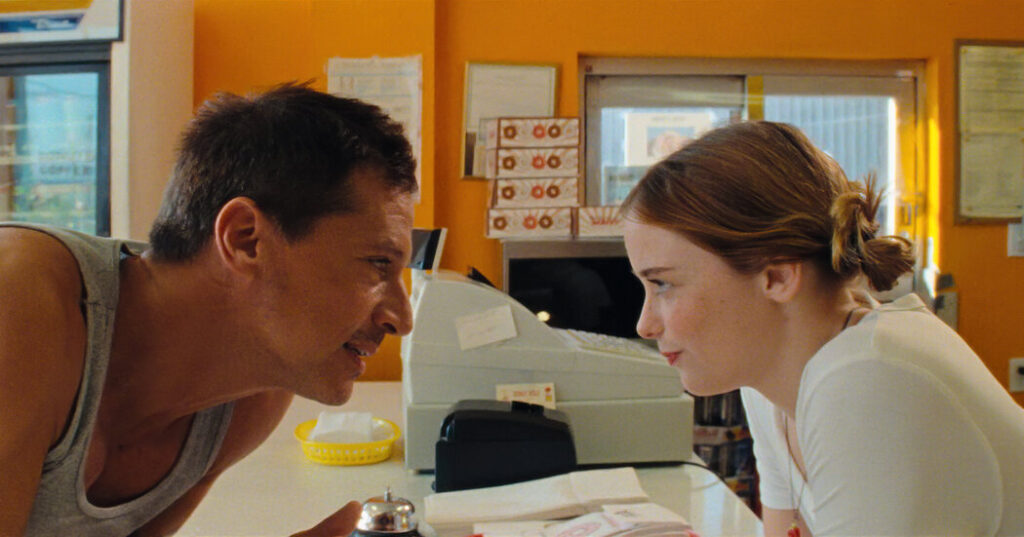
Cognitive dissonance is a valuable artistic tool, but there’s something especially fascinating about Sean Baker’s Red Rocket, which is one of the most enjoyably disturbing—and disturbingly enjoyable—movies I’ve seen in quite some time. On one level, it’s a blaring warning beacon—a chillingly persuasive portrait of exploitation and predation. Yet it’s also a pleasingly relaxed hangout comedy—a sun-kissed ode to the eternal pleasures of sex and drugs and NSYNC. It’s appalling and enthralling; I was aghast watching it and can’t wait to see it again.

The force of nature who provides Red Rocket with its queasy allure is Simon Rex, a journeyman actor and chiseled beefcake whom I’ve never seen before but will almost certainly be seeing again. Armed with a rippling chest and a wolfish smile, Rex plays the coyly named Mikey Saber, a washed-up porn star crawling back home to his impoverished roots in Texas City, where he attempts to shack up with his estranged wife (Bree Elrod); unable to secure legal employment thanks to the lengthy gap in his résumé (“You can call Brazzers and ask for a pay stub…”), he starts scratching out a living by selling weed to local oil riggers. He also manages to ingratiate himself with his wife and her couch-potato mother (Brenda Deiss), thanks to his rugged charm, not to mention his other talents. As his prior occupation suggests, Mikey is good with his dick and also slick with his words, which helps compensate for the black hole where his soul should be. Read More

Don’t Look Up: May the Planet Jest in Peace

Jonah Hill, Leonardo DiCaprio, Meryl Streep, and Jennifer Lawrence in Don't Look Up

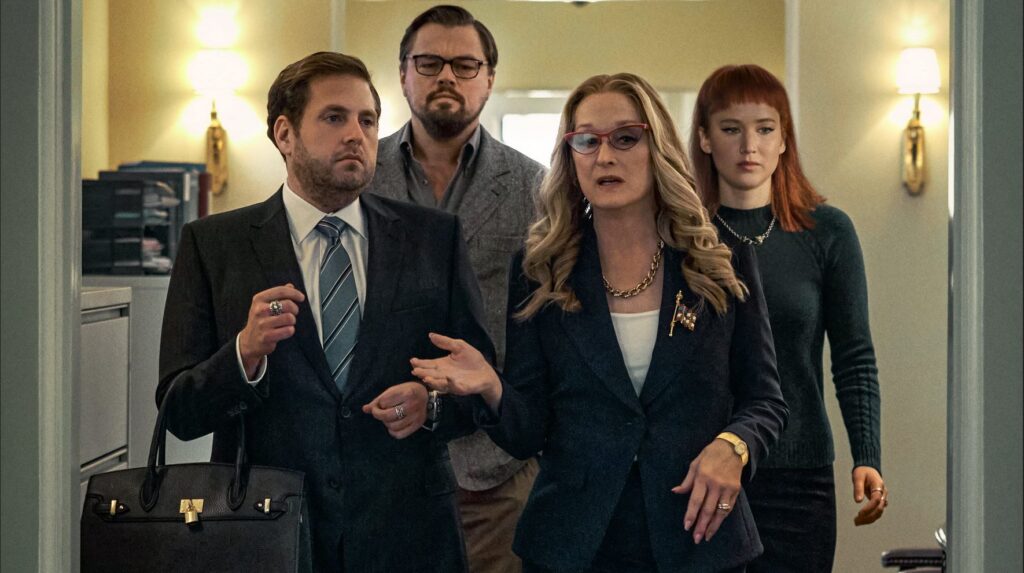
Are you familiar with the scientific phenomenon known as climate change? If not, then you might find Don’t Look Up, the new star-studded political satire from Adam McKay, to be profoundly eye-opening. Doubtless, McKay wishes it to provoke outrage as well as laughter; this has been his shtick ever since The Other Guys’ closing credits featured a flurry of graphics illustrating the mechanics of a Ponzi scheme. It isn’t a critic’s job to predict how an audience will react, but I suspect that most people who possess rudimentary knowledge of global warming (and I, to be clear, am no expert) will greet McKay’s latest effort not with howls of fury but with snorts of derision. I suppose Don’t Look Up is a passion project, in the same way that certain third graders can be passionate when they’re arguing for a snow day.

It feels somewhat mean to criticize a movie that carries such an urgent message, even if the delivery of that message is fairly mean. To be sure, anger is an appropriate response to society’s collective shrug toward its own existential threat, and it’s undeniably maddening that the fact of climate change is still framed as a political issue—a polarizing debate in which #BothSides present meritorious arguments. Yet agitprop tends to be more persuasive when it’s targeted; here, McKay paints with such a broad brush that he sacrifices precision. In addition to attempting to skewer the electoral establishment—embodied here by Meryl Streep as a coldly calculating, vaguely Trumpian president, flanked by an army of flunkies and an Oedipally charged chief of staff (Jonah Hill)—he also lampoons greedy tech profiteers (Mark Rylance plays an awkward genius designed to recall Mark Zuckerberg and Elon Musk), militaristic jingoism (Ron Perlman pops up as a demented former general), mainstream media (Cate Blanchett and Tyler Perry play fatuous morning-show anchors), celebrity culture (Ariana Grande and Scott Mescudi suck up some oxygen as vain pop stars), millennial slackerdom (Timothée Chalamet receives a measure of dignity as a skateboarder), and social-media vacuity (fake memes routinely spring up). It’s a lot—the film clocks in at a baggy 145 minutes—and that muchness seems to be an element of McKay’s broader point. If you aren’t part of the solution—that is, if you don’t subscribe exactly to his hazy set of principles, which I guess could be described as Pro-Science—then you’re part of the planet-killing problem. Read More

Licorice Pizza: Age Is Just a Wonder

Cooper Hoffman and Alana Haim in Licorice Pizza

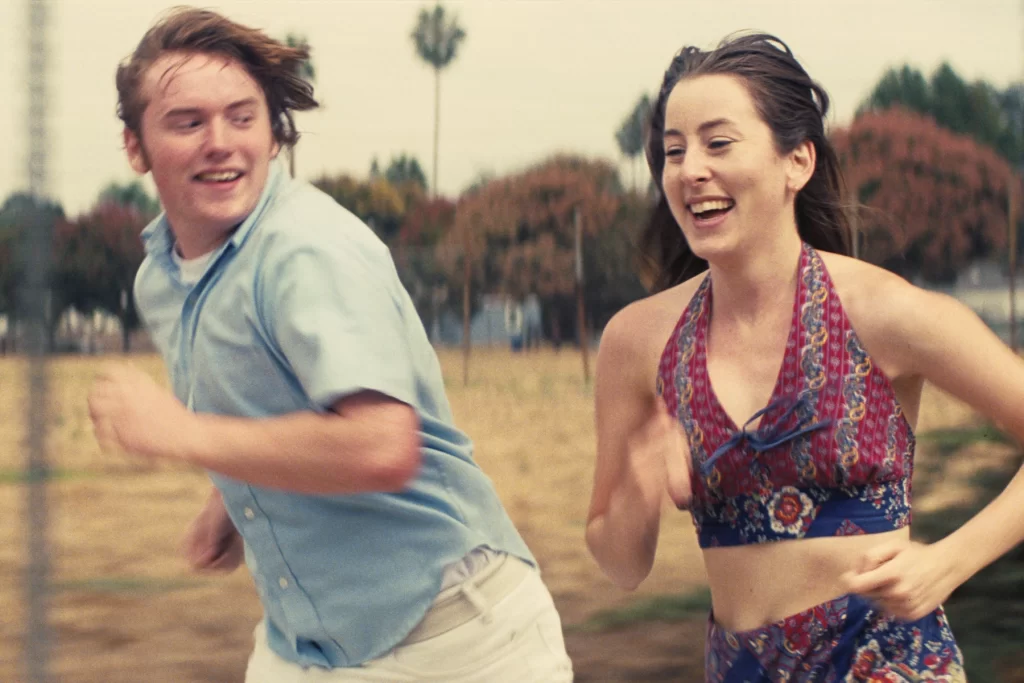
The heroes of Paul Thomas Anderson’s Licorice Pizza are always running, though they never seem to get anywhere. Their sprinting is heedless—the kind of panicked, exuberant racing that epitomizes the heightened quality of youth, when every crisis is life or death and every experience provokes either jubilation or disconsolation. They run and they run—across vacant golf courses and through crowded malls and down sunbaked streets—but they always end up back where they started, confused and angry and lost. They’re essentially attached to opposite ends of the same spoke, moving together in a constant circle, yet never coming any closer to their quixotic destination: each other.

This would seem to describe a doomed romance, a tragic love story that follows the trajectory of a Wong Kar-wai picture. Such a suspicion is only reinforced by the arc of Anderson’s filmography. He may be a more variable and omnivorous director than, say, his namesake Wes, but his movies tend to thrive on tension and conflict; the ruthless oil baron of There Will Be Blood, the fanatical cult leader of The Master, and the imperious fashion designer of Phantom Thread are all defined by their indomitable will, and his films derive their energy from the way their protagonists attempt to impose that will on a society that shackles and stifles them. So perhaps the happiest surprise of Licorice Pizza is how loose it is. Rather than straining to flatten us with grandiosity, Anderson has applied his considerable craft to a story that is warm, earnest, and relaxed. This is far from the weightiest effort of his career, but it may well be the sweetest. (The only real competition in that regard comes from the euphoric Punch-Drunk Love.) Read More

Belfast: The Troubles of Growing Up, Like and Unlike Everyone Else

Jamie Dornan, Ciarán Hinds, Jude Hill, and Judi Dench in Belfast

The opening scene of Belfast, the new film from Kenneth Branagh, announces the movie as both a narrow slice-of-life comedy and a more ambitious historical drama. Following some trivial narration from Judi Dench, the wan colors shift into crisp black-and-white, and the camera glides along a street in Northern Ireland, revealing a homey, intimate neighborhood. (A title card informs us that the date is August 1969.) The mood is relaxed and cheerful; children are kicking a ball around, adults are yammering idly, and everyone seems to know everybody’s name. Yet as nine-year-old Buddy (newcomer Jude Hill) traverses the road and spars good-naturedly with some shopkeepers, this peaceful idyll is shattered by the sudden arrival of armed hooligans. As they snarl threats and smash windows, the camera pivots around Buddy, spinning faster and faster, underlining his vulnerability and panic. What was once bliss has been replaced by terror.

Roughly based on Branagh’s own childhood, Belfast is a noble, enjoyable, not entirely successful attempt to document both sides of this formative coin. It seeks to frame the traditional hallmarks of the coming-of-age picture—the fledgling romances, the quixotically striving parents, the classroom grievances, the petty illegalities—against the backdrop of social unrest and religious conflict. That it struggles to fuse these disparate halves into a cohesive whole is due less to tonal inconsistency than cinematic execution, or maybe priorities. Over the course of a long and uneven career, Branagh has proved himself capable of working on a large scale—I remain a fan of his straitlaced Hamlet, while the operatic thriller Dead Again is arguably his best work—but here, whether because of lack of interest or inadequate filmmaking chops, he fails to invest the movie’s ostensibly sweeping commentary with much energy or clarity. He’s more committed to evoking the particular pleasures and predicaments of his youth with loving detail and misty-eyed nostalgia. Read More