Magic Mike XXL: Forget Your Day Job, It’s Time to Party

Channing Tatum and co. are back for "Magic Mike XXL"

A few months ago, I saw a movie about an inveterate warrior who gets pulled back into a turbulent conflict, and who uses his ingenuity and physical prowess to triumph in battle. A few days ago, I saw another movie with a similar storyline, about a legendary figure who grudgingly returns to the battlegrounds of his past, relying on both his cunning and his skill to achieve immortality. And while the two films are undeniably different—Mad Max: Fury Road is about a life-or-death struggle set in a post-apocalyptic wasteland, whereas Magic Mike XXL is about a stripper performing in Myrtle Beach—their dissimilarities, from a filmmaking perspective, are almost incidental. The traits that made Mad Max: Fury Road such a sensation—the no-holds-barred attitude, the revelatory practical stunt work, the palpable swagger—apply with equal force to XXL. Both worship at the altar of cinematic excess, and both thrill their audiences with their verve and dexterity. It makes little difference that, while Max faces a hail of bullets, Mike is bombarded with “a tsunami of dollar bills”.

In conventional critical terms, Magic Mike XXL might appear to be a bit thin. It has no real plot to speak of, it is not especially interested in character development, and it is positively disdainful of plausibility. Certainly it lacks the lacerating bite of its predecessor, which benefitted from Steven Soderbergh’s artistry, expertly camouflaging a wolf’s tale of loneliness and manipulation in the sheep’s clothing of glamour and decadence. (For this sequel, Soderbergh has passed directing duties on to his longtime assistant, Gregory Jacobs, though he returns as both cinematographer and editor, working under his usual twin pseudonyms, Peter Andrews and Mary Ann Bernard.) But virtually none of this matters. XXL doesn’t have time for trifling concerns like plot and character, and watching the movie, neither will you. You will be too busy cheering its electric set pieces and succumbing to its infectious spirit of euphoria. Read More

Dope: A Harvard Wannabe Gets a Thug Life Education

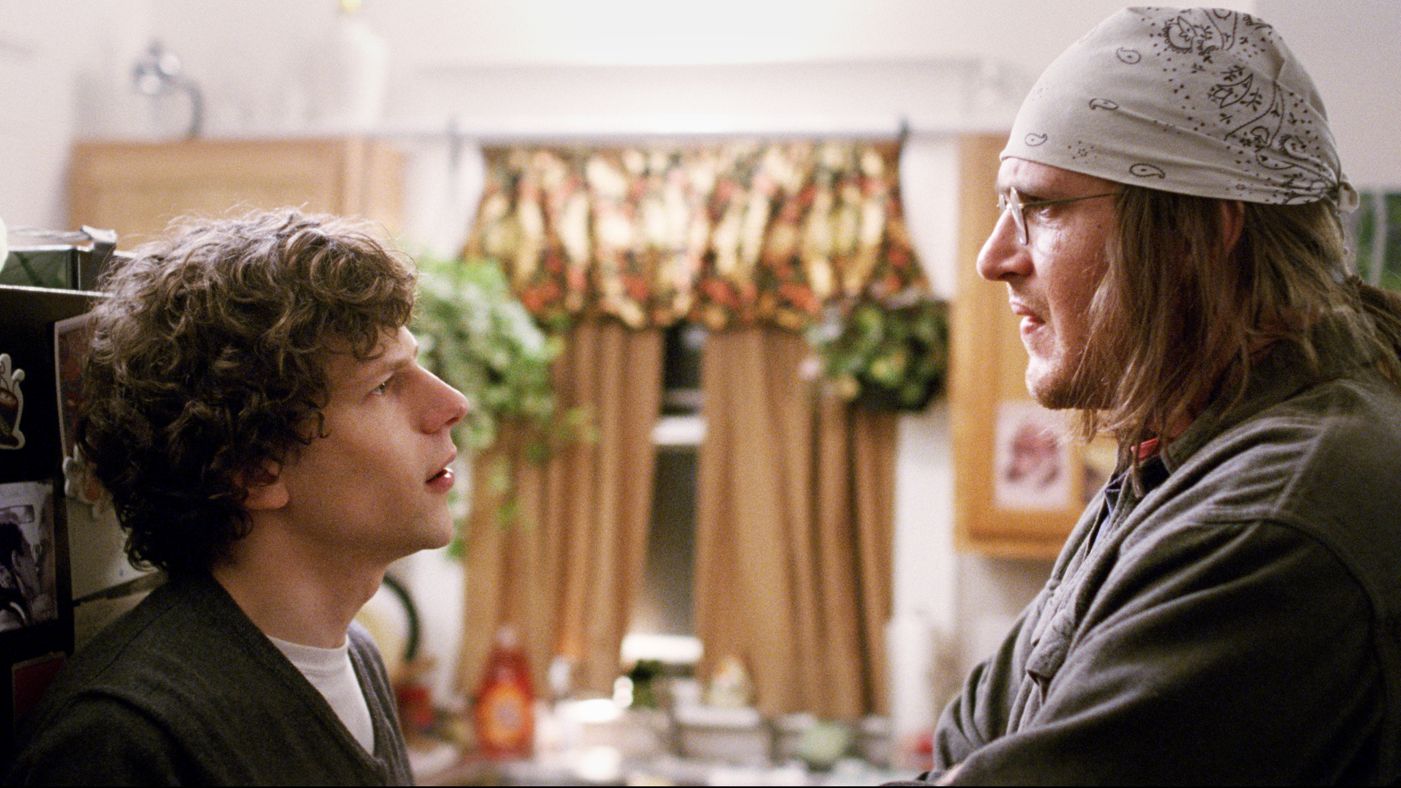
Shameik Moore gets in over his head in "Dope"

An early scene in Dope, Rick Famuyiwa’s highly entertaining mess of a movie, perfectly encapsulates the film’s tone. It features its protagonist, a black high school student named Malcolm (Shameik Moore), fleeing with his two best friends from a pair of Los Angeles gangsters. It’s a frenetic scene, with Malcolm and his pals riding pitiful bicycles while the thugs give chase in a roaring red El Camino. Then, as the desperate teenagers pedal across an overpass, the camera suddenly switches to a static wide-shot, revealing that the overpass is labeled, in austere capital letters, “Thurgood Marshall Justice Plaza.” That level of silent wit—the confidence to quietly slip in a reference to America’s first black Supreme Court Justice in the middle of a frenzied chase sequence—is indicative of Dope‘s sly sense of humor, not to mention its hectic, erratic sensibility. This mélange of styles and tropes is far too chaotic to be a great movie, but it’s precisely that sense of unruliness that makes it so much fun.

Dope initially scans as a lively satire of Boyz N the Hood, John Singleton’s seminal coming-of-age story about black youths growing up on hard streets in hard times. Malcolm, the son of a single mother, lives in The Bottoms, a crime-ridden district of Inglewood. His neighborhood is swimming in drugs and beset by gang violence (the red-clad Bloods are especially prominent), and he’s under constant threat of thievery or worse. Yet Malcolm, contrary to expectation, is neither a reprobate nor a victim. He is instead, as Forest Whitaker’s playful opening voiceover informs us, a geek. He dresses like a goofball, he rocks a ludicrous high-top fade, and he and his aforementioned friends, Jib (Tony Revolori, the lobby boy from The Grand Budapest Hotel) and Diggy (Transparent‘s Kiersey Clemons), are utterly obsessed with ’90s hip-hop culture. His top priority is not avoiding jail or scoring drugs—it’s getting into college, which is why he’s penned a singular application essay entitled, “A Research Thesis to Discover Ice Cube’s Good Day.” Read More

Inside Out: Sweet Emotions, and Sad Ones, Too

Five emotions wrestle with one another, and more, in "Inside Out"

At one point in Inside Out, the two main characters walk under a lettered archway that reads, “Imagination Land.” It’s a fitting marker, given that this movie is the latest (and nearly the greatest) offering from Pixar, that cinematic factory of innovation and ingenuity that has been delighting audiences for two decades with its inimitable blend of vibrant animation and smart storytelling. Also fitting is that the protagonists are named Sadness and Joy, as these are the two primary emotional responses that Inside Out deftly, generously evokes. You will undoubtedly experience pangs of sadness in watching this poignant portrayal of a child in crisis, struggling valiantly to process her swirling feelings of confusion, alienation, and loss. As for joy? That comes from everything else.

The ostensible hero of Inside Out is Riley (voiced by Kaitlyn Dias), a plucky, relatively normal 11-year-old whom we first meet moving with her parents from the ice-covered lakes of Minnesota to the bustling cityscape of San Francisco. Yet while Riley is the film’s chief human character, she is not its focal point. Rather, Inside Out takes us inside Riley’s brain to explore the workings of her emotions, which we discover are literal beings themselves, with their own bodies, minds, and temperaments. They include Fear (Bill Hader), a jumpy lavender fellow with a bowtie and a prominent proboscis; Disgust (Mindy Kaling), a greenish girl with wavy hair and perpetually rolling eyes; and Anger (Lewis Black, naturally), a squat and fiery hothead who regularly bursts into flame and whose color you can probably guess. Rounding out this fantastic five are, of course, Sadness and Joy; Sadness (The Office‘s Phyllis Smith, perfectly cast) is a rotund blue figure who wears oversized spectacles and shuffles her feet morosely, while Joy (Amy Poehler, ibid) is the yellow-skinned, cobalt-haired pixie who serves as the group’s perky, quietly flawed leader. These five personifications of feeling—exposed nerve endings made real—operate in concert (and occasionally in conflict), huddling over a gadget-laden control panel and helping to shape Riley’s experiences, her emotional reactions, and, really, her entire life. Read More

To Greatness and Beyond: In Anticipation of Inside Out, Ranking Every Pixar Movie

Buzz Lightyear and Woody got Pixar started back in 1995 with "Toy Story"

Pixar is the only movie studio that has achieved brand recognition. You never hear people say that they’re excited about the new Fox Searchlight release or that they’re lukewarm on the latest Warner Bros. picture. But Pixar, through a 20-year, 14-film run of (mostly) extraordinary and original work, has cultivated its reputation to the point that it’s become the industry benchmark for animated fare. Read reviews of animated releases from other companies, and you’ll invariably find comparisons to the gold standard, whether laudatory (“Looks just as good as any Pixar movie!”) or—more commonly—derogatory (“It isn’t bad, but it’s no Pixar.”).

This did not happen by accident. The studio sports a stellar success rate, both commercially and (more importantly, at least in this context) artistically. It is also a model of storytelling consistency, which should not be confused with sameness. The typical Pixar movie exhibits two key characteristics: breathtaking animation and inspired imagination. The rest of the world is gradually catching up on the first front—DreamWorks’ How to Train Your Dragon 2 is an especially gorgeous example—but John Lasseter and his brilliant minions remain comfortably in the lead on the second. There is something magical about the studio’s best works, an ability to transport you to worlds of limitless invention and possibility. But as innovative as these movies can be, they also often carry a profound emotional resonance, grounding their fantastical stories in recognizable human feelings. The old line on Pixar movies is that they’re enjoyable for both kids and adults, but what they really do is temporarily transform curmudgeonly adults into joyous kids. Read More

Jurassic World: Fleeing from the Past, All Over Again

Chris Pratt attempts to tame velociraptors in "Jurassic World"

A giant looms over the tourists of Jurassic World, a towering figure that casts a long, dark shadow. But it is not a dinosaur. It is, rather, the specter of Steven Spielberg and the lingering greatness of the original Jurassic Park. One score and two years ago, our forefather of blockbuster filmmaking brought forth into multiplexes a new species of movie, a thrilling adventure of CGI-assisted wonder. But as striking and terrifying as certain moments of Jurassic Park were—the sight of water rippling from a faraway impact, the reveal that a reassuring hand is attached to a severed arm, that iconic warning that “objects in mirror are closer than they appear”—what made it truly special was its intimacy. Spielberg makes movies about fantastical creatures and aliens with an inimitably human touch, and in Jurassic Park, he made us care about the people he was terrorizing, from Sam Neill’s wary paleontologist to Richard Attenborough’s hubristic businessman to (most memorably) Jeff Goldblum’s cynical mathematician. It is not hyperbole to suggest that every effects-laden studio production released since 1993 has measured itself, at least in part, against the staggering triumph of Jurassic Park.

Jurassic World, the fourth and not-at-all-bad installment in the dino franchise, never entirely evades the yawning shadow cast by its primogenitor. But this is less a failure of imagination than a consequence of evolution. The world has changed. We now demand increasingly bigger amazements from our summer blockbusters, to the point where it’s difficult to cram emotional texture or narrative depth into a product already bulging with action and spectacle. Or, as one character puts it: “No one’s impressed by a dinosaur anymore.” I beg to differ, and as evidence, I need look no further than Jurassic World. This movie, which was directed by Colin Trevorrow from a screenplay he wrote with three others, may lack certain filmmaking fundamentals—plotting, character development, halfway-decent dialogue—but it is damn impressive. Read More