Shang-Chi and the Legend of the Ten Rings: How to Contain Your Dragon

Simu Liu in Shang-Chi and the Legend of the Ten Rings

Shang-Chi and the Legend of the Ten Rings could have been a damn good comic-book movie, if only it hadn’t been about the Ten Rings. Neatly ornamented circlets that flash blue-and-purple lightning, these conjoined jewels vest their bearer with cosmic power, which is cool for him but unfortunate for us. I’m sure that blasting bolts of deadly energy from your wrists is an efficient method of laying waste to your enemies; visually speaking, it’s a drag, and so is this film’s prologue, which appears poised to squander the great Tony Leung—saddling him with lank hair and medieval armor, then watching as he magically vaults over and slices through an entire opposing army. He’s lord of the blings, and his growling invulnerability initially marks him as yet another tedious Marvel villain.

Happily, the Ten Rings factor little into Shang-Chi, at least until its predictably torpid climax. Even the tired prologue is something of a feint, seeing as how it’s followed by a second preamble, this one far more elegant. Flashing forward a thousand-odd years to 1996, it finds Leung’s heavy, Xu Wenwu, newly shorn and stumbling into a pastoral grove, where he trades balletic blows with his future wife, Ying Li (Fala Chen); their graceful combat, as much a dance as a fight, recalls the stylish wirework of Crouching Tiger, Hidden Dragon. And for most of its runtime, Shang-Chi aspires to that level of intimacy and fluidity, eschewing CGI pyrotechnics and globe-altering stakes in favor of taut action and clenched family drama. Read More

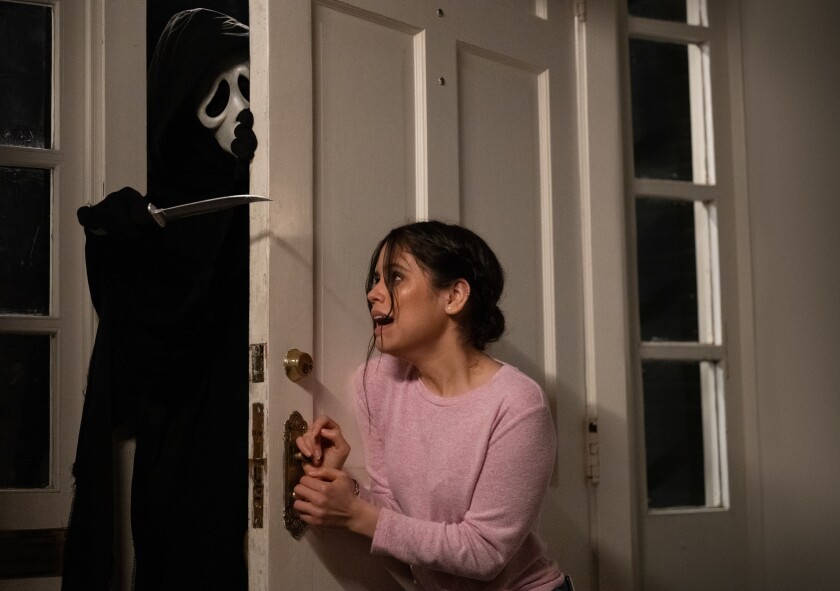
Candyman: Mirror, Mirror, Time to Maul

Yahya Abdul-Mateen II in Candyman

The premise of Candyman has always struck me as a peculiar illustration of risk versus reward. Most supernatural summonings involve some sort of Faustian bargain; sure, the heroes of Bedazzled, The Picture of Dorian Grey, and Rosemary’s Baby all sold their souls (or their son), but they at least got something out of it. Here, the lore is far less complicated, and commensurately less appetizing: Say the name “Candyman” five times while looking into the mirror, and his reflection will appear… and will promptly kill you. To me, such a proposition is in no way enticing. At least the dude in Mephisto can claim to have been duped; if you want to blame someone for getting your throat sliced open by Candyman, all you need to do is look in the mirror.

To its credit, this new Candyman, which was directed by Nia DaCosta from a script she wrote with Win Rosenfeld and modern horror impresario Jordan Peele, is at least partly aware of this absurdity; when one character learns of the legend, she understandably asks, “Who would do that?” followed by a very funny smash cut to a gaggle of vapid high school girls commencing the ritual. In any event, narrative plausibility is not DaCosta’s concern. She’s more interested in fusing the visceral with the political—in making a spine-chilling horror movie that doubles as a trenchant commentary on Black life in contemporary America. She isn’t entirely successful. As a metaphorical text, Candyman is admirable but awkward, struggling to vibrate with its desired resonance. But as a fright fest, it’s pretty good—not exactly scary, but engrossing and polished. There’s plenty of poise to go along with the blood. Read More

Original Screenplay Weekend! On Annette, Reminiscence, and the Night House

Rebecca Hall in The Night House; Rebecca Ferguson and Hugh Jackman in Reminiscence; Adam Driver in Annette

Some original screenplays are more original than others. Last week, for example, I reviewed Disney’s Free Guy, a jumbled, weirdly fascinating action comedy that prides itself on not being based on any existing intellectual property, then spins an entire film from references to (and rip-offs of) other intellectual properties. I was happy to see Free Guy perform well (it’s now spawning a sequel, naturally), if only because I want studios to keep making original movies. As if by magic, this past weekend featured the release of three such pictures, a veritable bonanza of novel #content. (Technically there were four, but I failed to make time for Martin Campbell’s The Protégé.) None is a perfect film—in fact, all three have considerable problems—but my disappointment is tempered by my enthusiasm for their very existence. I didn’t love any of these movies, but I did love that I was able to watch them.

Of the trio, The Night House is the most conventional, which isn’t to say it’s typical. Directed by David Bruckner from a script by Ben Collins and Luke Piotrowski, it’s a ruminative ghost story that’s less interested in freaking you out than pulling you in. Its heroine, a high school English teacher named Beth (a fantastic Rebecca Hall), isn’t just the frightened resident of a haunted house; she’s also a little bit scary herself. An early scene, in which she calmly shames a grade-grubbing parent into stunned silence, reveals her capacity for blunt anger, while a night out with colleagues quickly turns into an unhappy hour where busybodies tiptoe around a powder keg. Read More

The Green Knight: It’s Not Easy Being Guillotined

Dev Patel in The Green Knight

During one of the many ruminative exchanges in David Lowery’s The Green Knight, a common young woman scoffs at her paramour’s obsession with greatness. “Why is goodness not enough?” she wonders with a combination of selfishness and curiosity. Like most of its maker’s movies, The Green Knight operates—or attempts to operate—as both a sincere answer to the question and an emphatic rejection of its premise. In films like the Malick-infused crime drama Ain’t Them Bodies Saints and the austere metaphysical puzzler A Ghost Story, Lowery wasn’t aiming for passable entertainment; he wanted to make high art, true masterpieces that reshaped our attitude toward what cinema can be. (His Ghost Story follow-up, The Old Man & the Gun, was enjoyable in part for how atypically relaxed it was.) Judged against that impossible standard, he failed both times, and does so again here; The Green Knight is no masterpiece. But it is undeniably a mighty work, and its towering ambition—the way it takes an epic poem and updates it with its own combination of beauty, whimsy, and nonsense—is itself commendable.

The title of that poem, “Sir Gawain and the Green Knight” (by Anonymous), briefly emerges on screen, in an Old-English font that’s nigh unreadable; over the course of the proceedings, other headings make similarly quick appearances, each harder to decipher than the last. In fact, illegibility is something of a precept for the movie, be it vocally, visually, or narratively. Actors often mumble lines, their “thees” and “thines” drowned out by the clangs of nature or Daniel Hart’s moody score. The image, especially in the opening scenes, is often dark, as though a fog of war has settled over the screen. And the trajectory of the story, which follows Gawain (Dev Patel) on a picaresque adventure, is regularly interrupted by strange sights and odd digressions. Read More

Pig, Gunpowder Milkshake, and the Instant Legacy of John Wick

Karen Gillan in Gunpowder Milkshake; Nicolas Cage in Pig

John Wick is technically an original character, but the films featuring him aren’t really anything new. They’re just slickly repackaged creations that combine the archetypes of the classic Western—the retired warrior begrudgingly forced back into battle—with the balletic flair of John Woo’s gun-fu pictures. Still, their mythology is so wonderfully detailed, and Keanu Reeves’ central performance is so intensely charismatic, that the franchise has quickly morphed from pastiche into primary source. Now, when a genre exercise like Nobody hits theaters, it’s instantly billed as “Bob Odenkirk doing John Wick”.

Last week alone saw the release of two new movies that wear their Wick influences loudly: Gunpowder Milkshake, featuring Karen Gillan as an assassin on the run, and Pig, starring Nicolas Cage as a hermit who’s drawn back into a dangerous underworld. Neither is nearly as good as the best Wick flick (that remains Chapter Two, though Parabellum certainly has its moments), but they’re nonetheless interesting for how they both pay tribute to and differentiate themselves from the film that has suddenly become the standard-bearer for revenge cinema. Read More