The Lighthouse: Stormy Weather, Madness on the Horizon

Robert Pattinson and Willem Dafoe in Robert Eggers' "The Lighthouse".

A punishing movie whose bits of greatness are obscured by a fog of auteurist pretension, The Lighthouse is a deeply frustrating experience, a tantalizing work that defies explanation and categorization. It defies enjoyment too; as technically impressive and formidably confident as it may be, it isn’t much fun to watch. But it does carry a genuine personality, the imprint of a director who refuses to sacrifice his bizarre vision for the sake of more quotidian values like accessibility. Or, you know, coherence.

That director is Robert Eggers, whose first feature, the terrific horror movie The Witch, blended creeptastic folk-story terror with silky filmmaking craft. It also featured characters speaking in period-specific dialect, a trick Eggers repeats here, though the setting has been bumped up by a few centuries to the late 1800s. The screenplay, which Eggers wrote with his brother Max, is laden with old-timey jargon—“aye” in place of “yes”, “ye” instead of “you”, etc.—which enhances the film’s already-ornate degree of detail. Assuming, of course, you can understand what the hell they’re saying. Read More

The Zombieland and Maleficent Sequels Both Fail, But for Different Reasons

The cast of "Zombieland: Double Tap", all clearly terrified of Angelina Jolie.

Asked to describe Claude Rains’ self-regarding police captain in Casablanca, Humphrey Bogart replies, “He’s just like any other man, only more so.” Aside from accurately summing up one half of cinema’s most beautiful friendship, that quip encapsulates what might be called The Law of the Hollywood Sequel. The motion picture industry is big business, so it’s only logical that when a movie makes money, you make another one. And because follow-ups are typically driven more by fan enthusiasm than by creative compulsion, you make the sequel just like the original, only more so: more action, more jokes, more special effects, more stars, more blood.

Last weekend saw the release of two decidedly different sequels which, if not exactly long-awaited, are certainly far-removed from their respective progenitors. Maleficent: Mistress of Evil arrives five years after Robert Stromberg’s surprise smash, which found Angelina Jolie donning pointy black horns and vivid green contact lenses for a reimagining of Disney’s Sleeping Beauty. Five years is an eon by Hollywood standards, but it’s half the interval between Zombieland: Double Tap and its predecessor, whose comic take on the apocalypse won moviegoers’ hearts and wallets a full decade ago. These unusually long gaps might suggest that both sequels are motivated by art rather than commerce—that their creators returned to their universes after significant time away because they’d actually developed exciting new stories rather than because greedy studios recognized an opportunity to cash years-old checks. Read More

Gemini Man: Twice the Star Power, Quintuple the Speed

Will Smith (and Will Smith) in "Gemini Man".

There’s a reason that movies are classically referred to as motion pictures: They move. Silent or talkie, black-and-white or Technicolor, the quintessence of cinema over the past hundred-odd years is the collective experience of watching images in motion. In the Harry Potter books, J.K. Rowling imagined portraits wherein the subjects ceaselessly shift and budge, a clever conceit that also underlined just how miraculous real movies are. They’re magic brought to life.

Ang Lee has contributed more to this paranormal art form than most, in variety if not in volume. Over a startlingly diverse 12-year stretch (from 1995 to 2007), he made a Jane Austen period piece, an incisive family drama, a war picture, a martial-arts fantasy, a comic-book adaptation, a romantic weepie, and a political thriller. But in his late period, Lee has taken to tinkering with the machinery of the movies itself, to exploring new ways of beaming images onto a silver screen. His Life of Pi, while narratively and thematically flimsy, is one of the few films to make productive use of 3D; scenes of a young man traversing an ocean with a computer-generated tiger were gripping in their visual splendor. Then came Billy Lynn’s Long Halftime Walk, which Lee shot not just in 3D but at 120 frames per second (five times the industry standard of 24), a useless flourish which disguised the fact that the movie was the most forgettable thing he has ever made. Rather than course correcting, Lee has now (ahem) doubled down on the gambit with Gemini Man. It’s an ambitious folly that might start cementing Lee’s unfortunate cinematic legacy, that of a once-gifted storyteller who became so obsessed with changing how movies look and move, he forgot to make them good. Read More

Joker: Violence. Murder. Insanity. It’s a Riot!

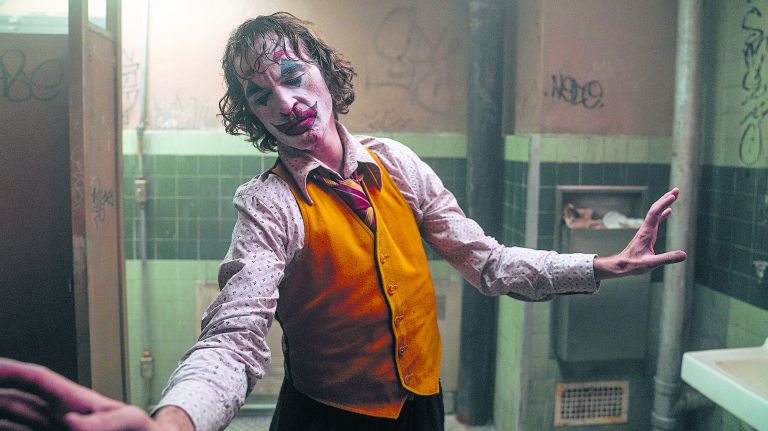
Joaquin Phoenix in "Joker"

Borne on the waves of controversy and leaving a trail of smoggy fumes in its wake, Joker is arguably the movie of the year. Not the best movie of the year, mind you—not even close. But while the events of this strange and faintly maddening film take place in 1981, in the fictional realm of Gotham City, it is plainly designed to tap into the anxieties of the present moment, to Say Something significant, whether about art, commerce, politics, or society. It screams to be pored over, analyzed, debated; it’s a movie that also feels like the belabored setup for a podcast. Does it glorify incel culture, or is it a pointed critique of toxic masculinity? Is it a scabrous attack on the wealth gap, or an ardent defense of the established social order? Is it a violent fantasy, or a repudiation of violence?

In theory, these are interesting questions, but Joker, which was directed by Todd Phillips from a script he wrote with Scott Silver, has no interest in answering them. That may in itself sound bold; after all, some of the world’s greatest art is open to vigorous interpretation. Yet the great irony of this movie—the gag that surely has its maker imitating its antihero, cackling in high-pitched glee—is how meaningless it is. It feints at profundity, but it does not trouble itself with forming actual ideas. It is less a Rorschach test than a brightly colored finger painting. It splashes the frame with divisive topics—police brutality, mental illness, social unrest, powerful men, victimized women—and then passes off such haphazard daubing for the articulation of genuine themes. To the extent Joker has a philosophy of any interest, it is that it proclaims itself to be interesting. Read More

Official Secrets: Blowing the Whistle, and Facing the Consequences

Keira Knightley in "Official Secrets"

Three days before I saw Official Secrets, the Washington Post released a story that provided new details regarding a previously filed whistleblower complaint, which alleged that President Trump had made an improper promise to a foreign leader. The whistleblower, a member of the intelligence community, had felt compelled to take action because he believed that Trump’s conduct rose to the level of an “urgent concern”, which appears to be spook-speak for A Big Fucking Deal.

The aftermath of these explosive revelations is currently unspooling on various media: newspapers and their online affiliates, with their wide range of clickbait headlines and weary fact-checks; Twitter, with its armchair policy experts and viral memes; and—the President’s primary source of information gathering—TV news programs, with their ranty guests and exasperated moderators. The pages of history surrounding these events are currently being written; movies dramatizing them will surely pop up in the ensuing years and decades. In a less insane, more cinematically karmic world, this ongoing furor might have served as serendipitous marketing for Official Secrets, a movie which—if you can believe it—involves a civil servant in an intelligence agency who blows the whistle on her government after discovering that it’s engaged in illegal activity regarding foreign countries. Read More