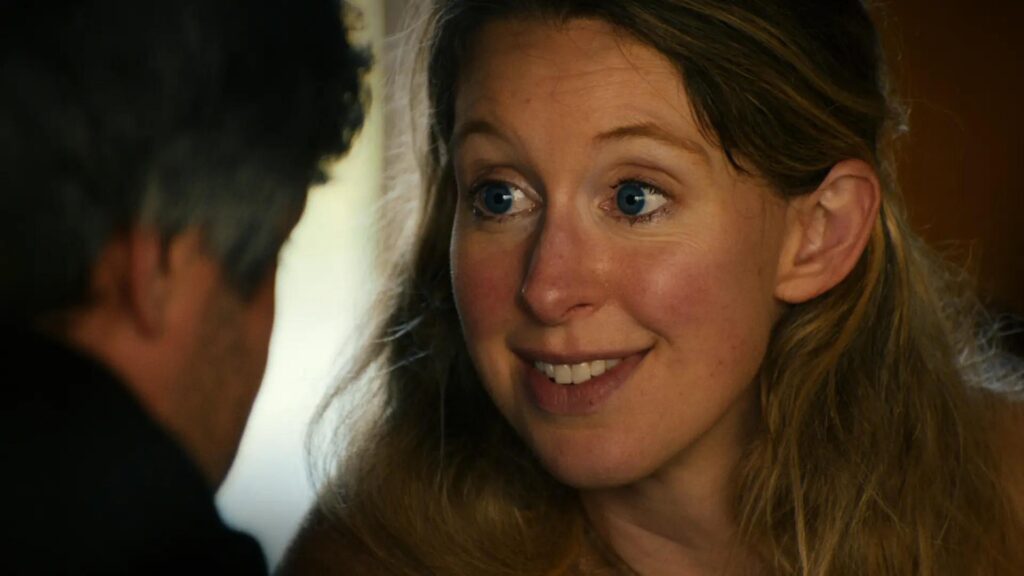
Elizabeth Holmes is a fraud. Nathan Fielder is a freak. Those may sound like vicious accusations, but in Holmes’ case, the charge has been substantiated by a federal jury, which found her guilty in 2022 of swindling investors. As for Fielder, you need only watch a few minutes of any episode of his television work to learn that he’s painfully, pathologically awkward. They would seem to make strange bedfellows. But one of the insights of You Can See Everything, the brain-scrambling documentary that Fielder has made with Lance Oppenheim, is that people can be difficult to pin down, and can surprise you if you make an effort to understand them. Sometimes that effort involves questioning your own assumptions. And sometimes it means following them around with cameras for a solid month.
I’m being more literal than you might think. As a matter of nuts-and-bolts production, You Can See Everything is notable for the startling degree of access that Holmes and her partner, Billy Evans, have granted to the filmmakers. The brunt of the movie takes place in their Del Mar beach house, chronicling the 34 days preceding Holmes’ scheduled surrender at a federal prison in Texas. The couple’s ostensible rationale—which reflects either brazen confidence or breathtaking naïveté—is that an unvarnished depiction of their home life will combat the media’s prevailing narrative of Holmes as a conniving huckster: the reckless woman who duped credulous financiers into believing that she and her healthcare company, Theranos, had invented a nigh magical device which could screen for countless diseases from a single drop of blood. Despite the guilty verdict, she maintains her innocence, and the film practically dares you to ask whether she’s telling the truth. The questions only pile up from there.
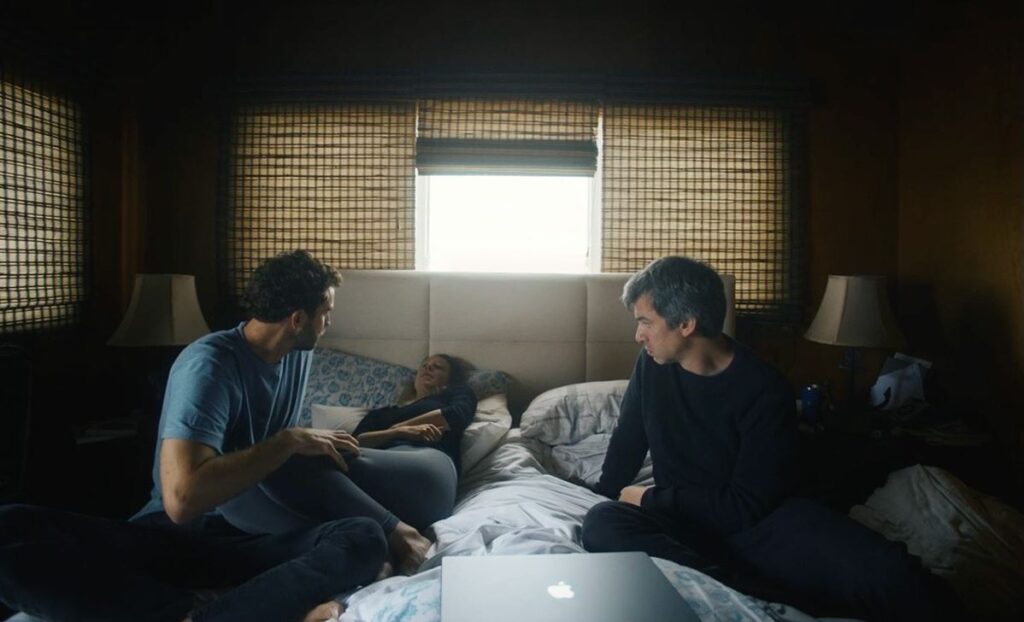
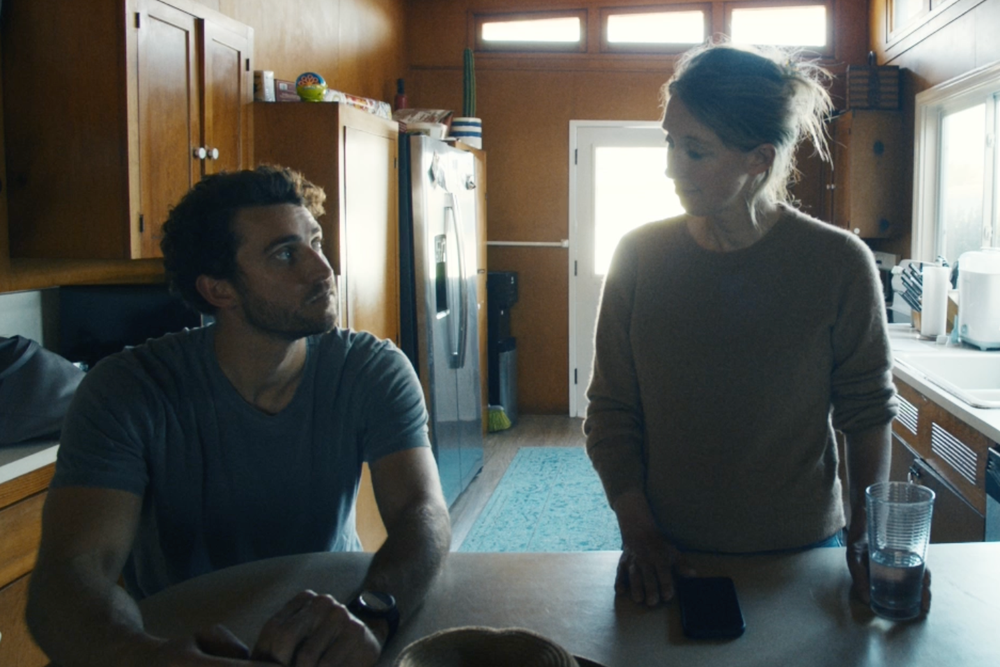
Technically speaking, the project’s veracity would appear to be unimpeachable. Fielder and Oppenheim seem to have cameras in every room, almost as if they’re making a melodrama-free version of Big Brother. (In this, You Can See Everything operates in conversation with Oppenheim’s Primetime, which contemplated the artificiality lurking beneath allegedly candid footage.) Their technique is simultaneously sloppy and exacting. They often allow boom mikes and other equipment to remain in the frame, reinforcing the movie’s vérité bona fides, yet they also supply an extraordinary array of close-ups, paying particular attention to the characters’—by which I mean the people’s—faces. It’s a fly-on-the-wall approach, only if the fly talked and also looked confused a lot.
Fielder has reason to be vexed. On its surface, the film’s title derives from a text message that Holmes, rebranding herself from Elizabeth to Liz, sends to Nathan insisting that his breadth of vision is absolute: “fyi you can totally see everything.” (Nathan, characteristically unsure of how to respond, simply hits the thumbs-up reaction.) As the movie progresses, the validity of her titular assurance gets cast into doubt. We can plainly see quite a bit of Liz and Billy: their shared warmth with their children, their anxiety over her impending imprisonment, their (perhaps deluded) enthusiasm for rebooting the disgraced Theranos into a new phase of operations. But there remains a cloud of uncertainty hovering around them, a veil that Nathan can’t seem to pierce. He spends a good deal of the picture staring into Liz’s enormous, unblinking blue eyes, but despite the strength of her conviction—that she has nothing to hide, that she didn’t deceive anyone about Theranos’ technology, that she’s never told a single lie—he struggles to ascertain the truth. Is seeing believing? Or is he just looking at a façade—a character she’s created?
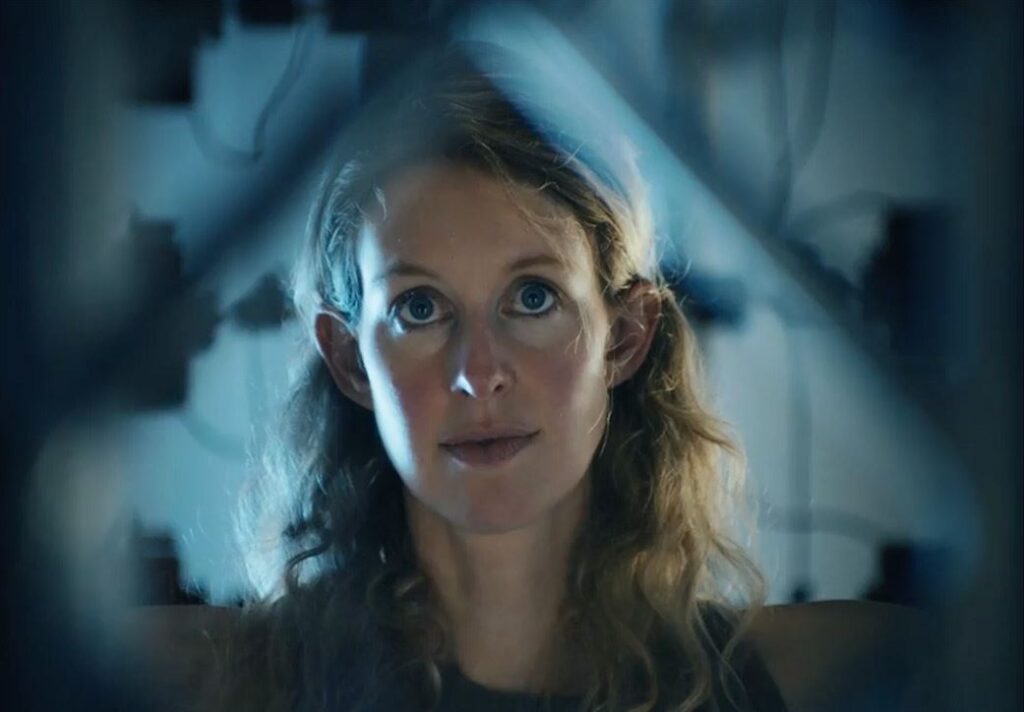
That phrase stems from a quote attributed to Holmes in a New York Times profile, language that she and Billy vigorously dispute. Their allegation of faulty reporting adds yet another layer of recursion to You Can See Everything’s inquisitive exercise, and another potential meaning to its title. Just who is “you,” anyway? Is it Nathan, the recipient of that seemingly inviting text message? Or is it you, the viewer, who’s processing all of this years later, through the scrim of the screen? We like to think of documentaries as presenting us with images of unshakable truth, but they’re also the product of artistic choices. Fielder and Oppenheim, working with the editor Adam Locke-Norton, have culled hundreds of hours of raw footage and arranged it into a coherent (if combustible) narrative, one that streamlines their preferred story and sharpens their pet themes. We can see only what they choose to show us.
If these musings sound academic, that’s because the first half of You Can See Everything’s 174 minutes is more interesting to scrutinize intellectually than to actually watch. Most of the conversations are unremarkable, and the picture’s inherent awkwardness—when he isn’t chatting with Liz or Billy, Nathan tends to skulk in the shadows, squinting like a voyeur or maybe an unusually hesitant serial killer—regularly provokes nervous laughter. (This is most pronounced during a shot of Billy showering—ladies, you can totally see everything—followed by a cut to Nathan fidgeting in the hall.) It’s intriguing but not exactly gripping.

Still, the movie steadily draws you in as Nathan strives to reconcile the public image of Theranos’ opportunistic founder with the fresh-faced, wide-eyed woman before him. A scene where the three principals discuss Theranos’ purported capabilities—its promise that it can perform virtually any chemical test—represents an intricate parsing of language: Can the same words can have different meanings for different people? Later, Nathan shows them a few episodes from The Dropout—Hulu’s excellent miniseries which won Amanda Seyfried an Emmy for her portrayal of Holmes—and Liz’s curiosity quickly curdles into misery, aghast at the (supposed) gap between fact and fiction. There is also a spellbinding sequence where Nathan cues up “Who’s on First?” for the couple and then interrogates a laughing Liz about why the routine is funny, only for her to confess that she didn’t get the joke. Regardless of how you feel about Elizabeth Holmes, her confusion in that moment is heartbreaking.
Had You Can See Everything tried to maintain this rigorously observant approach for three full hours, I suspect that it would have eventually exhausted both itself and its audience. But at its rough midpoint, the movie introduces a new wrinkle, one that both expands its scope and energizes its pacing. The spoiler-averse may wish to leave now, though it’s a credit to Fielder’s ingenuity that a shift in filmmaking methodology can somehow be classified as a plot twist.
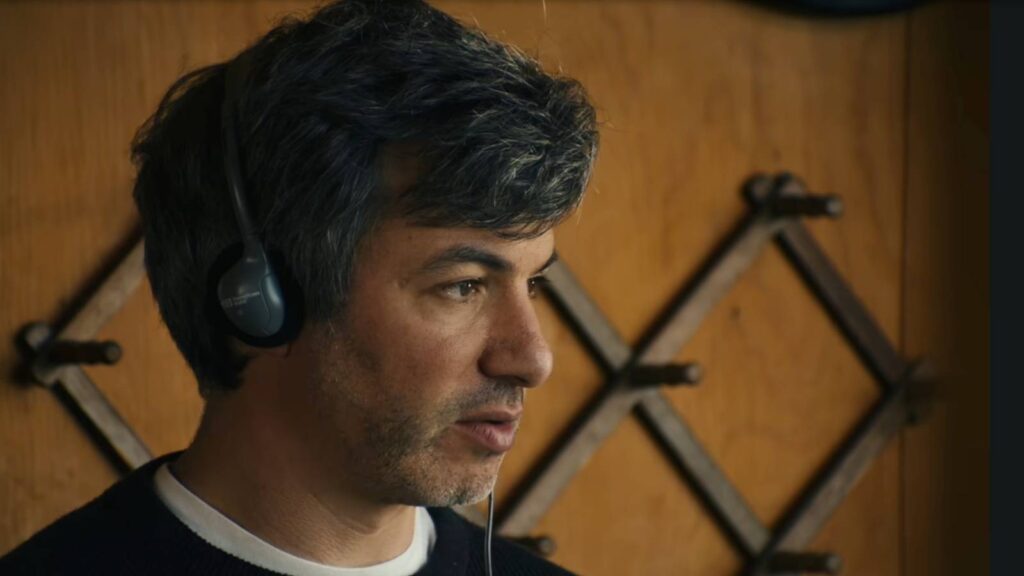
With The Rehearsal, Fielder sought to redraw the boundaries of reality TV, building vast replicative sets and concocting elaborate scenarios in order to work through his phobia of human interaction (and, in its superior second season, his obsession with plane crashes). He adopts a related approach here—there is even a time jump which functions as a temporal mirror to The Rehearsal’s stunning flashback—but rather than preparing for future incidents, he wields the technique to dive into the past, recreating prior unfilmed encounters in an attempt to hunt for further clues into Holmes’ enigmatic persona. It’s a striking marriage of documentary realism and dramatic license, and it explodes the movie’s ideas about art and life into a fireball of examination, suspicion, and compassion.
Speaking of marriage, if You Can See Everything is scrupulously ambivalent regarding its opinion of Liz, it proves less reserved in its judgment of Billy. After she goes to prison, he keeps on grinding (and maybe grifting), and his actions suggest not a partner perpetuating a shared vision, but a man cannibalizing an incarcerated woman’s very existence. With no apparent grasp of irony—remember that the criminal case against Holmes was rooted in her deceit—Billy certifies the use of Liz’s likeness, tweets provocations from her social media account (naturally, he’s a fan of Charlie Kirk), and even acquires power of attorney over her. (It’s only fitting that his new venture relies on AI, given the technology’s capacity for fakery.) His zeal for control manifests most visibly when he suddenly demands that Nathan terminate an interview with a business partner and turn off the cameras, an ultimatum that doesn’t quite square with his “document everything” shtick. “He is batshit crazy,” someone says of Billy—a smash-cut laugh line that doubles as an accurate assessment.
And what of Liz, that once-ruthless entrepreneur—The Dropout’s fictionalized exhortation of “Get the fucking money!” is deployed more than once here—who now passes herself off as a guileless victim? You Can See Everything is wary of drawing definitive conclusions, but Fielder doesn’t let trifling details like inscrutable faces or federal lockups thwart his investigative mission. Instead, in a nervy, inspired maneuver, he partners with Seyfried, who improbably fulfills the overlapping roles of interview subject, co-detective, and role-player. In its closing act, the movie delivers a series of Rehearsal-style scenes that are exhilarating in their rippling implications, touching on the unknowability of truth, the danger of the observer effect, and the power and limits of filmmaking as a mode of storytelling. Above all, they confirm the brilliance of Seyfried’s talent as a performer. Elizabeth Holmes may or may not be a fraud. But Seyfried’s fearless incarnation of her will surely prove to be her legacy’s greatest invention.
Grade: A-

Jeremy Beck is the editor-in-chief of MovieManifesto. He watches more movies and television than he probably should.