

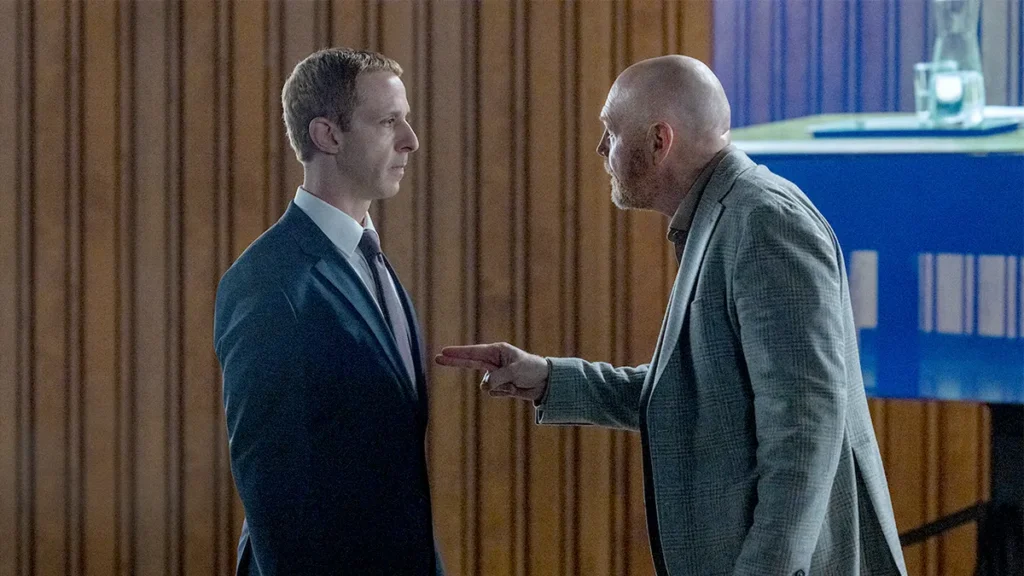
Aaron Sorkin’s characters talk so fast, you invariably miss nuggets of their verbiage, but The Social Reckoning features one particular exchange that warrants special attention. Mark Zuckerberg, played by a zombified Jeremy Strong, is arguing a point of philosophy with a former friend and colleague (Bill Burr). This in itself is unusual—richer than Scrooge McDuck, Facebook’s CEO has surrounded himself with docile yes-men, so he isn’t accustomed to being challenged—but Zuckerberg still isn’t giving any ground in this verbal jousting session. “I’m a free speech absolutist,” he says, “except where—” at which point his combatant cuts him off and lands a body blow: “You can’t say ‘absolutist’ and ‘except’ in the same sentence.”
This is typical Sorkin dialogue: sharp, snappy, quietly erudite. It is also a vivid encapsulation of the fraught political environment that the movie regards with justifiable suspicion. As with most Sorkin vehicles, The Social Reckoning is a film about smart, principled individuals doing battle against a mighty institutional machine. This means that, depending on your perspective, it’s either a righteous expression of anger or a shameless display of sanctimony. There’s room for both, but even if Sorkin’s rhetoric is as old-fashioned as his references—this is surely the first picture about technological titans that contains a digression about Frank Capra—he nonetheless centers important issues plaguing contemporary America. He may be stuck in the mud, but his message still powers through.
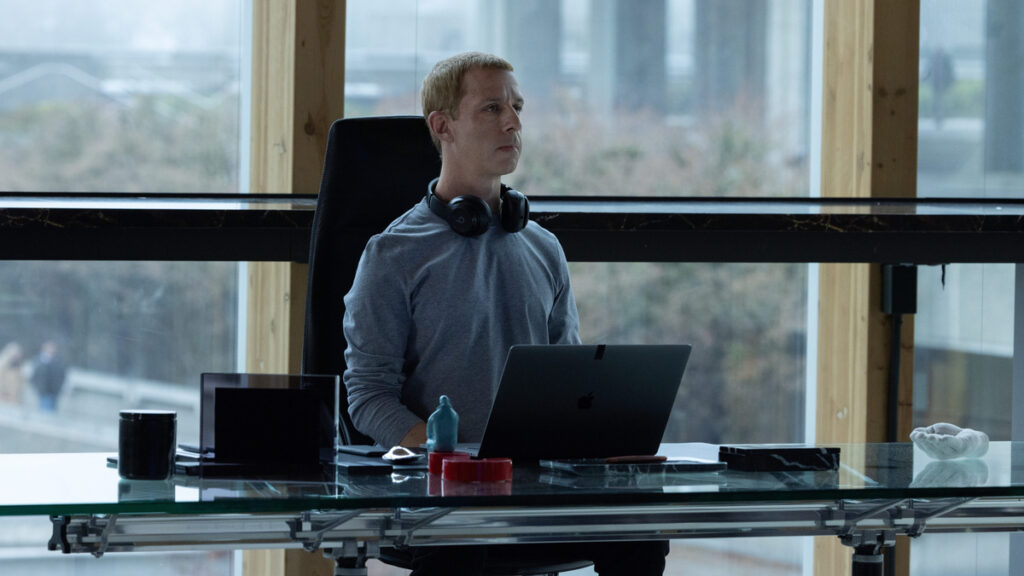
It’s a less comprehensive message than some might like. Thematically, The Social Reckoning sounds a piercing alarm, linking the coarsening of online discourse and the spread of misinformation—depicted here as the product of a conscientious conscious decision to boost engagement and stoke outrage—with the rise of right-wing fascism and its concordant threats to global democracy. This is a sweeping conceit, but it unfolds onscreen in a narrow scope that some might find unduly limiting. The name of Elon Musk, the world’s first trillionaire and self-proclaimed “free speech absolutist”—the guy who bought his own social media website and used it to amplify white-supremacist ideology—is never mentioned. Neither is Donald Trump, though he is alluded to. In this movie’s myopic field of vision, the toxicity of the internet is solely attributable to one pitiful man and his venal corporate empire.
And frankly, such reduction is fine. It’s understandable to wish that The Social Reckoning cast a wider net—that it more broadly and explicitly denounced the poisonous algorithms and tech-bro gluttony which have become embedded in modern life. But one of Sorkin’s skills as a writer is to synthesize tracts of data and churn them into drama. It’s what was so daring about his screenplay for Steve Jobs, which captured the length of the Apple giant’s shadow by condensing his life to a handful of product launches. Here, in confining his focus to Zuckerberg and Facebook, he manages to convey the urgency of his ideas while also telling a taut, streamlined story.

But speaking of giant shadows: The Social Reckoning is, of course, a sequel—er, “companion piece”—to The Social Network, David Fincher’s transcendent 2010 study of Facebook’s founding and ensuing turmoil, which turned a legal squabble over computer code into an anguished portrait of a young man’s shattered soul. Among the strengths of that majestic movie, which a certain critic declared the single best picture of the prior decade, was the productive tension between Sorkin’s inimitable, hyper-intelligent wordplay and Fincher’s own unshakable stylistic authority, which elevated simple dialogue scenes to exhibitions of (not so delusional) grandeur. (How many tech dramas can make room for a thrilling, wordless canoe race set to an electronic cover of “In the Hall of the Mountain King”?) By comparison, this Sorkin-directing-Sorkin follow-up can’t help but feel small. That said, he’s established his competence behind the camera, throwing in the occasional flourish (black-and-white flashbacks, colorized title cards) while also using crisp editing (supervised as usual by Alan Baumgarten) to ensure that, although the words remain the star, the images aren’t mere background for a filmed play.
As is Sorkin’s wont, The Social Reckoning unspools across multiple timelines. The principal narrative begins in 2019 in San Francisco, where Wall Street Journal reporter Jeff Horwitz (Jeremy Allen White) investigates his suspicions about Facebook and its disproportionate presence in adults’ lives. (As Horwitz’s dubious but supportive colleagues, Betty Gilpin and Gbenga Akinnagbe are both in fine form.) He locates a sympathetic, if clandestine, ear in Frances Haugen (a very good Mikey Madison), a Facebook engineer who champions the company’s professed goal of connectivity, but who questions whether her “Civic Integrity” team might just be compliance window dressing designed to conceal more nefarious profit motives. As Horwitz circles Haugen and presses her for information, we periodically toggle forward to a 2021 Facebook strategy session where a PR consultant (Wunmi Mosaku, joining the ranks of “Wait, she’s actually British??”) preps Zuckerberg for his upcoming Congressional testimony regarding Facebook’s electoral influence.
Sorkin’s screenplay, which draws from memoirs by Horwitz and Haugen (plus Roger McNamee’s Zucked), predictably name-checks Woodward and Bernstein, but while The Social Reckoning camouflages itself as a political thriller—contributions include Jeff Cronenweth’s dark, sinister lighting and Alexandre Desplat’s brooding score—it is really, as with most Sorkin films, a series of tense conversations. The Zuckerberg scenes can feel vaguely didactic—plot-wise, they mostly function in service of a late reveal that bears an unfortunate resemblance to Season 3 of The Morning Show—but it’s nevertheless illuminating to see how gingerly he’s treated by his subordinates. If Jesse Eisenberg played the Harvard dropout with the obsessive intensity of a serial killer (in keeping with Fincher’s career-long preoccupation), Strong, with his ramrod posture and clipped speech patterns, turns Zuckerberg into something like a cyborg. His staff’s job—which encompasses not just massaging his responses, but also choosing a properly shaded tie and even teaching him how to nod his head—is to help this soulless robot pass as a real boy.
More dynamic is the repartee between Horwitz and Haugen, even if Sorkin can’t help but indulge in his usual gendered retrogression. “I appreciate the mansplaining,” Haugen says at one point, to which Horwitz (an obvious Sorkin surrogate) smugly responds, “Speaking on behalf of all men, that’s something women say when they’re losing an argument.” Take that, ladies! Sorkin also contrives to dress Madison in an array of skimpy outfits that would make her sex worker from Anora blush. Oh, and her supposed genius has never heard of the Metro desk, and she seems mystified by the very concept of basketball.

And yet, the arc of Haugen’s broadening disenchantment, and the trust she commensurately forges with Horwitz, provide The Social Reckoning with its emotional axis. Part of this is thanks to Madison, whose face can convey a tempest of anxiety—fear, pain, guilt—and who imbues her whistleblower with both resolve and helplessness; the scene where Haugen overhears a teenage girl who’s being bullied on Instagram and feebly encourages her to contact Facebook’s support forums is heartbreaking for its impotence. (For a more visceral demonstration of social media’s facility for sowing chaos in schools, check out Mike Flanagan’s recently released Carrie.) And part of it is that, despite Sorkin’s curmudgeonly tendencies, it remains fun just listening to his characters talk.
What they talk about—vectors and percentages, fact-checking and content-moderating—isn’t typically grist for cinematic excitement. Yet the verbal energy of The Social Reckoning nonetheless translates into kinetic momentum, even as the movie ends up straddling a strange middle ground, occupying zones of both triumph and despair. There’s a lovely final gesture from Madison—calling back, naturally, to a Newsroom-style piece of sporty education—that will bring a smile to your face. That grin may quickly vanish when you leave the theater, look at your phone, and see whatever hateful content your feed is spewing. If The Social Reckoning doesn’t wholly reconcile this inconsistency, it still succeeds as an insulated piece of interpersonal drama. It also compels me to implore you: If you enjoyed this review, please like and subscribe.
Grade: B

Jeremy Beck is the editor-in-chief of MovieManifesto. He watches more movies and television than he probably should.