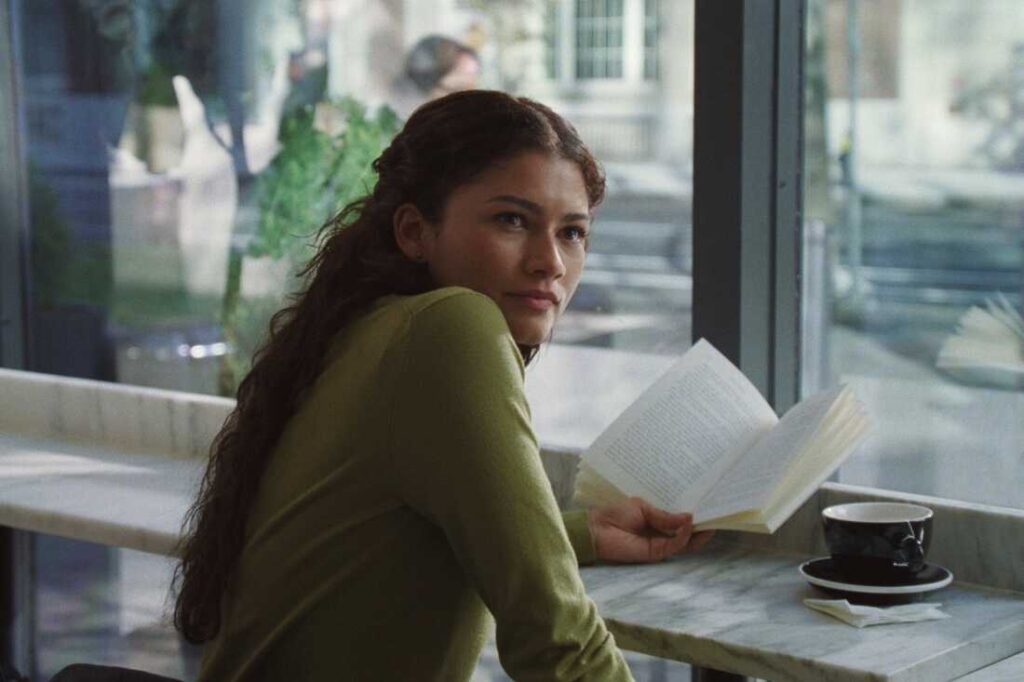
It’s a classic meet-cute. He spies her in a coffee shop reading a book. He has to talk to her, so he quickly googles the novel and approaches her with some canned, cheesy material about how much it spoke to him. He keeps stumbling over his words, panicking when she refuses to engage, only for her to startle and remove an unseen AirPod from her left ear. “I’m deaf in this one,” she explains, and he starts to melt, realizing she didn’t hear a damn thing he said, but then she throws him an unexpected lifeline: “Do you want to start again?”
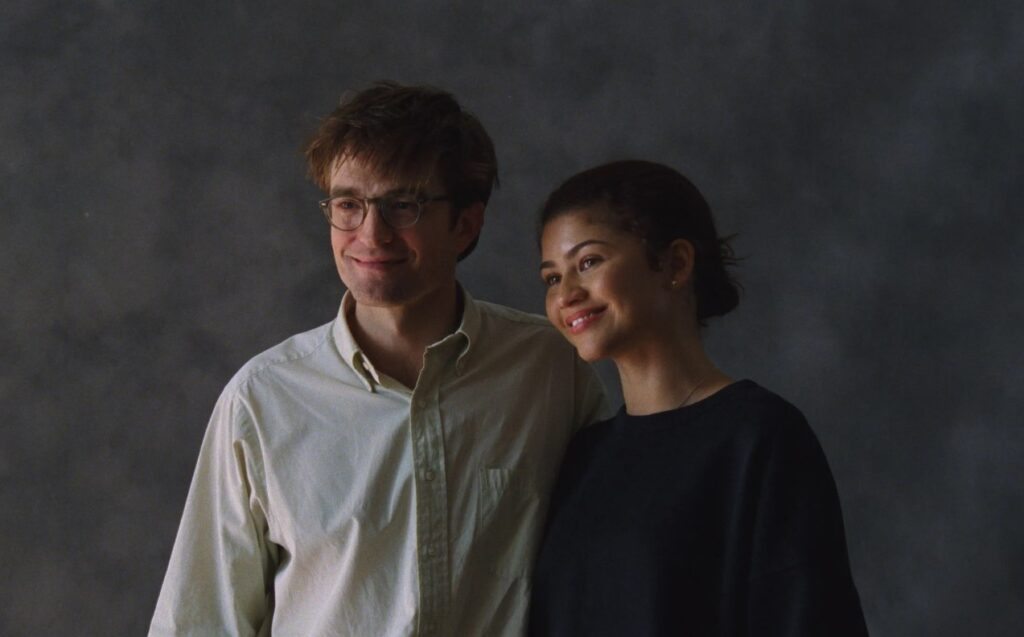
This is the delightful opening scene of The Drama, a bewitching and provocative movie that initially unfolds as a storybook romantic comedy. Emma (Zendaya) and Charlie (Robert Pattinson) are the perfect couple: smart, attractive, blessed with verbal and physical chemistry. Their courtship checks all of the boxes, in particular a magical first kiss that would be the envy of Jane Austen. It’s now the week of their wedding, and we learn the details of their fairy-tale engagement as Charlie runs a draft of his speech past his best man, Mike (Mamoudou Athie), who’s so moved he starts crying. Everything is so light and sweet and charming, you wonder if Kristoffer Borgli, the film’s writer and director, somehow got the title wrong. He didn’t.
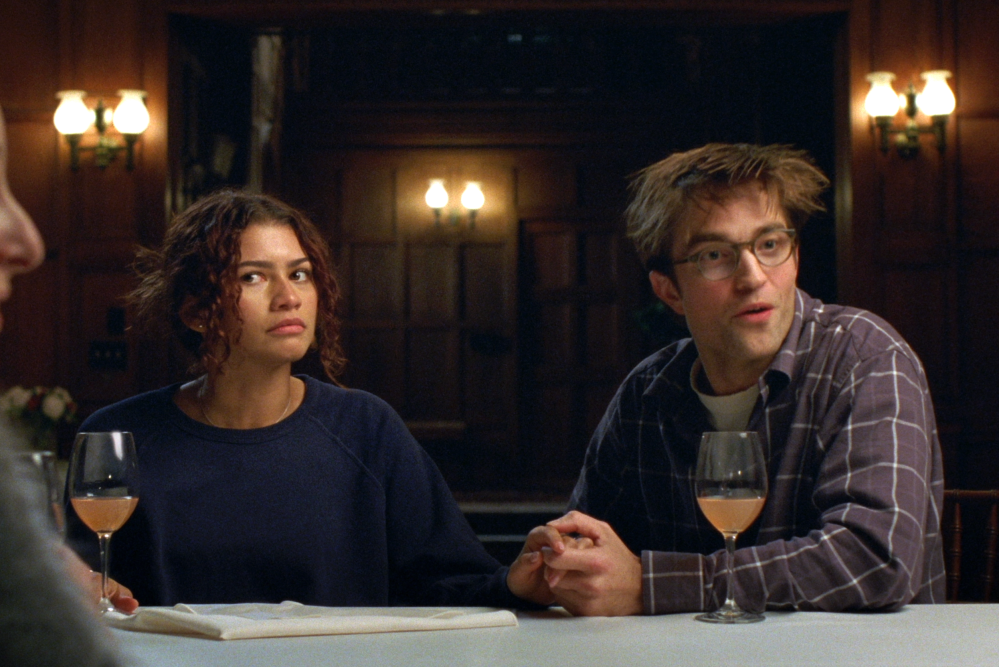
The pivotal scene in The Drama—the load-bearing sequence that jerks the movie into a different tonal register—occurs around 20 minutes in, when Charlie and Emma are attending a wine tasting with Mike and his wife, Rachel (Alana Haim). They’ve guzzled a bit too much booze—there’s a nice throwaway moment where the camera follows the sommelier as she goes to retrieve another bottle, purportedly for her clients’ further scrutiny, and her boss barks at her, “We’re not a bar”—and they unwisely decide to share the worst thing that each of them has ever done. Mike once prioritized his own safety over that of his girlfriend, Rachel impulsively locked a boy in a closet when she was a kid, and Charlie harassed a classmate online—all instances of bad behavior, no doubt, but not necessarily deplorable. Then it’s Emma’s turn.
Spoiler sensitivity is a fraught subject in critical circles—are we obligated to shield readers from important plot points? does doing so hinder our incongruous duty to provide comprehensive analysis?—so I’ll split the difference and simply say that Emma’s past misdeed involves guns in some capacity. (To A24’s credit, the trailer does a decent job threading this needle.) What really matters is how her audience reacts to her confession: Rachel vents self-righteous fury, Mike is quietly disgusted, and Charlie… well, Charlie becomes gripped by a paralyzing confusion that threatens to demolish his and Emma’s perfectly constructed romance.
How well do we know the ones we love? We like to concoct fantasies of absolute honesty—visions of metaphysical reciprocity that traffic in words like “true love” and “soulmate”—but the truth tends to be blurrier and messier. The chief question probed by The Drama is how we respond when the ugliness of real life befouls the unblemished beauty of our mind’s eye. (For a TV series concurrently exploring an imperiled wedding, check out Netflix’s Something Very Bad Is Going to Happen.)
Charlie now knows this thing about Emma, a thing he didn’t know before. This information is destabilizing, but how much weight should he really put on it? Does it make the two years of uninterrupted happiness they’ve just shared any less blissful? Isn’t she the same person he fell in love with? Or has she always had a clandestine dark side, a simmering rage that he’d simply chosen to ignore? Come to think of it, why was she so angry at that random guy in the crosswalk? Why does she chop fruit for her smoothies with such aggression?
Borgli frames this material as a delicate mix of ticking-clock suspense and cringe comedy. His prior feature was Dream Scenario, an intriguing, overstretched Nicolas Cage vehicle that had little interesting to say about cancel culture, but which at least said it in interesting ways. The Drama is less nominally ambitious but more emotionally precise, locking in on its characters’ clenched indecision with queasy realism. There are only a few pieces of tangible action: a brief physical altercation, a few fumbling sexual overtures, a bit of vomiting. But every scene is suffused with discomfort, as strained laughter and feigned politeness mask deep-seated helplessness and fear.
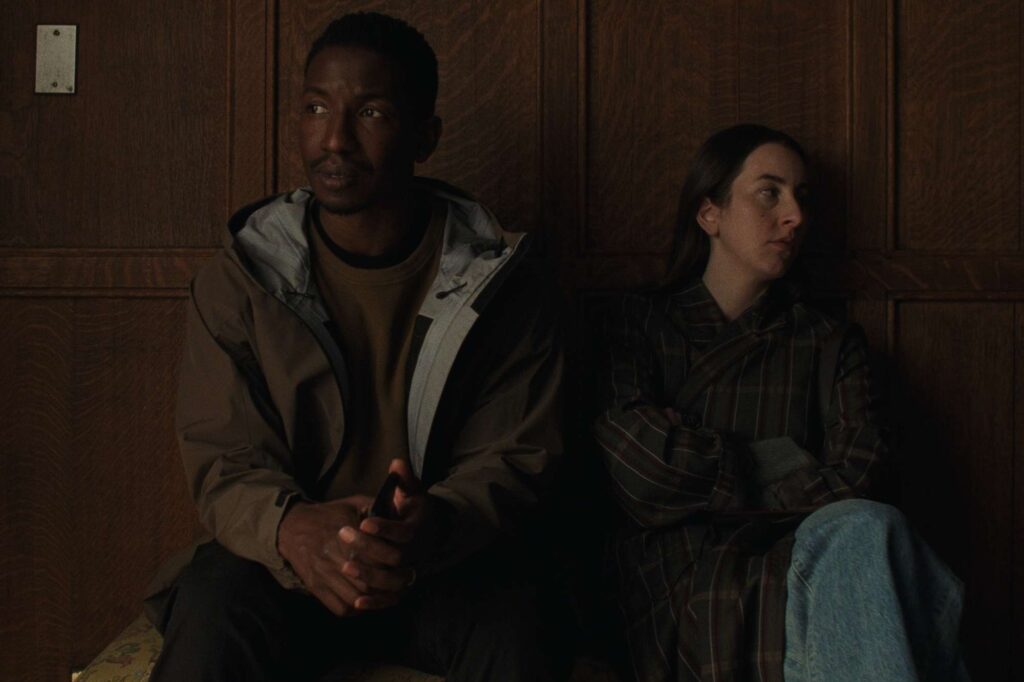
The Drama is aesthetically workmanlike, but Borgli deploys a style of rigorous agitation, translating his characters’ fraying mental states into clear visual language. There are lots of quick cuts and sudden inserts, blending flashbacks, reveries, and hallucinations—most notably shots of Emma caressing rifles with disturbing sensuality. (Daniel Pemberton’s discordant score only amplifies the anxiety.) The result is an atmosphere of vertiginous tension, such that seemingly mundane sequences—a painfully awkward photoshoot, an encounter with a coworker (Hailey Benton Gates, who had a bit part in Zendaya’s Challengers) that mingles desire with self-loathing—curdle with dread. It’s hard to think of another cinematic wedding where each loaded toast carries such stressful, escalating anticipation.
Borgli’s cast is uniformly attuned to his storytelling rhythms—Haim and Athie develop their own anti-chemistry, Rachel’s relentless indignation waging constant war against Mike’s tight-lipped exasperation —but that doesn’t mean The Drama places all of its characters on equal footing. (That both key partnerships are interracial goes unremarked upon, a sensible screenwriting choice, at least from this privileged white dude’s point of view.) Emma, in particular, isn’t so much a full-fledged participant in the titular chaos as a passive observer of it. She has her moments, like a suddenly antagonistic sex scene or a brilliant bit with a kitchen knife, but she primarily serves as an instrument for Charlie’s self-doubt; the lightning-quick shot of blood pouring from her ear onto her dress is a striking image, but it’s really about him, not her.
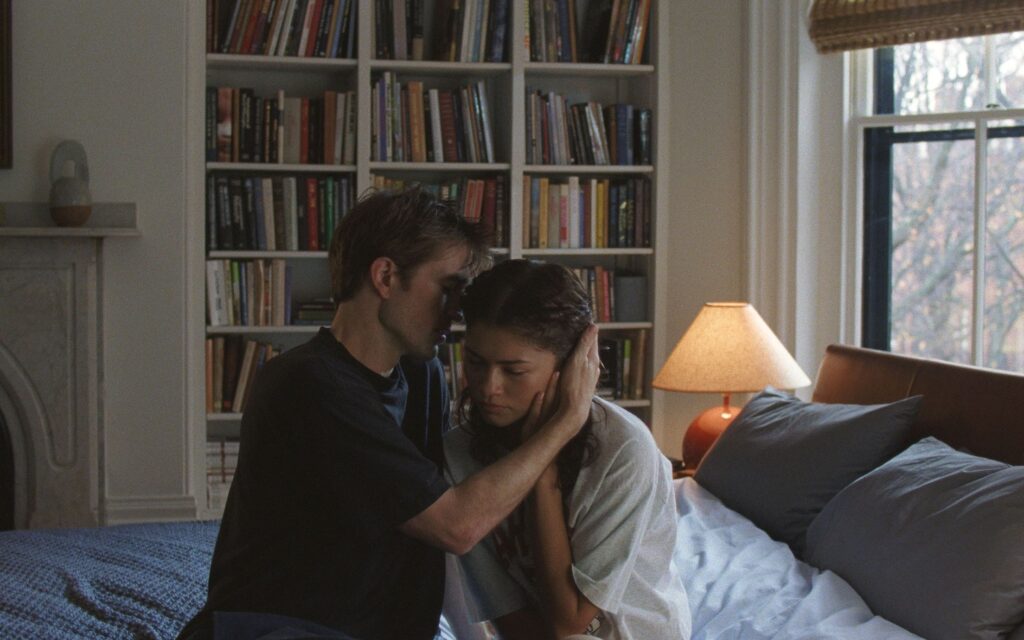
Which isn’t really a complaint, because The Drama’s greatest asset is Pattinson’s performance, which is both openly jittery and stealthily controlled. “You’re a weird little British freak,” Emma says to him on their enchanting first date; she’s teasing, but this ostensible heartthrob is most effective when he can warp his charisma into off-kilter shapes. Charlie may be handsome and smart, but he is also weak-willed and selfish, and Pattinson is heroic for how he plays up the character’s sweaty, slimy desperation.
“Smile naturally, like how you would smile in life,” that aforementioned photographer instructs Charlie, as Pattinson contorts his face into a sickly artificial grin. It’s a funny-sad sequence that epitomizes The Drama’s facility for stripping away a relationship’s sheen of contentment and revealing the turmoil burbling beneath. Everyone has their secrets. But this thoughtful, prickly little movie is too engrossing, too incisive, to be kept under wraps.
Grade: A-

Jeremy Beck is the editor-in-chief of MovieManifesto. He watches more movies and television than he probably should.