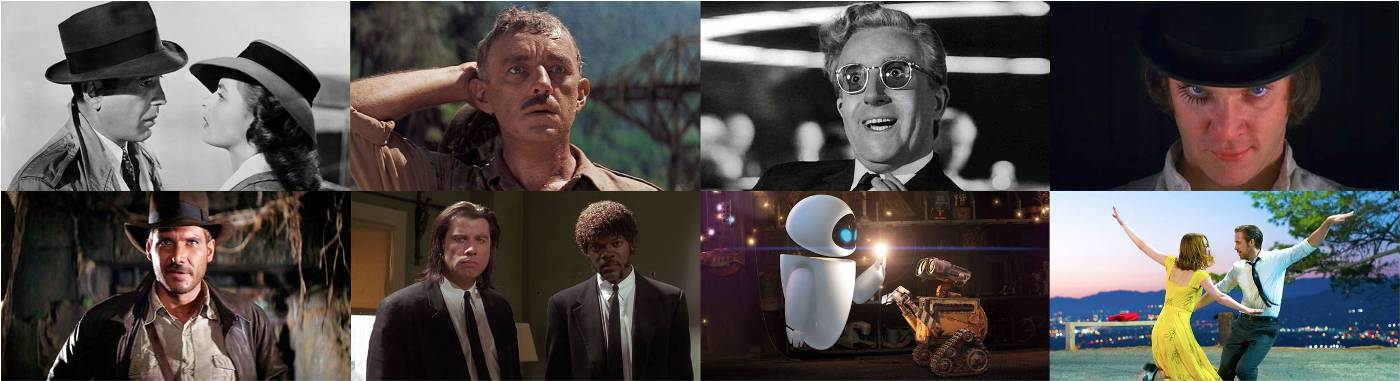
Movies aren’t better just because they’re sad. Sure, the Oscars tend to favor dramas over comedies, but making people feel bad isn’t an inherent artistic good. As with any other subgenre, the success of depressing pictures hinges on qualities beyond their deflating subject matter: the specificity of the characters, the nuance of the performances, the skill of the filmmaking.
This past weekend saw the expanded release of two small, family-centric movies whose tone can hardly be called cheerful. Both execute their assignment of shaking you up, though only one breaks new cinematic ground in the process.
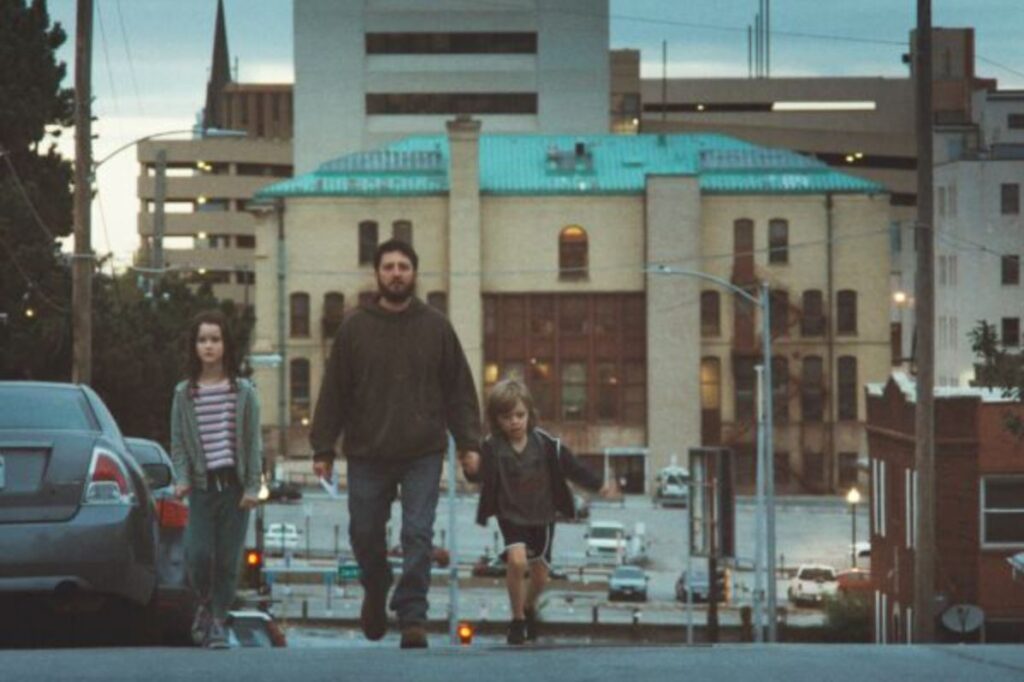
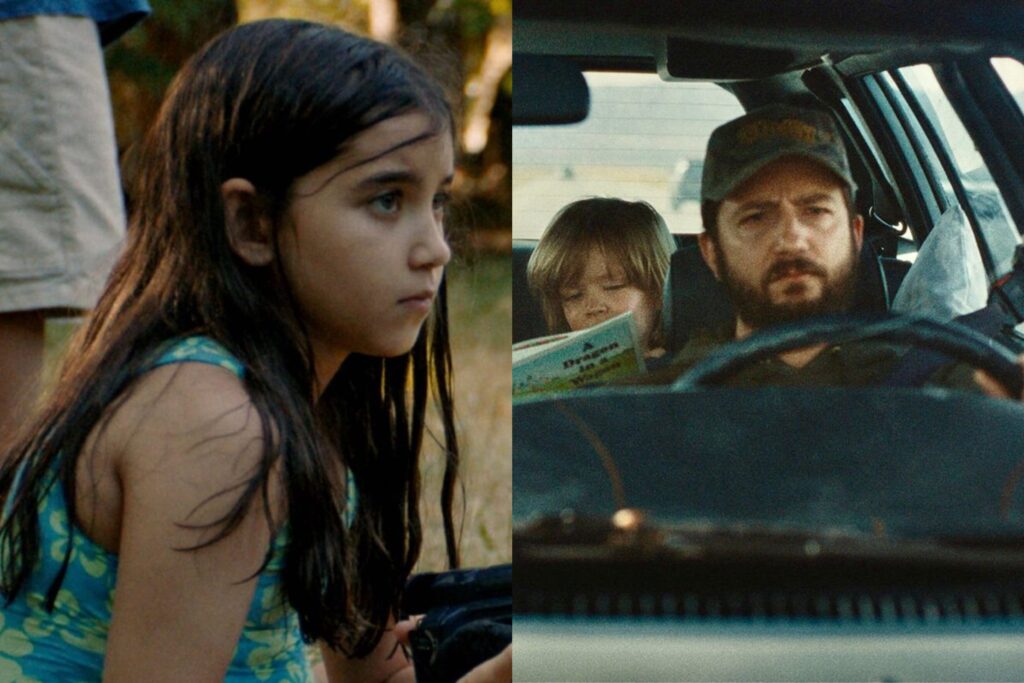
In structural terms, Omaha, the feature debut of Cole Webley, is a road picture. It follows a father, credited only as Dad (John Magaro), who takes his two children—nine-year-old Ella (an excellent Molly Belle Wright) and five-year-old Charlie (Wyatt Solis)—on a trip through the heartland. It’s a muted journey whose primary stops are greasy diners, convenience stores, and cheap motels. Not a whole lot happens, because happenings are reserved for people who have money.
Working from a script by Robert Machoian (The Killing of Two Lovers), Webley plays coy about the true reason for this familial adventure, which begins in Nevada and heads east toward the titular city. But he and Magaro waste little time articulating a miasma of pervasive anguish. The film’s first shot, of wilting flowers in a kitchen, suggests a recent bereavement. The house is quiet, the colors drab. And Dad, despite Charlie’s energy and Ella’s earnestness, seems sullen and burdened. When Ella asks him for a dollar so that she and her brother can split an ice-cream sundae, he winces before digging into his wallet. Dollars don’t grow on trees; they don’t grow in the Salt Flats either.
Thematically, Omaha’s message is unvarnished: American poverty is real, and it fucking sucks. Yet one of the movie’s ironies is that, while Dad and his kids have been brutalized by systemic forces beyond their control (and beyond the scope of the screenplay), most of the individuals they meet are perfectly nice, even compassionate. A sheriff’s deputy offers Dad a moment of grace before nailing an eviction notice to his front door. A woman waiting in line at a gas station gives Ella some travel advice. A cashier helps Dad allocate what little remains of his food stamps. The road to annihilation is paved with good people.
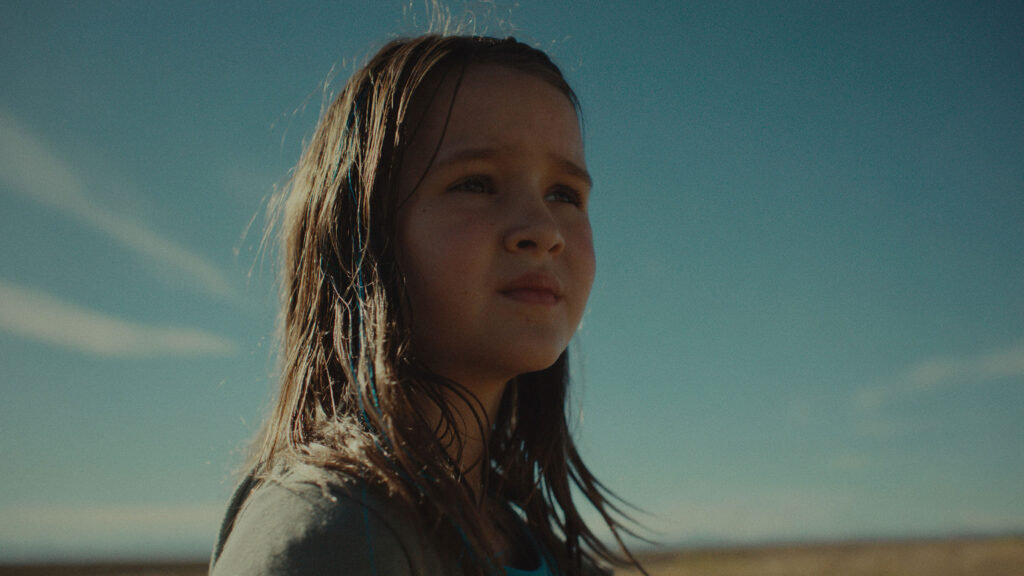
Omaha is designed to function as a faucet of tragedy, each scene adding yet another drip to its bucket of overflowing sorrow. But for me, the movie lands its strongest punch relatively early, when Dad stops at an animal shelter to donate the family’s golden retriever. Ella, who had previously chastised her father for feeding the dog fast-food burgers, breaks down. “I’m sorry, you can give him people food!” she wails, her self-reproach running a stake through my heart.
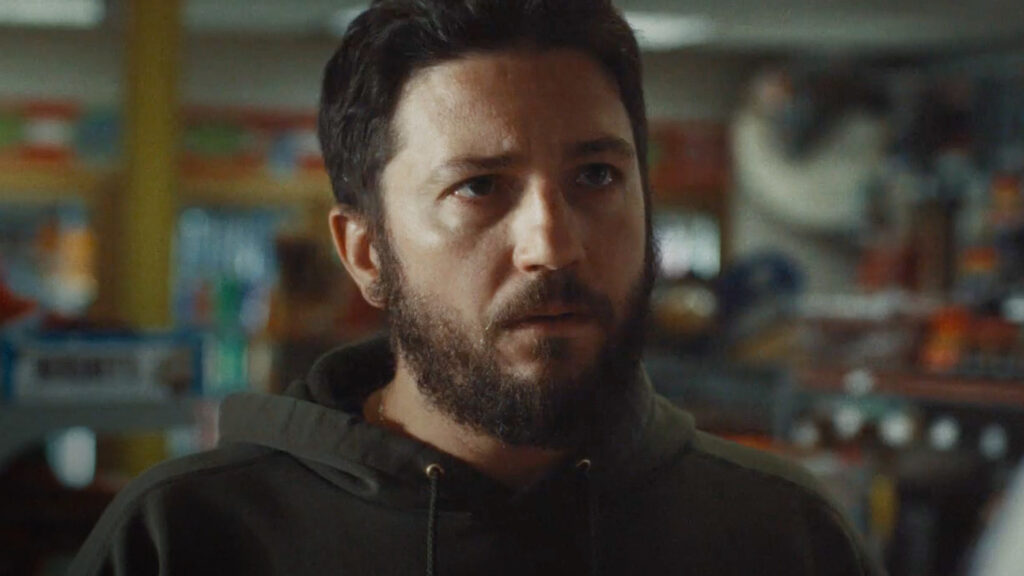
There are plenty of additional upsetting incidents in store, though Webley is smart enough to modulate the oppressive misery with moments of peace and harmony: the flying of a kite, the visit to a zoo, the repeated scenes of Ella and Dad jointly push-starting his broken-down car. In its plot, the film represents a curious cross between She Rides Shotgun, in which a father and daughter traversed the southwest in flight of gangsters, and Nomadland, in which Frances McDormand ambled through the Western time zones while befriending fellow wanderers. In eschewing the intensity of the former, Omaha never quite attains the richness of the latter. It suffers from a schematic indieness, progressing inexorably toward its terminus with minimal variation or insight.
Of course, that inevitability is the movie’s whole point. “I don’t know what else to do,” Dad says to no one in particular, and Omaha is dispiritingly persuasive in its negative image of the American dream—a land without choice or opportunity or hope. Despite its oddly judgmental closing crawl, it provides you with paradoxical relief. If you bought a ticket for this movie, you’re indulging in a luxury its characters could never afford.
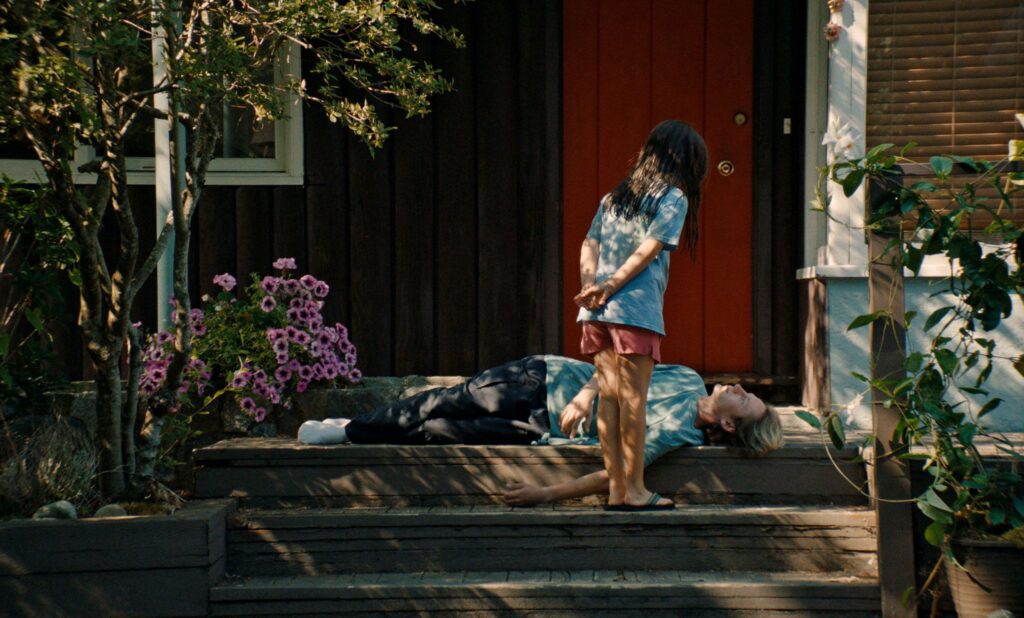
Despite taking place in Canada, Blue Heron shares a number of plot points with Omaha: social workers, petty shoplifting, distressed parents striving to do the best they can for their kids. But while both films center on child welfare, Blue Heron, the first feature from writer-director Sophy Romvari, is a more ambitious and provocative production. It similarly chronicles a narrow slice of life, but it does so in ways that feel radical and new.
At first, everything feels new for Sasha (Eylul Guven), the watchful eight-year-old girl whose family has just emigrated from Hungary to Vancouver. (The time period is unspecified, but judging from the visible technology—a bulky Macintosh computer, some Super Nintendo cartridges—we’re in the mid-’90s.) It’s quite the adjustment, but she acquits herself well, learning the language and making friends. It helps that her family, comprising two slightly older brothers and two supportive parents, is close-knit. Except…

Most of Blue Heron unfolds from Sasha’s perspective, but its catalyzing character is Jeremy (Edik Beddoes), her teenaged half-sibling. With his pale skin, wavy blond hair, and thin glasses, Jeremy looks a bit out of place in this snug little home. He evidently feels out of place too, as he appears to suffer from an undiagnosable malady that manifests in the form of tantrums and other erratic episodes. No one thing that Jeremy does is especially horrible; he’s an angry boy, not the demonic kid from The Omen. But the accumulating gravity of his constant petulance—repeatedly bouncing a ball against the house, screaming in the backseat of the car, stealing trinkets from a local shop, walking on an unstable roof, even punching a window—places a colossal weight on his parents, who have no idea how to relieve their son’s pain and who also fear for the safety of their three younger children.
You don’t need to know anything about Romvari (I’d never heard of her) to recognize that Blue Heron is a work of semi-autobiography; that comes through in both the texture of her storytelling and the lucidity of her filmmaking. Her shooting style is intimate and oblique, assembling less a collection of traditional scenes than a series of glancing snippets and half-overheard conversations. (I was reminded, in some ways, of Joanna Hogg’s The Souvenir.) With precision and generosity, she invites you inside the family home, allowing you to observe the parents’ escalating panic, and to join in Sasha’s wonderment and confusion.
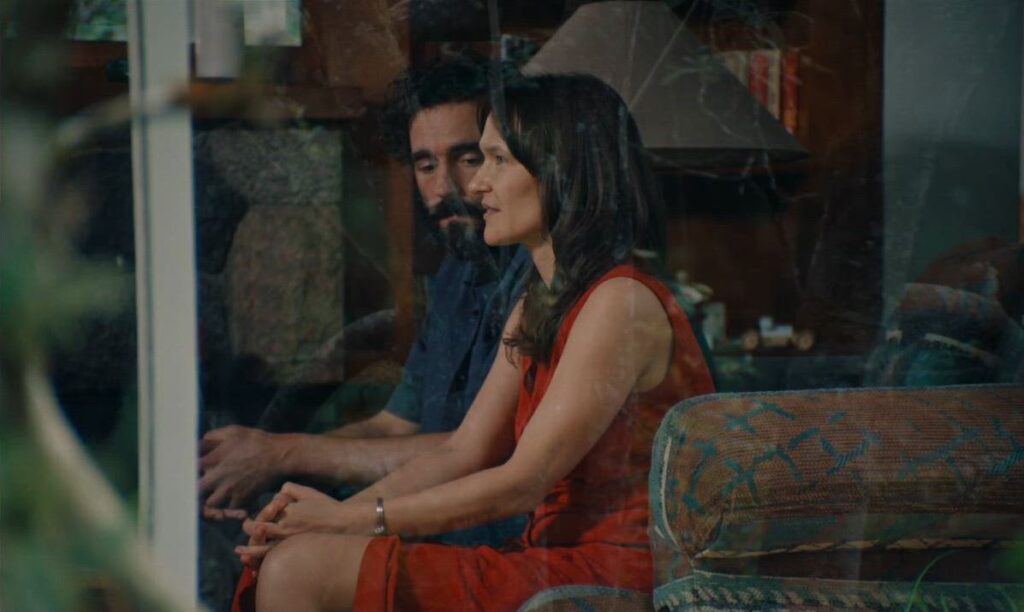
Which, even more so than Jeremy’s tribulations, proves to be the movie’s true subject. For its first half, Blue Heron is an engaging but fairly straightforward portrait, capturing the rhythms of Sasha’s life with recognizable methodology, if uncommon delicacy. But then it leaps forward, both chronologically and architecturally (behold, smartphones!), and transforms into a different sort of picture entirely.
I hesitate to say too much about Blue Heron’s triumph of reimagination—not out of spoiler sensitivity, but because the tactility of Romvari’s images and the boldness of her writing don’t easily lend themselves to words. Suffice to say that we flash ahead to the adult Sasha (a terrific Amy Zimmer), now a filmmaker who is using the tools of her trade to the illuminate the hazy darkness of her own childhood. She seems accomplished, if not fully happy—there’s a fleeting moment of her alone in the bathtub, luxuriating in the rat-a-tat banter of His Girl Friday—but she is plainly preoccupied with her past, and the only way for her to grapple with it is to make a movie about it.

The meta kinks of Blue Heron are alluring, but they aren’t its main attraction. What really captivates is how Romvari uses conventional technique to turn the process of filmmaking into a form of both recall and reinvention. With deceptive simplicity, she somehow collapses the very fabric of time, so that Sasha’s remembrances of her younger days share space, sometimes literally, with her present self. The result is overpowering not because Sasha’s upbringing was so sad, but because Romvari’s vision acquires the clarity and the mystery of memory.
As in Omaha, there are no bad people in Blue Heron, just troubled souls trying to solve an unsolvable problem. The crucial difference is that, whereas Omaha is making a point, Blue Heron is conveying an experience—the uncanny sensation of climbing into a time machine and uncovering the shrouded secrets of your youth.
Grades
Omaha: B
Blue Heron: A-

Jeremy Beck is the editor-in-chief of MovieManifesto. He watches more movies and television than he probably should.