A long time ago, in a galaxy not far away, there was a swashbuckling sci-fi/Western TV series whose snappy writing and charismatic actors eventually inspired a bona fide big-screen adventure. But enough about Firefly. Here we have The Mandalorian and Grogu, the latest product in the Disney empire’s content-generation machine. It’s been seven years since the last Star Wars movie (the unduly maligned Rise of Skywalker), during which time the Mouse House has glutted your streaming queue with all manner of Sithian spin-offs. These offshoots varied in quality—Andor was quite good, The Book of Boba Fett was pretty bad, I forget everything that happened in Obi-Wan Kenobi and Ahsoka—but they all fulfilled their mission of sating fans’ appetites for intergalactic mayhem and Force-laden profundity. The Mandalorian was the first of these, and also the most successful according to certain commercial metrics, so it’s been plucked from the outer rim of television and holo-projected into the multiplex, where Disney hopes that the universe’s deadliest bounty hunter and his loveable little green friend will restore the franchise to its prior cinematic glory.
It’s a dubious bet. But when I tell you that The Mandalorian and Grogu is my least favorite Star Wars film to date, it’s both an expression of my disappointment and an acknowledgement of my advancing age. This world that once filled me with excitement and joy—the blue-tinted rushes through hyperspace, the exotic lightsaber duels, the premonitions that someone has a bad feeling about this—now seems chilly and mercenary. Did I grow up, or did the movies bog down?
Perhaps that’s a false choice. But rather than immediately succumbing to the dark side of negativity, let me acknowledge that this latest interstellar romp, which was directed by Jon Favreau from a script he wrote with Dave Filoni and Noah Kloor, is by no means incompetent. It features an array of impressively designed locations, branching beyond the arid confines of Tatooine and exploiting the stylistic versatility intrinsic to the franchise’s planet-hopping construction. The special effects, while not exactly tangible, are largely convincing, and have been applied to manufacture a range of distinctive alien creatures. And the score, by Ludwig Göransson, is stupendous, augmenting the recognizable, Morricone-style riff from the television series with bursts of brass and bolts of electronica.
Yet the most noteworthy achievement of The Mandalorian and Grogu lies in what it is not: a plodding continuation of the TV show. Sure, the movie traffics in lore that will activate the neurons of existing fans: exposition about a special helmet; genealogy traced to Jabba the Hutt; totemic lines of dialogue like “This is the way” and “I can bring you in warm, or I can bring you in cold.” (I confess to being bummed when a fleet of X-wings showed up and nobody ordered, “Lock S-foils in attack position.”) But while the uninitiated may be puzzled by the diminished state of imperial governance (the New Republic is now in charge) or the identity of a copilot (turns out he’s from the animated Rebels series, who knew?), they will have no difficulty tracking the main plot, which operates as both a samurai-like escapade and a buddy comedy. Rather than busying itself with franchise continuity, the screenplay homes in on a narrow galactic sector, and the simplicity is refreshing.
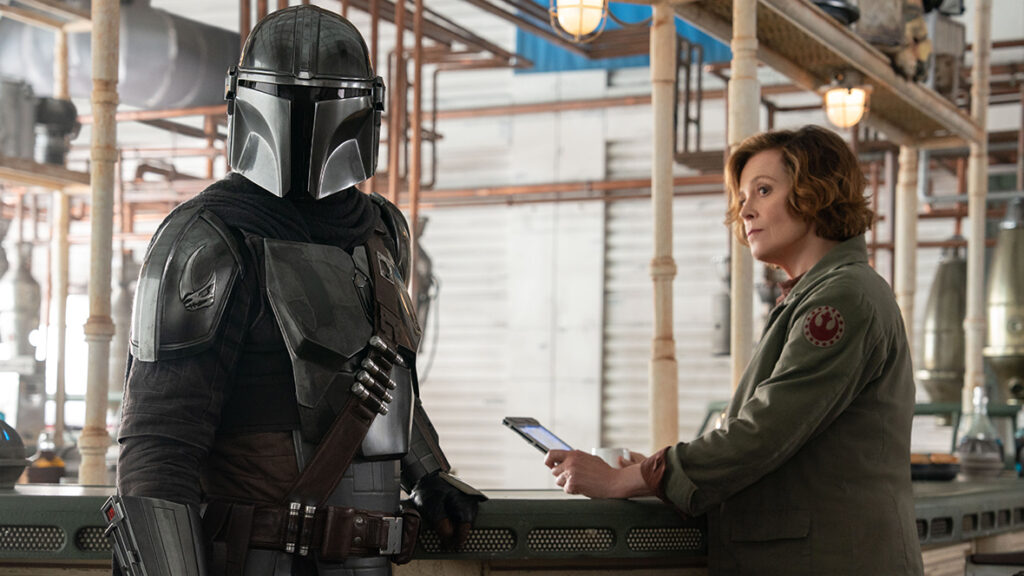
Our titular ronin, played with suitable physicality by Pedro Pascal (plus a few on-set doubles), is technically named Din Djarin, though everyone appears to call him Mando, so I will too. (Thankfully, there never seem to be two people from Mandalore on screen at the same time, otherwise things could get confusing.) His apprentice completes the film’s title, though you surely know him better as Baby Yoda. Together they agree to track down Jabba’s son, Rotta (voiced by Jeremy Allen White), who reportedly has intel on the whereabouts of an elusive imperial warlord. (A demented part of my brain flitted to the analogy of Allied hunters capturing escaped Nazis after World War II, but the script is even less invested in exploring the fallout of fascist rule than it is in providing meaningful female characters, a paycheck-collecting Sigourney Weaver notwithstanding.) Their journey brings them to multiple planets—the two most notable are a teeming nighttime metropolis whose crowded streets and glittering signage vaguely recall Blade Runner, and the Hutts’ forested homeland—where they wrestle with disreputable gangsters, double-crossing barons, merciless assassins, and the perpetual craving of Grogu’s sweet tooth.
The particulars of this caper aren’t very interesting, nor are they important. The purpose of a science-fiction picture like The Mandalorian is to treat you to a buffet of otherworldly sights and sounds, boosted by propulsive action and lightened by offbeat comedy. So the main problem with this movie is that, for all its noise and motion and periodic novelty, it proves neither thrilling nor funny.
Oh come on, you say; who wouldn’t enjoy watching Jabba the Hutt’s son engaged in mortal combat? Jon Favreau, for one. The former comic actor has settled into a lucrative career as Disney’s preeminent steward of intellectual property, but he scarcely bothers to infuse his set pieces with any ingenuity or dynamism. There’s a gladiatorial fight involving Mando and Rotta—first as enemies, then as collaborators—and its lackluster execution cries out for the bright vivacity that George Lucas brought to a similar sequence in Attack of the Clones.
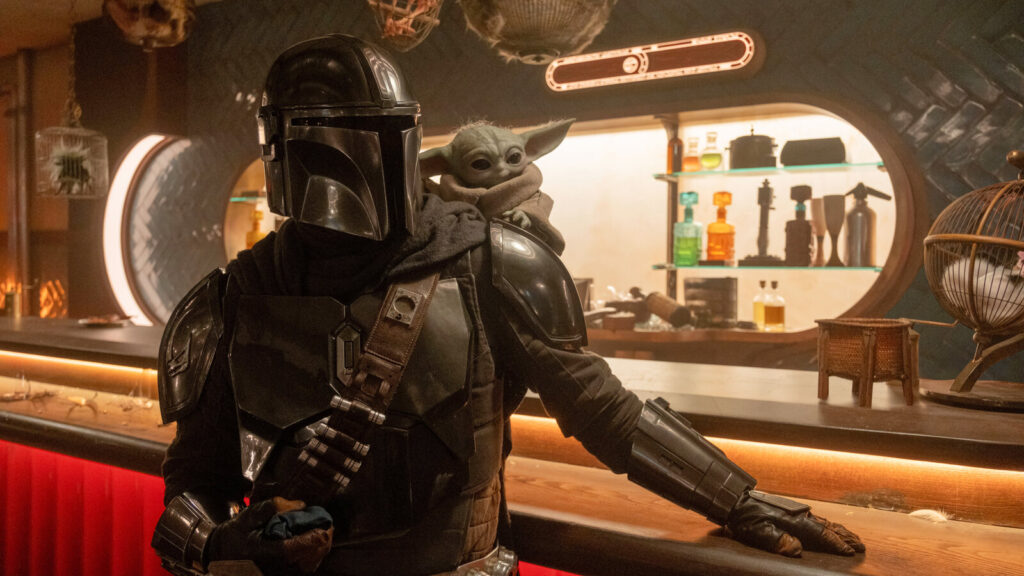
Speaking of brightness, the overall palette of Mandalorian is murky and grey, with insufficient color to penetrate the haze. There are times when Favreau uses darkness to his advantage, such as a midnight raid where one of Mando’s cool-looking rivals carries out a ruthless attack. But for the most part, the putative action is uninspiring, with sluggish momentum and indifferent choreography—not to mention pale echoes of more alacritous Star Wars films. (Mando’s underground battle against a snarling beast is just a feeble recycling of the Rancor scene from Return of the Jedi.) This is especially true when Hutts are involved. Jabba was a classic villain in part because of his hulking immobility; turning his progeny into bruising warriors is a conceptual blunder.
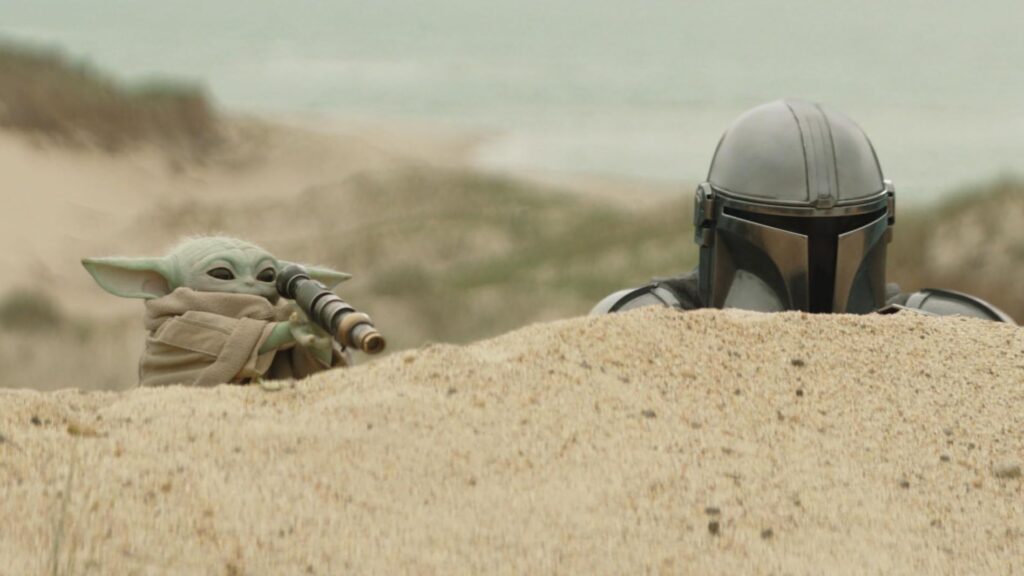
For his part, Grogu occasionally uses the Force to levitate people or objects, but he otherwise isn’t a key player in the fighting, which is the right approach. The introduction of “The Child” in the series premiere of The Mandalorian remains one of the few truly memorable moments in the Star Wars TV-verse, and Favreau still has a good handle on the character. He’s an absolute cutie, with pointy green ears and large black eyes that are strangely expressive. Conceived through a combination of puppetry and animatronics (plus the usual CG embellishments), he’s a natural crowd-pleaser, and his youthful sweetness makes him an ideal vehicle for silent comedy.
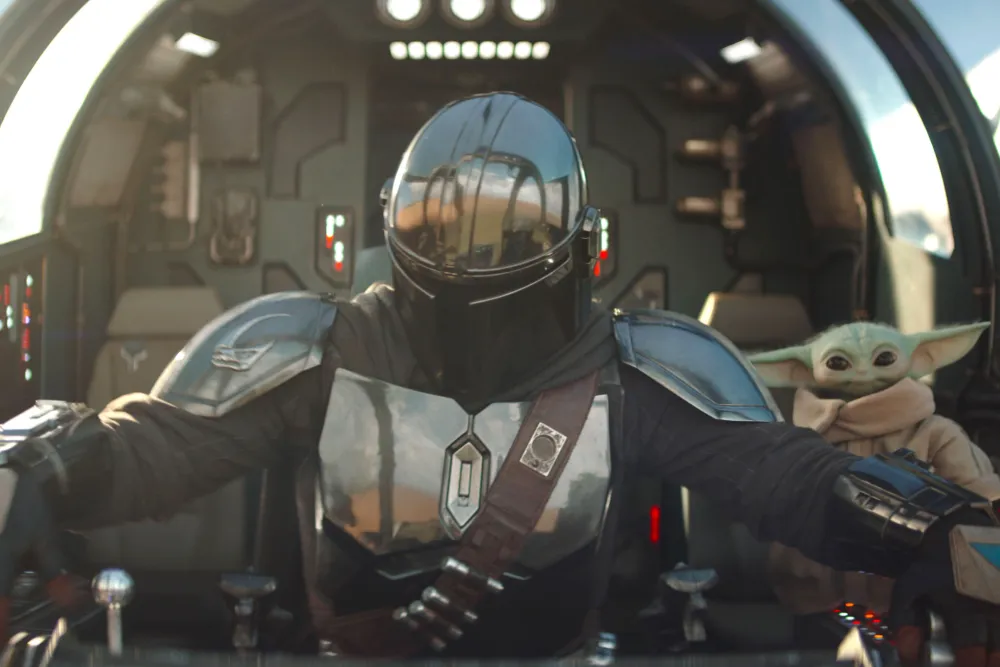
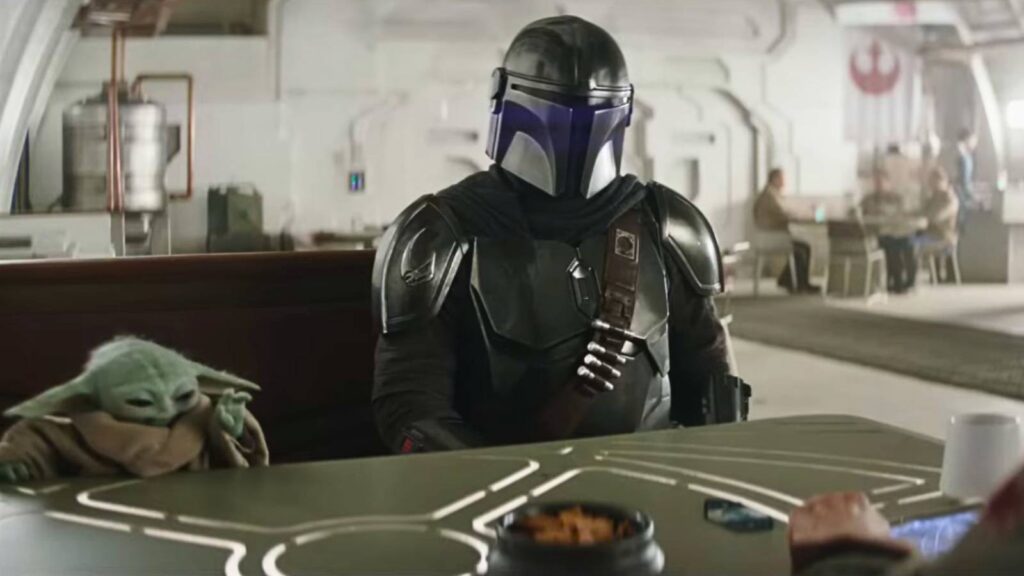
And yet, the movie does little to capitalize on Grogu’s inherent adorability. Yes, there’s a playful runner about his love of candy, but he spends most of his time just trotting alongside Mando, who treats him less like a child than a pet, issuing commands like “stay” and “heel.” Eventually, Grogu falls in with a band of Gizmo-like critters called Anzellans (related to Rise of Skywalker’s Babu Frik, and again voiced by Shirley Henderson), and while their antic bustling and murmured phrasings might look charming at first glance, it quickly grows tiresome. Star Wars shouldn’t be reminding me of the Minions.
There’s a pandering quality to much of Mandalorian—a sense that it’s a thoughtfully curated enterprise rather than a work of artistic freedom. The exception is a striking late sequence that finds Mando incapacitated, with Grogu scrambling to protect his benefactor. This interval, which features an unusually laid-back fisherman (Stephen McKinley Henderson), isn’t persuasive in any conventional manner, but it unfolds with a hushed uncertainty, along with a welcome impression of creative risk. It’s the one time the movie feels new.
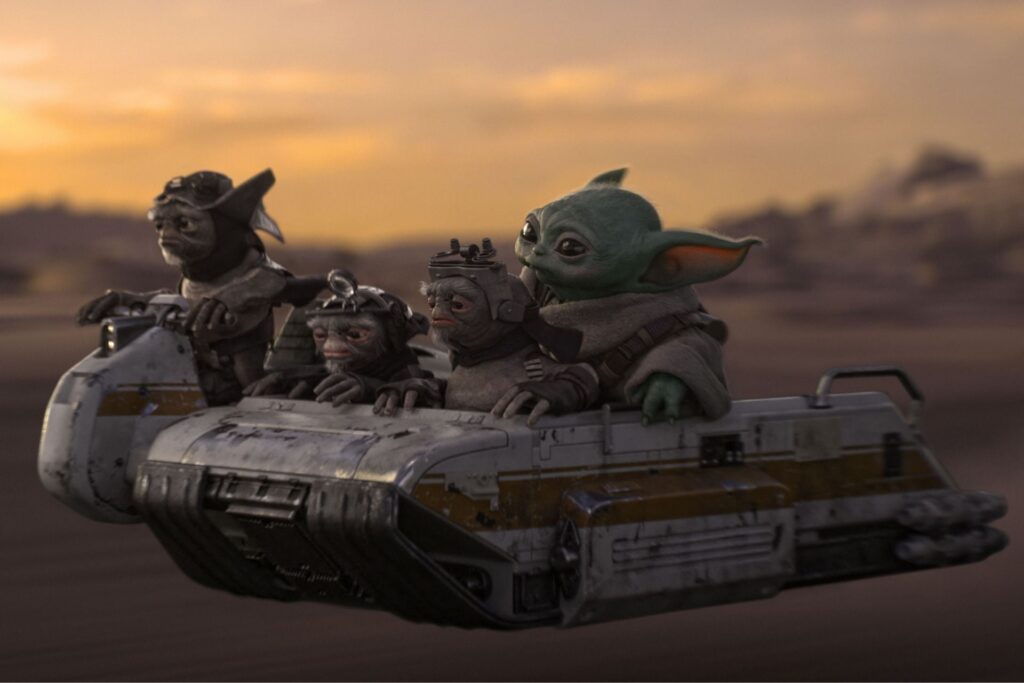
It also throws the rest of the film into unflattering relief, underlining that Favreau is acting less as a storyteller than a caretaker—a capable, cautious shepherd whose mandate is to produce more franchise content that appeals to everyone without upsetting anyone. Maybe this has always been the case; maybe the Star Wars pictures of my youth and early adulthood weren’t as buoyant and imaginative as they appear in my memory. But to my eyes, The Mandalorian and Grogu struggles to conjure the icy wonder of The Empire Strikes Back, or the emotional gravity of Revenge of the Sith, or the vibrant reinvention of The Last Jedi.
Except it doesn’t really struggle, because it doesn’t actually try to deliver such boldness. Star Wars used to be dubbed space opera, but despite this movie’s shootouts and betrayals, its abiding atmosphere is one of safety. Grogu hasn’t yet started speaking, meaning it’s unclear if he’ll inherit Yoda’s penchant for twisting sentences into pretzels, so allow me to do it for him: The way, this is not.
Grade: C+

Jeremy Beck is the editor-in-chief of MovieManifesto. He watches more movies and television than he probably should.