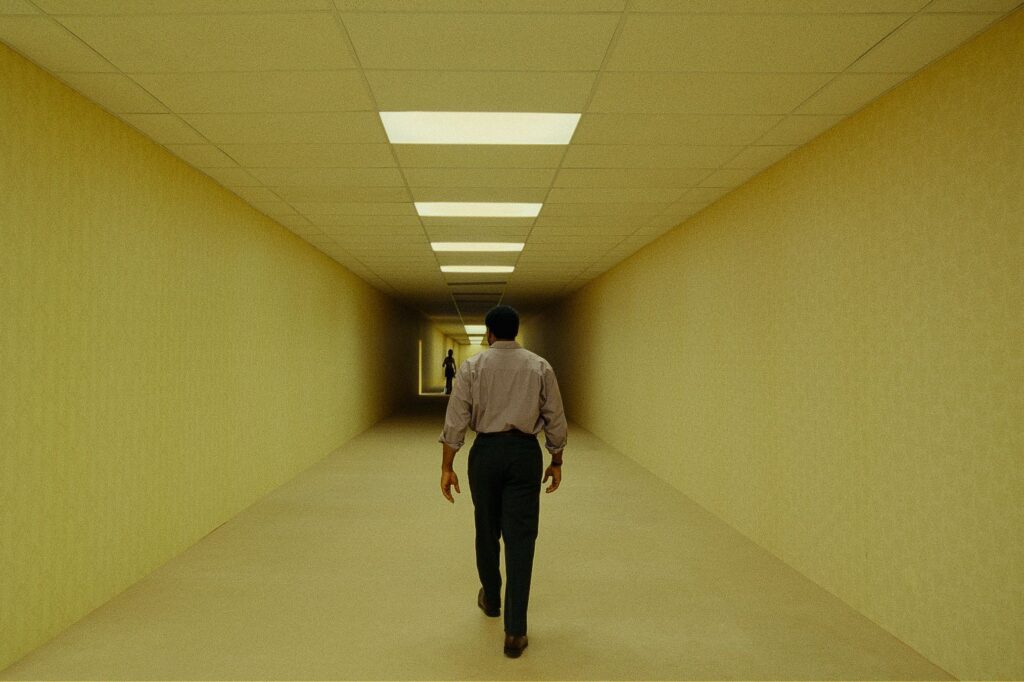
It’s been a rough few decades for the retail furniture business. First came the internet. Then the housing market crashed. And now arrives Backrooms, a head-tripping horror picture that conceives of a big-box emporium whose basement contains a secret gateway to hell. It’s a work of fiction, but it still might give homeowners pause before they go browsing through the aisles looking for their next loveseat.
Backrooms is the brainchild of Kane Parsons, and the story behind the story—why is this thing such a hit? Just what exactly is a YouTuber? Wait, this guy is twenty?—threatens to overwhelm the movie proper. So it’s important to acknowledge that Backrooms, while far from perfect, is an accomplished and distinctive feature debut. It suggests the work of an artist with his own unique vision, even if that vision isn’t yet fully formed.
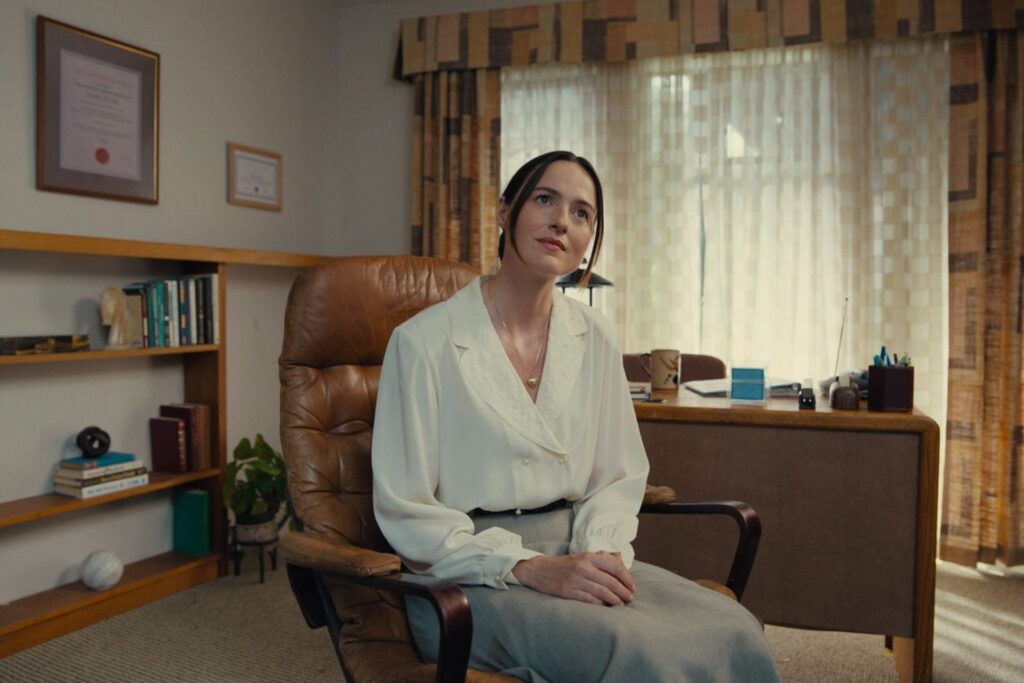
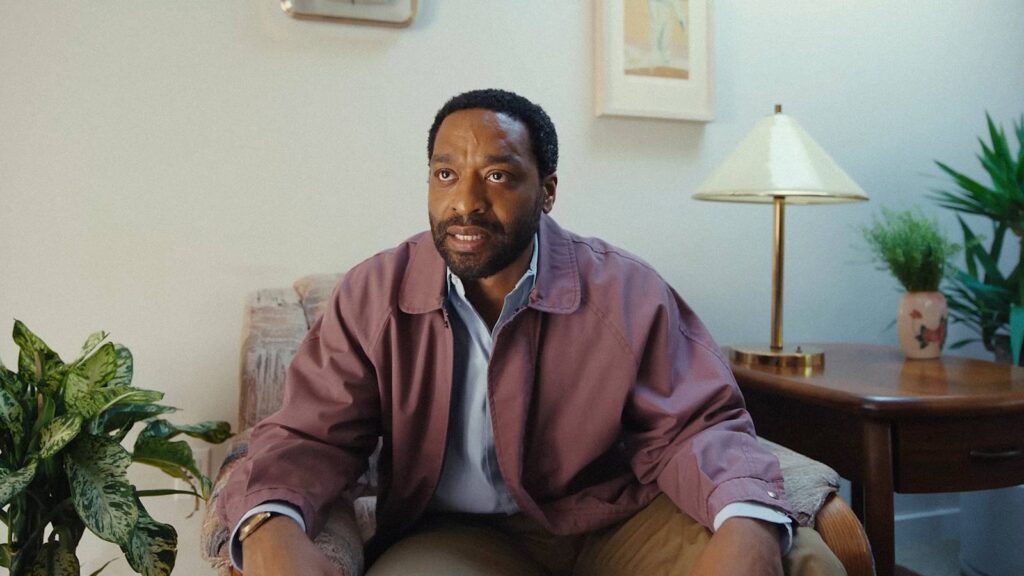
In fact, misshapenness is the film’s primary subject, along with the sensation it attempts to evoke. The screenplay, by Will Soodik, is alternately clunky and fuzzy, but it cleanly articulates the movie’s conceptual slipperiness during a scene where Clark (Chiwetel Ejiofor) tries to explain a bizarre phenomenon to his therapist, Mary (Renate Reinsve). “Imagine describing a dog to someone who’d never seen one before,” he says, “and then asking them to draw it.” The result, he hypothesizes, might approximate the animal but would also be inaccurate and alien. Backrooms endeavors to visualize that distortion—to use carefully ordered objects and images to embody the dreamlike chaos of the subconscious.
Despite his metaphors, Clark’s issues are less philosophical than financial. He runs a furniture outlet called Cap’n Clark’s Ottoman Empire, and business is far from booming; early on, we see him filming a cringeworthy commercial where he cosplays as a weird pirate-sultan hybrid and speaks in a goofy accent, and it hasn’t generated much foot traffic. (“You can open the store now,” he tells his assistant, to which she replies, “We’ve been open.”) Vexed by inexplicably high electric bills—the circuit breaker contains a strange diagonal switch that doesn’t seem connected to anything—he keeps flipping the lights on and off, which is how he discovers a mysterious glow emanating from a basement wall. And then, like Lucy Pevensie by way of Kitty Pryde, he stumbles through this partition and into another world.
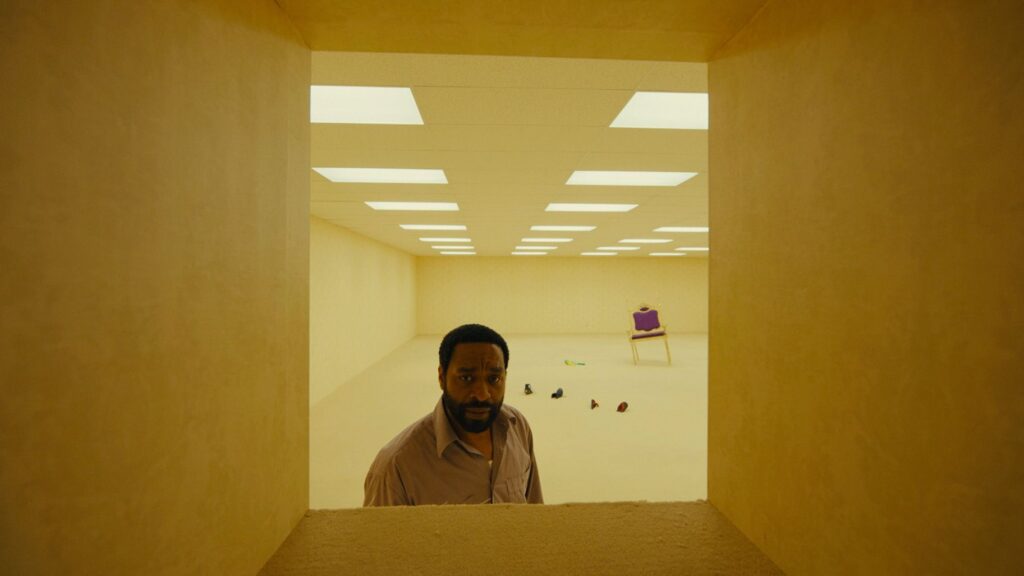
That world, with is sickly yellow lighting and cavernous hallways, is the real achievement of Backrooms, which is above all a triumph of imaginative set design. Working with production engineer Danny Vermette (on loan from Osgood Perkins), Parsons has invented a sprawling, captivating mirror realm that is both spooky and meticulous. Articles of furniture are littered everywhere, many half-buried in the floor. Walls slope and curve at odd angles. Ribbons of signage flap about, their lettering garbled and twisted. Escheresque staircases jut into the ceiling. Random doors, often with multiple knobs, lead everywhere and nowhere. Oh, and there might be a monster stomping around.
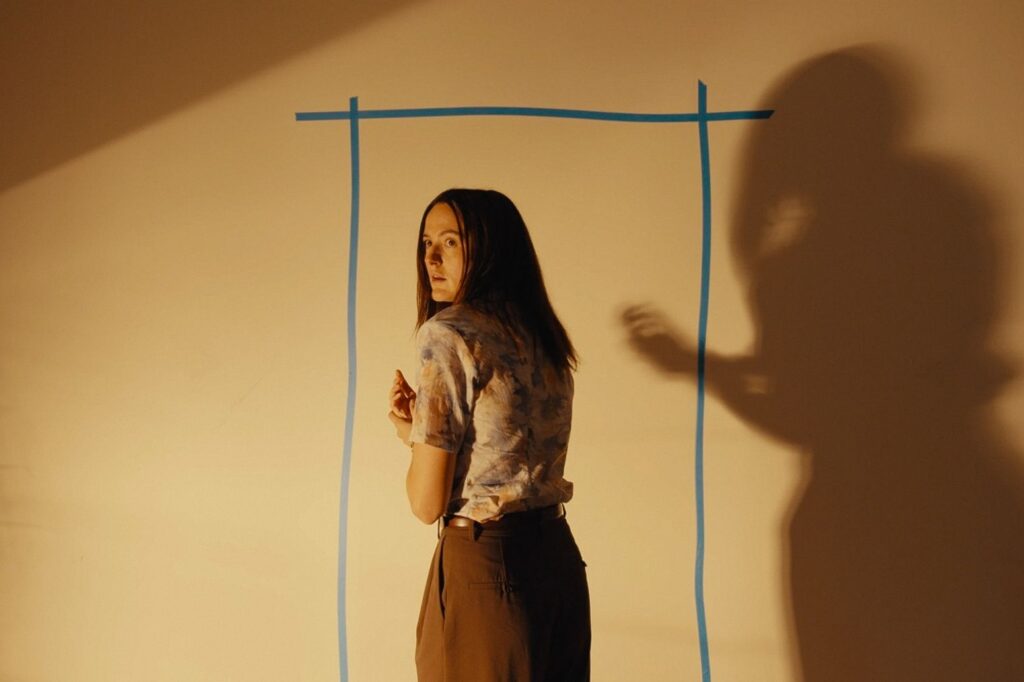
The best passages in Backrooms take place during its first half, when you share in Clark’s fear and awe as you try to process its confounding surreality. Parsons is plainly acquainted with videogames, and he regularly adopts the point of view of characters holding cameras, the aspect ratio tightening and the image quality degrading in the manner of found-footage horror. This results in some very scary sequences—one involving a rope that transforms from safety harness into instrument of violence, another where Clark’s camera is suddenly picked up by an unseen figure. Parsons also enjoys toying with perspective, as in an early scene with a demolition crane that somehow blends Mary’s youthful innocence with her adult melancholy.
Where, you might ask, is all of this heading? The question is both the movie’s nightmare-fueled engine and the source of its problems. Backrooms, in subgenre terms, is a mindfuck picture. It aims to disorient you, and to place you in the same scrambled headspace as its baffled characters.
This Lynchian ambition would be more effective if those characters were developed or interesting. Yet despite persuasive performances from Ejiofor and Reinsve, neither lead becomes anything more than a vehicle for the plot’s contortions. Sure, we learn a bit about them—Clark appears to have been a shitty husband, while Mary is still grappling with trauma she endured at the hands of her mentally ill mother—but we never really connect with them, which is why their ostensibly fraught final confrontation falls flat. They’re pawns in a devilish shell game.
The particulars of that game aren’t really meant to be understood… or are they? One eye-catching shot in Backrooms finds the camera swooping down and down, descending through numerous levels of its off-kilter universe as the same nominal room continually relinquishes its distinguishing features, becoming increasingly devoid of detail. It’s a flourish that recalls Inception, with its vertiginous dream levels, though Parsons and Soodik don’t pretend to match Christopher Nolan’s degree of obsessive precision. But neither do they truly commit to “just go with it” ambiguity. Instead, the movie occupies a (har har) liminal space between clarity and mystery. Mark Duplass pops in for a few scenes as a labcoat-clad egghead who seems primed to finally explain things, and his presence scans as a sop to audiences who demand resolution, even though his dialogue is nonsensical.
This dissonance makes Backrooms somewhat unsatisfying, but satisfaction is virtually anathema to its puzzle-box structure (to say nothing of dramatic or emotional coherence). That doesn’t salvage the film’s narrative shortcomings, but it does make it easier to embrace its visual ingenuity and its heady aspirations. This is a decidedly flawed movie. It is also an encouraging portent, a sign that the continued subsistence of a lively independent cinema—a fertile land of innovation and experimentation—is far from a dream.
Grade: B-

Jeremy Beck is the editor-in-chief of MovieManifesto. He watches more movies and television than he probably should.