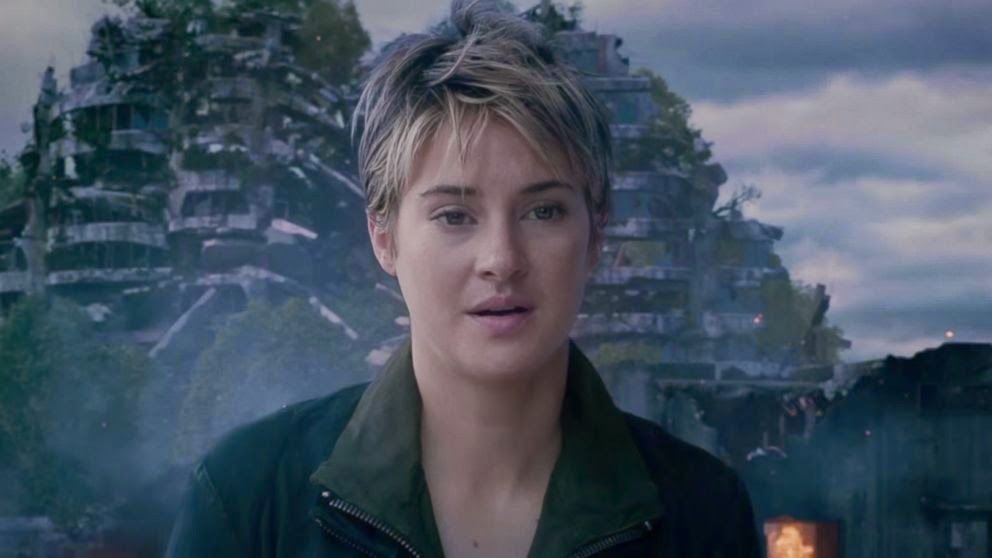
Jupiter Ascending: Mila Kunis Is a Queen, Channing Tatum Has Cool Boots

Mila Kunis heads off to space in the Wachowskis' "Jupiter Ascending"

You have to hand it to Andy and Lana Wachowski: They don’t do things halfway. The Matrix was a heroic work of maniacal vision, but even their lesser movies, like the vibrantly colorful Speed Racer and the cockamamie, sporadically delightful Cloud Atlas (which they co-directed with Tom Tykwer) felt like products of artistic aspiration rather than dutiful commercialism. Now they return with Jupiter Ascending, a grandiloquent space opera that attempts to fuse the galaxy-trotting mythology of Star Wars with the familial treachery of Shakespeare. It is a labor of love, with emphasis on the labor. Like all of the Wachowskis’ films (with the exception of their first feature, the taut, terrific crime thriller Bound), this one strains for greatness; unlike their early catalog, it is ultimately weighed down by its own leaden seriousness. An enormously ambitious undertaking, Jupiter Ascending glistens with flop sweat, and you can sense the frantic desperation of its creators. It’s a valiant effort, which is another way of calling it a noble failure.

Not a typical one, though. There is far too much visual splendor and painstaking world-building on display here to dismiss Jupiter Ascending as yet another trifling, noisy, wannabe franchise-starter. After a ludicrous prologue set in Russia, we begin on a faraway planet, where Kalique and Titus Abrasax (Tuppence Middleton and Douglas Booth), two royal siblings dressed in finery, talk idly about the colonization of distant worlds. They are interrupted by their elder brother, Balem (a campy, scenery-munching Eddie Redmayne), who appears suddenly by stepping through a shimmering void in the air. The three speak in the thin politeness that masks bitter jealousy, and their social hierarchy is made clear when Titus casually asks Balem if he might consider parting with one of his more valuable properties. “What’s it called? Earth?” Read More

Maps to the Stars: Where Satire Meets Schlock

Mia Wasikowska and Julianne Moore in David Cronenberg's "Maps to the Stars"

David Cronenberg is a profoundly talented filmmaker, and he’s never made a normal film. But originality isn’t itself a good, and as gifted as Cronenberg may be, his ability to heighten the natural language of cinema—to create movies saturated with intrigue and weirdness—can work both ways. When he starts with a strong premise and an intelligent screenplay, he can make operatic marvels like The Fly, A History of Violence, and Eastern Promises. But give him a leaky script and false characters, and his instinctive intensity will only magnify the material’s flaws, resulting in stultifying dreck like Crash, Spider, or Cosmopolis. It’s this innate capacity for augmentation—for blowing up a picture to gargantuan size—that makes Cronenberg perhaps the worst possible choice to make Maps to the Stars, a half-baked Hollywood satire that gradually morphs into a tacky horror movie. With a less capable director, Maps to the Stars would have been little more than a harmless bore. Under Cronenberg’s lurid stewardship, it’s a fascinating atrocity.

The movie begins as a disorienting blur, introducing us to its major players and forcing us to discern their connections ourselves. We meet Agatha (Mia Wasikowska), a burn victim clad in a black dress and matching elbow-length gloves, who arrives in Los Angeles and immediately hires a chauffeur, Jerome (Robert Pattinson, who headlined Cosmopolis), to whisk her to the homes of various celebrities. Then, we’re suddenly inside one of those homes, where 13-year-old Benjie (The Killing‘s Evan Bird), a Justin Bieber-like child star, speaks lewdly with his mother, Christina (Olivia Williams). His father, Stafford (John Cusack), appears briefly and babbles about Tibet, then disappears to engage in a bizarre training session—an apparent combination of massage and hypnotherapy—with Havana (Julianne Moore), a hysterical actress with severe mommy issues. Read More

Focus: Will Smith and Margot Robbie Are Light as Air, But the Plot Is All Fumes

Will Smith and Margot Robbie in "Focus"

A breezy, sexy, ultimately empty crime caper, Focus is a victim of its own sleight of hand. It is so intent on hoodwinking its audience and disguising its characters’ motivations that it doesn’t entertain so much as tease, constantly taunting us with one version of events before yanking out the rug again and again. It’s the kind of movie where nothing is what it seems. That does make things unpredictable, since no viewer could possibly anticipate Focus‘ sudden twists and hairpin curves. But following this movie’s labyrinthine structure becomes less a tantalizing task of puzzling things out than a tedious exercise of wait-and-see. When you’re constantly on guard for the next big surprise, nothing is truly surprising.

Here’s the good news: For its first 40 minutes or so, Focus is a blast. The ageless Will Smith stars as Nicky, an inveterate con man who decides to tutor Jess, a fledgling pickpocket played by the fast-emerging Margot Robbie (last seen heating up the screen in The Wolf of Wall Street and set to appear next summer as Jane in Warner’s Tarzan reboot). They make a pretty pair, he with his relaxed handsomeness, she with the pale blue eyes and curves that need no introduction. Their difference in years may consternate some viewers—at 46, Smith is nearly twice the age of the 24-year-old Robbie, and his goatee now betrays the slightest whispers of grey—but his charisma hasn’t waned, and it’s easy to buy the mutual attraction that quickly leads them tumbling into bed. It’s a romance that operates on surface appeal rather than real heat, which proves problematic once Focus tethers its twist-and-turn plot to the notion that Nicky, typically such a cool customer, has fallen desperately in love. Read More

Kingsman: The Secret Service—Making Violence and Stupidity Look Cool

Colin Firth tutors Taron Egerton in "Kingsman: The Secret Service"

The centerpiece of Kingsman: The Secret Service, a happily idiotic action comedy from Matthew Vaughn, takes place in a Kentucky church. As a bigoted preacher spouts fiery rhetoric to his eagerly racist flock—including an undercover spy played by Colin Firth—an invisible toxin is released, infecting everyone in the pews with a bloodthirsty savagery. For the next five minutes, the church turns into a carnival of death, with the parishioners murdering one another with any and all weapons available (guns, knives, grenades, organ pipes), until only Firth’s impeccably dressed secret agent is left standing. It’s a sequence that sounds nightmarish, but it plays almost like a musical number, with limber choreography and a rollicking tempo. All that’s missing is the “applause” button.

Welcome to the world of comic-book writer Mark Millar, an execrable place of severed limbs, exploding heads, and casual misogyny. It’s the kind of cinematic universe where the hero saves the world, then rewards himself by having anal sex with a Scandinavian princess. Cool, right? OK, maybe not. Yet as loathsome as Millar’s worldview may be, adaptations of his work can at least carry a certain charge, even if it’s not the provocative kind that Millar would wish. That’s especially true when the man doing the adapting is Vaughn, a nimble and fast-moving filmmaker whose fleetness allows him to faithfully recreate Millar’s orgies of revulsion without lingering over their repellent implications. Take that scene in the church. From any sane perspective, it is thoroughly grotesque. But Vaughn stages the horrific spectacle with such alacrity and flair that, as the camera swoops and soars and the blood spurts everywhere, you may find yourself tapping your foot to the rhythmic slashing of arms and the symphonic spray of bullets. Read More

Oscars 2014 recap: “Birdman” soars, “Boyhood” slips, and Neil Patrick Harris flops (and Sean Penn cracks wise and ill-advised)

Birdman director Alejandro G. Inarritu

So how were this year’s Oscars? It depends on which part of me you’re asking. As a movie fan, they were intriguingly democratic—each of the eight Best Picture nominees walked away with at least one statuette—even if I was disappointed in the Academy’s choice for its top prize. As a show business fan, they were pretty awful, with a limp performance from host Neil Patrick Harris and a draggy first two-and-a-half hours that were only marginally redeemed by some strong speeches on the back end.

But as a prognosticator, they were pretty good. I went 17-for-21 this year (81%), a dip from last year’s career-best 19-for-21 performance, but still reasonably impressive given the relative unpredictability of this year’s slate. (Translation: I couldn’t just check off Gravity for one-third of this year’s races.) My success, as always, was the combination of painstaking research and dumb luck. I’ll take it.

Read More