Knock at the Cabin: Whoever Wins, They Choose

Dave Bautista, Abby Quinn, and Nikki Amuka-Bird in Knock at the Cabin

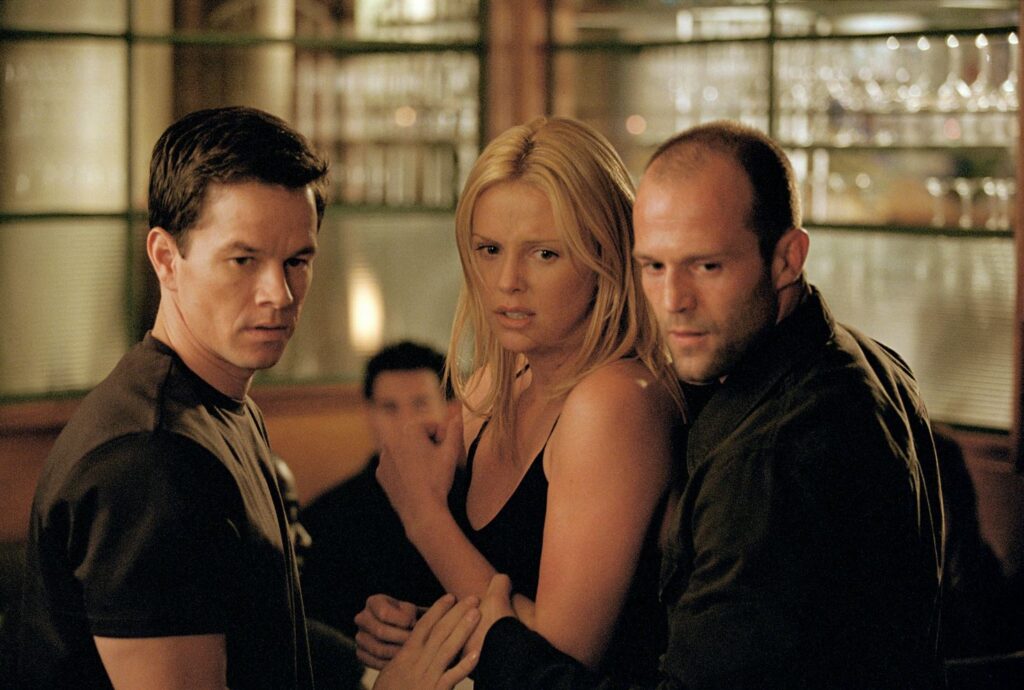
In one of the many tense sequences in M. Night Shyamalan’s The Village, a young woman implores a housemate to shut the door before a malevolent force breaks through: “Don’t let them in!” That same pleading desperation permeates the opening scenes of Knock at the Cabin, Shyamalan’s new thriller, which finds a vacationing family—an adorable seven-year-old named Wen (Kristen Cui) and her two fathers, Eric (Jonathan Groff) and Andrew (Spoiler Alert’s Ben Aldridge)—under sudden assault from a quartet of armed, menacing invaders. But where The Village cultivated a tone of suffocating suspense (what will happen?), the mood here is instead one of clammy inevitability. The trespassers break through the cabin’s fortifications with minimal resistance, quickly tying up our heroes and establishing that the movie will not unfold as a typical home-invasion yarn. Sure, you may briefly wonder whether the victims will use their collective guile to escape (did someone just mention Chekhov’s gun?), but mostly you ponder why the intruders are there and—once you learn that answer—whether there is any legitimacy to their stated purpose.

Ever the economical storyteller, Shyamalan answers the first of those questions in a matter of minutes. (Even he isn’t as efficient as the film’s trailer, which naturally divulges the entire plot.) The housebreakers—led by gentle-giant Leonard (a very fine Dave Bautista), who’s joined by the fretful Sabrina (Nikki Amuka-Bird), the timid Adriane (Abby Quinn), and the surly Redmond (Rupert Grint, currently starring on the Shyamalan-produced Servant)—behave according to a peculiar, seemingly contradictory code. On the one hand, they are obviously threatening, with their crude weapons (mallets, picks) and their grim determination. Yet despite their forcible entry and disturbing fervor, they insist—with apparent honesty—that they aren’t there to hurt anyone. Rather, they solemnly inform their captives that unless the family sacrifices one of its own, the world will end. And to prove the truth of their purported prophecy, they will ritualistically kill one of their own until the prisoners—watching helplessly, and goosed by ensuing television reports of global bedlam—resolve to make an impossible choice. Read More

Infinity Pool: The Excremental Tourist

Alexander Skarsgård in Infinity Pool

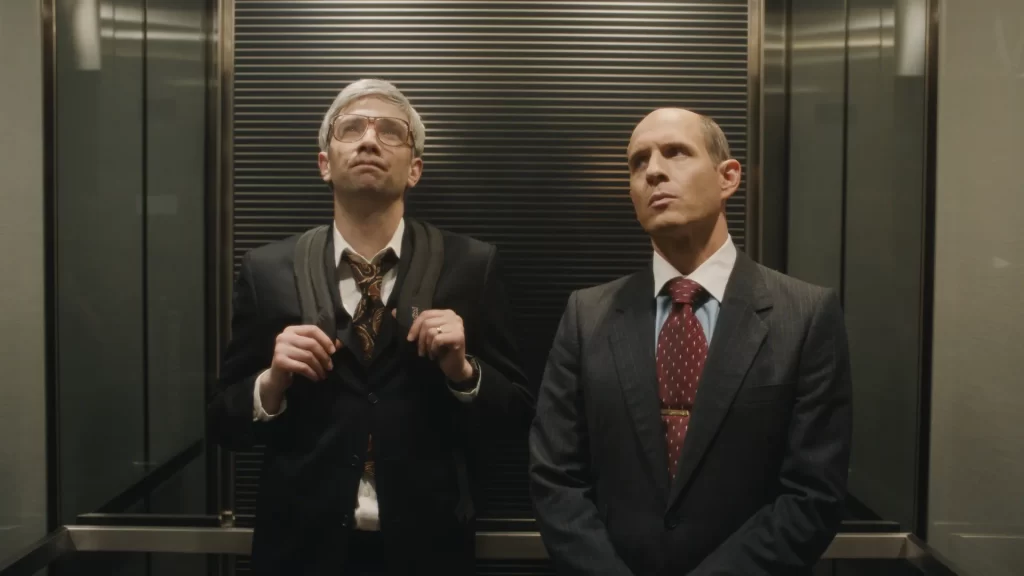
If Brandon Cronenberg is anxious about being compared to his father, he’s doing a good job hiding it. His prior feature, the art-house hit Possessor, leveraged the metamorphic gifts of Andrea Riseborough (newly minted Oscar nominee!) for a sordid story of corporeal invasion and existential agony. Now he returns with Infinity Pool, a wild and grimy phantasmagoria full of damaged bodies and deranged images. It may lack the deceptive polish of his pop’s best work, but it rivals him for sheer nastiness.

This is a matter of theme as well as form. In broad terms, Infinity Pool is a crude satire of white privilege and colonialist prerogatives. It’s set in the fictional country of Li Tolqa—filming took place in Croatia and Hungary, but the looming specter of “rainy season” suggests Southeast Asia—which attracts tourists with its opulent resorts and sandy beaches, but which someone ominously describes as “uncivilized.” The movie’s premise, which stirs echoes of last year’s Dual (and also The Prestige), revolves around a particularly perverse kind of black market: When interlopers break the law and find themselves subject to the third-world nation’s draconian justice system, they can evade punishment by paying the authorities (embodied by a louche Thomas Kretschmann) a hefty fee to manufacture a double—a perfect recreation endowed with their memories as well as their appearance—who will then suffer the death sentence in their stead. The only catch (OK fine, there are lots of catches) is that they must bear witness to their doppelganger’s execution. Read More

Women Talking: Hide and Speak

Ben Whishaw, Rooney Mara, and Claire Foy in Women Talking

If you think the title of Women Talking is bluntly descriptive, wait until you hear the perspective of Neitje (Liv McNeil). Fifteen years old and perpetually frustrated, she takes stock of the surrounding proceedings—a nonstop parade of feminine discourse and verbiage—and groans, “This is so boring!” It’s a wry meta moment that also (ahem) speaks to the unenviable difficulties facing Sarah Polley, the gifted and empathetic director who has chosen, for her first feature in a decade, to adapt the popular novel by Miriam Toews. That title is no lie; this is a dialogue-driven movie with limited action (the catalyzing incidents occur offscreen) and minimal plot. The challenge for Polley, who also wrote the screenplay with Toews, is to invest what’s primarily a verbal exercise with cinematic verve and dramatic urgency.

If she doesn’t exactly succeed, she has at least answered Neitje’s complaint with guile and skill. Women Talking is hardly kinetic, but it’s paced briskly enough to stave off accusations of sluggishness. If anything, some of Polley’s editing techniques—rather than deploying typical flashbacks, she frequently inserts random, lightning-quick cuts to prior brutalities (blood smeared on walls, bruises dotting legs)—are too abrasive to be boring. These moments tend to be more distracting than disquieting, and they don’t so much jolt the story to life as disrupt its fluid rhythms. Still, Polley evades point-and-shoot banality, and some of the film’s artistic choices—the desaturated color scheme that looks like the camera is fighting through a scrim, the rippling guitar-plucked score from Hildur Guðnadóttir, the ominous overhead shot of wagons pushing past onlookers in white straw hats—lend double meaning to an early title card that reads, “What follows is an act of female imagination.” Read More

M3gan: Hell Comes to the Dollhouse

Amie Donald as M3gan

They say the eyes are windows to the soul, which is why the most expressive anthropomorphic characters in cinema—E.T., Gollum, Wall-E—all sport wide, soulful peepers. But windows work both ways. In M3gan, the sly and spry new horror-comedy directed by Gerard Johnstone, the titular android gazes out into the world through a pair of delicate grey-blue irises, less concerned with comprehending her internal essence than with mapping her external environment. Her vision is rendered like that of an eerily empathetic cyborg—when she sees a person, she instantly analyzes their “Emotional State” and assigns quantitative ratings to various feelings (trust, joy, fear), like a talent scout grading an athlete—but she’s doing more than just gauging behavioral patterns. She is constantly downloading new data and feeding it into her processor, which means she’s learning, judging, evolving.

How, you might wonder, will such a creature ultimately regard our society? Then again, you might not wonder that, because if you’ve seen any previous entry in the child-doll subgenre of horror, you already know. Yet while M3gan’s predictable plotting rarely deviates from its predecessors’ silly and shrieky playbook, it is nevertheless a thoroughly enjoyable diversion—smart, funny, and even a mite provocative. Read More

The Whale: Fat’s All, Folks

Brendan Fraser in The Whale

The first time we see Charlie, the protagonist of Darren Aronofsky’s The Whale, he’s masturbating to pornography on his couch. You might think that such a recreational pursuit would grant him enjoyment, but Aronofsky stages the scene with sober, funereal gloom. The lighting, by the cinematographer Matthew Libatique, is dark and muted; the music, by Rob Simonsen, is swollen and sinister. Charlie’s breathing is ragged, and the intensity of his effort presumably stems from his weight—a gargantuan 600 pounds. His obesity, we instantly realize, has plunged him into deep despair, such that even a ritual of pleasure has become a labor of misery.

Aronofsky is no stranger to depicting anguish, and Charlie shares with the director’s other heroes—the feverish addicts of Requiem for a Dream, the haunted dancer of Black Swan, the panicked housewife of mother!—an essential helplessness. Typically, Aronofsky amplifies this level of torment by wielding his own restless energy and rambunctious filmmaking imagination, but The Whale requires a more restrained approach. Based on a play by Samuel D. Hunter (who also wrote the screenplay), it’s an intimate chamber drama, set in a single location (Charlie’s Idaho home) and featuring minimal action or excitement. Read More