Video games are designed to be played. Movies are meant to be watched. This distinction has thwarted many filmmakers who have attempted to translate the button-mashing activity of the console to the seat-reclining passivity of the multiplex. So when I say that Resident Evil, Zach Cregger’s new adaptation of the 30-year-old Capcom franchise, is probably the best video game-inspired picture I’ve ever seen, I’m not bestowing an especially high compliment (nor am I working with a significant sample size). As with many members of its subgenre, it’s deficient on (har har) multiple levels: organizationally repetitive, emotionally thin, and thematically vacant. But it does thread a delicate needle, paying tribute to the aesthetics of its source medium while also operating like a bona fide movie.
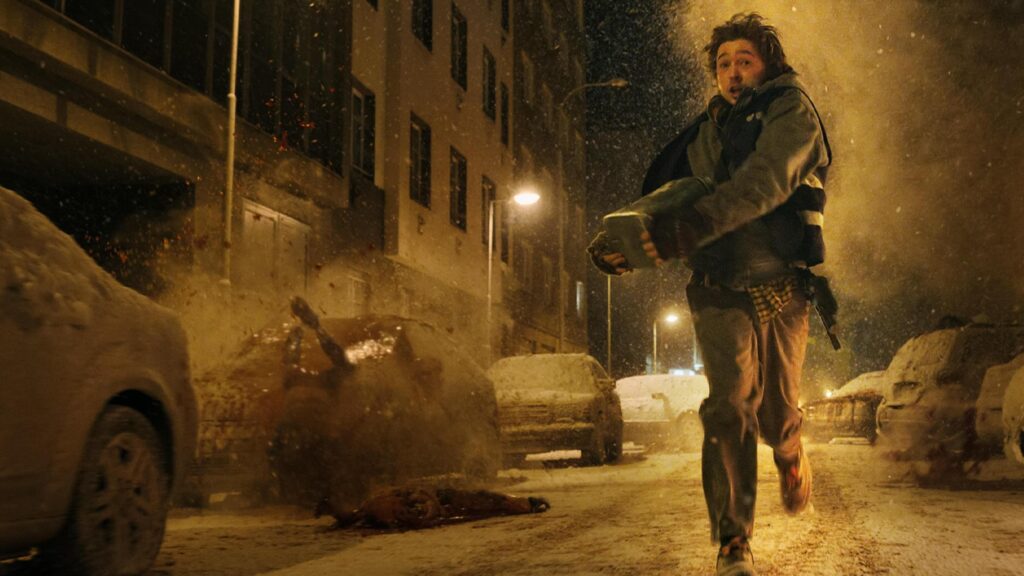
This is a matter of both structure and style. The plot of Resident Evil, which Cregger wrote with Shay Hatten (John Wick: Chapter 4), functions as a straightforward mission narrative. On a dark and snowy night, Bryan—a slow-witted courier played with dim-bulb charm by Austin Abrams—is tasked with delivering a precious medical artifact to the fictional metropolis of Raccoon City. His seemingly simple quest quickly escalates into a series of fraught, life-or-death predicaments as he arms himself with various weapons and is menaced by supernatural foes. These challenges, which broadly present an increasing degree of difficulty and culminate in a final confrontation (though the identity of the big boss may surprise you), tend to be logistical: climb a ladder, unlock a door, scale a building. You can practically see the life meter in the top corner of the screen.
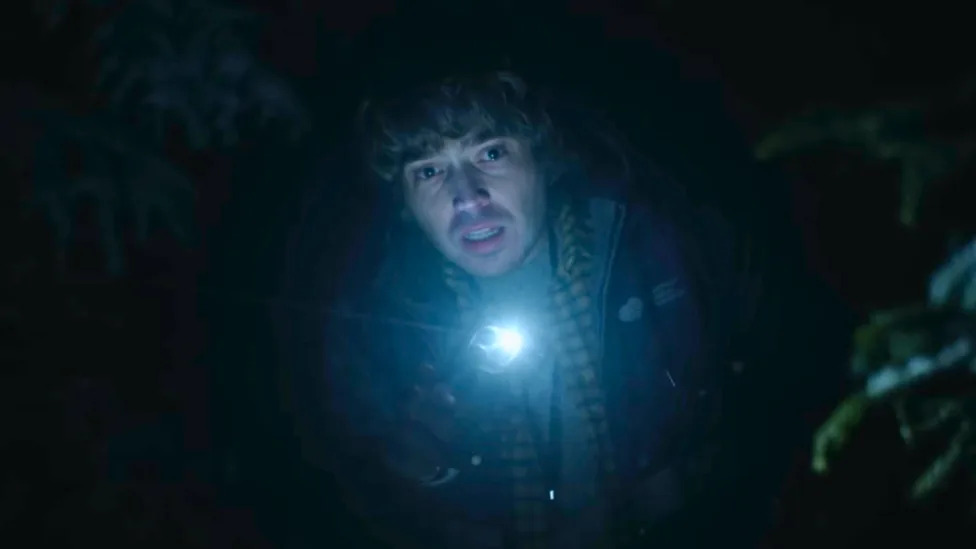
Cregger visualizes this dynamic with a combination of cheeky wit and silky craft. Working with the cinematographer Dariusz Wolski (The Last Duel), he routinely replicates the first-person shooter look of classic games like Quake and Half-Life; once Bryan obtains a shotgun, its barrel is often half-visible at the bottom of the frame, the camera conveying the character’s field of vision. At the same time, Cregger provides a cinematic polish, with smooth follow shots, clean framing, and thoughtful lighting. Resident Evil is a movie full of ghastly images—corpses fusing into monstrous amalgamations, rats bursting out of orifices, Paul Walter Hauser wearing a suit—but it nonetheless unfolds with a kind of perverse beauty.
Cregger’s persistent competence stands in marked contrast to his protagonist, a bumbling doofus who is the virtual antithesis of a conventional action hero. Bryan seems like a decent guy, but he’s woefully ill-equipped for the perils that await him, constantly cursing as he struggles with simple tasks like unchaining padlocks or loading ammunition. He’s less the star of a video game than a garden-variety schmuck, and Abrams, who had a small but crucial role in Cregger’s Weapons, helps ground this fantastical picture with his hapless realism and comic self-deprecation. “I fucking suck at guns!” Bryan laments after another episode of poor aim, and it’s those moments of Joe-Schmo despair—along with Abrams’ credible goofiness and terror—that lend the movie its soul.
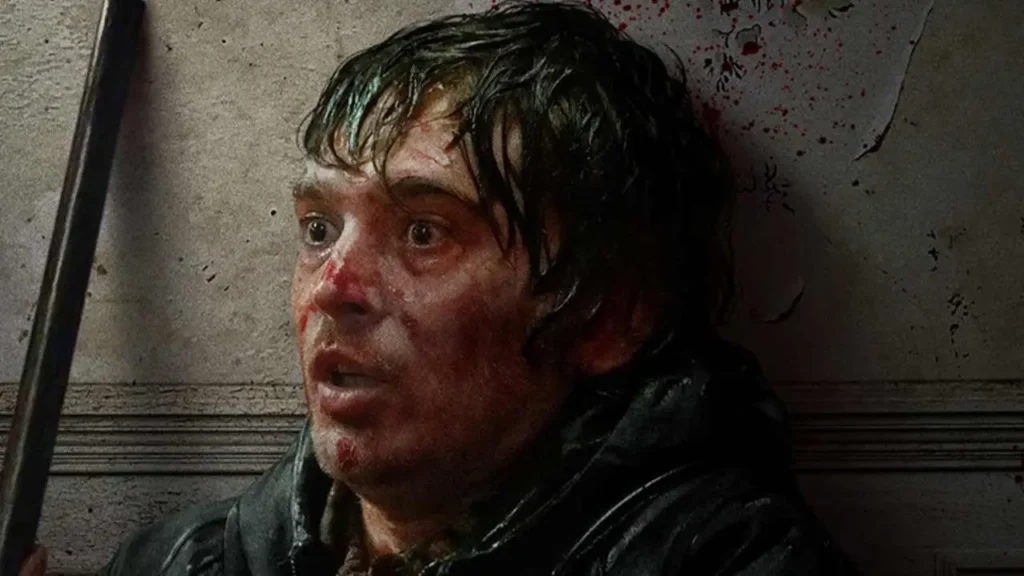
Or at least what passes for one. The story of Resident Evil is unapologetically linear—Bryan evades a frenzied dog in a barn, grapples with an infected girl in an RV, dodges acidic vomit in an elevator, etc.—but for all its momentum, it acquires little in the way of depth. (Bryan does fumble a critical phone call with his unseen girlfriend, then later leaves an ostensibly affecting voicemail, but these fleeting instances can’t create real poignancy.) This makes it both rewardingly unpretentious and also—in the context of Cregger’s nascent, highly promising career—something of a disappointment.
Cregger’s prior two features as writer-director were Barbarian, which revitalized the haunted-basement trope with new juice, and Weapons, which did the same for the everyone-is-connected gimmick while also gesturing toward intriguing ideas about violence and aging. They were both tightly constructed, spookily entertaining thrillers; they were also both wholly original. Resident Evil isn’t unduly beholden to its inspiration—for the record, I’m largely unfamiliar with the franchise’s lore, never having played the games and only having watched one of the prior films, Apocalypse (I recall nothing except Milla Jovovich kicking unholy amounts of ass)—but it nevertheless carries a whiff of artistic compromise, suggesting the work of a director who’s tailoring his considerable talents to embedded scripture rather than creating something truly new.

Perhaps this is just what happens now for cogs in the Hollywood machine: You make a few head-turning novelties, then you use your newfound recognition to acquire a bigger budget and merchandise a beloved piece of intellectual property. Not everyone can be Jordan Peele or Christopher Nolan. (Hell, as terrific as The Odyssey may be, it is arguably the granddaddy of IP translations.) And again, Resident Evil strikes the balance quite nicely, as Cregger exhibits obvious affection for his source without falling through the trapdoor of undue reverence. But in stylishly transforming the programmed rigidity of a video game into the streamlined urgency of a horror movie, he has also curtailed his own ambition.
Resident Evil still holds your attention until its climax, which—paradoxically—surrenders the schematic POV and considers the perspective of new figures. These scenes of anonymous characters hiding and shrieking are the movie’s most familiar, and most tedious. They also symbolize the enterprise’s broader shortcomings. Resident Evil is a deftly made, eminently watchable adaptation of a popular video game. But for all its technique, it lacks a compelling point of view.
Grade: B-

Jeremy Beck is the editor-in-chief of MovieManifesto. He watches more movies and television than he probably should.