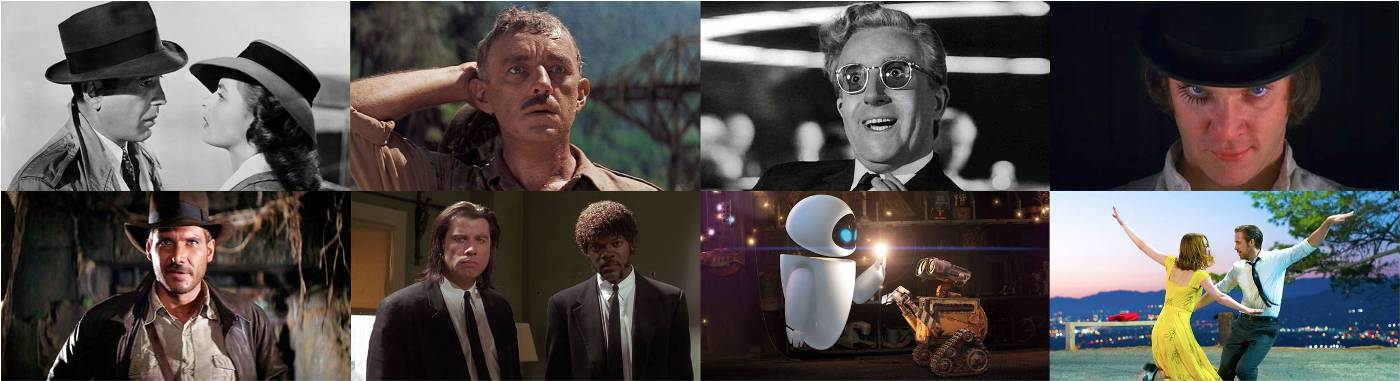
The best performances of the 2000s

Lists are idiotic. I love them.

O.K., so I know that’s one of those glib contradictions that invariably results in eye-rolling, but it really does represent my paradoxical attitude toward lists, at least when it comes to ranking works of art. In a sense, lists are an extension of star ratings because they provide a hard-and-fast method of numerical comparison; movie #7 is ranked higher than movie #8, so therefore, movie #7 is better by definition. And this notion, taken in its purest form, is simply farcical. The reason I’m so staunchly opposed to grading movies with star ratings (for the record, I hereby solemnly vow that you will never see a star rating at the Manifesto) is that I firmly believe that the notion of assigning a quantitative value to a work of art is profoundly stupid. I recognize that one of the primary functions of a critic is distillation – we’re supposed to condense our thoughts on a two-hour movie into a reasonably short, readable piece that concisely and clearly represents our overall opinion – but there’s a line between summing things up in a handful of paragraphs and just picking a number that mystically functions as a conclusive evaluation. Adherents of the mechanism will stress that star ratings supplement the text of their review instead of merely substituting for lucid writing, but how many readers, when given the option, choose to skip the words and glance at the number? It’s the easy way out.
Read More

The king of the world shows us a magnificent new one in Avatar

Perhaps the most breathtaking moment in James Cameron’s Avatar – a movie that takes the breath from its awestruck audience with startling regularity – occurs roughly 45 minutes into the film. It introduces us to Neytiri, a blue-skinned warrior with amber-gold eyes and a supple 12-foot frame. Perched gracefully on a tree branch, Neytiri has spotted an intruder (who happens to be Jake Sully, our story’s hero), and she moves silently to eliminate the threat. Pulling her bowstring taut, she is poised to strike when, suddenly, something catches her eye: a wispy, jellyfish-like organism, floating delicately in midair. The ethereal life form drifts toward Neytiri, eventually settling on the tip of her arrowhead. Neytiri, for reasons unknown to us at the time, takes this as an admonition of her combative instinct; she lowers her bow, and Jake Sully is allowed to live a little longer.

This is a beautiful scene. It takes place in complete silence (with the exception of James Horner’s soft, reverent score), yet it constitutes a moment of both exquisite suspense (what will happen?) and slack-jawed wonder (just what are these creatures?), plus it effectively advances the movie’s story. But the scene is particularly noteworthy because it is possible – indeed probable – that none of what we see was ever actually filmed, instead constructed within the confines of a computer. (I use the word “confines” loosely, as Avatar suggests that any alleged boundaries of computer-assisted filmmaking may in fact be illusory.) Yet watching the scene unfold, I never for a moment questioned the authenticity of Neytiri, the tree branch, or the wispy creature. I was simply transfixed on what was happening, wondering who this Amazonian was and why she suddenly refused to kill.
Read More

A moping moon, but some light still shines through

“It was pretty terrible. I really enjoyed it.”

 
That was me, one year ago, on the phone with my father, giving him my brief and not entirely rational assessment of a little movie called Twilight, which has now become America’s latest mega-franchise – the second installment, New Moon, raked in a cool $142.8 million this past weekend, good for third all-time behind The Dark Knight and Spider-Man 3. And while I’m impressed (and more than a tad awed) at the remarkable commercial success of the Twilight films, I have to admit that I’m a little confused as well.
 
Mainstream movie nut that I am, I’m generally a sucker for the studio-manufactured charms of a big-budget, multi-volume, special-effects-laden blockbuster franchise, but I can’t confess to being a devotee of the Twilight saga. Maybe that’s because it isn’t marketed to my demographic (I am not, in fact, a lovesick teenage girl, despite my occasional indulgence in emotionally devastating female-empowerment pop music). More likely it’s that I haven’t read Stephenie Meyer’s books (partly because I hardly read anything these days, partly because even Meyer’s ardent fans seem to concede that the novels are poorly written). But most of all it’s that, in all honesty, I don’t think the Twilight movies are very good.
 
Read More

A child imagines wild things, shrouded in mystery

“I’m expecting your review of Where the Wild Things Are in my inbox by noon tomorrow.”

That was my buddy Brian two days ago, and while he wasn’t offering me a salaried position at a major newspaper in exchange for my commentary, I was nevertheless pleased to learn – as I always am – that someone wanted to know my particular opinion of a film. But he wasn’t the only one. A number of people I know have expressed enthusiasm about Spike Jonze’s adaptation of Maurice Sendak’s beloved book, including those who are rarely enthused about movies.

Of course, this sense of intrigue isn’t unique to my personal sphere of contact; box office estimates pegged Where the Wild Things Are to earn $32.5 million this weekend, which places it eighth all-time among movies opening in October (ignoring inflation). This is, if you’ll pardon the pun, a rare beast. Oftentimes, when intrepid directors resolve to transform a classic childhood text into a movie, audiences tend to grumble. (There’s a reason Encyclopedia Brown has thus far failed to decipher the map to the multiplex.) Yet for whatever reason – perhaps a savvy marketing campaign (the trailer made excellent use of Arcade Fire’s “Wake Up”), perhaps a viewing public starved for an imaginative work – the standard outcry that often accompanies the transfer of a landmark literary work to the screen has in this case been replaced by exuberant anticipation.
Read More

“Right when he got it in the door.”

(Warning: The following post contains heavy spoilers for the sixth episode of this season of “Mad Men”. If you watch the show, ensure you watch the episode before reading.)

Yesterday, my buddy Pat asked me if I’d watched this week’s episode of “Mad Men” yet. Due to a confluence of obnoxious circumstances, I ashamedly admitted that I hadn’t. He then encouraged me to watch as soon as possible, suggesting it might be the best episode in the show’s’ history. “Mad Men” being one of the best television programs of the modern era – and Pat being a notoriously harsh critic – this was no small claim.

Now, I believe that when people hear from a reputable source that a certain piece of art (movie, TV show, book, etc.) is “can’t-miss” per se, they’re subject to a curious combination of heightened anticipation and gnawing anxiousness. Expectations are obviously raised, but there inevitably comes a nagging sensation that those expectations somehow aren’t being met – not because the art isn’t actually providing a strong level of entertainment or pleasure, but because there’s a voice in the back of your mind asking, “Should I be enjoying this even more?”.

So upon hearing Pat’s news, I got quite excited, and I have to confess that for the first 40 minutes or so of the episode, I kept wondering if I might be missing something. (This is in no way a rebuke toward Pat – I may be spoiler-crazy, but I have no issues with someone who simply expresses his enthusiasm. Really.) It wasn’t that I wasn’t enjoying the episode (I certainly was); it was just that I was waiting for it to distinguish itself from the rest of the season’s exceptional caliber.

And then the secretary ran over the British guy’s foot with a lawnmower.

I mean, wow.

Read More