The End of the Tour: Talking About Writing, and Other Demons

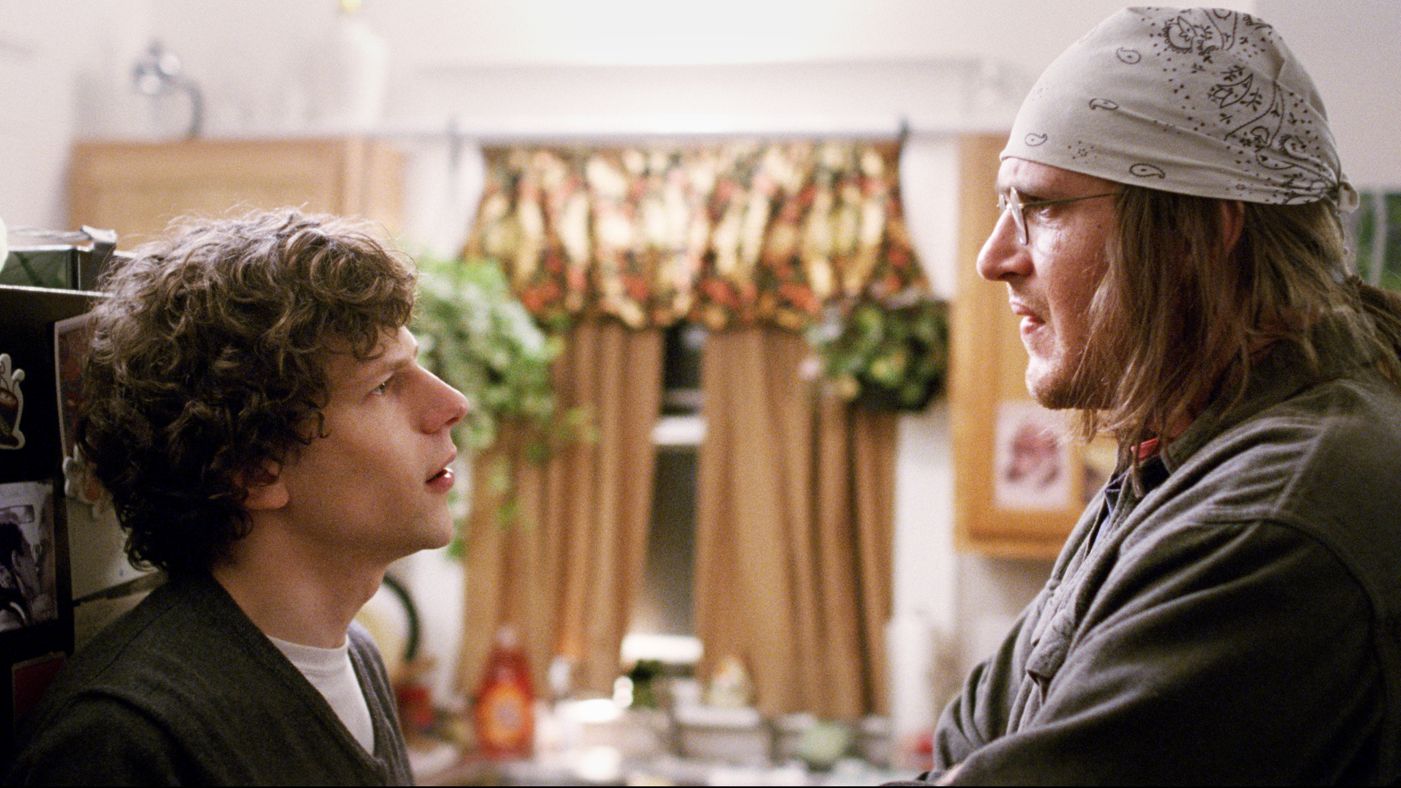
Jesse Eisenberg and Jason Segel talk (and talk) in "The End of the Tour"

Writing in the New York Times in 1996 about Infinite Jest, the magnum opus from David Foster Wallace, the critic Jay McInerney wrote, “While there are many uninteresting pages in this novel, there are not many uninteresting sentences.” I feel similarly about The End of the Tour, James Ponsoldt’s compassionate, provocative, and occasionally dull recreation of the five-day period shortly following the release of Infinite Jest, in which Rolling Stone‘s David Lipsky trailed Wallace on his promotional rounds. It is not an especially kinetic movie, and if it is in no hurry to go anywhere, its luxuriant patience occasionally creeps into stasis. But it is also a sharply scripted and profoundly affecting character study, tenderly depicting two writers who are deeply committed both to their specific jobs and to the grander notion of composing meaningful words. Wallace and Lipsky both believed that their prose, as painful as it was to conceive, might actually mean something. The End of the Tour nobly honors their commitment, even if certain stretches of its narrative feel meaningless.

The movie opens in 2008, with a dumbfounded Lipsky (Jesse Eisenberg, even better than usual) learning of Wallace’s suicide, a tragic event whose dark shadow looms over The End of the Tour. It then flashes back 12 years, revealing Lipsky as a hungry and energetic young writer who keeps hearing about this rapturously received tome called Infinite Jest. Animated by both jealousy and disbelief, he scoffs at the reviews claiming that this mammoth novel heralds the arrival of the next Pynchon. Then he reads it. Not long after, he’s pleading with his editor at Rolling Stone to interview Wallace for a celebrity profile, and then he’s jetting off to snowy Illinois, hoping to reconcile this generation-defining book with the mere mortal who wrote it. Read More

Trainwreck: She’s a Downtown Girl, Living in a Man’s World

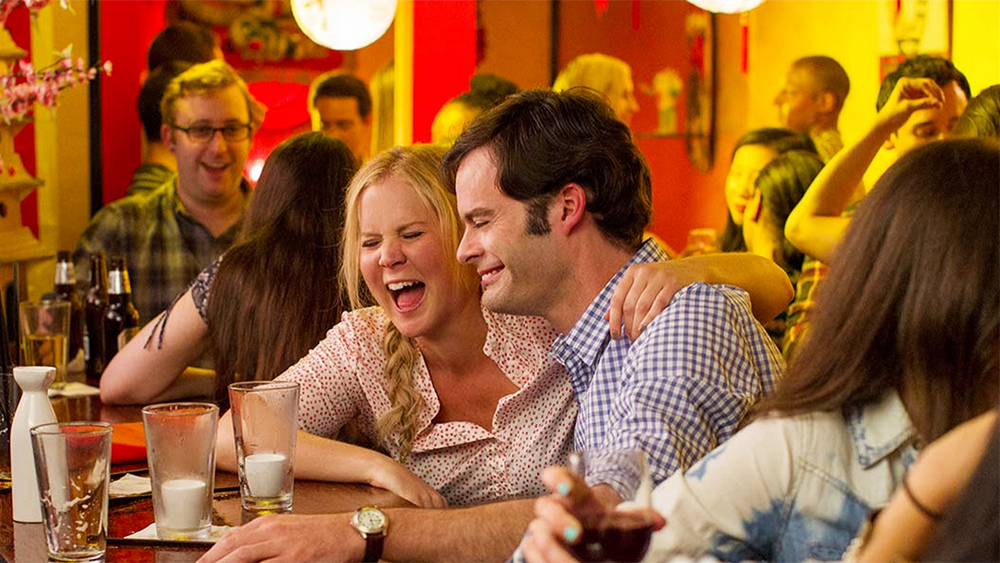
Amy Schumer and Bill Hader find love in "Trainwreck"

They may both tower over the modern comedy world, but Judd Apatow and Amy Schumer aren’t very much alike. Apatow’s works, particularly The 40-Year-Old Virgin and Knocked Up, are best known for the overgrown man-children at their center, but they’re also curiously wholesome and sweet. He relies heavily on crudity and profanity, but he does so in the service of a romantic ideal—the notion that love can conquer all obstacles and generate true happiness—that is pure, cornball formula. But Schumer is a deconstructionist. She has ascended to the apex of the comedy landscape precisely because of the way she obliterates formula, exposing stereotypes and upheaving convention. Trainwreck, which Apatow directed from a script written by Schumer, is the funny, fascinating, and somewhat frustrating attempt to reconcile these two disparate voices into a unified song. Like its protagonist, it is often at war with itself. And, like its protagonist, it is vulgar, confused, warmhearted, and generally a hoot to hang out with.

Schumer plays Amy (in case you doubted the story’s autobiographical bona fides), an unapologetically promiscuous boozehound whom one might call a slut or a female stud, depending on one’s level of sexism or enlightenment. The idea that women can be funny, frisky, and lewd should hardly have been a revelation in 2011, but it was novel enough to turn Bridesmaids (which Apatow produced) from a well-made, modest comedy into an outright phenomenon. Now, Trainwreck extends that sense of gender liberation to the bedroom. That’s where we first meet Amy, tumbling between the sheets with an anonymous schmo, extracting pleasure from him before feigning sleep to avoid the obligation to reciprocate. “Don’t judge me, fuckers,” she admonishes via voiceover. It’s an odd plea, given that she spends most of the movie judging herself. Read More

Dope: A Harvard Wannabe Gets a Thug Life Education

Shameik Moore gets in over his head in "Dope"

An early scene in Dope, Rick Famuyiwa’s highly entertaining mess of a movie, perfectly encapsulates the film’s tone. It features its protagonist, a black high school student named Malcolm (Shameik Moore), fleeing with his two best friends from a pair of Los Angeles gangsters. It’s a frenetic scene, with Malcolm and his pals riding pitiful bicycles while the thugs give chase in a roaring red El Camino. Then, as the desperate teenagers pedal across an overpass, the camera suddenly switches to a static wide-shot, revealing that the overpass is labeled, in austere capital letters, “Thurgood Marshall Justice Plaza.” That level of silent wit—the confidence to quietly slip in a reference to America’s first black Supreme Court Justice in the middle of a frenzied chase sequence—is indicative of Dope‘s sly sense of humor, not to mention its hectic, erratic sensibility. This mélange of styles and tropes is far too chaotic to be a great movie, but it’s precisely that sense of unruliness that makes it so much fun.

Dope initially scans as a lively satire of Boyz N the Hood, John Singleton’s seminal coming-of-age story about black youths growing up on hard streets in hard times. Malcolm, the son of a single mother, lives in The Bottoms, a crime-ridden district of Inglewood. His neighborhood is swimming in drugs and beset by gang violence (the red-clad Bloods are especially prominent), and he’s under constant threat of thievery or worse. Yet Malcolm, contrary to expectation, is neither a reprobate nor a victim. He is instead, as Forest Whitaker’s playful opening voiceover informs us, a geek. He dresses like a goofball, he rocks a ludicrous high-top fade, and he and his aforementioned friends, Jib (Tony Revolori, the lobby boy from The Grand Budapest Hotel) and Diggy (Transparent‘s Kiersey Clemons), are utterly obsessed with ’90s hip-hop culture. His top priority is not avoiding jail or scoring drugs—it’s getting into college, which is why he’s penned a singular application essay entitled, “A Research Thesis to Discover Ice Cube’s Good Day.” Read More

Love & Mercy: Picking Up Vibrations, Good and Bad Alike

John Cusack stars as one half of Brian Wilson in "Love & Mercy"

Being a musical genius must be hard. You hear harmonies no one else can hear, you struggle to communicate your vision to your band mates and studio bosses, and if you’re fortunate enough to be able to actually produce revolutionary music, your innovative advances often go unnoticed until they’re discovered by later generations. But making a movie about such a genius—conveying those enigmatic bursts of internal, auditory inspiration through the visible, visual medium of cinema—is similarly perilous. Love & Mercy, Bill Pohlad’s strange and sensitive biopic of the Beach Boys’ Brian Wilson, does not entirely conquer this challenge. Despite its whirring sound design and persistent effort, it never quite communicates the creative synapses firing within its protagonist’s big, drug-addled brain. But Love & Mercy is nevertheless a compelling portrait of artistic triumph and toil. It is also, more surprisingly, a touching romantic drama. It’s odd that a film about such an idiosyncratic man is at its best when it is at its most conventional.

That doesn’t stop Pohlad, working from a screenplay by Oren Moverman (director of The Messenger) and Michael Alan Lerner, from laboring strenuously to circumvent the customs of the genre. His most obvious and daring maneuver is to structure Love & Mercy as two separate mini-movies. In one, set in the mid-’60s, Wilson (Paul Dano) drifts from his brothers and colleagues while obsessing over the production of the Beach Boys’ seminal album, Pet Sounds. In the other, set some 20 years later, a mentally ill, overmedicated Wilson (now played by John Cusack, delivering his best performance in more than a decade) romances a Cadillac saleswoman, Melinda Ledbetter (Elizabeth Banks, radiant), and wilts under the yoke of his domineering psychotherapist, Dr. Eugene Landy (Paul Giamatti, bewigged and ferocious). Love & Mercy toggles back and forth between the two eras without any particular rhythm or formula. (Think The Godfather Part II, only, er, not quite as good.) It’s an engrossing approach that nonetheless fails to reap any real dividends; it’s fair to wonder how the film would have played in linear fashion, given that neither subplot clearly informs the other. Of course, that lack of causality between the two stories is arguably the point, which is why, in the abstract, Love & Mercy‘s jagged chronology makes sense. This is a fractured movie about a broken man. Read More

’71: Behind Blurred Enemy Lines

Jack O'Connell runs for his life in "'71"

There is scarcely a glimpse of true color to be seen in ’71, apart from the occasional piercing pop of Jack O’Connell’s sky-blue eyes. Yann Demange’s fumbling, gripping tale of a soldier trapped behind enemy lines, it takes place in a washed-out landscape of grimy greys, dirty browns, and burnt-out fire-orange. Unfortunately, that sense of abiding murkiness extends to Gregory Burke’s screenplay, which assembles a motley bunch of Irish gangsters and does little to differentiate them. But even if ’71‘s storytelling is muddled, its execution is consistently riveting. Directing his first feature, Demange has made a pulse-pounding thriller that demonstrates a bone-deep understanding of filmmaking suspense. It’s scary to think of what he could do with a more attentive script.

The latter two-thirds of ’71 are imbued with a feverish, exhausting tension, but it begins as something far different: a touchingly humane platoon picture. O’Connell stars as Gary Hook, a young private in the British Army who’s going through the usual grueling training regimen, running great distances with a rifle slung across his back before crawling through the mud. But his commanding officers, rather than peppering him with the typical accusations of worthlessness (think Full Metal Jacket), preach loudly and encouragingly about the virtues of teamwork. “Help each other!” one CO barks as Hook and his comrades attempt to scale a mock wall. It’s a seemingly straightforward command that ’71, as it descends deeper into desperation, distorts and refracts with chilling ambiguity. Read More