The two main characters in Toy Story 5 are named Joy and Anxiety. Wait, sorry, that was Inside Out 2. But like most outputs from the Pixar animation factory, the Toy Story franchise has always mingled childlike delight with gnawing apprehension. Its titular playthings, be they cowboys or spacemen or dinosaurs, perpetually worry about their charge’s well-being, to say nothing of their own potential obsolescence. They’ve battled maniacal prospectors and tyrannical bears and possessive dummies, but none of that has prepared them for their most daunting challenge yet: an iPad.
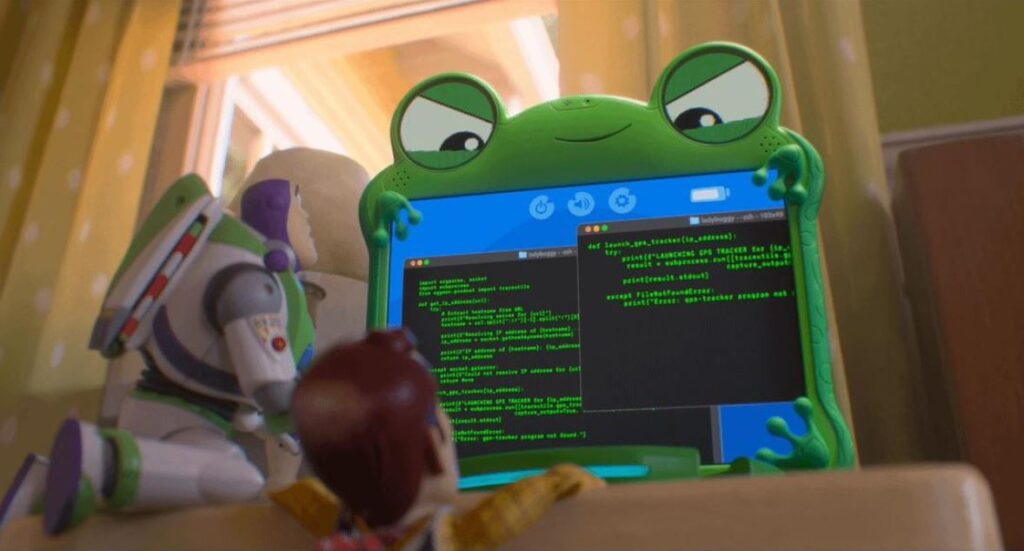
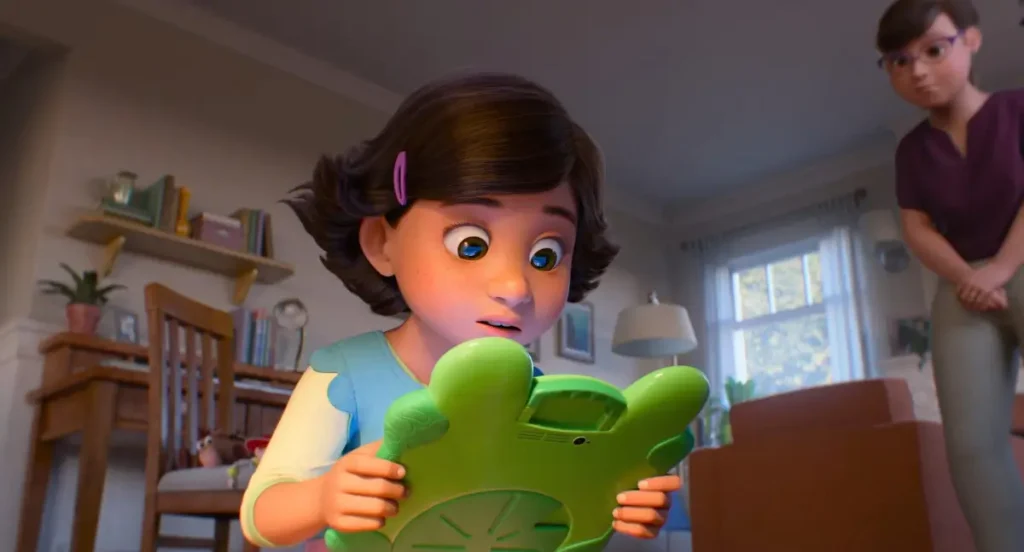
Technically she’s a smart tablet. Her name is Lilypad, as befits her glossy green bezel, but despite her smooth finish and smoother voice (as provided by Greta Lee), she isn’t here to make friends—at least, not with toys. Lily is the property of eight-year-old Bonnie (Scarlett Spears), the kindhearted, soft-spoken girl whom we first met in Toy Story 3, when she became custodian of the action figures and stuffed animals who previously belonged to Andy. Those relics have plenty of experience assimilating new arrivals—the thrust of Toy Story 4 involved Woody (Tom Hanks) looking after the freshly assembled Forky (Tony Hale), a misshapen utensil who was less interested in playing with children than diving into trash—but Lily represents a different sort of threat to their established ecosystem. She may have the same prime directive (ensure Bonnie’s welfare), but whereas our existing toys are products of spit-and-glue physicality, Lily operates in the digital ether, using her online functionality and programming savvy to connect Bonnie with screen-wielding peers. What is the labor of a sandcastle or the complexity of a racetrack compared to the ease of a group chat?
One of the marvels of the Toy Story films is how, even as they feature the same general set of characters and adventures (rescues, chases, escapes), they never seem to repeat themselves. Toy Story 5 arrives 31 years since Woody first mixed things up with Buzz Lightyear (Tim Allen), and it introduces a new set of practical and thematic concerns: namely, the increasing prevalence of technology in children’s lives. Bonnie is an imaginative little girl who enjoys playing with toys in the traditional sense, inventing elaborate scenarios—an early scene finds Forky marrying a fellow utensil (“I now pronounce you husband and knife!”), only for the wedding to be derailed by a mysterious poisoning—while performing most of the physical and verbal effort herself. This might sound like normal youthful behavior, but it proves to be an exception in Bonnie’s neighborhood, where the other kids spend most of their recreational time not actively handling toys but passively staring at screens.
This isn’t novel territory, not even for Pixar; Wall-E conceived of a paralyzing future where people had grown so accustomed to automated assistance, they could scarcely rise from their mechanized lounge chairs, while the villain of Incredibles 2 was called “the Screenslaver.” Yet Toy Story 5 still resonates, in part for how it links its distinctly modern unease with its eternal worries about parenting. Sure, the toys want to be a presence in Bonnie’s life, but they also just want what’s best for her, which is why they view the actions of Lily—who swiftly adds Bonnie to a text chain and helps arrange a meetup with three classmates who barely look up from their own tablets—with such despair. They’ve supervised and guided their ward for years, and now she’s yielding control of her life to some device?
The central conflict of Toy Story 5, which was directed by Andrew Stanton from a screenplay he wrote with McKenna Harris (also credited as co-director), is essentially a war between Lily and our old pals to captain Bonnie’s autonomy. That sounds a bit contradictory, but Bonnie herself is an unusual thing. The kids in this franchise tend to be vehicles of the plot rather than characters with their own personality; they like playing with toys, so the real issue is who gets played with, and how. But here, Bonnie’s very interest in toys gets thrown into question—she’s repeatedly mocked for her creative leanings and silly voices, causing tears on both sides of the screen—and the animators spend inordinate time on her face, articulating her shame and self-doubt. This sequel isn’t necessarily more humane than its predecessors, but it is more focused on its humans. (Well, on kids at least; the adults whom we glimpse remain generically agreeable parents who never seem troubled by toys that constantly disappear or reappear at random.)
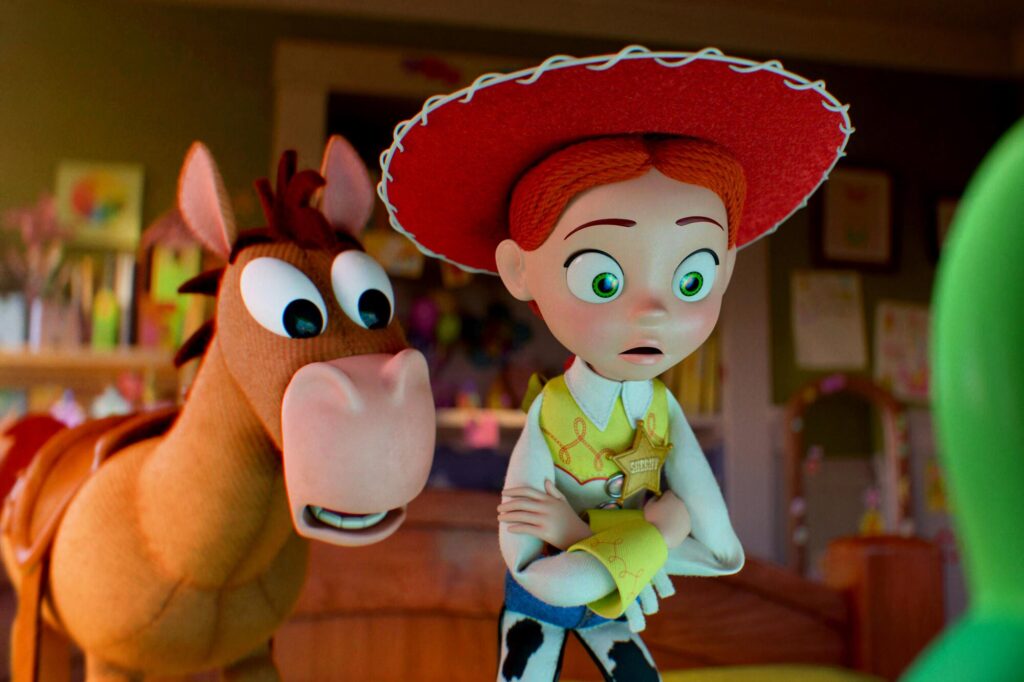
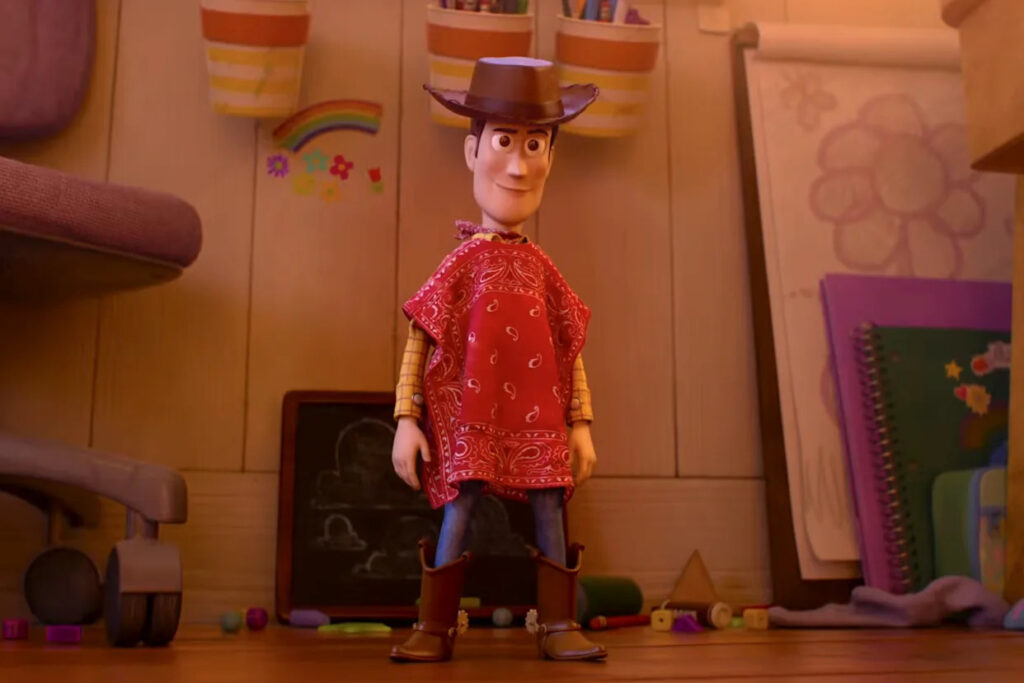
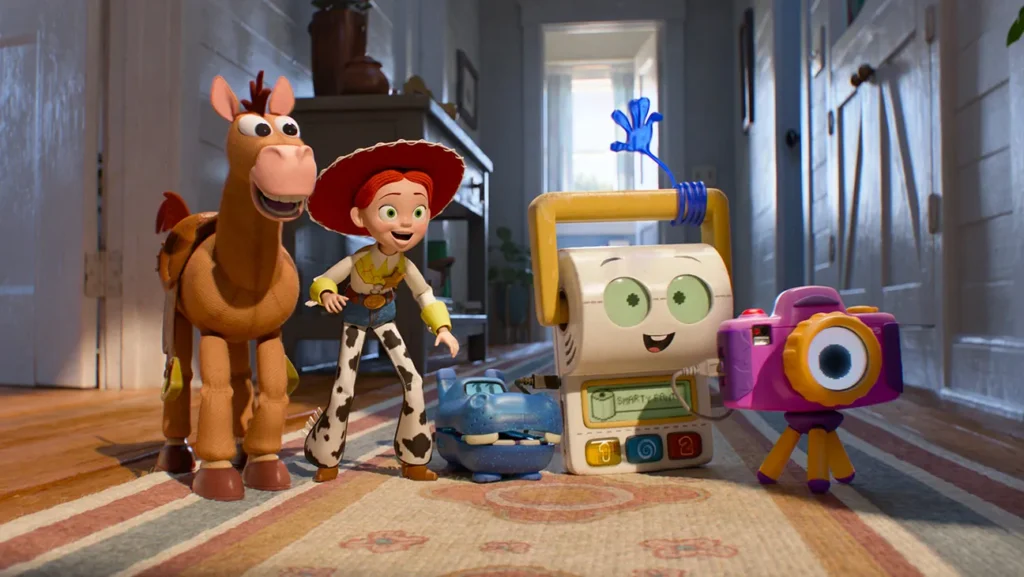
The toys, however, retain center stage, though a new hierarchy emerges. The primary hero of Toy Story 5 isn’t Buzz, who is vexed by a bout of romantic uncertainty (prompting questions of toyetic sexuality best left unanswered), or Woody, who ended the prior picture by venturing out on the road, and who has since aged into a venerable gunslinger, acquiring a poncho, a bald spot, and a beer belly. It is instead Jessie (Joan Cusack), the gung-ho cowgirl with an adorable silent horse called Bullseye. Jessie now proudly wears the sheriff’s star that once belonged to Woody; she has also inherited his mantle of leadership, along with a domineering insistence that she, more so than anyone else, is best equipped to safeguard Bonnie’s happiness.
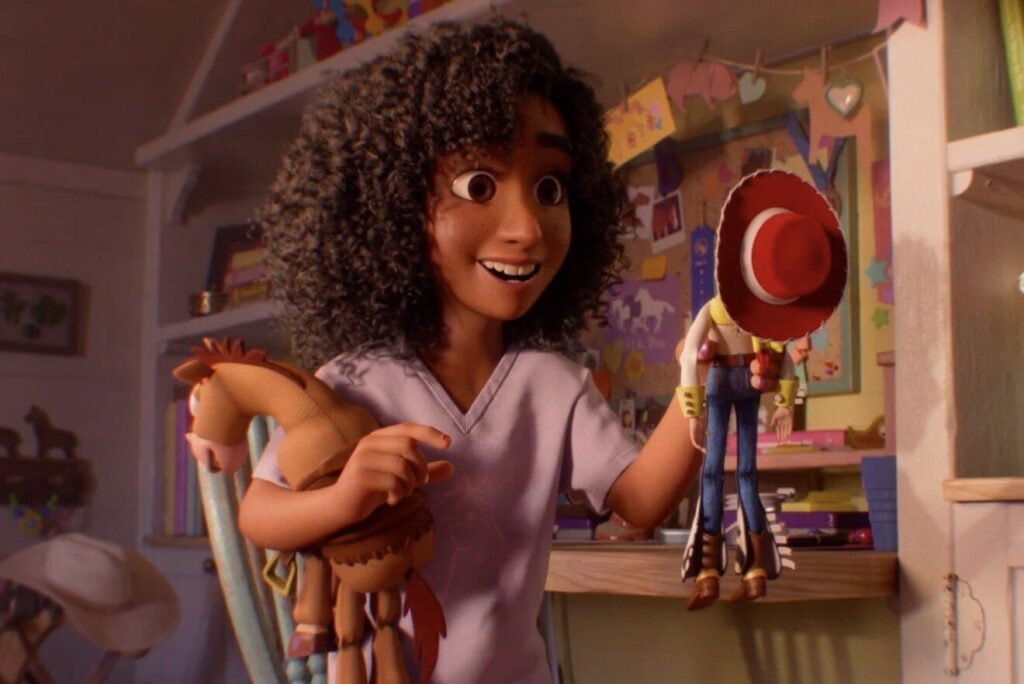
Stanton and Harris’ script deftly weaves together several separate narrative strands; one focuses on Woody and Buzz reconnecting and slipping into familiar antagonistic patterns (as Mr. Potato Head quips, “it’s good to see them fighting again”), while another tracks a lost fleet of Buzz Lightyear floor models using their newfangled gadgetry to escape a remote island and search for “Star Command.” But the story’s main thread centers on Jessie, who first accompanies Bonnie to a disastrous sleepover, then reckons with her own past by returning to the home of her very first owner. There, per tradition, we meet several new toys, here long-discarded contraptions from the pre-internet age: a digital camera (Shelby Rabara), a satellite-based GPS (Craig Robinson), and a handheld potty trainer with an inflated sense of self-importance (Conan O’Brien). More importantly—remember what I said about the movie’s focus on humans?—we encounter Blaze (Mykal-Michelle Harris), a cheerful young girl who owns a horse and a pig, and who shares Bonnie’s predilection for flights of fancy. Jessie clocks Blaze as a kindred spirit and, in a ploy that vaguely recalls The Parent Trap, resolves to unite her with Bonnie, envisioning a more genuine friendship than Lily’s engineered outings with those zombified classmates.
The specifics of these machinations, involving carefully timed photos and secretly manipulative messages, are more functional than exhilarating. There are some cute moments, in particular those involving the upgraded Buzz figurines (he’s no longer just falling with style), but the chases and leaps—a mad dash through an occupied house, a scramble on a roadway—unfold with limited ingenuity.
But for all their vroom-vroom energy, the Toy Story movies have never really been about action. They’re more about family—not just the agonies and ecstasies or parenthood, but the interpersonal connections that engender devotion, solidarity, and sacrifice. Jessie, even more than Woody, struggles with deep-seated abandonment issues—the pain that she told us about way back in Toy Story 2 has never really left her—and her journey here is affecting for the way it harmonizes her stouthearted loyalty with her more corrosive insecurities. Bonnie’s salvation is hers too.
This proves eye-catching as well as moving. The visual caliber of a Pixar production is invariably taken for granted, but Toy Story 5 is resplendent for its textural detail—the dots of Jessie’s hair, the folds of Bullseye’s coat—along with its fluid animation. Stanton, who previously helmed two of Pixar’s greatest pictures (Wall-E and Finding Nemo), has also concocted a new aesthetic for the in-universe hijinks, as Bonnie and Blaze’s toy-laden daydreams carry a fuzzy, heightened look, the better to emphasize their fantastical quality.
And therein lies Toy Story 5’s obvious irony: It’s a movie about the perils and pitfalls of technology—in this, it’s bizarrely reminiscent of Gore Verbinski’s Good Luck, Have Fun, Don’t Die—that is also a work of extraordinary technical proficiency. (Notably, those marooned Buzz figures are styled, “Hi-Tech Edition.”) The Walt Disney Company has spent hundreds of millions of dollars on a computer-animated blockbuster, complete with an end-credits song from Taylor Swift, and its message is for kids to stop looking at screens?
Well, sure. Movies, at their core, are rooted in the act of make-believe, and for all its vast resources, Toy Story 5 is by people as well as about them. (I am taking Pixar at its word that the filmmakers didn’t use A.I.) That’s why Bonnie’s earnestness is so poignant; she may just be a child, but she is also an ambassador of artistic creation. Kids grow up, life goes on, and even the shiniest toys get thrown away. But no matter how efficient and pervasive devices like Lilypad grow to be, they’ll never render the whimsical wonders of Pixar obsolete.
Grade: A-

Jeremy Beck is the editor-in-chief of MovieManifesto. He watches more movies and television than he probably should.