
Fifteen years ago, Nicolas Winding Refn improbably delighted audiences with Drive, a glittering, electronica-tinged jewel of a thriller about a wheelman mired in gangland savagery. Since then, the Danish provocateur has made three features, two TV shows, a handful of shorts, and few new fans. I haven’t seen all of Refn’s post-Drive output, but what I have watched—the films Only God Forgives and The Neon Demon, plus the Netflix miniseries Copenhagen Cowboy—suggests the work of a postmodern imp concocting some sort of experiment in anti-entertainment. With perverse pleasure, Refn assembles the raw materials of putatively interesting pictures—vivid colors, gorgeous actors, shocking violence—and then scrambles them into final products that are dreary and charmless. He seems to fancy himself the cinematic prince of darkness, but his movies are less devilish than simply dull.
Her Private Hell, Refn’s latest piece of feature-length trolling, isn’t without its surface diversions. As befits the studio that distributed it, it supplies a good deal of neon—bright bursts of pink and blue slashing through its literal and metaphoric fog. The production design is, if not exactly legible, at least striking, with jagged plinths and infinite spires. The costumes are eye-catching, in particular a seductive red leather coat that seems intended to inspire fetishism. The movie might be appealing if it weren’t so insufferable.

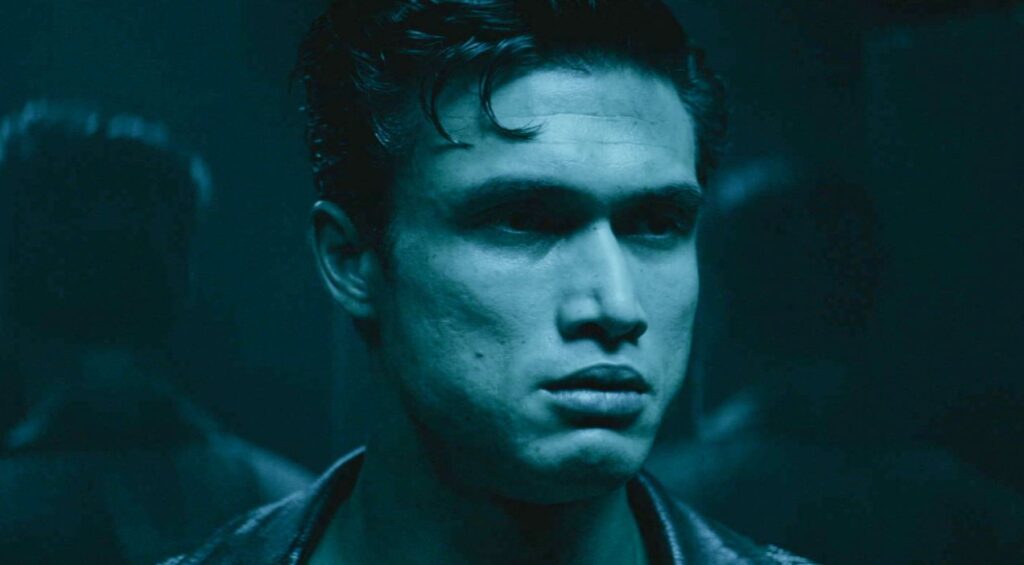
My quarrels with Refn’s work don’t lie exclusively with his obtuse storytelling, though it hardly helps. Any written summary of Her Private Hell risks ascribing logic to a narrative that is proudly, lazily incoherent. As best I can gather, Elle (Companion’s Sophie Thatcher) is a famous actress who’s just arrived on set to shoot a new science-fiction movie. (Her face is often bedazzled with tiny, shiny studs, presumably as part of her role’s makeup.) She’s staying at the aptly named Tower Hotel, a gleaming monstrosity with gilded elevators and vast beams that rise up from what may be the actual underworld. There she’s joined by Hunter (Kristine Froseth), a coquettish, fangirly co-star, and Dominique (Havana Rose Liu, served far better in Tuner), Elle’s conspicuously young stepmother. Elle’s father, who bears the happily ridiculous moniker Johnny Thunders (Dougray Scott), saunters in to provide some doomy exposition about a mythical villain called The Leatherman. Meanwhile, a bereaved American soldier (Charles Melton) prowls the streets of Japan, where he attracts the bloody wrath of a sumo wrestler and the suspicious eye of a detective.
Again, this esoteric setup might portend a measure of intrigue, at least in a vacuum. The problem with Her Private Hell is that it basically does take place in a vacuum, at least emotionally. It’s a work of dead air, a patchwork of haphazardly connected scenes that do nothing to develop the paper-thin characters or advance the nonsensical story. The actors are all attractive, but Refn’s screenplay (which he wrote with Esti Giordani) forces into their mouths pseudo-profundities that preclude them from giving credible performances. People fight and fuck and die, all with no apparent reason, and certainly with no suspense.
You might perceive all of this as some sort of mischievous joke—a winking deconstruction of genre fare. But as with most of Refn’s films, Her Private Hell is resolutely humorless, instead operating with a suffocating sense of self-importance. There is quite a bit of bloodshed and brutality, but Refn stages everything at such a remove that his nominal set pieces are turgid and inert. This again suggests an act of intentional withholding, as if the grand auteur is steadfastly refusing to imbue his material with any semblance of clarity or catharsis. Movies can be enigmatic, of course, but they still need to engross you; Refn prefers to alienate.

What passes for dramatic tension here is the strained relationship between Elle and Dominique, who may or may not be illicit lovers as well as professional collaborators. “I promise you, I will always be your evil stepmother,” Dominique coos, though she later rebuffs Elle’s advances. Score one for fauxcest fans, I suppose, but the characters’ desires and motivations are indecipherable. From one scene to the next, they pantomime lust and resentment in ways that carry no discernible connection. They aren’t people, just prettified objects.
Observing the vapid Hunter flinging herself at a leering older man, Elle asks Dominique, “How can someone be so attractive yet so unfuckable?” It may be a rhetorical question, but the answer is plain enough. Just watch one of Refn’s movies.
Motor City, the seedy new crime thriller from Potsy Ponciroli (Old Henry), is in most ways a more conventional, less experimental picture. It’s a tale of revenge and redemption, following familiar archetypes—the ex-con, the femme fatale, the corrupt cop—as they collide and do battle. For the most part, it’s nothing you haven’t seen before: a serviceable, forgettable programmer that might in the past have found a second life on cable TV. But there’s one unusual thing about it: Nobody talks.
OK, that isn’t strictly accurate. Over the course of Motor City, snatches of speech can be heard, and the characters themselves plainly engage in conversation. But Ponciroli, working from a script by Chad St. John, has conceived the movie to be virtually free of dialogue, instead telegraphing the characters’ emotions through image and sound. This approach isn’t unprecedented—recent feature examples include Kim Ki-duk’s Moebius and John Woo’s Silent Night, while both Buffy the Vampire Slayer and Mr. Robot dropped largely silent episodes on television—but it’s nonetheless quite unique for an American production.

That Motor City works as well as it does—that it reasonably engages on the levels of plot and character, rather than just operating as a self-indulgent flourish—is a testament to Ponciroli’s commitment and skill. Leveraging a loaded ’70s soundtrack that presumably sucked up 90% of his budget, he takes the visual iconography of film noir—a man in a black coat, a woman in a gold dress, a shiny engagement ring—and shapes it into a wordless but purposeful narrative. The most impressive thing about the movie is that in fact feels like a movie.
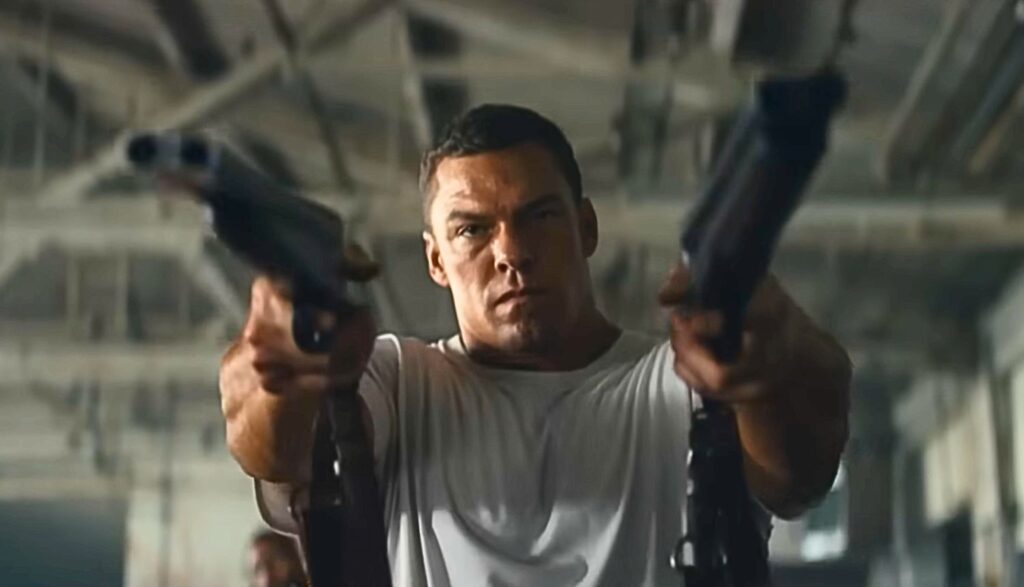
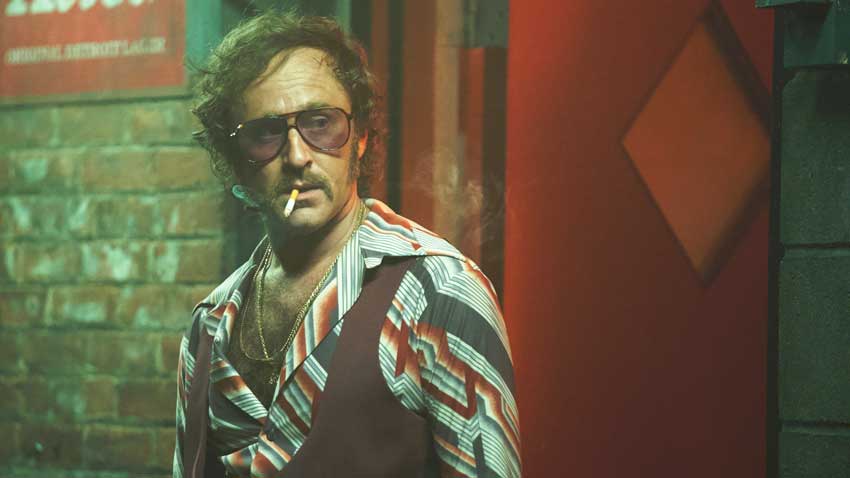
Not that its story is especially complicated. Played by the burly Alan Ritchson, Miller—we learn the characters’ names through scraps of evidence, like a nametag or a postcard—is a reformed criminal trying to make it on the straight and narrow. One night outside a bar, he meets Sophia (Shailene Woodley), a looker in search of a better life and also a cigarette. Sparks fly, but their blissful romance displeases her ex, Reynolds (Ben Foster), a gangster who conspires with an amoral detective (Pablo Schreiber) to frame Miller as a drug dealer and reclaim Sophia as his property. Considerable mayhem ensues.
The conceit of Motor City is fairly simple, but Ponciroli manages to infuse the setup with variety and freshness. Oftentimes, the movie plays akin to a music video, the characters performing their actions—hatching schemes, stealing cars, proposing marriage—in slow motion while accompanied by either classic songs (Fleetwood Mac, David Bowie, Donna Summer) or the insistent thrum of Steve Jablonsky’s score. (Detroit legend Jack White, who served as an executive producer, also cameos as a piano player in a restaurant.) On other occasions, the silence is diegetic, as when a floored Sophia sees Reynolds walk into her diner, then sizes him up for several minutes before finally whispering, “Hello.”

Woodley’s work in that scene—the shock, the hesitation, the resignation—is excellent. None of the characters in Motor City is well-developed, but she comes the closest to conveying genuine emotion and interiority, her thoughts and pain registering on her open face. Her male counterparts prove less persuasive. Ritchson, whose main qualification for playing Jack Reacher on TV appears to be his sheer size, arguably benefits from the film’s conceptual restriction (he’s forbidden from ever opening his mouth), but he still chiefly resembles a big block of wood. Foster and Schreiber mostly let their costumes do their work for them, though they at least look the slimy part.
As a brawling thriller, Motor City is mostly competent and occasionally imaginative; there’s an intense fight sequence in an elevator, while the image of a muscle car spraying gasoline on the pavement, soon to be ignited by a flicked cigarette, is arresting. Yet ironically, as the film leans harder into Miller’s obsessive quest for vengeance, it relinquishes its sense of novelty, instead proceeding as a generic John Wick clone. This is particularly true in its third act, when it abandons all pretense of humanity and becomes a one-note medley of carnage and killing. The finale purports to be a loud, hard-charging climax, but sometimes at the movies, action speaks softer than words.
Grades
Her Private Hell: C-
Motor City: B-

Jeremy Beck is the editor-in-chief of MovieManifesto. He watches more movies and television than he probably should.