Nobody else could have done this. I’m not suggesting that no other contemporary filmmaker could have adapted The Odyssey, which seems to get remade in some fashion every few years, officially or otherwise. But only Christopher Nolan possesses the requisite combination of vision and hubris to remold Homer’s classic poem into a movie so tailored to his thematic, aesthetic, and moral concerns. For a quarter-century, Nolan has built a distinctive brand of scrambled timelines, breathtaking innovation, and cornball romanticism; he’s cultivated his own mythology. Now he has the chutzpah to bring his singular artistry to bear on the granddaddy of all myths.
The results of his herculean labor (sorry) are both expected and surprising. In terms of scale, The Odyssey is a monumental achievement—a huge, exhilarating work of relentless energy and unimpeachable technique. Such an accomplishment shouldn’t be taken for granted, but it was virtually axiomatic the instant the projected was announced. What proves more striking is the movie’s gritty humanity. It’s an epic yarn of pillaging and seafaring, of gods and monsters, but its grandeur is engraved with punchy writing and credible emotions.
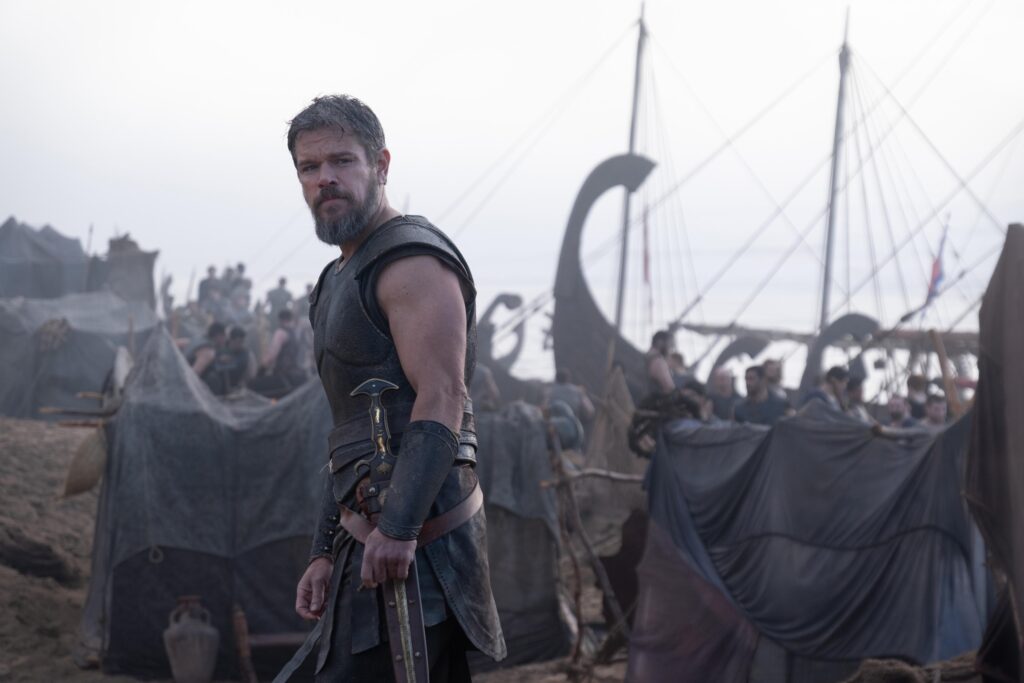
One of Nolan’s most interesting decisions is to use the vernacular, eschewing lofty rhetoric in favor of terse, snappy prose. There is a bit of cognitive dissonance, watching all of these sword-and-sandal-clad warriors talking like citizens of the industrialized world (American accents are the norm here), but that’s in keeping with a movie that grounds its fantastical wonders in earthy realism. Nolan has long been an underrated dialogue writer, and while The Odyssey is far from his funniest picture, it features plenty of sharp line readings. “He died helping us escape,” Odysseus (Matt Damon) says to subordinates who beseech him to perform burial rites for a fallen comrade; “we’ll honor him by escaping.” Later, a slain Greek soldier (Elliot Page) implores Odysseus to tell his father of his valorous exploits, concluding with a priceless petition: “Feel free to add some stuff.”
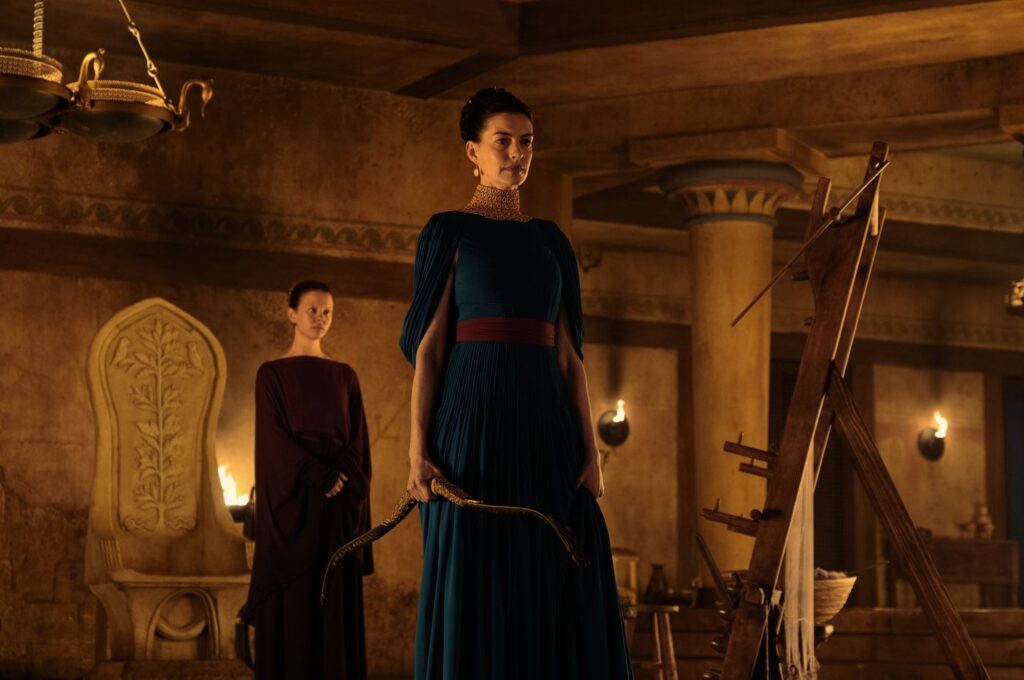
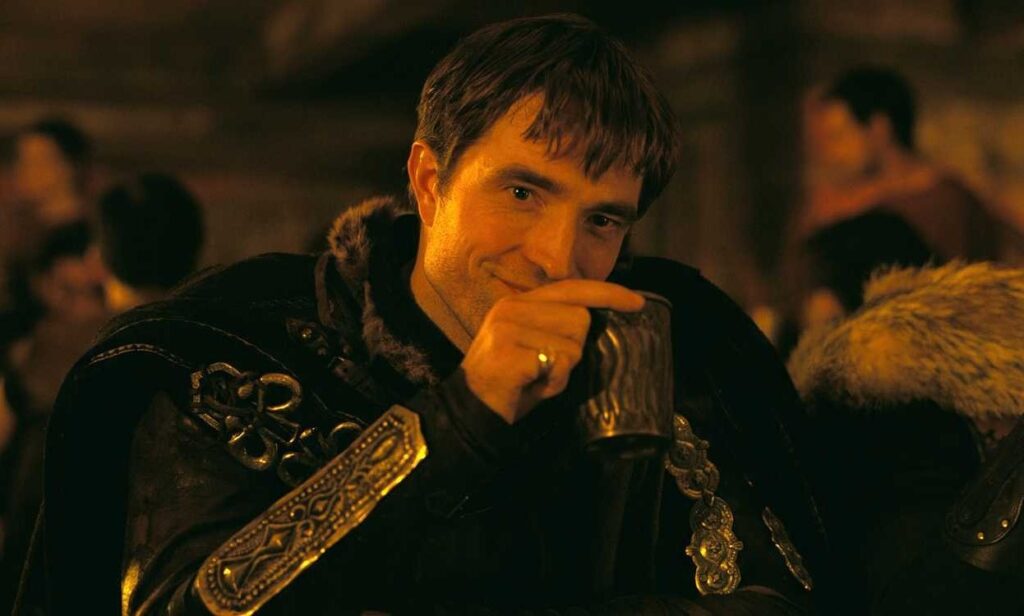
There is quite a bit of stuff in The Odyssey, though as a matter of adaptation, Nolan has done less adding than subtracting, excising certain subplots from Homer’s text and streamlining other episodes. The movie runs a healthy 173 minutes, but as with all of the director’s productions, it is expertly paced, always building but never tiring. (Ludwig Göransson’s persistent, constantly crescendoing score underlines this feeling of perpetual swell.) And while Nolan remains allergic to linear storytelling—unless you count Memento, which is scrupulously linear… in reverse—the narrative here is relatively straightforward, surveying conflicts on two fronts. On the shores of Ithaca, the queen Penelope (Anne Hathaway) and her son Telemachus (Tom Holland) wait and wait for Odysseus to return from the Trojan War, which ended 10 years prior; as their hope wanes, a rabble of suitors—most visibly the sneering Antinous (a terrifically slimy Robert Pattinson)—presume his death and demand that Penelope take a new husband and coronate him king. Separately, Odysseus—aided at times by Eurylochus (Himesh Patel), his half-loyal, half-skeptical first mate—faces an array of terrors, both mortal and supernatural, as he desperately tries to make his way home.
None of this will shock you, assuming you have even a passing familiarity with one of literature’s most famous tales. In terms of plot, The Odyssey progresses along a predetermined trajectory (though Nolan, ever the trickster, still manages to smuggle in a devastating late reveal). The movie derives its dynamism and its power not from what happens but how: the crispness of its performances, the vividness of its presentation, and the urgency of its themes.
Myths tend to be stories of heroes and villains, but while The Odyssey has plenty of good and bad guys, it muddies its black-and-white characterizations with streaks of grey—particularly in its title figure. Odysseus is plainly a smart dude—it’s his stroke of genius involving a wooden horse that finally ends the siege of Troy, after all—and he seems to be a decent captain, treating his men with fairness and respect. But his pragmatism is flecked with selfishness; his pride in taunting the Cyclops jeopardizes his crew, and when forced to choose between Scylla and Charybdis, he doesn’t hesitate to sacrifice a half-dozen sailors so that he retains the possibility of seeing Ithaca once more. He even resolves to listen to the Sirens’ lovely and deadly song, though Nolan cheekily doesn’t let us hear it, instead having Odysseus describe the melody to Eurylochus in a wistful, haunting monologue.
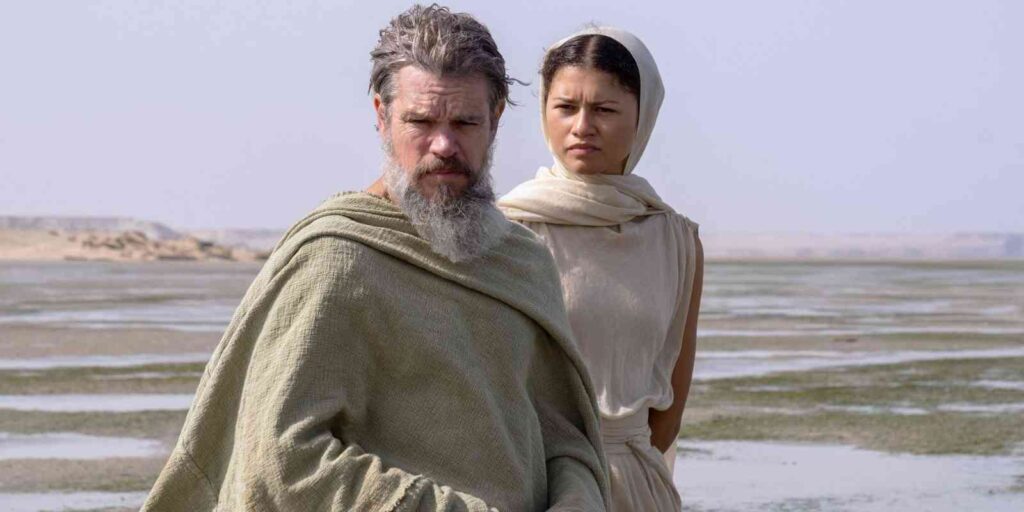
Damon delivers that speech with a spartan beauty that encapsulates his rigorous, rugged performance. For all its escapes and slayings and general mayhem, The Odyssey often finds its protagonist alone, stuck in place and racked with guilt. He carries with him two totems—one reminding him of Penelope’s devotion, the other of Antinous’ treachery—and is repeatedly visited by two different women: Athena (played by Zendaya), that multifaceted goddess who regards him with curiosity and gloom, and Calypso (Charlize Theron), the nymph who plies him with lotus flowers and offers him a peaceful alternative to his martial life. Heavily bearded and leanly built, Damon embodies the physical and emotional weight of Odysseus’ journey, making you feel (to paraphrase Indiana Jones) both the years and the mileage. He makes the mythical personal.
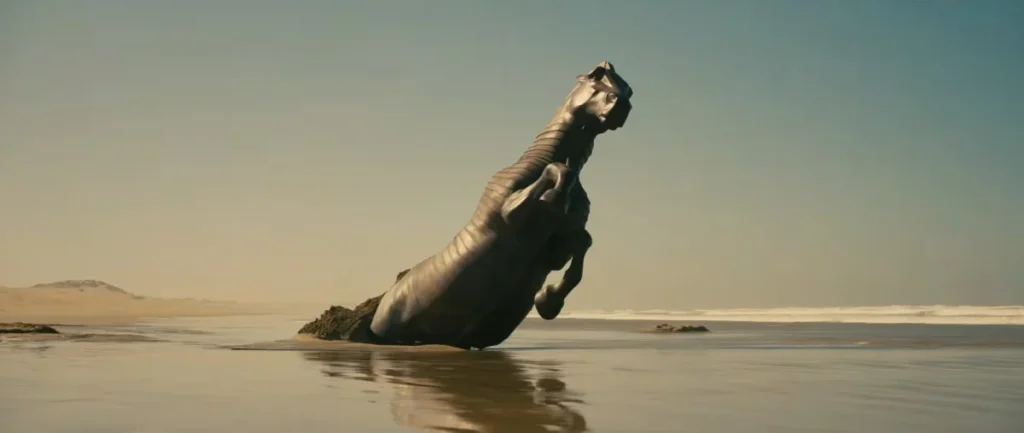
Not that The Odyssey skimps on spectacle. As a choreographer of action, Nolan isn’t as fluid as someone like Steven Spielberg or James Cameron—most of the fighting here is breathless and choppy rather than elegant and lucid—but as a purveyor of eye-popping blockbuster imagery, he is unparalleled (with no disrespect to Denis Villeneuve). Nautically speaking, the movie suggests an oppositional version of Dunkirk—whereas that World War II saga chronicled beached soldiers praying for deliverance via the water, this follows naval warriors scrambling to make landfall—but it mirrors that picture’s majestic maritime scope. Overhead shots of ships looking tiny amid the raging sea, or of Odysseus walking on a desolate shoreline, convey the enormity of his struggle and the relative puniness of his will. (Here I should probably mention that I watched the film projected in lustrous 70mm, albeit not in IMAX.) At one point, while trapped in a dank cave, a crewmember discovers that the Cyclops can talk and expresses surprise that the one-eyed beast never spoke to his captives, to which Odysseus replies, “Do you talk to ants?”; together, Nolan and his usual cinematographer (Hoyte van Hoytema) visually convey that sense of mortal insignificance—of mere men subjects to the whims of gods.
As compared to Odysseus’ oceanic adventures, the scenes set in Ithaca are more prosaic, shot in low light and trafficking in intrigue rather than excitement—at least until the final act, when the narrative’s disparate strands weave together in an electrifying display of cathartic violence. But while Nolan is hardly a feminist, The Odyssey improbably operates as a stinging rebuke of patriarchal entrenchment. Penelope—who frets about a potential invasion by “the people from the sea,” and who seethes that “only a man” can sit the throne—is a hostage in her own house, surrounded by men who perceive her as nothing more than a stepping stone for their own greed; Antinous, in particular, is a creature of shameless ambition, and Pattinson embraces the role’s conniving nature with delectable relish (he even seduces Mia Goth!). Meanwhile, when Telemachus seeks sanctuary in Sparta, he discovers that the beautiful Helen (Lupita Nyong’o) now sports a scarred face, a punishment inflicted by her husband (Jon Bernthal) because she had the temerity to leave him. Even the enchantress Circe (Samantha Morton), often depicted as capricious and cruel, here takes the form of a female avenger, transfiguring Odysseus’ men into pigs in order to demonstrate their true nature.
That last sequence is engaging but also faintly predictable. As was the case with Oppenheimer, I confess that I experienced a twinge of disappointment when I learned that Nolan was tackling such a recognizable story, rather than fabricating an entirely new concoction as he did with Tenet or Interstellar. (Or Inception or The Prestige. My man has made some awesome movies.) And as with Oppenheimer, my disenchantment turned to awe when I beheld how Nolan had embroidered such well-known material with his unique sensibility.
Again, this isn’t simply a matter of filigreed production design, though you will surely marvel at the finely carved wood and the feathered helms. (Ellen Mirojnick’s costuming of Benny Safdie’s Agamemnon, with its blue sheen and metallic braid, deserves its own museum wing.) The true greatness of this movie lies in how Nolan has imbued an ancient legend with new force, and also new sorrow.
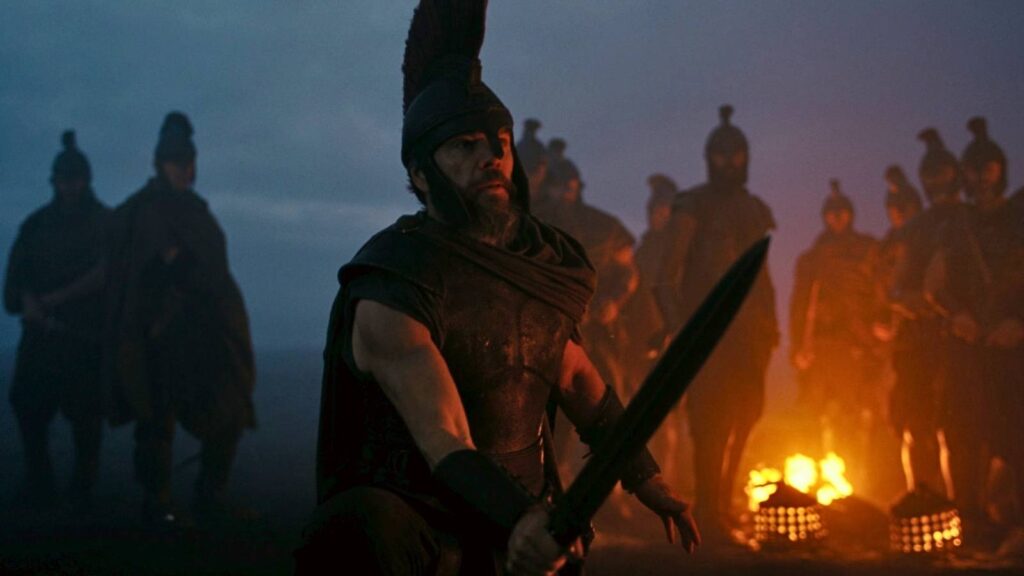
The centerpiece of The Odyssey is the sacking of Troy, which is shown twice. The first is a rip-roaring set piece, a thrilling display of kinetic energy that combines delirious momentum—the camera follows Odysseus at a sprint as he finally exits the horse, which he describes as reeking of piss and shit and drowning men—with hushed, fraught suspense. (It culminates in a glorious image: the city gates freshly opened to find Agamemnon standing in the center, regal and alone, only for hundreds of troops to suddenly come pouring in from behind him.) But the second is of an entirely different character, observing the Greeks’ militaristic slaughter with profound sadness. They say no war film can be anti-war, but I find it impossible to watch this sequence and perceive it as anything other than a vigorous condemnation of imperialist savagery.
An opening title card informs us that The Odyssey takes place in “a time of apparent magic.” Well, what is cinema if not a form of sorcery? Drawing on his prodigious talent and his estimable cast and crew (plus a few hundred million dollars), Christopher Nolan has conjured an emphatic and essential movie: arresting and impressive, yes, but also grave, poignant, and human. Homer’s poem may indeed be several millennia old. But the magic here is self-evident, and the time is now.
Grade: A

Jeremy Beck is the editor-in-chief of MovieManifesto. He watches more movies and television than he probably should.