
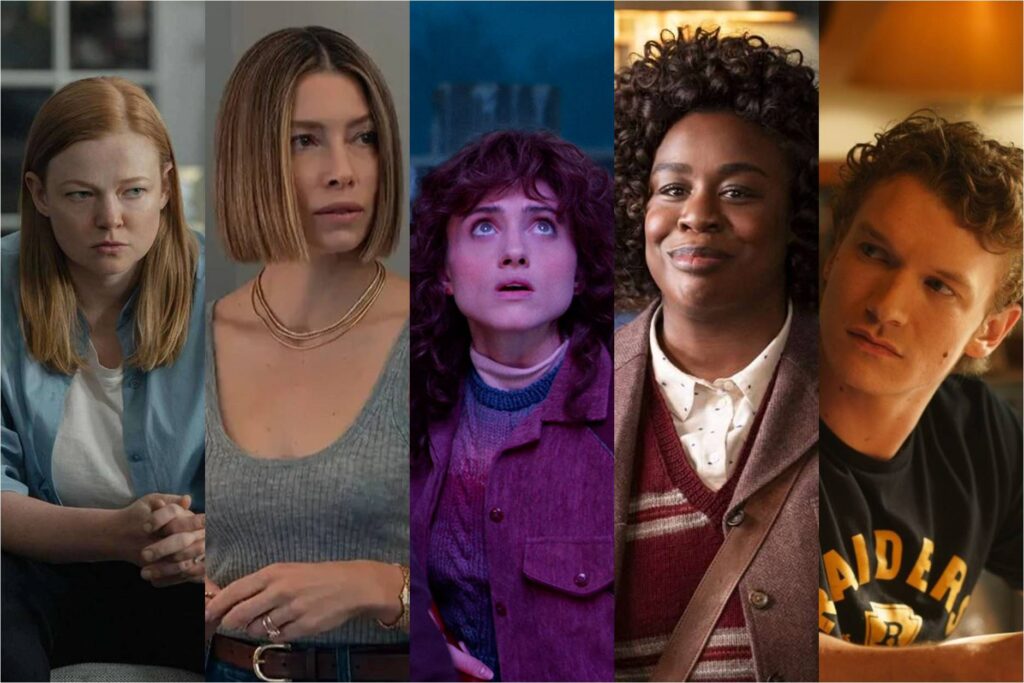
Our rankings of every TV show of 2025 march on. For previous installments, check out the following links:
#s 97-86
#s 85-71
#s 70-56
#s 55-41
40. Common Side Effects (HBO Max, Season 1). Strange one, this. It’s a quirky animated production that’s full of odd characters and absurd scenarios. It is also an impassioned indictment of the pharmaceutical injury, meaning it functions as a complex conspiracy thriller as well as a workplace satire. The fit can be ungainly, but Common Side Effects—much like Scavengers Reign, which co-showrunner Joseph Bennett also created—is distinctive and unique, firing off provocative ideas with confidence and ambition. It provides a rush, even if it won’t get you addicted.
39. Stranger Things (Netflix, Season 5; 2022 rank: 34 of 110).
38. Heated Rivalry (HBO Max, Season 1).
The zeitgeist doesn’t discriminate. It will come for you at random, whether or not you’re ready for it. These shows have nothing in common, save for how they swarmed popular discourse. In its bloated final season, Stranger Things is a far cry from the taut, heady adventure series (first released in 2016!) that mingled elements of Stephen King and Steven Spielberg. It’s an obvious victim of its own success, compelled to create a sprawling mythology that overwhelms its more intricate pleasures. And yet, the show still knows how to deliver a knockout set piece or three; if it’s often paralyzed by its own bigness, its sheer size also allows it to take some enormous, satisfying swings.
Is this what the future holds for Heated Rivalry? The short, spiky two-hander seems destined for bigger (if not better) things, given the startling amount of cultural cachet it’s accumulated. But to the extent its first season works—and not everything about it does—it’s thanks to the tightness of the writing and the intimacy of the characters. As a sports saga, Heated Rivalry isn’t remotely persuasive (I cringed whenever I heard an announcer say “Boston Raiders”), and certain plot points strain credibility. But as a love story, it’s moving and evolving, capturing the sweep of its leads’ emotions with empathy and grace. Throw in a potential star-making performance from Connor Storrie, and it has the heart of a champion, even if it ends up being a flash in the pan.
37. The Residence (Netflix, Season 1). My first litmus test for a murder mystery is that litmus tests are generally stupid. My second litmus test is that if all a whodunit makes you care about is the identity of the culprit, it has failed; the key is the investigation itself, and the personalities at its center. By that metric, The Residence mostly works. Fashioning the lead detective as a neurodivergent birder flirts with danger, but Uzo Aduba has the agility to pull it off, and the supporting cast is dotted with character actors who blend in rather than stick out. (Randall Park is particularly good as Aduba’s skeptical partner who inevitably comes to acknowledge her genius.) The show’s framing device is awkward, and its “Murder at 1600!” conceit pays limited dividends, but the story still operates with enthusiasm and momentum. Now if only the development of a body dropping in the White House could transform from fiction into reality.
36. The Better Sister (Amazon, Season 1).
35. All Her Fault (Peacock, Season 1).
Here we have two ostensibly trashy airport-novel adaptations that are a bit more sophisticated than they first appear. As a whodunit, The Better Sister is fairly pro forma, with the usual red herrings, false suspects, and cheap cliffhangers. But despite its padded running time, it holds your interest, thanks mostly to strong performances from Elizabeth Banks and Jessica Biel, who craft a sororal relationship that’s gratifyingly complicated—tense, warm, fraught, loyal. The series also touches on meaningful themes, in particular gender dynamics in marriage, and it integrates them into its suspense plot adroitly. It has a sleazy body and a thoughtful brain.
All Her Fault is even more of a smuggler. It initially presents as hybrid of a kidnapping thriller and a privileged melodrama, full of ghastly twists and frantic discoveries—Big Little Lies meets Gone Girl. But while it largely adheres to that template on a macro level, the series quietly pivots into a more intimate and disturbing character study, exposing the cracks beneath its heroes’ seemingly sturdy foundation. Sarah Snook understands the hysterical assignment, while Jake Lacy does a nice job spinning his White Lotus dickhead into a different, more slippery direction. (The purpose of Dakota Fanning’s presence is less clear, but it’s still nice to have her around.) The real achievement of All Her Fault lies in how it stealthily elides its own genre imperatives. It’s a missing-kid show where the fate of the child proves beside the point.
34. Wolf Hall: The Mirror and the Light (PBS, Season 2; 2015 rank: 31 of 62). The 10-year hiatus here makes the Stranger Things production schedule look punctual. But Wolf Hall is comfortable moving at its own pace, gliding through Tudor history with its own mix of crisp elegance, black humor, and quiet melancholy. A curtain of anguish hangs over this second season, in which Mark Rylance’s Thomas Cromwell reckons with his past misdeeds even as he scrambles to evade the king’s wrath. It’s nicely designed and strangely entertaining, in a “Those days sure were wild!” kind of way, but most of all it’s just sad. History will judge us all, and we will all be history.
33. Hacks (HBO Max, Season 4; last year: 2 of 88). Uh oh. Look, so long as Jean Smart and Hannah Einbinder are trading barbs while also fighting back against the comic patriarchy, Hacks will always be an enjoyable show. But in Season 4, it starts to calcify slightly, recycling old ideas and often spinning its wheels. That doesn’t nullify its pleasures; the actors are still sharp, the jokes are still funny, and the themes are still resonant. But it does make you wonder if the series has already maximized its potential, meaning it’s now sloping downward. Remember, this show started with the premise that Smart’s comedienne was in an artistic rut and needed to make a dramatic pivot. Sometimes, art catches up with itself.
32. Overcompensating (Amazon, Season 1). Yes, the look of 32-year-old Benito Skinner playing a college freshman isn’t great. And yes, the idea of structuring an entire show around the agony of being closeted in the year 2025 seems a bit dated. But straight from its opening line (“Hi, I’m Benny, I love pussy”), Overcompensating powers past any logistical concerns and succeeds as a warm and insightful campus comedy. Skinner may be too old for the part, but he’s an inviting presence, and he and Wally Baram have strong platonic chemistry. And even if the coming-out concerns feel antiquated, the series understands the paralyzing and pervasive nature of social pressure, which remains eternal. Boys will be boys, and frat bros will make you insecure whether you’re gay or not.
31. Outrageous (Britbox, Season 1). The key here is the tone. Outrageous tells the true-ish story of the Mitford sisters, two of whom went to Germany and, well, fell in with the wrong crowd (or maybe just embraced their true selves). A series set in 1930s Europe would seem destined to be dark, but while Outrageous is frank about the specter of encroaching fascism (then and now!), it’s also fizzy and fun, with lively writing and warmly sketched characters. (As the carefree but loving patriarch, James Purefoy is basically doing the exact same thing Dominic West did in The Pursuit of Love.) There’s an undercurrent of horror running through the show—look at these foolish aristocrats and their casual prejudices!—but it doesn’t spoil the jovial atmosphere. It recognizes that if you’re going to recall the collapse of civilized society, at least you can show us a good time in the process.
Coming later today: spies, gladiators, dancers, and neighbors.

Jeremy Beck is the editor-in-chief of MovieManifesto. He watches more movies and television than he probably should.