

Rachel McAdams is a babe. It’s been over two decades since she broke out with the one-two summer punch of Mean Girls (where she played a scholastic queen bee) and The Notebook (where she portrayed the object of Ryan Gosling’s eternal devotion), and her wholesome sex appeal hasn’t waned a bit. Even when she tamps down her natural vivacity—as a dogged spy in A Most Wanted Man, as a subjugated housewife in Disobedience—her spark of glamour remains irrepressible. So it’s both a stretch and a joke that Send Help finds McAdams playing Linda Liddle, a socially maladroit office drone with stringy hair, a prominent pimple on her chin, and an even larger mole on her cheek. As her onomatopoetic surname suggests, Linda is meek, weak, and mousy. If Regina George didn’t terrorize her in high school, it’s only because Linda was too small to be noticed.
Less total loser than thankless nobody, Linda works in the accounting strategy and planning department of a generic firm, where her rigorous calculations get co-opted by her dismissive male superiors. (The screenplay, by Damian Shannon and Mark Swift, intentionally keeps her job’s details vague.) She may know numbers, but her personality is radioactive; when she tries to invite herself to a planned karaoke outing, her coworkers stare at her like she’s speaking an alien language. Linda’s fumbling is especially unfortunate given that she’s desperate to impress her new boss, a preening hotshot named Bradley (Dylan O’Brien) with custom loafers, a private putting machine, and a lifelong membership in the boys’ club. He seems approachable enough (“Open door policy!”), but he’s an oily prick who wants nothing to do with her; when she traps him by her cubicle, his face goes through several stages of agony as he gradually resolves to wipe a smudge of tuna fish off her lip. There’s no possible scenario where Bradley would truly value Linda. Is there?

It’s tempting to imagine an alternate universe—a fantastical utopia devoid of trailers and marketing and online chatter—that allows viewers to experience Send Help completely cold, though the opening credits—in particular their final words, “directed by Sam Raimi”—might still provide a clue of the genre jolts to come. Suffice it to say that despite its efficient and well-observed establishing scenes, the movie isn’t a punchy satire of workplace gender dynamics—at least, not exclusively. It is, more directly, a life-or-death thriller. En route to a business meeting in Thailand, the company jet goes down, and Linda and Bradley wash up on a deserted island—the sole survivors. The brunt of the picture chronicles their frantic efforts to endure and escape, a joint enterprise that shifts their imbalanced relationship in a decidedly different direction.
Linda, it turns out, isn’t just a master of spreadsheets; she is also a skilled survivalist. (The title sequence teases this by displaying the spines on her bookshelf, and we later learn that she once auditioned for Survivor.) She knows how to position giant leaves to collect rainwater. She’s familiar with the technique of “double floor lashing.” She can even make fire! She’s the ideal companion to be stranded with, provided Bradley can swallow his pride and accept his new world order—one in which the roles of superior and subordinate have decisively reversed themselves. Good thing he’s a humble guy and not a pompous asshole.
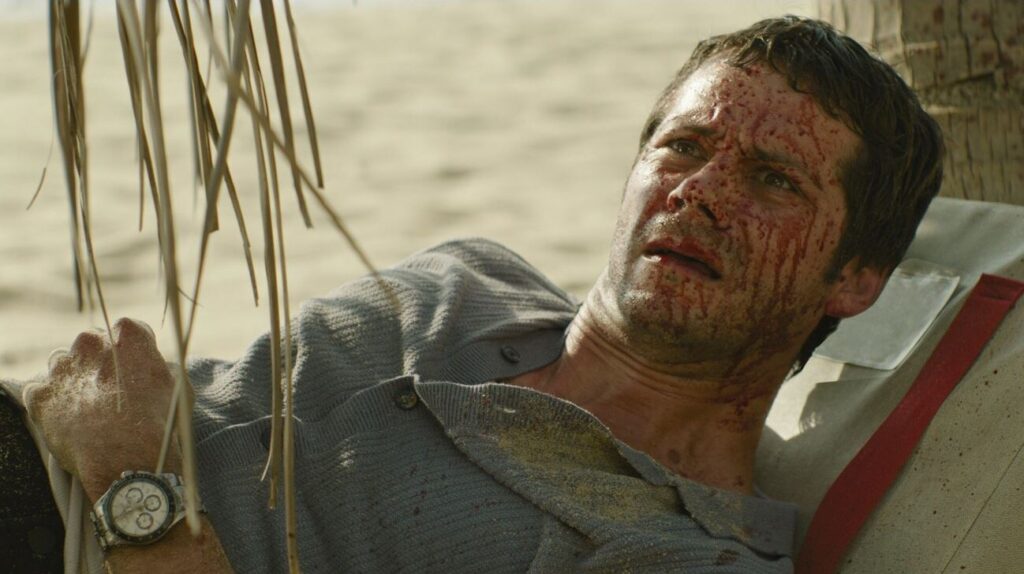
In the abstract, Send Help’s setup might read as schematic—who’s the boss now, huh??—but the actors round it out with canny, fine-grained texture. McAdams’ star power makes Linda’s transformation from frumpy minion to boar-hunting girlboss credible, but she also brings an underlying shiftiness. Even as Linda revels in her newfound power—it isn’t long after the crash when the camera alights on her face and finds her looking close to happy—she remains attracted to Bradley, and her nascent resolve mingles with her suppressed desire. You never quite know what she’s thinking.
O’Brien’s work is similarly deceptive. Bradley is a disturbingly recognizable type: the entitled failson whose privilege obscures a deep-seated intellectual insecurity. But he’s not a complete moron, and as he recognizes Linda’s talents, his approach to his predicament evolves, camouflaging his selfish instincts with ostensible compassion and charm. Bradley is the obvious villain of the piece in part because he genuinely perceives himself as the victim, and O’Brien uncovers countless varieties of pathetic self-regard.

The richness of these performances brings intrigue and depth to a film that is, at its core, a set piece machine—albeit one with a distinctive tone. Raimi is underrated for his versatility, but here he confidently revisits the intersection of horror and comedy that animated his Evil Dead trilogy (plus Drag Me to Hell). Consider his first big sequence: There have been plenty of nightmarish plane crashes in cinema over the years (Cast Away, Flight, Society of the Snow), but I’m not sure I’ve ever seen an aerial malfunction as simultaneously scary and funny as the one in Send Help, which begins with gasping and screaming and ends with Linda glancing out her window, seeing a bug-eyed passenger howling in terror, and quietly pulling down the shade.
There is quite a bit more, most of it satisfying. An early montage delivers a repeated dolly across Bradley’s face, his swollen indignation gradually giving way to sullen resignation. A jump-scare by a cliffside earns the moniker, given that I literally leapt from my seat. There are spurting fluids and poisoned meals and threatened mutilations, most of which are deployed with vivid flair and expert patience. There are memorable visuals, too; the late shot of a woman’s hand protruding from the sand, engagement ring clamped onto her rotted finger like a metallic parasite, is an indelible image.

The upshot is a movie that, for most of its runtime, manages to be enjoyable, suspenseful, and unpredictable. The exception is the noisy climax, when the picture’s simmering tension inevitably gives way to more prosaic shouting and bloodletting. It’s not badly executed, but it lacks the subversive excitement of the earlier passages. (It is also simply not as good as the last scene in Coralie Fargeat’s Revenge, because little is.)
Overall, however, Send Help is an immersive experience that also functions as a robust defense of a specific form of filmmaking. I’m not referring to desert-island capers (though we can hardly have too many of those); I’m talking about original entertainments in which a gifted director places capable actors in a hooky premise and gets down to work. Linda Liddle means business. Much like her, this species of genre fare must survive at all costs.
Grade: B+

Jeremy Beck is the editor-in-chief of MovieManifesto. He watches more movies and television than he probably should.