Maybe TV isn’t so mediocre after all. When I embarked on this annual exercise at the beginning of the week, I lamented how much modern television falls under the uninspiring umbrella of “content.” In terms of percentages, I still think that’s true, but the most recent subsets of these rankings reminded me just how many TV shows I genuinely enjoy watching, even if they’re far from perfect. Maybe the medium is in existential peril, but if it’s flaming out, at least it’s providing some quality entertainment while it burns.
Here are MovieManifesto’s top 10 TV shows of 2025:
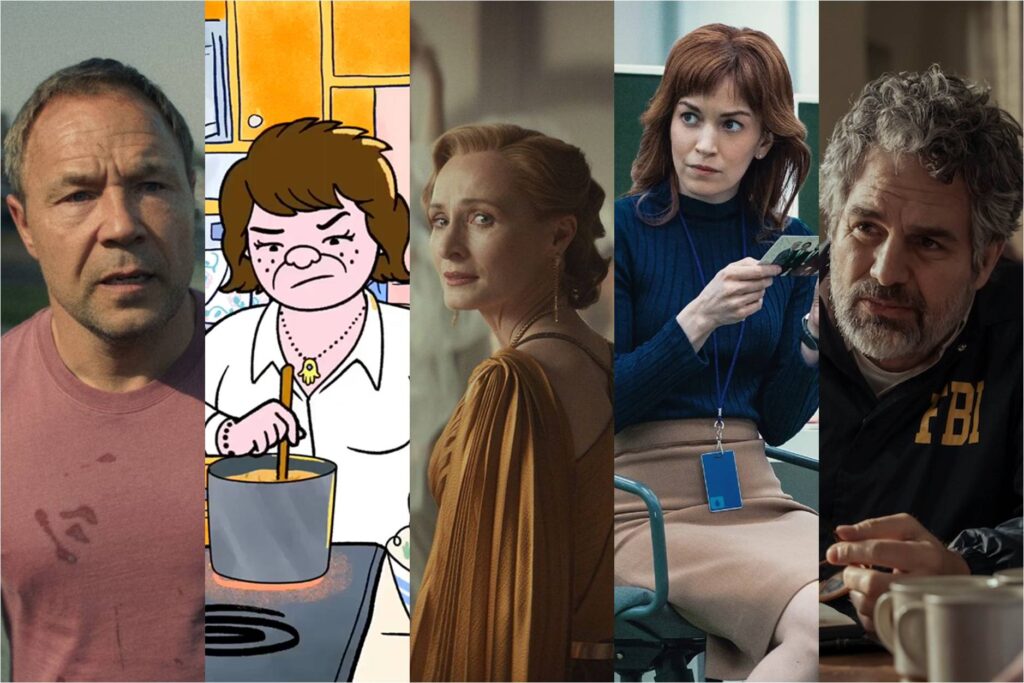
10. Poker Face (Peacock, Season 2; 2023 rank: 6 of 94). The most significant discussion I heard surrounding this season of Poker Face occurred after it ended, when Rian Johnson revealed that Natasha Lyonne wouldn’t be returning and that he was contemplating replacing her with none other than Peter Dinklage. That could be amazing, but let’s be sure to celebrate what Johnson and Lyonne have already given us. Season 2 may lack the “Wow!” freshness of the inaugural outing, but it remains supremely enjoyable, embroidering its irresistible premise with punchy writing, sturdy execution, and a bevy of talented character actors. Despite a cute reveal in the finale, I don’t really care about the series’ long-form story, but Johnson doesn’t seem to worry about it either; he’s more focused on delivering tidy, absorbing episodes that leverage the show’s central conceit in canny and versatile ways. So maybe that planned Dinklage gambit will somehow pay off. To paraphrase a pop-culture hero from a different Johnson-related universe, never tell this show the odds.
9. Severance (Apple, Season 2; 2022 rank: 13 of 110). Empirically, I should dislike this show. In form and function, it would seem to follow some of the worst instincts of contemporary TV: long, drawn-out mysteries; an overly complicated mythology; curlicued plotting that practically requires you to consult Wikipedia post-viewing to ascertain what the hell happened. And yet, Severance is made with such confidence, such precision, that it overpowers any theoretical concerns about its structure or pacing. There are big ideas at play here—about work and life, love and loss, capitalism and self-determination—but the series never feels like a philosophical think-piece. It’s too colorful, too imaginative, too forceful. (Well, except for that one Patricia Arquette episode, which put me to sleep.) More importantly, its vigorous craftsmanship informs its provocative questions, and vice-versa. You don’t need to partition its brain from its body.
8. The Bear (FX on Hulu, Season 4; last year: 10 of 88). Sorry, it still fucking rules. By this point, you know what you’re going to get from The Bear. The story will inculcate a sense of ticking-clock desperation without really going anywhere in particular. A few of the episodes will be quasi-format-breaking and thus especially memorable; for Season 4, these are an intimate stroll through the city with Ayo Edebiri and her removed cousin, and a sprawling wedding that gives extensive screen time to roughly 50 different actors. The aesthetic will be ambitious and immersive, with strong visual command and lots of R.E.M. needle drops. The geographic and industrial details will be rigorous and self-indulgent. And the overall tone will attempt a kind of triangular balancing act, trying to mingle plotty suspense, quippy comedy, and familial melodrama. The menu isn’t changing. I eat it up every time.
7. Hal & Harper (MUBI, Season 1). Cooper Raiff thinks a lot of himself. He’s a multi-hyphenate—here he’s the sole credited writer and director, he’s an executive producer, he edited the majority of the episodes, and oh yeah he also stars as one half of the titular sibling duo—and while he’d surely never label himself a wunderkind, he’d probably be happy to accept the designation. All of this might make you inclined to despise Raiff, and that inclination probably won’t dissipate once you learn the conceit of Hal & Harper, in which he and Lili Reinhart play disaffected twentysomethings and also portray younger versions of themselves (like, much younger). Yet the beauty of the series lies in its distinctive personality, as though it’s sprung fully clothed from its creator’s restless brain. The themes on display—leaving home, overcoming grief, risking failure—may not be novel, but they’re articulated with the same agitated energy that Raiff brings to his performance. (Also, so much Waxahatchee!) This is a very effortful show, with choppy editing and visible style, but its vigor is enveloping, allowing it to acquire exquisite tenderness. It’s a portrait of ordinary life that feels like anything but.
6. Andor (Disney, Season 2; 2022 rank: 17). I almost hate myself for loving this show. It’s pure corporate branding—a calculated effort at exploiting a distressed commercial asset and appealing to a fading consumer base. Oh it’s Star Wars but, like, for grown-ups, how revolutionary. (As for Disney’s strategy of releasing the series in weekly three-episode chunks, may it be cut in half and thrown down a melting pit.) And yet, Andor is just too damn good for me to kvetch about cynical profit motives. The storytelling is top-notch, in particular the mid-season focus on an impoverished colony that somehow, some way evokes Les Misérables. The visuals are crisp and clean and inventive. The characters are impossibly well-drawn, most notably Stellan Skarsgård’s Machiavellian conspirator and Genevieve O’Reilly’s precarious politician. And the social commentary is improbably some of the most trenchant in modern art, speaking eloquently to the mechanics of imperialism, the horrors of genocide, and the danger of misinformation—or as O’Reilly’s bureaucrat puts it, the death of truth. Such loaded language would seem out of place in a Star Wars property, but Andor manages to be both a fantastical adventure and a powerful political document, and with luck its success might inspire studios to give writers greater freedom in telling fresh stories within established environments. As Forest Whitaker says in one of the series’ most surprising and memorable scenes: Let it run wild.
5. Adolescence (Netflix, Season 1). The hook of Adolescence, in which every episode unfolds over a single take, is fraught with danger; draw the audience’s attention to your style, and you’re liable to distract them from your substance. But performative showmanship is one of many themes coursing through this series, which tackles traditional notions of puffed-up masculinity in the impersonal digital age. As a matter of technical skill, it’s astonishing, both for the agility of its camerawork and the sincerity of its performances. (Everyone is good, but Erin Doherty, holy hell.) The craftsmanship knocks you out and also pulls you in, tethering you to the sharply drawn characters even as the show grapples with weighty concepts like bullying, gender roles, and online toxicity. Intimate and sweeping, hushed and explosive, this short, spiky series contains multitudes, even if it makes one thing clear above all: The kids are not all right.
4. Long Story Short (Netflix, Season 1). I’ve already written at length about this show, focusing on its thoughtful and moving depiction of American Jewishness. There is, of course, quite a bit more going on: a playful, time-hopping structure; a daring blend of realism and absurdity; clever and colorful animation; funny, vibrant dialogue that reinforces an abiding affection for its characters. It’s a reflective series that’s also a hoot. With humor and empathy, Long Story Short examines a typically Jewish family, which means it reminds me a lot of my own life and also feels totally, thrillingly different. L’Chaim!
3. The Last of Us (HBO, Season 2; 2023 rank: 1). I’ve never played the game. I don’t think that really matters, but most of the discourse I’ve seen surrounding this show centers on its relationship to its source, so I figured I’d clarify. (There seems to be a four-quadrant framework: It hews closely to its inspiration, which makes it either loyal or tentative; or it deviates dramatically, which makes it either ambitious or traitorous. Whatever.) All I can say is that from my ignorant/blissful perspective, The Last of Us remains ferociously compelling television, with rich characters, propulsive set pieces, and a carefully calibrated blend of long-form plotting and taut focus. There’s a sequence in the second episode that’s one of the most shocking things I’ve ever seen on TV, but this series is far more than the sum of its twists. It’s a fully realized drama, and it’s anchored by a phenomenal lead performance from Bella Ramsey, who reveals new shadings of her embittered, indomitable heroine with every scene. (Kaitlyn Dever is a predictably perfect addition as Ramsey’s foil.) In one poignant moment, Isabela Merced watches Ramsey sing an acoustic rendition of “Take on Me,” and the emotions playing visibly across her face say it all. This show knows what it’s like to look at something and fall in love.
2. Task (HBO, Season 1). Brad Ingelsby must be some sort of warlock. His first TV series, Mare of Easttown, transcended its genre trappings to become my single favorite show of 2021. Now with Task, he returns to another hoary template, the cops-and-robbers thriller, and again imbues it with remarkable tension and specificity. The setup may be familiar—a squad of feds led by Mark Ruffalo investigates a string of drug burglaries perpetrated by Tom Pelphrey—but the details feel thrillingly new and vividly embodied: Ruffalo’s world-weary despair, Pelphrey’s animalistic intelligence, Alison Oliver and Fabien Frankel’s winsome chemistry. As a crime yarn, Task is tightly plotted, doling out fraught revelations and thumping action sequences at a steady clip. As a story of human frailty and compassion, it’s even more impressive and surprising. It traffics in suspense and brutality, but its true sensibility is one of grace.
1. Pluribus (Apple, Season 1). It sure gives you plenty to think about. Conceptually speaking, Vince Gilligan’s follow-up to Better Call Saul poses weighty philosophical questions: about the value of free will, about the conflict between individualism and collectivism, about the merits and drawbacks of honesty, about the utility of harlequin paperbacks. It’s a lot to chew on. But what makes Pluribus great—what makes it far more than a ruminative hypothesis about social governance—is how meticulously it’s constructed as a piece of dramatic pulp. The writing here is so controlled, so precise, it might feel overdetermined if it weren’t also so lively and funny. I don’t so much watch this show as surrender to it, basking in its fluid rhythms, its lustrous images, its ruthlessly perfect timing and pacing. It’s the most electrifying ethics seminar ever held.
And then there is Rhea Seehorn, whose casting is both a fait accompli and a brilliant meta joke. Her Better Call Saul lawyer was all clenched intellect and unyielding poise, so naturally here she plays the most emotionally volatile woman on literally the entire planet. She’s mesmerizing. But Pluribus is more than an actorly showcase; it’s a unified ensemble achievement, with all facets of its production—the writing, the visuals, the music and sound, the cast—operating in absolute lockstep. Its tantalizing last line is both a giddy tease and a broader mission statement. With its boisterous imagination and its painstaking execution, this show is ready to blow up the world.
(To view our complete ranking of every TV show of 2025, click here.)

Jeremy Beck is the editor-in-chief of MovieManifesto. He watches more movies and television than he probably should.