Long Story Short is a surrealistic animated comedy whose plot points include wolves invading schools, mattresses bursting from tubes, and donors misplacing sperm. It’s the most relatable TV show I’ve seen in years.
This dissonance isn’t exactly unthinkable. Raphael Bob-Waksberg, the creator of Long Story Short, is best known for BoJack Horseman, the wonderfully ridiculous Netflix series that anthropomorphized animals and afflicted them with decidedly human problems. Compared to the absurdity of BoJack, Bob-Waksberg’s newest effort can feel downright grounded; there are no talking cats, no underwater festivals, no three kids standing on top of each other in a trench coat presenting as “Vincent Adultman.” But aside from confining its speaking parts to two-legged creatures—there is a cute dog named The Undeniable Isadora Duncan, but it merely barks—Long Story Short resonates with me for a more specific reason: It’s a rich and complex portrait of American Jewishness.
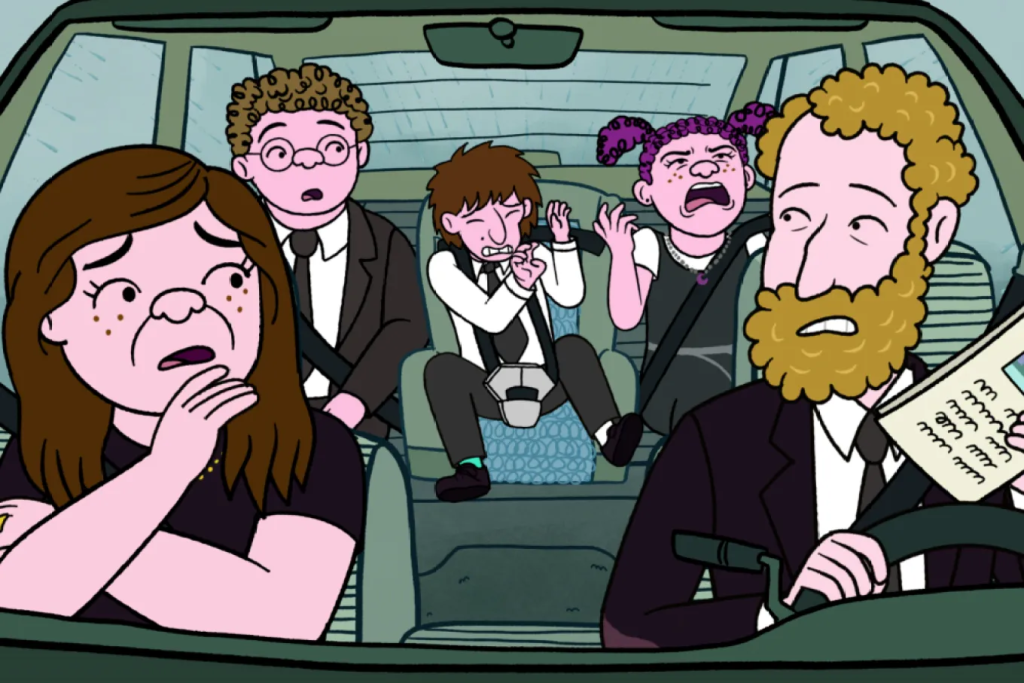
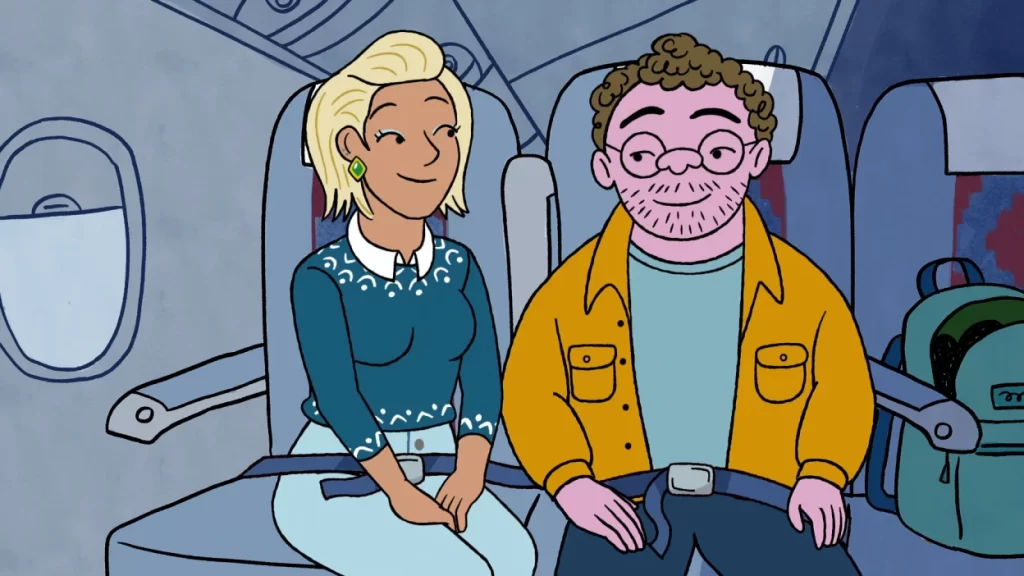
What does that mean? It’s a question as much for the characters as for the audience. The family at the center of Long Story Short is the Schwoopers, a portmanteau derived from their resolute matriarch, Naomi Schwartz (voiced by Lisa Edelstein), and her weary husband, Elliot Cooper (Paul Reiser). They have three children—Avi (Ben Feldman), a fussy aesthete who corrects people when they say things like “The Arcade Fire”; Shira (Abbi Jacobson), a walking fireball prone to impulsive behavior; and Yoshi (Max Greenfield), a dilettante whose harebrained schemes evoke BoJack Horseman’s Todd—who are all young. At least, they’re young when the series opens; one of the pleasures of Long Story Short is how it hopscotches around in time, spanning roughly three decades as its characters mature and regress, marry and divorce, grow apart and come together. One of the threads that bind them is their Jewish identity—for example, Avi and Shira have a running joke about how “a schnook is entitled”—even if they grapple with it in dramatically different ways.
Is being Jewish a matter of religion? Of tradition? Of ethnicity, culture, knowledge, appearance? There is no one answer, yet in pondering these questions, Long Story Short makes a surprisingly poignant case for the connective quality of Jewishness—an assertion of particular value, given the current state of the world.
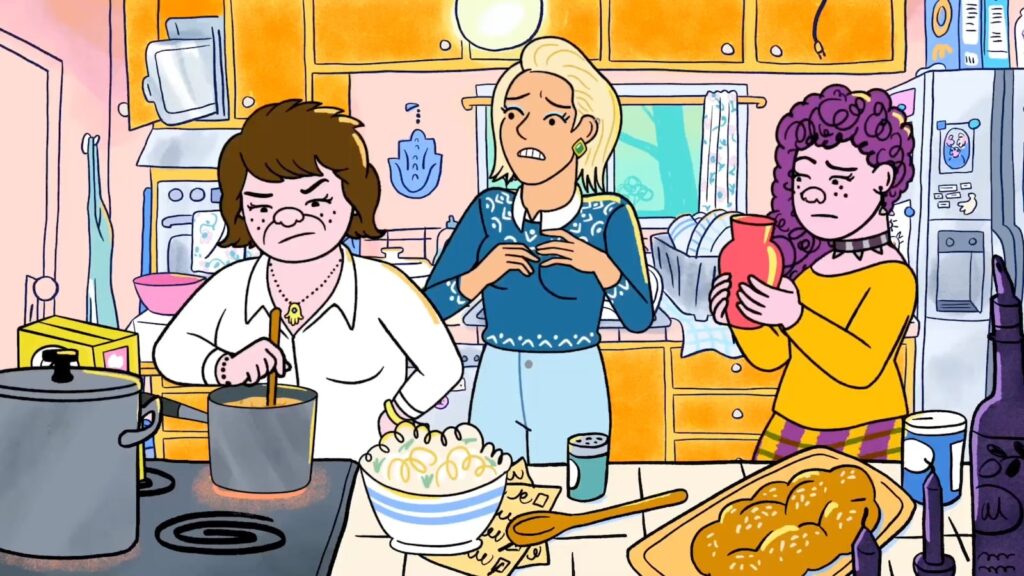
Not that the show is especially political, preferring to focus on its family. Naomi, defending the religious upbringing of her children, insists that she possesses the perfect and singular understanding of Jewishness: “a progressive egalitarian Conservative Judaism with an emphasis on ritual and community over faith and blind practice.” That seems reasonable enough, but as Avi grows older, he finds himself straying from his heritage, complaining that executing different ceremonies simply amounts to “doing a bunch of stuff” for no reason. For Shira’s part, she turns to cooking in a time of grief, hoping that replicating her deceased mother’s exact recipe for knish will create a closeness in death that they never shared in life. Shira’s wife, Kendra (Nicole Byer), initially pretends to be Jewish in order to wriggle out of a sticky situation at work, only to attend synagogue during Yom Kippur and become so moved by the notion of collective atonement that she decides to convert. And Yoshi, ever the listless and unfulfilled child, finds structure and kinship in Orthodoxy, even though its ancient codes and peculiar canons alarm his Reformist siblings.
The point is simple but important: Jews are not a monolith. Even within a single family, Jewishness is amenable to countless permutations; it can’t be reduced to a one-size-fits-all template (or two stone tablets) of beliefs and customs. And that’s a message that should be disseminated loudly and repeatedly, given how the extant political machinery in America is weaponizing the concept of Jewishness—and is purporting to combat anti-Semitism—in ways that are vulgar and dangerous.
A brief aside: Awhile ago, a friend of mine tried to argue that I’m not Jewish because I don’t believe in god. Setting aside the wisdom of policing someone else’s identity, it’s a supposition that misapprehends the manifold expressions of modern Jewishness. It’s a harmless enough mistake among pals, but the federal government is currently wielding similarly wrongheaded assumptions on a much larger and more troubling scale.
About a month ago, my alma mater announced that it had reached a settlement with the Trump administration, allowing for the restoration of federal grant funding that the government had previously withheld on the ground that, well, they’re in charge and they can do whatever they want. Among the agreement’s provisions was the university’s promise to codify its “sustained commitment to initiatives, programs and services to ensure a thriving Jewish community.” That word salad is unlikely to produce meaningful change; more importantly, it won’t truly serve to assuage the government’s concern for Jewish students, because that concern never existed in the first place.
The Trump administration doesn’t care about Jews. I know this, because Donald Trump is a hateful bigot who dreams of turning America into a white ethnostate—a notion that’s fundamentally anathema to any form of Jewishness, no matter how liberal or conservative. Instead, his regime’s supposed interest in protecting Jews cloaks its more insidious motives: its crude attacks on free speech, and its demonization of the Palestinian cause.
Anti-Semitism is a pernicious scourge that is intolerable in a free society. The problem is that the Trump administration has perverted the very idea of anti-Jewish prejudice, reframing it to encompass any gesture of support for Palestinians. If you oppose Israeli, you support Hamas. If you protest the bombings in Gaza, you deny the horror of the Holocaust. The false equivalency is breathtaking, and it erases any trace of nuance or range of thought.
There are undoubtedly plenty of American Jews who ally themselves with the state of Israel ideologically. They’re allowed. But in the government’s view, this is the only proper way to be Jewish; it’s like Naomi Schwartz’s blanket philosophy, only instead of being “progressive egalitarian,” it’s expressing unconditional support of a foreign power, even as it prosecutes a war. It’s the classic stereotype of dual loyalty, and it’s why Trump himself has expressed bafflement that any Jewish citizen might deign to vote against him.
I don’t pretend that everyone who clamors for Palestinian statehood is some holy crusader for justice treating Jews with the utmost respect; anti-Semitism remains prevalent, and it isn’t exclusively practiced by Trump and his squad of goons. But ask yourself, what is the more pressing threat to Jews in this country? Is it the nationalist president who deems his opponents “vermin,” and who claims migrants are “poisoning the blood” of the country? Is it the world’s richest man who makes Nazi salutes at rallies, who uses his social media app to call for “remigration,” and whose pet AI received programming instructions that led it to call itself “Mecha Hitler”? Or is it a bunch of loudmouthed college students protesting a genocide?
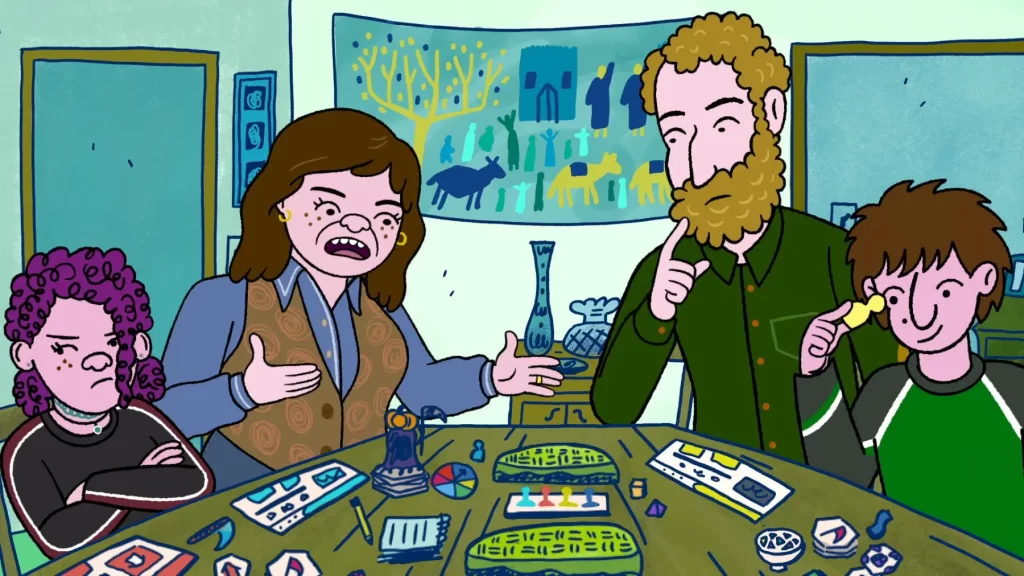
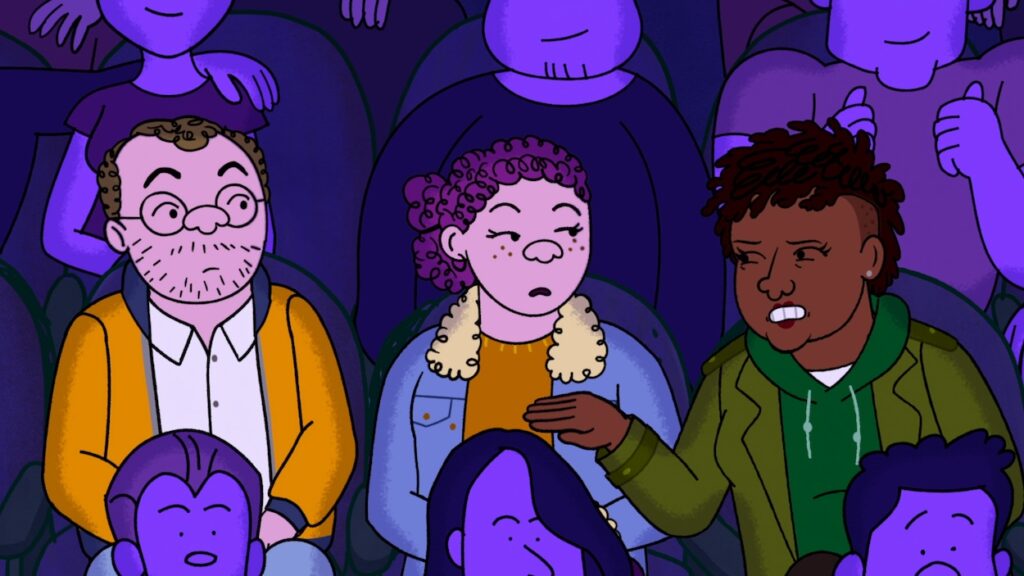
Long Story Short doesn’t directly tackle these issues; in fact, it studiously avoids them. Some might call that cowardice, but just as not all Jews inherently adhere to the same set of principles, not every TV show featuring Jewish characters is obligated to address the ongoing nightmare in Gaza. (The series’ most trenchant political episode comes when Avi aligns himself with a group of mothers to rail against the literal wolves that have taken over a school, only to discover that he’s unwittingly joined up with some lunatic “parents’ rights” activists.) And in depicting its inhabitants with such compassionate diversity, the show offers an implicit but forceful rebuke to anyone who seeks to paint all Jews with the same clumsy brush.
In the first-season finale of Long Story Short, Avi’s daughter, Hannah (Michaela Dietz), musters the courage to ask her somewhat-lapsed father for a bat mitzvah, only to question whether she’s sufficiently Jewish given that her mother is a shiksa. Avi surmises that such a technicality wouldn’t have spared Hannah from the Holocaust, concluding that “if you’re Jewish enough for Hitler, you’re Jewish enough for me.” It’s an arguably distasteful litmus test, but it nonetheless sharpens the idea that Jewishness is personal, even if it’s also ancestral and familial. When it comes to developing your own understanding of who you are—as a matter of identity, tradition, belief, what have you—there’s only one thing everyone should agree on: a Jew is entitled.

Jeremy Beck is the editor-in-chief of MovieManifesto. He watches more movies and television than he probably should.