One of the pleasures of moviegoing is vicarious excitement—the thrill of experiencing something you can’t possibly attain in real life. I am not a professional athlete, an ingenious detective, or a vampire slayer, but cinema brings me closer to such larger-than-life heroes, even if it can also shade them with relatable humanity.
This is particularly true when it comes to crime—especially theft. As a rule-abiding office drone who hesitates before lifting extra paperclips from the supply closet, I’m personally unacquainted with chases and shootouts and scores, so I have a weakness for movies about robbers scheming to pull a heist. The past few weeks saw two independent pictures featuring blue-collar characters who discover a latent aptitude for stealing, a talent that brings them both prosperity and danger. If neither made a peep at the box office, well, maybe that’s because they’re still eluding society’s dragnet.
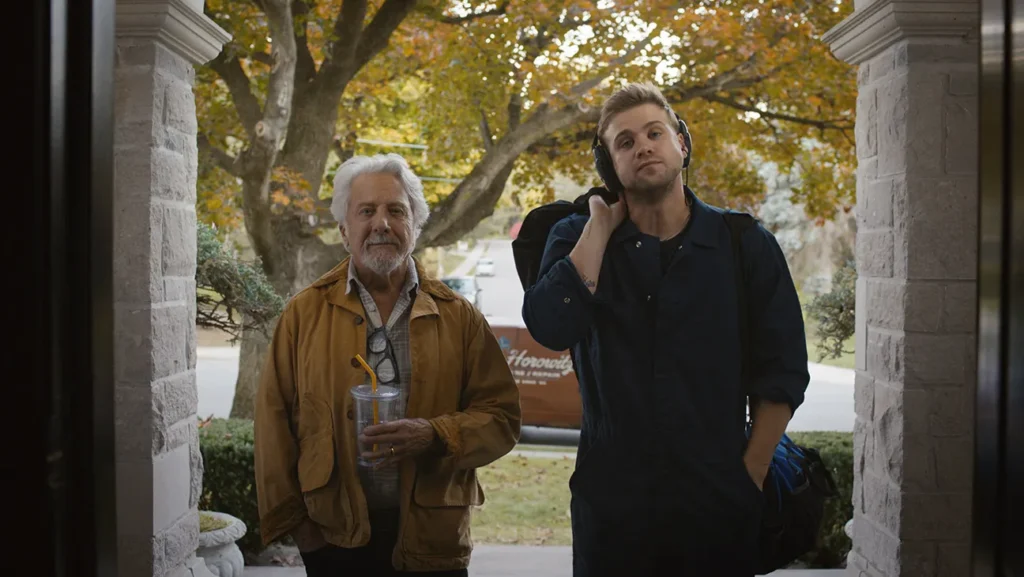
Not that the protagonist of either film starts out as a conniving lawbreaker. Tuner, directed by Daniel Roher from a script he wrote with Robert Ramsey, at first presents as a good-natured portrait of an esoteric industry. Niki (Leo Woodall) is a piano repairman who cruises around Manhattan in a custom van owned by his boss, the cheerfully boorish Harry (a pleasant Dustin Hoffman). Together they tweak stings and dust keys, serving affluent clients who treat pianos more as ostentatious furniture than actual instruments. That blasé attitude extends to the customers’ misguided view of the men they’ve hired; Niki has the soul of a craftsman, but when he shows up for a job, he’s just as likely to be asked to fix the toilet or install the router.
Tuner isn’t exactly a gearshift movie, but its amiable opening stretch hardly suggests a plot that traffics in tension and mayhem. If anything, it scans as a hybrid of Good Will Hunting and Sound of Metal. Niki was a piano prodigy as a child, but a rare condition called hyperacusis—an extreme sensitivity to noise—now precludes him from playing; constantly wearing earbuds to block out sound (he occasionally slips on giant headphones for extra protection), he uses his perfect pitch to diagnose faltering baby grands. At one gig, he meets cute with a student, Ruthie (a lovely Havana Rose Liu), an aspiring composer whose hostility and jealousy quickly morph into affection. At another, he encounters Uri (Lior Raz), a security contractor who refers to him by the film’s title, in an ingratiating tone that camouflages a shiver of menace.

It’s during the latter meeting where Tuner starts to slide from observational character study into suspenseful genre picture. As it turns out, Niki’s disorder carries an attendant criminal benefit: He can use his extra-sensitive hearing to crack open safes. And after Harry is hospitalized and faces crippling medical expenses, Niki agrees to accompany Uri on certain jobs and deprive wealthy patrons of certain valuables they won’t even notice are gone. (TV fans may flash to Jon Hamm’s amateur burgling in Your Friends & Neighbors.)
You will not be surprised to learn that Niki’s moonlighting as a thief eventually results in negative consequences. In fact, the broad trajectory of Tuner is somewhat predictable, as ill-gotten gains and evasive behavior lead to emotional strife and bloody reprisals. The screenplay features a handful of contrivances, including an unfortunately timed abduction that yields one of cinema’s gravest sins: missing a loved one’s recital.

Yet the movie remains consistently entertaining, with a gratifyingly specific milieu and sharply drawn characters. Niki is surely the sexiest piano tuner in world history, but Woodall’s charisma goes beyond mere handsomeness, and his simmering appeal harmonizes beautifully with Liu’s open vulnerability. Hoffman, in just a few spiky scenes, reminds you of his decades-long brilliance, while Raz’s casual malevolence portends a career of equal length.
Beyond that, Tuner just works as a tightly paced thriller with a unique hook. Niki’s condition alternately proves to be superpower and disability, and certain moments—the blast of an air horn, the crack of a gunshot, the recovery of a wristwatch—bring welcome individuality to the usual dishonor-among-thieves turmoil. (The sound design is impressively immersive and disorienting.) Everything crescendos to a note-perfect final scene—a bravura musical performance that will tempt you to stand and applaud, even as you’re also terrified of making the slightest bit of noise.

If Tuner initially keeps its genre cards close to its vest, Carolina Caroline isn’t so coy. It opens in medias res with a fixed shot of the façade of a motel complex, the cheap kind with grimy railings and faded paint. Out of one of the many red doors steps a woman in a black wig, and as she walks to the parking lot, the camera dollies alongside her (think History of Violence), carefully tracking her movement as she first vomits, then steals a truck by pulling a pistol on its unsuspecting owner. The tone would seem to be set: Here is a movie that will unspool as a sordid tale of sickness, violence, and desperation.
Yes, but also no. Certainly, Carolina Caroline is a crime yarn, trafficking in larceny and bloodshed. But despite its gunfire and its getaway cars, it isn’t chiefly a work of procedural intensity. Instead, its primary sensations are optimism, elation, and longing. Quite simply: It’s a love story.

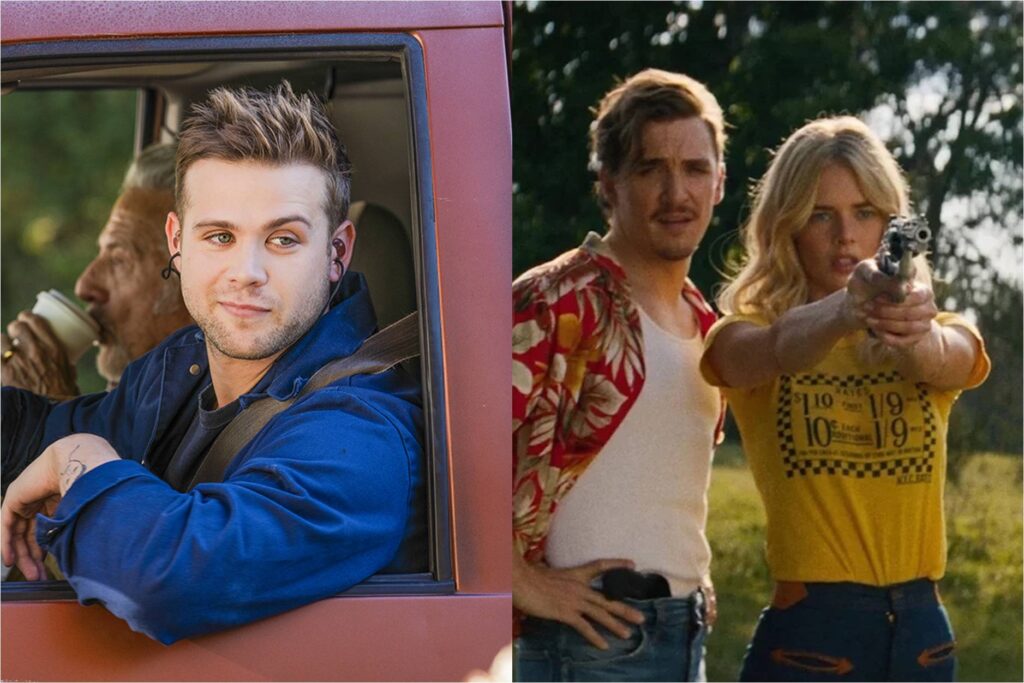
Caroline (played by Margot Robbie whoops sorry make that Samara Weaving) lives a passable but unfulfilling life in Texas, where she performs menial tasks at a gas station. One day, in strides Oliver (Kyle Gallner), a smiling, good-looking chap who also happens to be a professional grifter. He effortlessly swindles Caroline’s oblivious boss out of 10 bucks (think Paper Moon), but she sees through the scheme and confronts him. He’s impressed; he puts the “art” in con artist, and he isn’t in the business of getting caught, much less by some two-bit shelf-stocker. Soon they’re sharing drinks at a bar, and then she’s taking him to a midnight quarry where she pulls off her clothes to reveal red lingerie, at which point their cute little aw-shucks romance receives a jolt of sexualized electricity.
Their attraction is more than simply pheromonal. Caroline, we and she soon learn, shares Oliver’s facility for deception, and together they hit the road as he teaches her the tricks of his fraudulent trade (think Bonnie and Clyde). They knock off banks and bamboozle suits, and while they’re happy to fatten their wallets, what really seems to motivate them—what turns both of them on—is the act of stealing itself. Working from a screenplay by Tom Dean, director Adam Carter Rehmeier delivers some delightful montages, intercutting the pair’s daring robberies with their enthusiastic carnality. They’re not in this for the money, they’re in it for the thrill.

The first half of Carolina Caroline is deeply satisfying, and it speaks to the cathartic charge audiences receive while watching hot people do bad things. But as the story progresses and the capers grow increasingly dangerous, questions emerge about the film’s central relationship. Are Caroline and Oliver true partners in crime? Or is he a predator exploiting her poverty and naïveté? Sure, Oliver seems like a nice guy, and his musings about the vulgarity of capitalism and corporate supremacy appear genuine. He might also be a sociopath—a fiendish manipulator who uses his photographic memory and his advanced understanding of body chemistry to get what he wants. He’s a bit like Niki from Tuner, only with perfect aim instead of perfect pitch, and with a hunger in place of a conscience. The scene where he instinctively threatens a bellhop who spots Caroline’s trademark wig is genuinely scary, both for us and for her.
This introduction of moral uncertainty (think Emily the Criminal) complicates Carolina Caroline, but it doesn’t sully the movie’s entertainment value. Instead, it demonstrates the care that Rehmeier has for his characters—how he rounds out their genre misadventures with real human feeling. One thread of the plot involves Caroline’s search for her mother, who skipped town when she was an infant; their ultimate reunion at a bar, featuring an actress whose identity I shan’t divulge, is agonizing in its realism, disintegrating hope into ash. Yet a later scene, also at a bar, solidifies Caroline and Oliver’s mutual devotion, even as it inevitably leads to tragedy. It’s heartwarming and heartbreaking at once.

That swirl of emotion is becoming typical for Rehmeier, whose prior picture, the excellent coming-of-age jaunt Snack Shack, located undercurrents of tenderness and melancholy beneath the teenage hijinks. In aging up his characters, he has commensurately matured his filmmaking while once again benefitting from terrific actors. Gallner, who previously scuffed up his pretty-boy image as a frenzied killer in Strange Darling, is effortlessly likable as Oliver, which makes his periodic pivots into coldness all the more chilling. But the real star is Weaving, who makes Caroline simultaneously guileless and indomitable, peeling back layers to unearth reserves of intelligence, hesitation, and ardor. It’s a continuously evolving performance, as though she’s discovering new facets of the character in real time, right up until the movie’s impeccable last line.
As with Tuner’s vertiginous chaos, the criminal odyssey of Carolina Caroline could read as depressing, given how it chronicles fear, anguish, and loss. But I’m choosing to perceive it as affirming, and not just because the central romance is conveyed with such warmth and passion. For all her misdeeds, Caroline is a classic heroine—a beautiful girl in a one-horse town who ventures out into the world and finds herself. Some might call her journey nightmarish, but to make such a propulsive movie about it, well, that’s the American dream.
Grades
Tuner: B+
Carolina Caroline: A-

Jeremy Beck is the editor-in-chief of MovieManifesto. He watches more movies and television than he probably should.