
The possibility of intelligent life on other planets has long preoccupied countless dreamers, philosophers, and filmmakers—few more famous than Steven Spielberg. The director’s career is as versatile as it is vast, but every so often he has returned, like a pilot locked in an orbital loop, to the topic of extraterrestrials. Disclosure Day, his deeply enjoyable and sneakily provocative new movie, represents both another iteration of this process and a thoughtful update of it. It is plainly a work of science-fiction, featuring cosmic discoveries, dastardly villains, and earth-shaking developments. But it is also an urgent and thorny tract that fixates, quite profoundly, on the nature of the human race. For all its stargazing, it’s less about aliens than people.
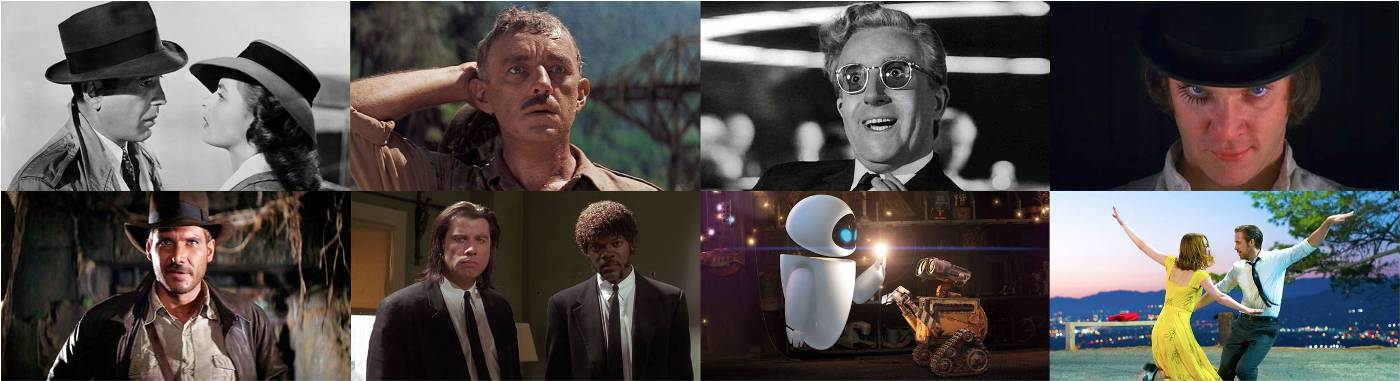
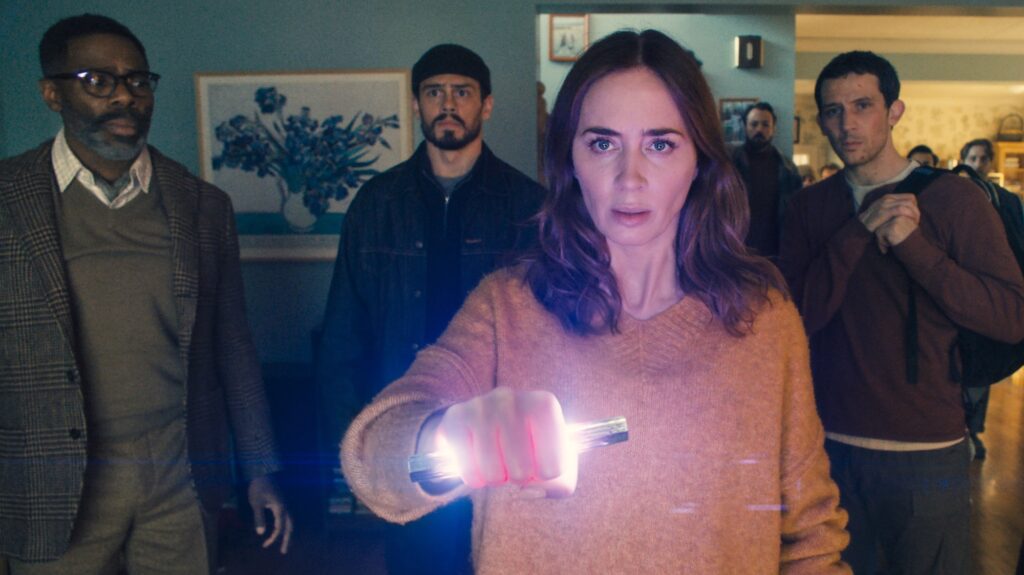
Not that anyone would confuse Disclosure Day for a sterile think-piece. It is instead, in nuts and bolts, a chase picture. Daniel (Josh O’Connor), a programmer at a paramilitary security firm called Wardex, has smuggled a trove of classified materials out of the company’s Virginia archives, along with a handheld MacGuffin-y device that looks like a cross between the cryptex from The Da Vinci Code and the neuralyzer from Men in Black. Catching him if he can is Wardex’s CEO, Scanlon (Colin Firth), who acquires some leverage by kidnapping Daniel’s girlfriend, Jane (Eve Hewson, who worked with Spielberg in Bridge of Spies). In the movie’s tense opening sequence, Scanlon and his no-nonsense underlings hold the lovers at gunpoint, only for Daniel to threaten to activate the device and use its apparent danger to pull off a daring escape, at which point the hunt is on.
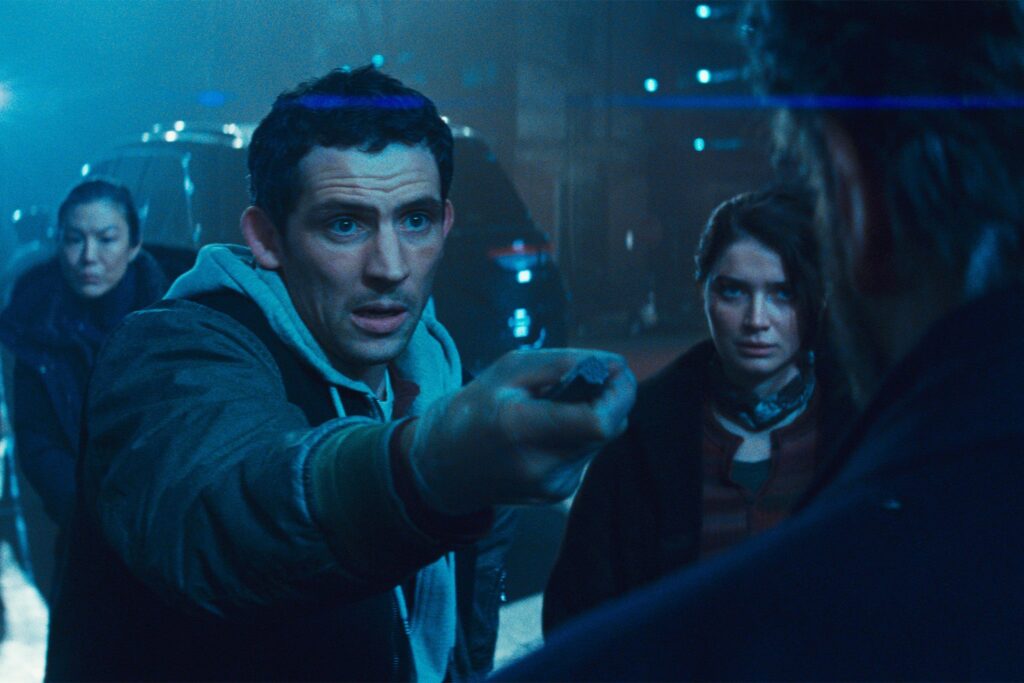
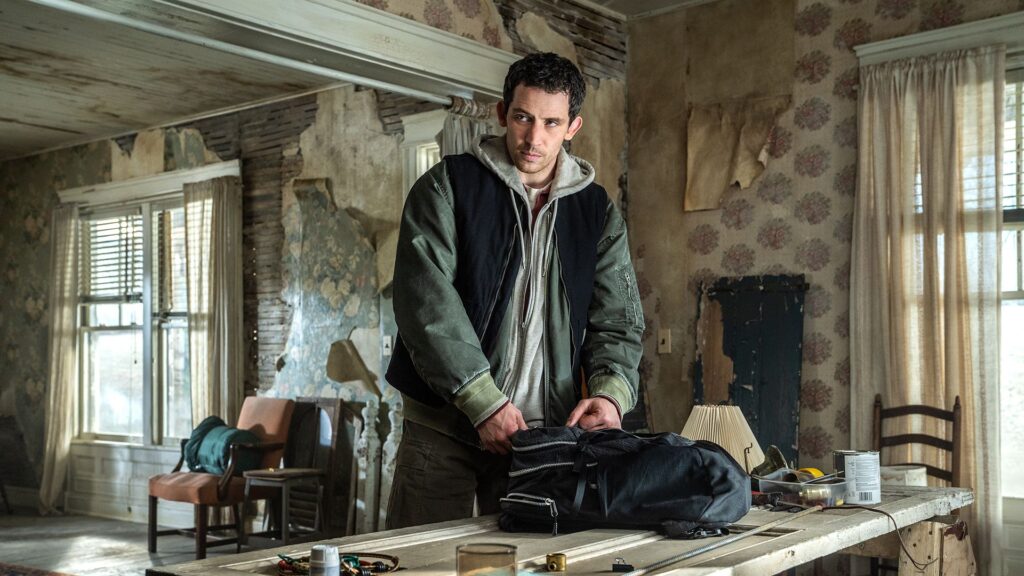
Is Daniel a whistleblower or a traitor? The casting of Firth as a ruthlessly officious bureaucrat should settle that question, but David Koepp’s screenplay (working from a story conceived by Spielberg) has more complex inquiries in store. To begin with, when they take refuge at a monastery, Daniel is stunned to learn that Jane was once a novitiate. “You were a nun?” he asks, his tone betraying the skepticism of a mathematician whose mind is rooted in numbers and logic. One of the movie’s thematic concerns is whether science and religion occupy mutually exclusive fields or overlapping zones; it’s as interested in faith as it is in facts. But faith in what?
We’ll get to that, but as a disciple of the church of cinema who worships at the altar of its preeminent blockbuster auteur, I must pause to venerate Spielberg’s superlative craftsmanship. Yes, Disclosure Day is brainy as well as brawny, but it is nonetheless replete with adrenaline-fueled set pieces that are orchestrated with consummate care and precision. Working with his regular cinematographer Janusz Kaminski, Spielberg’s camera doesn’t rush so much as glide, framing his images with a steadiness that’s both meticulous and unfussy. Speaking of regulars, he has lured his old pal John Williams out of retirement, and the great composer has responded with a spooky, spidery score. On a scene-to-scene basis, the movie is gorgeous and enveloping—the work of a great director who never gets in his own way.

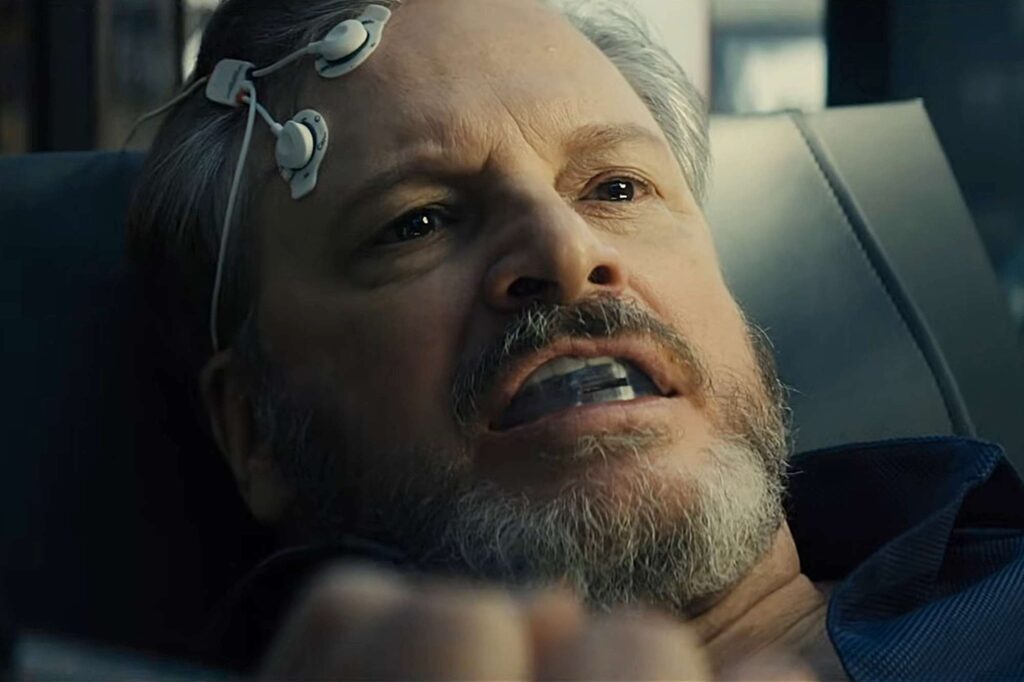
Spielberg also remains a shrewd and imaginative visual stylist. One of the most gripping sequences in Disclosure Day occurs when Scanlon, outfitted with Minority Report-like technology (plus a noticeably lo-fi mouthpiece), attempts a metaphysical feat called “diving,” using another of those mysterious pocket-sized artifacts to invade Jane’s mind and commandeer her body. The mechanics of this assault are largely (and correctly) unexplained, but Spielberg conjures an atmosphere of malevolent disquiet, most notably by swapping the color of Firth and Hewson’s eyes. Other, ostensibly more conventional scenes—a vehicular chase along dirt roads, a sudden flattening of corn stalks (shades of M. Night Shyamalan’s Signs), an impending collision between two ramming cars and an onrushing perpendicular train—are almost casual in how confidently they fuse traditional action choreography with modern special effects.
Yet for all its genre muscularity, Disclosure Day proves more invigorating when probing matters of the mind—in particular that of Margaret, a weatherwoman for a local Kansas City TV station. Played with vigor and perspicacity by Emily Blunt, Margaret initially seems unremarkable; she’s competent in her daily broadcasts, which she conducts in slim-fitting dresses and high heels (check out her trademark “weather shimmy”), but she’s unfulfilled and is considering pulling up stakes, causing tension with her boyfriend (Wyatt Russell). Then one morning, a cardinal flies into her apartment and fixes her with a curious stare, and immediately after this close encounter of the bird kind, Margaret starts behaving strangely. She briefly speaks Russian without realizing it. She talks her way out of a traffic ticket by somehow intuiting personal details of the officer’s home life. And in another riveting moment, mostly captured in a sinewy follow shot, she wanders into work, inexplicably assists a translator with his Korean, and then interrupts her own weather report to emit exotic sounds in a garbled, clackety dialect.
What, exactly, is going on? Margaret gradually manages to piece the clues together—not only exploiting a bizarre aptitude for reading others’ thoughts, but also finding an enigmatic kinship with Daniel, who appears to be the only person capable of comprehending her indecipherable transmission. At various points she is described as a passenger, and the performance of Blunt, who previously demonstrated her sci-fi chops in movies like Looper and Edge of Tomorrow, is brilliant for how it depicts the character’s rapidly evolving consciousness while also maintaining an air of gnawing befuddlement. Margaret is both kickass heroine and wide-eyed traveler, and Blunt’s ability to link the two creates an invaluable emotional tether as we plunge deeper into the film’s secrets.
Which are maybe not so explosive, at least not on their face. It is hardly a shock to learn that Daniel’s cache of stolen disk drives contains evidence of alien life on Earth. Rather than fabricating their own mythology, Spielberg and Koepp have incorporated strains of pop-cultural lore—Roswell, Area 51, little green men—and assembled them into a kind of greatest-hits package. The real suspense of the movie derives not from uncovering what governmental bigwigs like Scanlon are hiding, but from whether Daniel can execute his plan to reveal his illicit discovery to the broader world—whether the titular announcement will actually take place.
In terms of raw plot, Disclosure Day isn’t entirely coherent. Watching Margaret and Daniel close the distance between them is absorbing (not to mention viscerally exciting), but the ultimate product of their convergence—involving a recreation of Margaret’s childhood memories, plus more eerily still animals—isn’t clearly connected to the ensuing climax. Similarly, Margaret’s use of her supernatural abilities is inconsistent, as is Scanlon’s effort level in pursuing his quarry. It’s not difficult to pick at and poke holes in the screenplay, if you’re so inclined.
This would seem to be problematic for a movie that presents as an elaborate, pulse-pounding mystery. But as Disclosure Day hurtles into its final stretch, it lays bare its true subject, which isn’t the existence of aliens or the source of Daniel and Margaret’s ineffable connection, but something else altogether. The picture’s central conflict is really between Scanlon and Wakefield (Colman Domingo), a former Wardex principal who has since disavowed the company’s cloak-and-dagger operations and now supervises Daniel’s mission from afar. It’s a war of secrecy versus transparency; whereas Scanlon brazenly flouts morality and due process in order to safeguard precious intel, Wakefield is equally committed in ensuring that this data breaks through to the public eye.
There is little ambiguity here about the role of villain and hero. In multiple ways, Wakefield functions as a Spielberg surrogate: An old and thoughtful man who directs others’ actions, he spends most of his time on a stage set, overseeing the fastidious construction of a model home that will be used to convey a sensory, nostalgic experience. He also lectures Scanlon on the value of empathy, adopting a tone of intellectual earnestness that falls squarely in the wheelhouse of the filmmaker who is so often accused of softness and sentimentality.
A quarter-century ago in A.I., Spielberg delivered a sweeping, protracted finale that was widely disparaged as shameless and drippy. The closing scenes of Disclosure Day are more taut and prosaic, but they share with that epic a startling emotional nakedness. (Spoilers follow.) Having finally outmaneuvered Scanlon and his squad of mercenaries, Margaret and Daniel upload the stolen files to her station’s national affiliate, at which point an anchor—played with extraordinary sensitivity by Courtney Grace—begins reacting to the footage in real time. As she stammers over archival displays of extraterrestrial life and death, the whole world watches her broadcast, globally united in the awe of scientific discovery.
In essence, Spielberg has concocted a fantasy of newsiness—a yearning for the times of Cronkite and Murrow, when Americans hungrily consumed information of unimpeachable character. (Naturally, a control room staffer asks “Is this AI?” before being assured of the recordings’ veracity.) The easy, cynical response to such collective wonder is to dismiss it as mere pablum—the simplistic desire for common ground in a fractured, polarized society.
Fair enough. But the more I linger on the ending of Disclosure Day, the more poignant I find Spielberg’s unadulterated faith in human compassion. Aliens aren’t coming to save us; that’s our own job. And in preaching about the sanctity of empathy, Spielberg implicitly posits that our salvation lies in cinema. Going to the movies remains a holy act of communion—a sacred ritual of coming together, piling into the dark, and looking up at that big, beautiful screen.
Grade: A-

Jeremy Beck is the editor-in-chief of MovieManifesto. He watches more movies and television than he probably should.