You could spend an hour watching the first three minutes of Teenage Sex and Death at Camp Miasma, Jane Schoenbrun’s fascinating, frustrating new whatsit. After its brief and exaggeratedly bloody cold open—an actor receives facial touch-ups, then slaughters a few nitwits, producing geysers of red fluid—the movie revs into its title sequence, revealing the prior scene as in-universe footage from the titular low-budget horror flick. With speed and precision, Schoenbrun communicates a half-century of meta lore by way of a blizzard of media artifacts: piles of faded VHS tapes, dusty old newspaper appraisals, chintzy arcade games, screenshots of online verticals. It’s a blindingly fast montage that cleanly situates Camp Miasma as a fictional variant of durable franchises like Friday the 13th, Halloween, and other species of endlessly rebooted IP, one whose initial acclaim gradually gave way to hacky sequelized bloat. It’s an immersive introduction that also presents a thorny challenge: Can Schoenbrun say anything new about the slasher picture?
Kind of. Schoenbrun is an obvious student of the subgenre, and their excavation of its history is peppered with winking touches and loving references, even as it spikes that affection with suspicion. Yet while Teenage Sex—the real 2026 film, as distinct from Camp Miasma, the diegetic 1980s one—is decidedly brainy and innovative, it is also occasionally self-satisfied and ultimately incoherent. But it is watchable, and it’s plainly the product of a thoughtful and idiosyncratic creative voice. It may not be a great movie, but it’s one hell of a Criterion booklet.
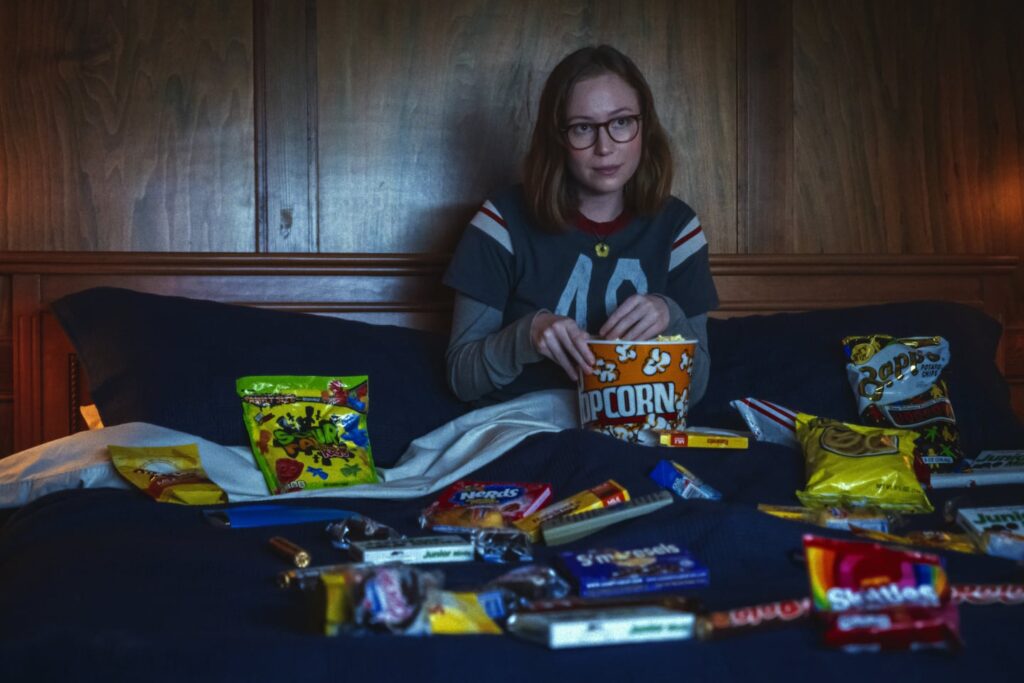
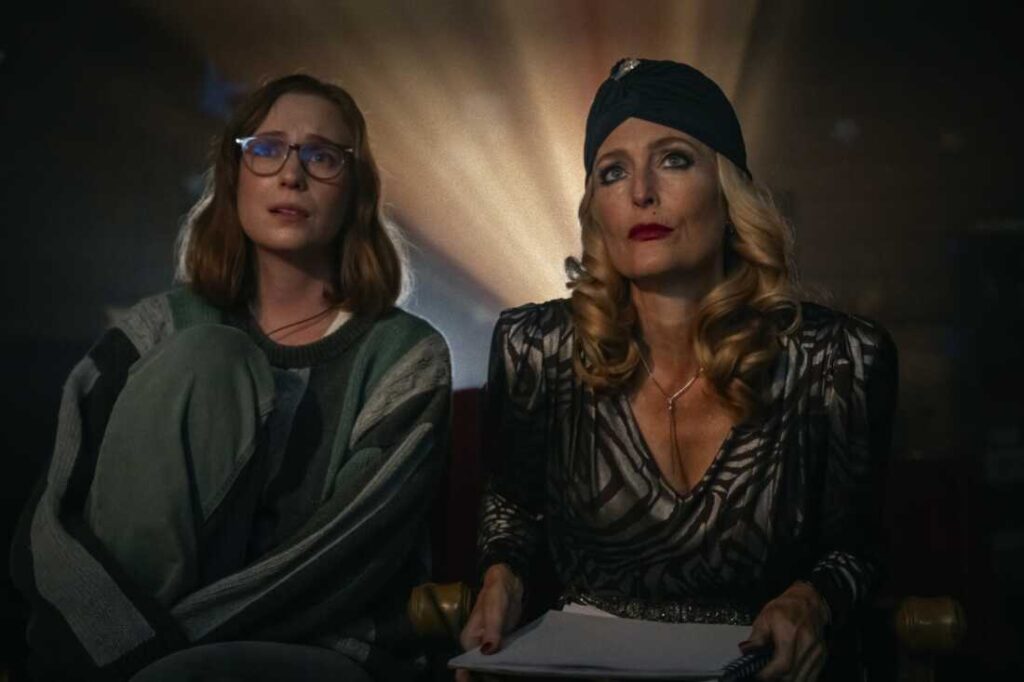
Schoenbrun’s surrogate here is the androgynously named Kris (Hannah Einbinder), a “Sundance wunderkind” whose experimental first feature—described as “Psycho from the perspective of the shower curtain”—earned her enough street cred to land the gig of recharging Camp Miasma’s revenue-generation machine. It’s an assignment she takes seriously—she treasures the original, which she watched too young—even if Schoenbrun quickly starts planting satirical seeds, like how Kris’ agent (Sarah Sherman) is identified as “Your Agent.” Despite her nostalgia, Kris clocks the series as problematic, which is why her remit isn’t just to make a scary movie about a summer-camp serial killer, but to infuse it with queerness, wokeness, and any other “ness” which might flatter the sensibilities of liberal audiences eager to flock to a progressive horror reboot that supplies lots of sex and death.
This concept—interrogating popular art, and drawing on its cathartic pleasures while also pinpointing its stereotypes—is familiar ground for Schoenbrun. Their prior feature was I Saw the TV Glow, a provocative picture about the enduring power of Buffy the Vampire Slayer that also produced some unfortunate discourse regarding critics’ obligations to highlight the transgender themes (subtly?) embedded in its narrative. Nobody will miss the point this time around.
“This part’s transphobic,” Kris whispers while watching an expository scene from Camp Miasma. No kidding. The saga’s villain, called Little Death (TV Glow’s Jack Haven), was bullied and killed as a teenager for the sin of gender nonconformity. Now, his ghost resides beneath a lake in a cassette-stocked lair (it contains a squishy horizontal orifice that puts the “V” in VCR), and he periodically emerges—bladed spear in hand, face concealed by a boxy, vent-like mask—to terrorize the camp’s summertime frolickers.
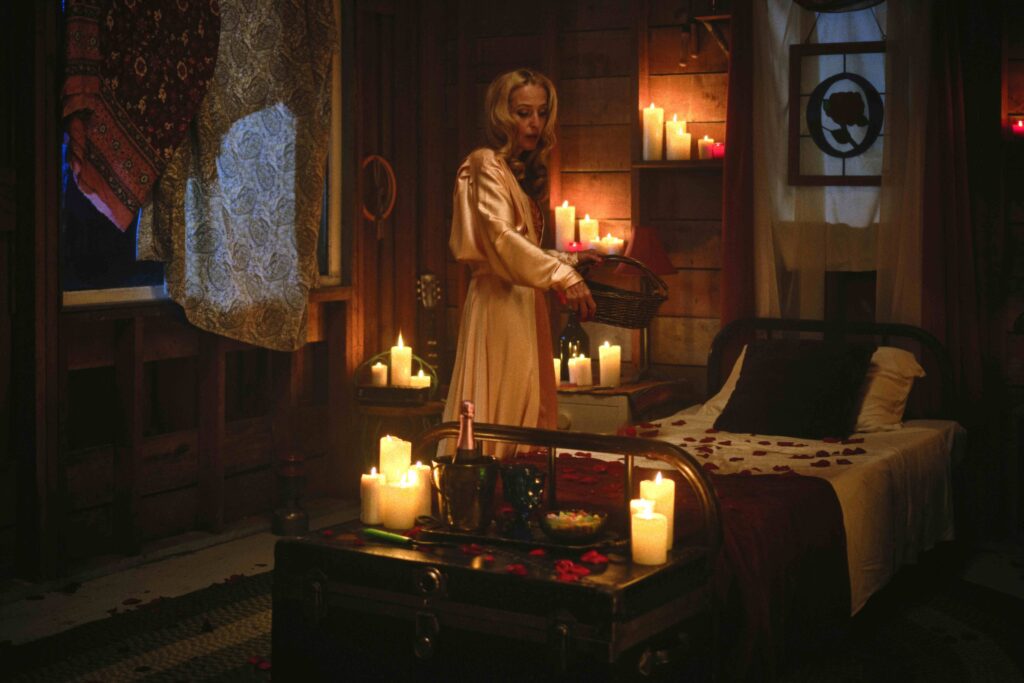
There is, as someone says to Kris, “a lot to unpack there.” But to their credit, Schoenbrun doesn’t bog the film down in academic inquiries. They keep things moving, maintaining the story’s propulsion even as they again flash some striking visual technique. Kris is set on recruiting Billy (Gillian Anderson, glazing her dialogue in a southern-fried marinade), the actor who portrayed Camp Miasma’s inaugural final girl and has since faded into obscurity (cue the Norma Desmond jokes), to return for the update, and her mission takes her to the snowy wilds of the northwest, where she seems to wander into another world. With an array of eye-catching tricks—matte paintings, smudged colors, possibly stop-motion—Schoenbrun lends the image a dreamlike quality, emphasizing the mounting surrealism of Kris’ obsessive quest.
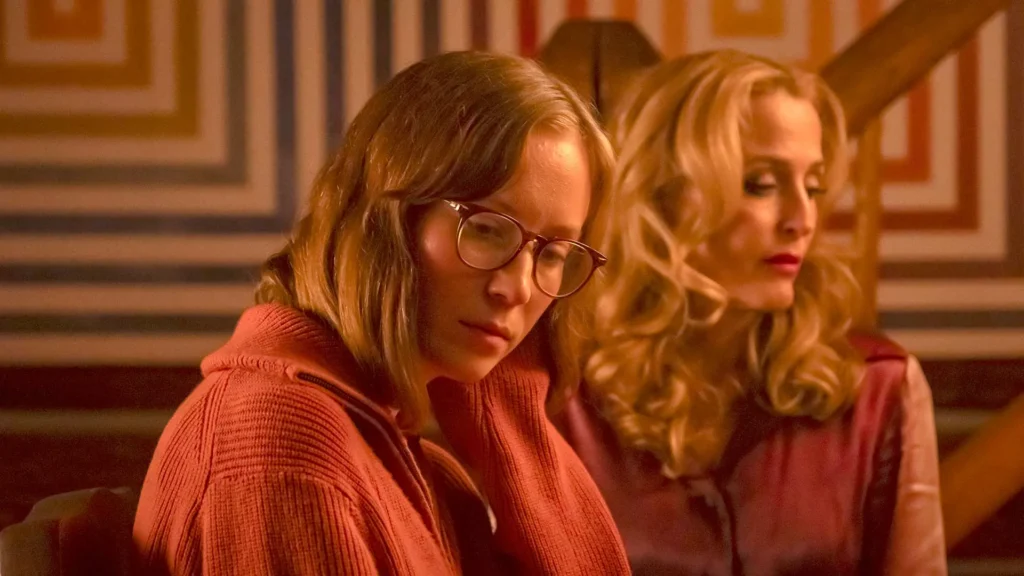
The two-handed middle third of Teenage Sex is its most arresting, as Kris and Billy slowly encircle one another, dropping their guard and revealing their innermost demons and desires, Einbinder’s neurotic restless harmonizing with Anderson’s casual glamour. “I think I saw too many movies as a kid, and it fucked me up real bad,” Kris confesses to Billy, who knows a little something about being traumatized by cinema. They rewatch Camp Miasma together—Kris can’t resist pointing out a split diopter shot, a shameless flaunting of technical know-how that I interpreted as a personal attack—and with startling conviction, Schoenbrun dives into the frame within the frame, letting lengthy stretches of the ’80s classic unfold at a leisurely pace. The most memorable of these is a bravura single-take sequence from Little Death’s murderous perspective, set to a ’90s pop hit that made me wonder if Schoenbrun had hacked my iTunes. (Most of the music cues—R.E.M., M83, Sally Shapiro—are intentionally anachronistic.)
That scene recalls In a Violent Nature, the brutish 2024 horror film which reimagined the slasher picture from the killer’s POV in a misguided exercise of banal showboating. Teenage Sex is far more entertaining and ambitious, both thematically and narratively. It is also commensurately undisciplined. Schoenbrun has a lot to say, but as was true with I Saw the TV Glow, they eventually sacrifice clarity in favor of atmosphere. As befits its title, the movie’s third act is an incomprehensible fog of bare skin and blood-soaked carnage. Fantasy and reality seem to merge, or perhaps trade places, and the effect is less entrancing than simply enervating.
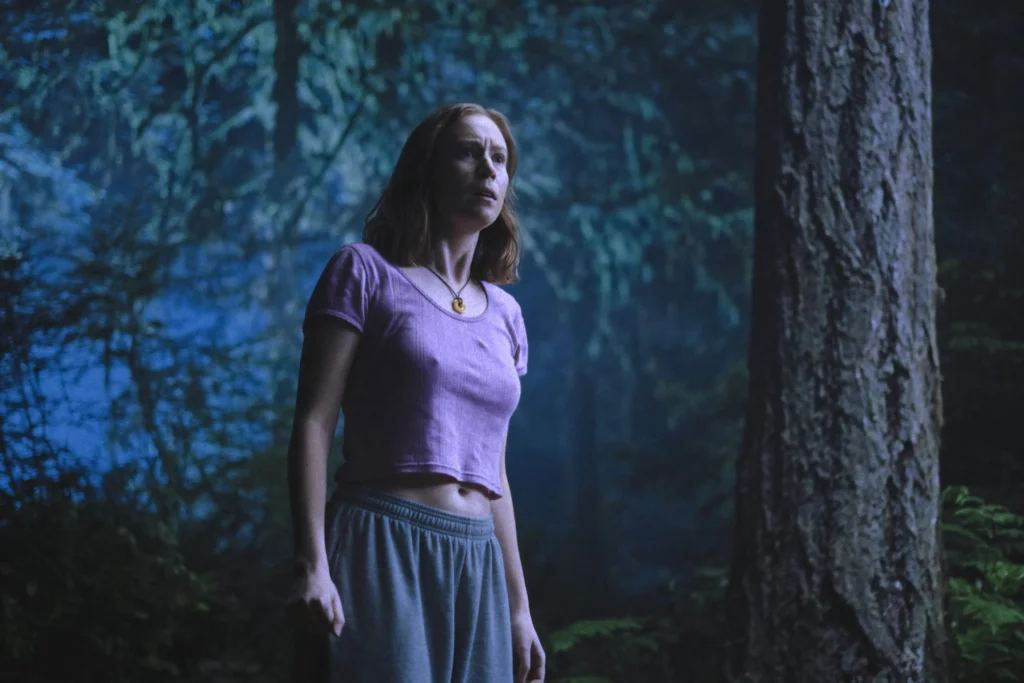
Shortly before it devolves into chaos, Teenage Sex delivers a hilarious scene where Kris pitches her absurdist ideas to a virtual roomful of befuddled studio executives (one of whom is playfully labeled, “Queer Assistant”). Chief among them is a skeptical suit played by Dylan Baker, who scoffs at Kris’ hyperactive imagination with palpable, middle-aged disgust. (As a more tactful producer, Jess McLeod cements themself as a performer to keep an eye on following their strong work earlier this year in Normal and The Audacity.) I doubt that Schoenbrun wants viewers to identify with Baker’s smug, out-of-touch bean counter, but as Teenage Sex collapses into nonsense, I found myself wishing that someone had subjected its director’s unruly instincts to greater oversight.
Of course, cold, crude logic is anathema to Schoenbrun’s warm, sensual method of storytelling, which attempts to translate deep-seated memories into lovingly tactile images. That doesn’t make this movie’s closing passages any more legible or satisfying, but it does counsel against restraining such an unusual and evocative vision. Even if Teenage Sex and Death at Camp Miasma is ultimately too abstract and impenetrable for my stubborn tastes, it seems likely to inspire its own sect of feverish devotees. With luck, it will enjoy a long and contentious afterlife in the annals of cult cinema, where it will lodge itself in the brains of aspiring filmmakers and really fuck them up.
Grade: B

Jeremy Beck is the editor-in-chief of MovieManifesto. He watches more movies and television than he probably should.