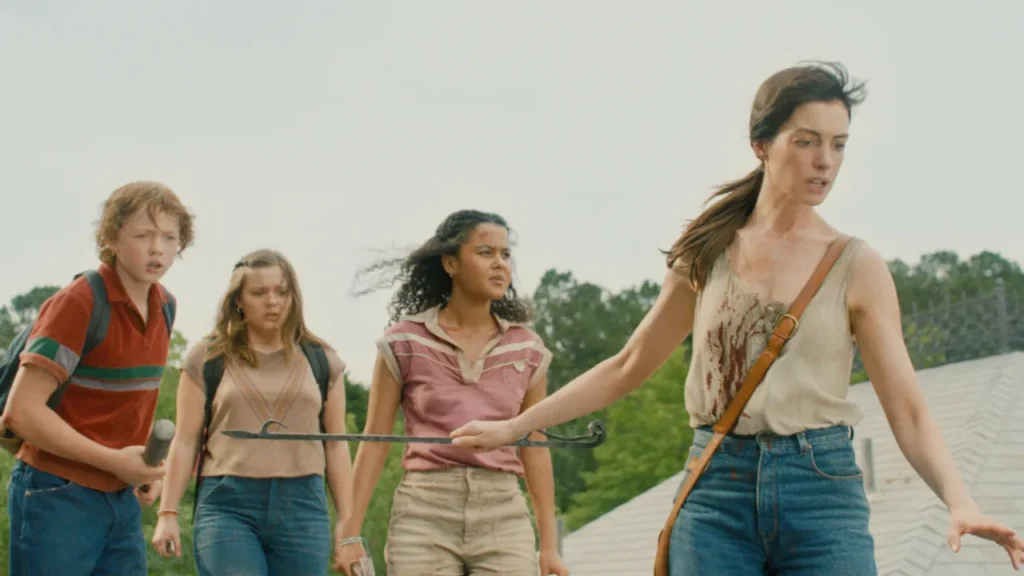
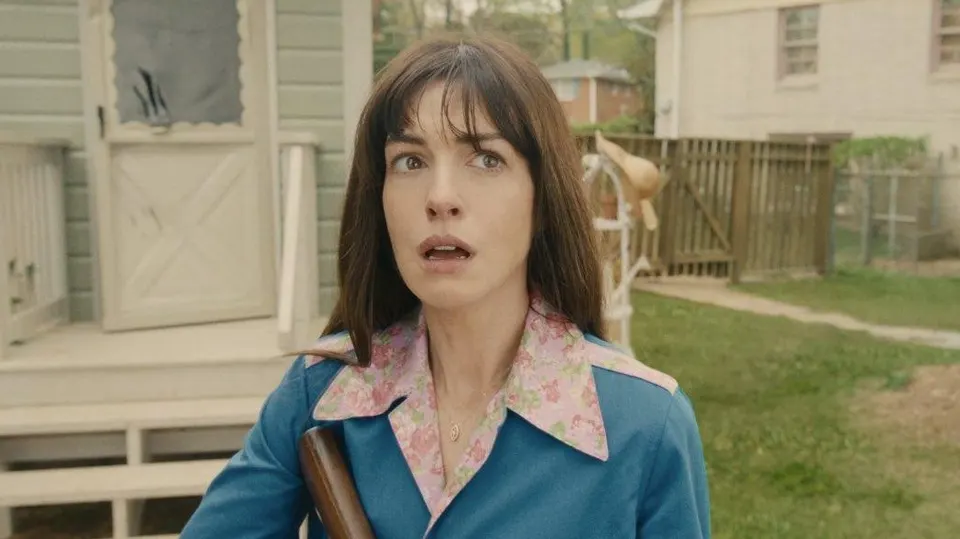
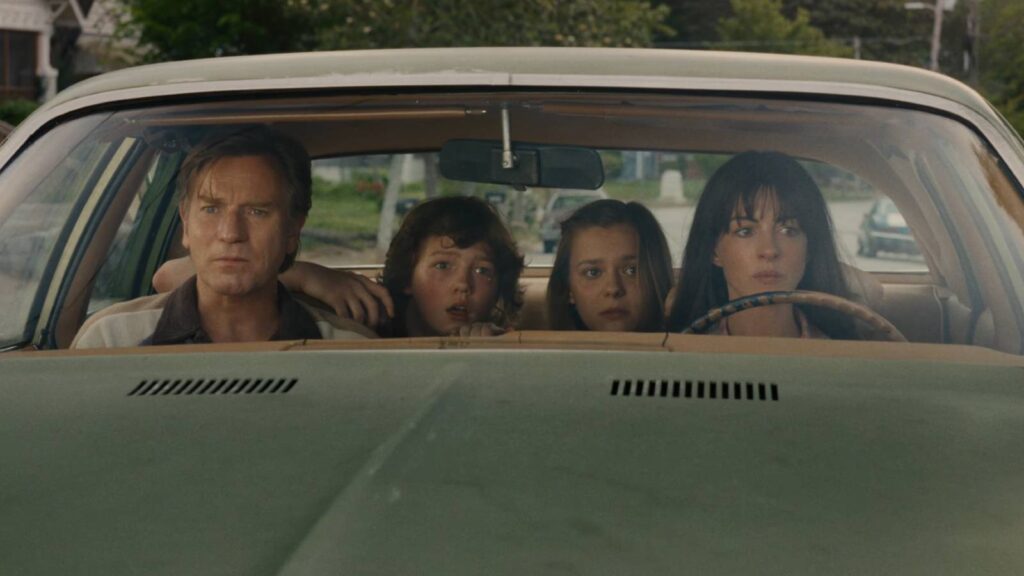
On the surface, everything looks perfect: sunny skies, verdant lawns, beaming kids. “You’ve got a great family,” a man says to Greg Platt (Ewan McGregor) as his wife and two children frolic at a local barbecue. But while outside observers might perceive Greg and Denise (Anne Hathaway) as the joint head of an idyllic nuclear household, a few strained glances and terse words reveal otherwise. His extra shifts as a pizza deliveryman aren’t paying the bills, she’s secretly channeling her resentments into a novel, and they’re rarely on the same page, whether socially or financially. They certainly can’t afford Cornell’s tuition for their daughter (Maisy Stella, from My Old Ass), who’s discovering that quoting Carl Sagan doesn’t impress pretty girls. Their son (The Monkey’s Christian Convery), is “acting out” and seems more comfortable playing with their rambunctious blue heeler than with his peers. They seemed destined for a rupture—an earth-shaking event that will permanently puncture their veneer of domestic bliss. And that’s before the monsters show up.
Like Companion, The Drama, and others of their ilk, The End of Oak Street is a film whose very premise arguably qualifies as a spoiler, given that it withholds its cards for around 20 minutes. So before wading into revealing waters—seas that its trailer and marketing campaign had no compunction swimming in—let me just say that this movie is a rollicking piece of mainstream entertainment. The first feature in seven years from writer-director David Robert Mitchell, it’s both imaginatively conceived and confidently executed. If it isn’t a work of great depth, that’s because its characters are too busy scampering to fully develop. Slow down in this town, and you’re liable to get eaten by a dinosaur.
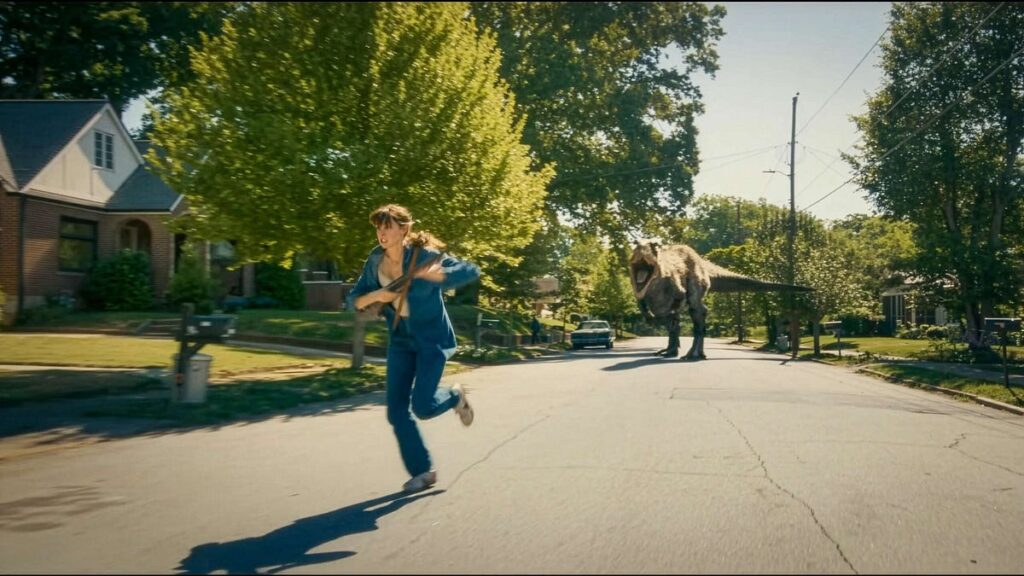
Hey, you were warned. The irresistible hook of The End of Oak Street is that it takes a perfectly ordinary American family and plunks them into an extraordinary situation—namely, by transporting their neatly ordered slice of ’80s Michigan suburbia into the chaotic wilds of predator-ravaging prehistory. It tears into Reagan-era nostalgia with very sharp teeth.
Not that Mitchell has much to say about trickle-down economics, women’s lib, or cathode-ray-tube televisions. He is more preoccupied with a specific icon of the decade: Steven Spielberg. This is a movie where boys ride around on bicycles, where adults gaze upward in slack-jawed terror, where raptor-like beasts attempt to crash through shabbily padlocked doors. (There is even “one big pile of shit.”) Cinematographer Mike Gioulakis throws a gauntlet to Janusz Kaminski to see who can deliver the greatest number of gliding camera moves, while composer Michael Giacchino should probably donate some of his salary to John Williams.
In one sense, the imitative quality of The End of Oak Street is dispiriting, given that Mitchell’s prior two films—the horror masterpiece It Follows, and the incomprehensible but gratifyingly ambitious neo-noir Under the Silver Lake—were exemplars of originality. But if his work here is less than inventive, he compensates with verve, discipline, and flair. This is by no means the best or most provocative movie about dinosaurs, but it’s among the most primally tense and enjoyable.
It also doesn’t waste your time. Running a lean 99 minutes, The End of Oak Street favors the second half of Jeff Goldblum’s famous observation from The Lost World, dispensing with the oohs and ahhs and focusing on the running and screaming. It gets to the good stuff.
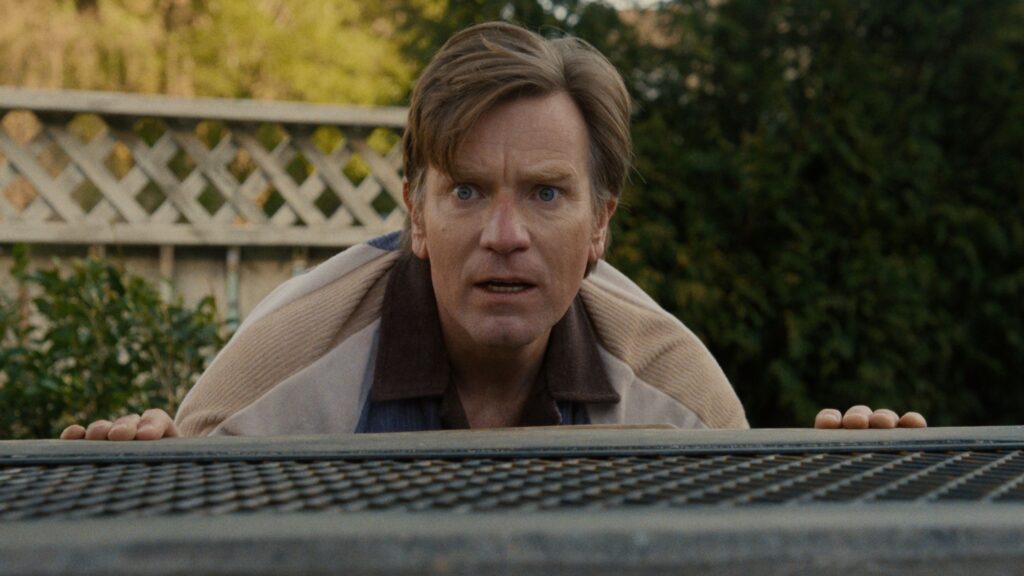
This isn’t to discount the movie’s early establishing scenes, which quickly secure your sympathy for the Platt clan while also articulating their fraught dynamics. They aren’t a generically wholesome family of four, they’re real people with real problems, and Hathaway in particular does solid work, embodying a decent woman who’s increasingly paralyzed by her personal stagnation. (McGregor is fine, but his American accent often defeats him.) The moment where Denise realizes that the pages of her book have been lost to flood in the basement is a lovely piece of silent disappointment. But soon her peril is less philosophical than existential.
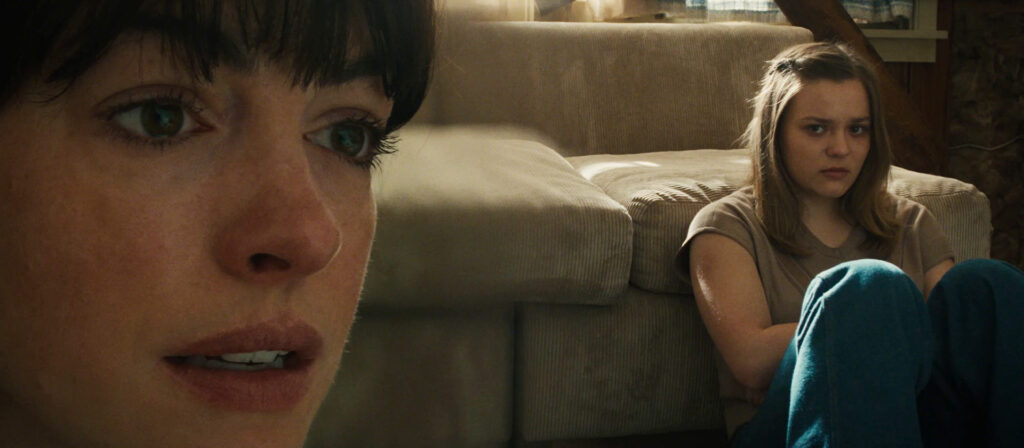
For all its hiding and shrieking, The End of Oak Street is fundamentally about a family collaborating to solve an unusual, seemingly impossible challenge. One of its best scenes is also one of its quietest: Huddled on their living room floor in a diamond configuration, adults and kids opposite one another, the Platts slowly process the enormity of their predicament. Mitchell frames most of his two-shots with a split diopter, capturing the terror on his actors’ faces while also emphasizing the metaphorical distance between parent and child. (Note to Lee Cronin: This is how you use that technique effectively.) They need to return home—not to their house, but to their time—and they have no idea how.
That’s pretty much it, but while it’s fair to criticize Mitchell for not doing more with his conceit, it’s equally important to recognize the vitality and ingenuity of his set pieces. He draws on some of the exhilarating patience and depth of field he brought to It Follows; multiple times, characters are unaware of a threat looming in the background, and its slow, menacing approach will have you scraping the leather off your armrest. Other sequences—Greg’s slow run alongside a fence that obscures an unseen danger; a hectic attempt to escape through a portal; the predictable yet delightful reemergence of that Australian cattle dog—hum with creativity while also leveraging clean and convincing special effects. (The large variety of computer-generated breeds on display will have amateur paleontologists shouting over one another to identify the many species.) And in the movie’s most bravura scene, Greg’s line “Is that a fucking dinosaur?” takes on a second meaning, the profane adjective transforming into a gobsmacked verb.
Tonally, The End of Oak Street carries a seriousness that’s absent from the dopey Jurassic World franchise (though it of course can’t compare to the original Jurassic Park), centering its characters’ emotions even amid all of the frantic howling and munching. A seemingly irritating subplot about a bully resolves with surprising tenderness, while a scene where Denise snarls at her son generates spikes of pain. Ironically, it’s this gravity that makes the movie’s final stretch—when Mitchell curbs his ferocity and instead indulges in soft, easy sentimentality—feel like such a betrayal.
That may sound like an odd complaint from someone who adores the notoriously maudlin Spielberg, and who found the finale of Disclosure Day to be profoundly moving. But beyond raising some timey-wimey questions which it has no interest in actually exploring, the ending here doesn’t earn its purported grace, instead coming off as contrived and discordant.
The good news is that the closing moments of The End of Oak Street are so far removed from the rest of the movie’s shivery intensity, they do little to retroactively nullify its absorbing pleasures. For a potentially heady time-travel picture, its charms are mostly on the surface. But filmmaking this crisp and precise can find a home in any era.
Grade: B+

Jeremy Beck is the editor-in-chief of MovieManifesto. He watches more movies and television than he probably should.