Zootopia: Sly Fox and Smart Bunny Solve a Caper, Teach a Lesson

Jason Bateman as a sly fox and Ginnifer Goodwin as an earnest bunny in "Zootopia"

The cliché about modern animated movies is that they satisfy both kids and adults. In reality, they tend to satisfy kids or adults, with specific elements aimed exclusively at each demographic; kids are entertained by talking animals and scatological humor, while parents are placated by wry sarcasm and the sporadic literary or cinematic reference. Disney’s Zootopia isn’t entirely immune to this kind of bifurcation—there are broad gags about genitalia (groan), and there are subtle jabs like a group of critters who work at Lemming Brothers Bank (ha!)—but for the most part, it avoids the trap of pandering to its audience. This doesn’t mean it has nothing to say; on the contrary, Zootopia targets its younger viewers with a message that is familiar but also well-meaning and even resonant. It’s a kids’ movie made by adults.

The surprising power of that message is initially obscured by the film’s brisk setup and lively visuals. As the punny title suggests—this is presumably the first animated movie that will inspire parents to teach their children about the writings of Thomas More—Zootopia takes place in a universe populated by anthropomorphic animals who live in apparent harmony. Our heroine is Judy Hopps (Ginnifer Goodwin), a perky bunny rabbit with big ears and a bigger heart who aspires to become the metropolis’s first cotton-tailed police officer. Judy may be small in stature, but her will is indomitable, and what she lacks in size she compensates for with quickness and guile. That’s an awfully familiar trope, and Judy’s quest for self-fulfillment results in the predictable recitation of trite platitudes found so often in children’s literature. Be yourself! Never give up! Follow your dreams! Read More

The Witch: A Puritanical Walk in the Wicked Woods

Anya Taylor-Joy in "The Witch"

Early in The Witch, Robert Eggers’s sly and skillful horror film, a man goes hunting with his 12-year-old son. They’re searching for game in the midst of a dark, ominous wood, but they also find time for some standard-issue father-son bonding. Only it isn’t quite standard-issue; when the man, William (Ralph Ineson), cautions the boy, Caleb (Harvey Scrimshaw), against the dangers of sleeping too late, he solemnly intones, “The devil holds fast your eyelids.” That delectable piece of diction encapsulates The Witch‘s dual preoccupations. It’s a movie about the danger of religious fervor, but it’s also about communication—what people say (and don’t say), and, more importantly, how they say it. As the adage goes, the devil is in the dialogue.

The Witch, which takes place in the 17th century, purports to base its tale of literal and allegorical horror on actual period sources. To that end, the characters speak largely in early-modern English, which means there are a great many thous, haths, and dosts. (Even the film’s marketing materials get in on the act, treating the title’s W as consecutive V’s.) This requires a small act of translation on the part of the audience—not unlike when listening to Shakespeare, you have to actively puzzle out the characters’ speech, rather than simply absorbing it. This assumes that you can hear it; the film’s sound design picks up the rustling of branches and the bleating of animals, often compelling you to strain your ears to comprehend every flavorful morsel of colonial argot. Read More

Deadpool: A Wisecracking Superhero Takes Aim at Bad Guys, and a Genre

Ryan Reynolds as a smartass superhero in "Deadpool"

There’s truth in advertising, and then there are the opening credits to Deadpool. Soundtracked to Juice Newton’s ’80s ballad “Angel of the Morning”, the camera pans and pulls slowly through a frozen still of interrupted carnage, and amid the suspended bullets and geysers of spurting blood, there peeks out a People Magazine cover. In that 2010 issue, People named Ryan Reynolds the sexiest man alive, so this would seem to be an opportune time for the title sequence to announce Reynolds’s presence in this madcap meta movie. Instead, the credits read, “Starring: God’s Perfect Idiot,” followed by other trivializing labels that summarize the remaining cast members: “a hot chick,” “a British villain,” “the comic relief,” “a CGI character.” The sequence concludes by informing us that Deadpool was produced by “asshats”, written by “the real heroes here”, and directed by “an overpaid tool”.

Is this anarchically funny or pitifully defensive? Who says it can’t be both? An ultraviolent superhero origin story filtered through the self-aware parody of send-ups like 21 Jump Street, Deadpool seeks to eviscerate the formula that pervades the Marvel Cinematic Universe while simultaneously hewing to that very template. (For the record, Deadpool is a Marvel production but is not formally associated with the MCU.) This means that it comes wrapped in a shield of protective irony that makes it virtually impervious to criticism. That is, how do you judge a pointless comic-book movie that so clearly knows it’s a pointless comic-book movie? Many MCU pictures are like schoolyard bullies, browbeating their mass audiences into submission through brute force. Deadpool is more like the class clown; accuse it of being stupid, and it’s likely to retort, “I know you are, but what am I?” Read More

Hail, Caesar! Give Me That Old-Time Hollywood, with Smirking Sincerity

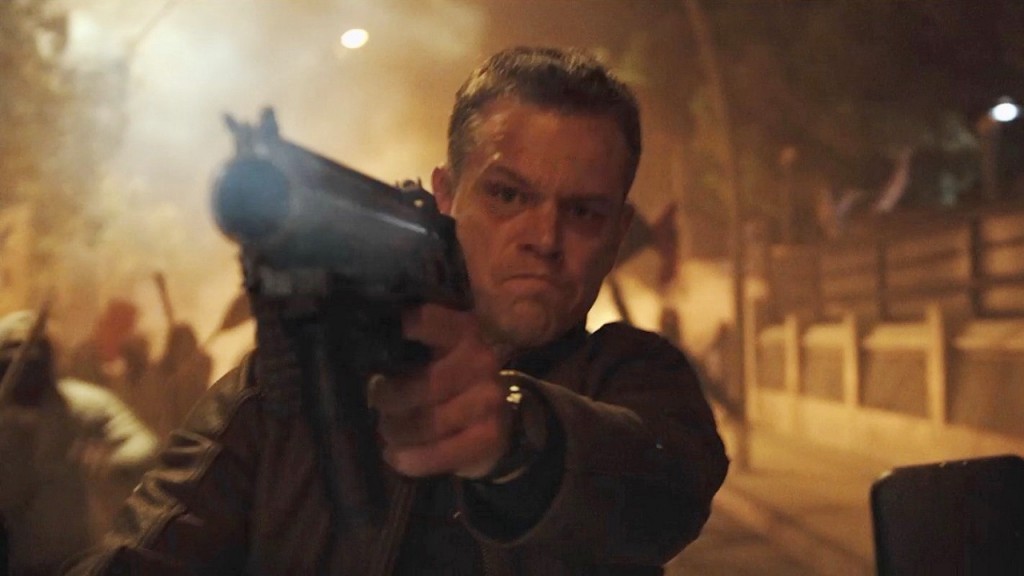
George Clooney as Baird Whitlock in the Coen Brothers "Hail, Caesar!"

There is quite a bit going on in the latest eccentric movie by Joel and Ethan Coen, beginning with its title. It is called Hail, Caesar!, and it is about the making of a sword-and-sandal epic called Hail, Caesar!, which comes complete with a subtitle, “A Tale of the Christ.” Students of Hollywood history will recognize that caption as the same one affixed to Ben-Hur, the Charlton Heston-starring colossus that seized 11 Oscars in 1959, but the Coen Brothers are interested in more than just nostalgic homage. Early in Hail, Caesar!—the real one, not the fake one, though it is occasionally difficult to distinguish the two—producer Eddie Mannix (Josh Brolin, fighting trim) assembles a quartet of religious cognoscenti and beseeches them to tell him if the script for his big-budget behemoth could possibly offend members of their respective faiths. This leads to a predictably funny whirligig of insults and confusion—the rabbi in attendance is constantly denigrating the views of his Christian brethren, while the minister insists that the film’s chariot-jumping scenes are narratively dubious—but the on-screen collision between religion and cinema is hardly incidental. For the Coens, filmmaking isn’t just a vocation. It’s God’s work.

But what about for Eddie? As Hail, Caesar! opens, he is experiencing a crisis of faith, one that has him rushing to the confessional at regular 24-hour intervals. Eddie is the fixer for Capitol Pictures, one of those titanic Old Hollywood studios that churns out star-powered, machine-authorized hits in the vein of Cecil B. DeMille blockbusters, Busby Berkeley musicals, and John Ford westerns (plus plenty of junk, too). He’s wrung out, exhausted from the endless hours and disturbed by the seedier aspects of his job. That doesn’t stop him from working. After we first see him unburdening himself to an apathetic priest, he hightails it to the Hollywood Hills and slaps around one of his stars, berating her for posing for naughty photos (the studio owns her glamorous likeness, you see) and sending her to rehab to dry out. Then it’s off to the back lot to wrangle obstinate directors, soothe haughty starlets, and divert nosy gossip columnists, the latter of whom are always sniffing out the latest scandal. This is to say nothing of the pictures themselves, many of which are behind schedule; when Eddie finally finds a moment to review the most recent dailies of Hail, Caesar!, he discovers that one of its major set pieces is interrupted by a title card reading, “Divine Presence to be shot.” Read More

The Revenant: In This Wilderness, It’s Men vs. Nature, and Man vs. Man

Leonardo DiCaprio braves the wilderness in Alejandro González Iñárritu's "The Revenant"

The Revenant defies categorization, not because it refuses to serve as a particular type of movie, but because it is so many movies at once. Both art film and action flick, both meditative drama and survivalist thriller, both historical fiction and contemporary allegory—the latest and craziest picture from provocateur Alejandro González Iñárritu wants it all. This level of naked ambition is rare in modern cinema, and it is tempting to praise The Revenant—a two-and-a-half hour adventure film with minimal dialogue and maximal craft—for simply existing. But look past its staggering audacity, and The Revenant reveals itself as a work of true duality, even beyond its mirrored ambitions. It is, in empirical terms, both a good movie and a bad one.

Let’s begin with the bad. Based on a novel by Michael Punke (Iñárritu wrote the screenplay along with Mark L. Smith), The Revenant‘s storyline is exceedingly slight. Set in the early nineteenth century, it follows a band of fur trappers in the American wilderness. Initially, there are roughly 30 of them, but after the native Arikara (dubbed “Ree”) spring an ambush—a characteristically bloody sequence filled with loud musket-fire and zooming arrows—their numbers are reduced to about 10, though only two are of any consequence. They are Glass (Leonardo DiCaprio), an inveterate tracker with a half-Pawnee teenage son, and Fitzgerald (Tom Hardy), a brusque trapper who is as unapologetically selfish as he is culturally insensitive. After Glass is severely wounded by a bear—more on that in a bit—he and Fitzgerald are separated from their unit; not one to loiter with an invalid, Fitzgerald murders Glass’s son and leaves the immobilized Glass for dead. The remainder of The Revenant focuses on Glass’sagonizing efforts to survive in the forbidding wild, driven by his need to enact revenge on his son’s killer. Read More