Pay attention to the tennis balls. As a middle-of-the-road racing picture, F1 supplies the expected zoom-zoom accoutrements: checkered flags, roaring engines, heavy tires frantically drilled into mighty chassis. But the most symbolically meaningful piece of sports paraphernalia on display is the set of yellow-green spheres that the film’s hero routinely bounces against a wall in order to test his reaction time. His facility may be equipped with a fancy electronic dummy that measures responses down to the millisecond, but he has no need for such new-age flourishes. He’s old-school.
So, in some ways, is F1, even if its presentation is also robustly contemporary. As a piece of storytelling, the movie is painfully obvious and familiar—a clumsy grab-bag of buddy comedy, underdog melodrama, and other hoary templates. But despite its thinness and its predictability, F1 isn’t without its durable pleasures. It has been muscularly directed by Joseph Kosinski, and it affords the satisfaction of watching talented actors execute their assignments with warmth and precision.
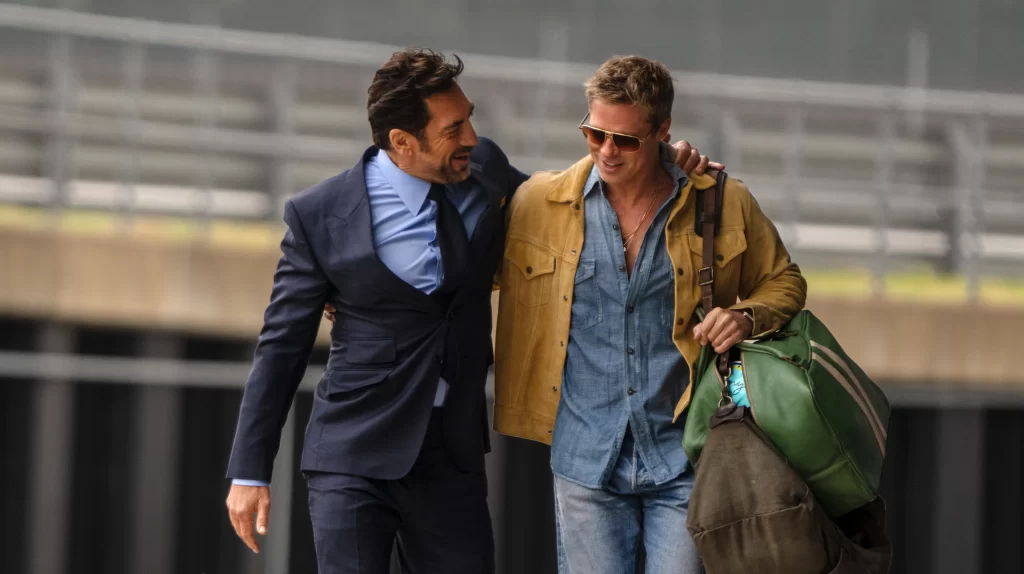
Similarly gifted, if theoretically less reliable, is Sonny Hayes (Brad Pitt), a driver who has no apparent family but who hails from an unmistakable lineage of aged sports-movie savants. Sonny was once a highly promising upstart, the kind of alluring figure who graced the cover of magazines before ego and circumstance short-circuited his career. His moment seems to have passed, but when an old pal (Javier Bardem) offers him a seat on a Formula One team that carries the unfortunate alphabet-soup name of APXGP, he can’t refuse one last shot at glory.
Sonny’s blend of skill, arrogance, and charm evokes a number of cinematic predecessors (Robert Redford in The Natural, Kevin Costner in Tin Cup), but his closest antecedent might be Pete Mitchell, the cocksure pilot from Top Gun who launched Tom Cruise’s shit-eating grin into superstardom. You can imagine the bratty Pete aging into someone like Sonny—or you could, if you hadn’t seen the actual flash-forward version of Pete a few years ago in Top Gun: Maverick. Kosinski, of course, directed that smash hit, and while F1 has no such intellectual property to draw on (the “original” screenplay is by Ehren Kruger), it similarly explores generational conflict, chronicling Sonny’s grudging partnership with a much younger colleague who perceives him less as an industry legend than an out-of-touch dinosaur.
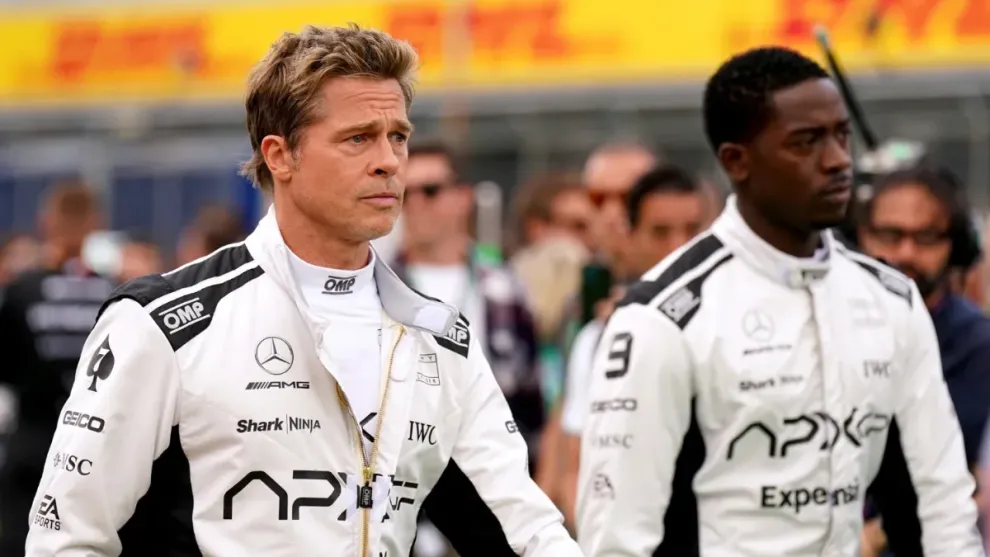
That would be Joshua (Snowfall’s Damson Idris), APXGP’s nascent driver whose untapped potential and youthful hunger inevitably recall Sonny’s since-squelched dreams of immortality. Despite sharing his quality of hubris, Joshua is really Sonny’s temperamental opposite: studious, raw, eager to play the public-relations game. Sonny, by contrast, is an intuitive creature—after a single lap in the APXGP car, he instantly diagnoses its mechanical problems, like how it struggles taking the corner on Turn 9—and a self-described “straight shooter” who evinces no desire to court popular appeal. (At an introductory press conference, when a reporter details a litany of Sonny’s personal and professional embarrassments and then asks if he wishes he’d done anything differently, Sonny responds, “Yes.”) The central dramatic arc of the movie follows Sonny and Joshua’s journey from rivalry to respect, learning to overcome their differences and work together to claim victory.
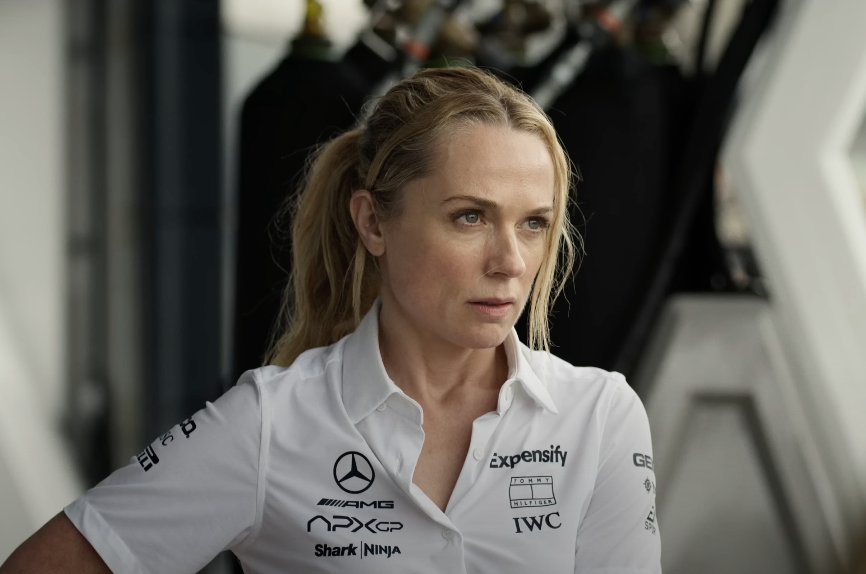
This isn’t surprising. Virtually nothing that happens in F1 is surprising. Formula One is inherently more intriguing than NASCAR because its tracks are all individuated rather than ruthlessly oval-shaped, but any viewer who’s even remotely versed in sports-movie lore can anticipate this film’s turns far in advance. There is a tiresome subplot involving corporate control of the team, one whose outcome is preordained thanks to an executive being played by Tobias Menzies. Sonny’s chiseled form and confident bearing at first repel and then magnetize Kate (a lovely Kerry Condon), the lead APXGP technician who can’t resist the irresistible; their coupling is less a true romance than a byproduct of the laws of physical attraction. Secondary characters—a female tire gunner (Callie Cooke), Joshua’s mother (Sarah Niles, from Ted Lasso)—threaten to become interesting before receding and conforming to the genre’s playbook.
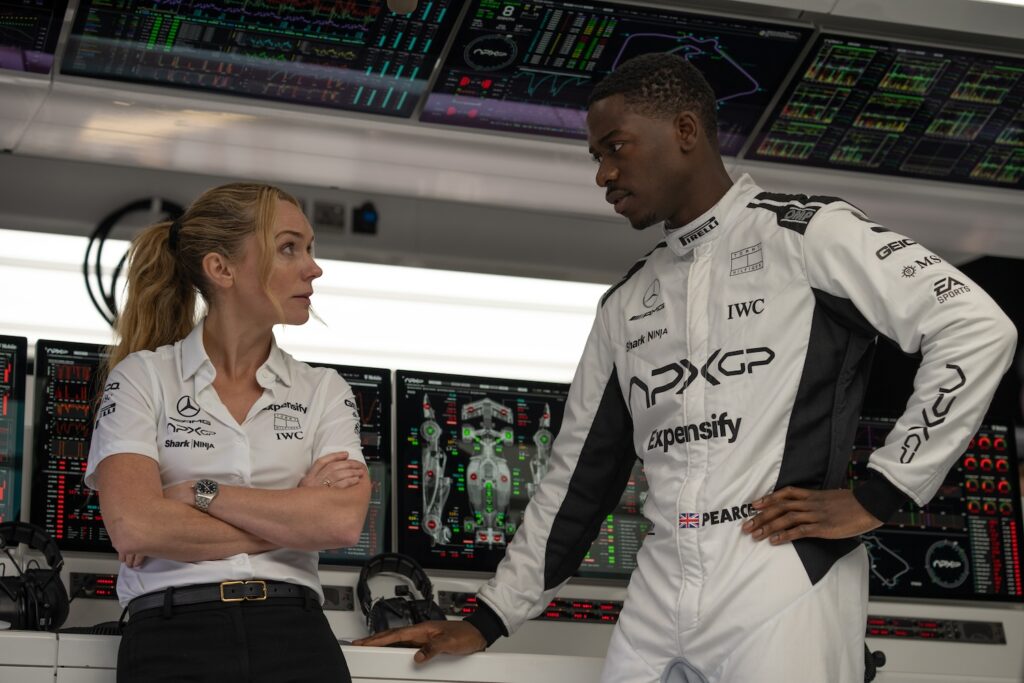
This isn’t so much a complaint as an observation. F1’s conventionality is less than thrilling, but the movie also understands the satisfaction of a competently made competitive drama. One ethos Kate repeatedly tries to instill in Sonny is that racing is a team sport, and while this picture is primarily a vehicle (sorry) for Pitt’s charisma, it is nevertheless a well-oiled product of artistic collaboration. Hans Zimmer’s unapologetically electronic score is an appropriate tone-setter, while Claudio Miranda’s cinematography manages to be vigorous and lucid at once. As for the actors, Pitt is largely on cruise control, but his relaxed approach reflects Sonny’s unflappable demeanor; in support (the Pitt crew?), Idris, Condon, and Bardem all do their best to smuggle nuggets of personality inside their stock characters.
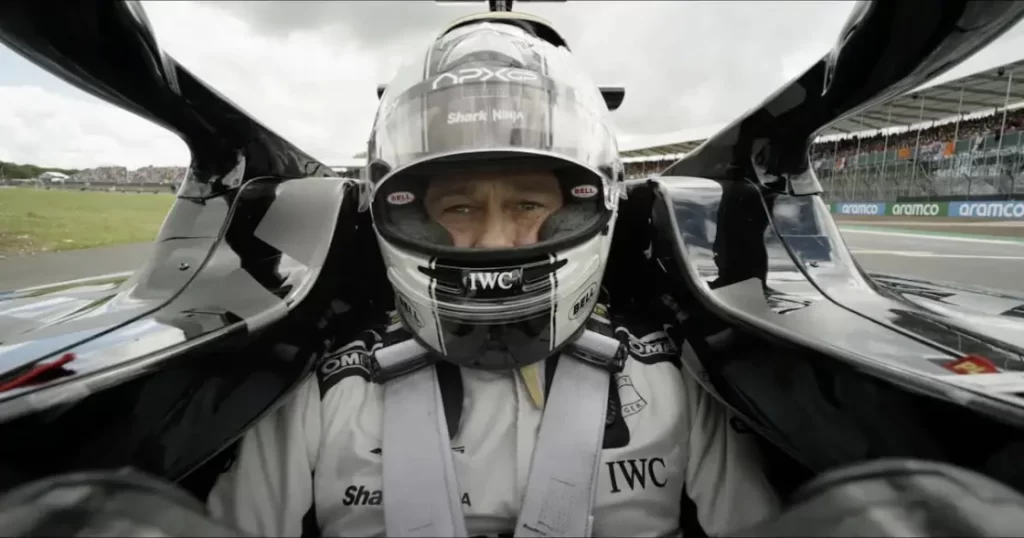
In any event, personality is not Kosinski’s concern—at least not the human kind. His chief interest lies in orchestrating the racing scenes themselves, which he hopes to imbue with the same tangible dynamism that made Top Gun: Maverick such a phenomenon. There is undeniable craft in his process, which plainly involves real cars and cameras along with the usual computerized wizardry. He also deploys a visual variety—split screens, POV images, sweeping crane shots—that lends energy and flair to all of the rattling and zooming.
Yet as well-executed as they are, F1’s set pieces bump up against the ceiling of the genre; it’s difficult to bring real cinematic excitement to what is essentially a bunch of scenes where one logo-littered machine attempts to speed its way past another. There are a lot of racing sequences in the movie (which runs a bloated 156 minutes), and while Kosinski’s commitment to realism is noble, it also results in an enervating sense of repetition. Aside from one (quite horrific) crash, he delivers a recurring parade of tactical maneuvers—pit stops, slingshot passes, desperate rearview-mirror glances—that gradually blur together.
And then there are the commentators, Martin Brundle and David Croft, whose endless prattle will have you reaching for a phantom Mute button. Presumably Kosinski was worried that absent explicit guidance, inexperienced viewers would be confused by Formula One esoterica like caution flags and safety cars. It’s a valid concern, but he has badly overcorrected because these dudes never shut up; they are constantly explaining things to you—not just about warming tires and lapping norms, but about Sonny’s disturbing recklessness or ingenious bravado. It reaches the point where you feel less like you’re watching a movie than listening to a radio broadcast.
“It’s not much of a story,” Sonny says to Kate when she asks about the trajectory of his career. Fair play—after all, he did call himself a straight shooter, and he’s a fitting ambassador for this enjoyable, forgettable movie that could have used a few more curves.
Grade: B-

Jeremy Beck is the editor-in-chief of MovieManifesto. He watches more movies and television than he probably should.