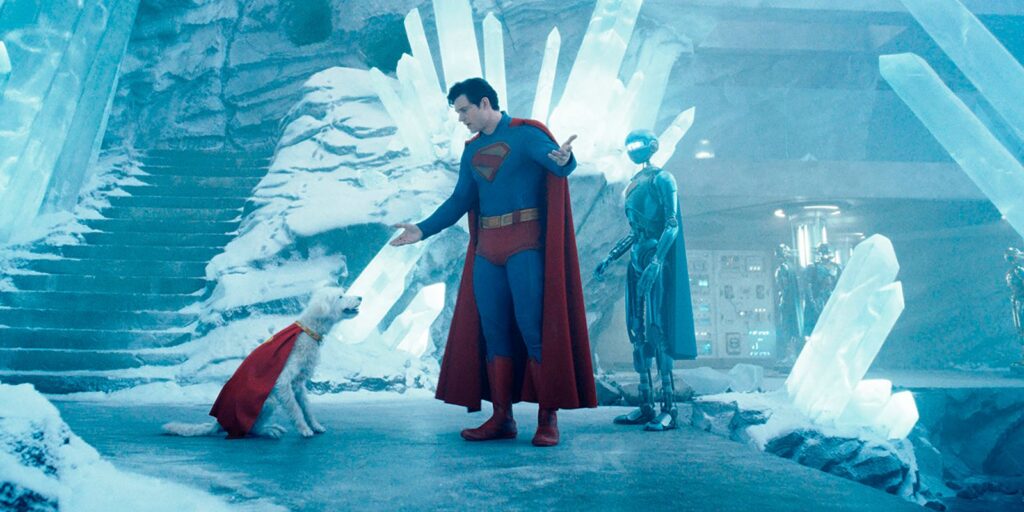
In some ways, Krypto is a bad dog. He doesn’t obey commands. He’s easily distracted, especially by flying squirrels. His affection borders on violence. “It’s more of a foster situation,” his caretaker says, quick to disclaim ownership of this mutant mutt with white fur, a red cape, and asymmetrical ears. Just because Krypto proves crucial in saving the world doesn’t make him any less embarrassing in public.
The spirit of Krypto—playful, excitable, anarchic—is one of the two lodestars guiding writer-director James Gunn in his reboot of Superman, the first feature he’s made for DC Studios since becoming co-chair of the company three years ago. The other animating principle on display is an invisible sense of duty—an obligation to reshape the Man of Steel into a wholesome and commercially pleasing figure. Gunn rose to prominence with his Guardians of the Galaxy pictures, which leavened the grandiose planet-saving of the Marvel Cinematic Universe with impishness and swagger. His challenge here is to retain those films’ sparky vivacity while still delivering a quality-controlled product with mass appeal—to merge comic with comic-book.

All in all, he has threaded the needle fairly well. Superman isn’t a great movie; it isn’t as consistently funny as the Guardians films or Gunn’s Suicide Squad reimagining, and it isn’t as intellectually cogent as, say, Black Panther. But it is a vast and happy improvement over Zack Snyder’s leaden collaborations with Henry Cavill, and if it eventually falls prey to the usual pitfalls of modern blockbuster cinema (weightless set pieces, excessive mythology), it is notably less interested in action than ideas.
Maybe too many. Gunn has crammed the movie’s (relatively brisk) 129 minutes with all sorts of material, and while it’s difficult to ding a superhero flick for having a surfeit of themes, the many topics here tend to jostle for room to breathe. Beyond functioning as a costumed extravaganza full of fights and flights, Superman is by turns (and sometimes all at once) a love story, a political parable, a science-fiction epic, a coming-of-age weepie, and a workplace sitcom.
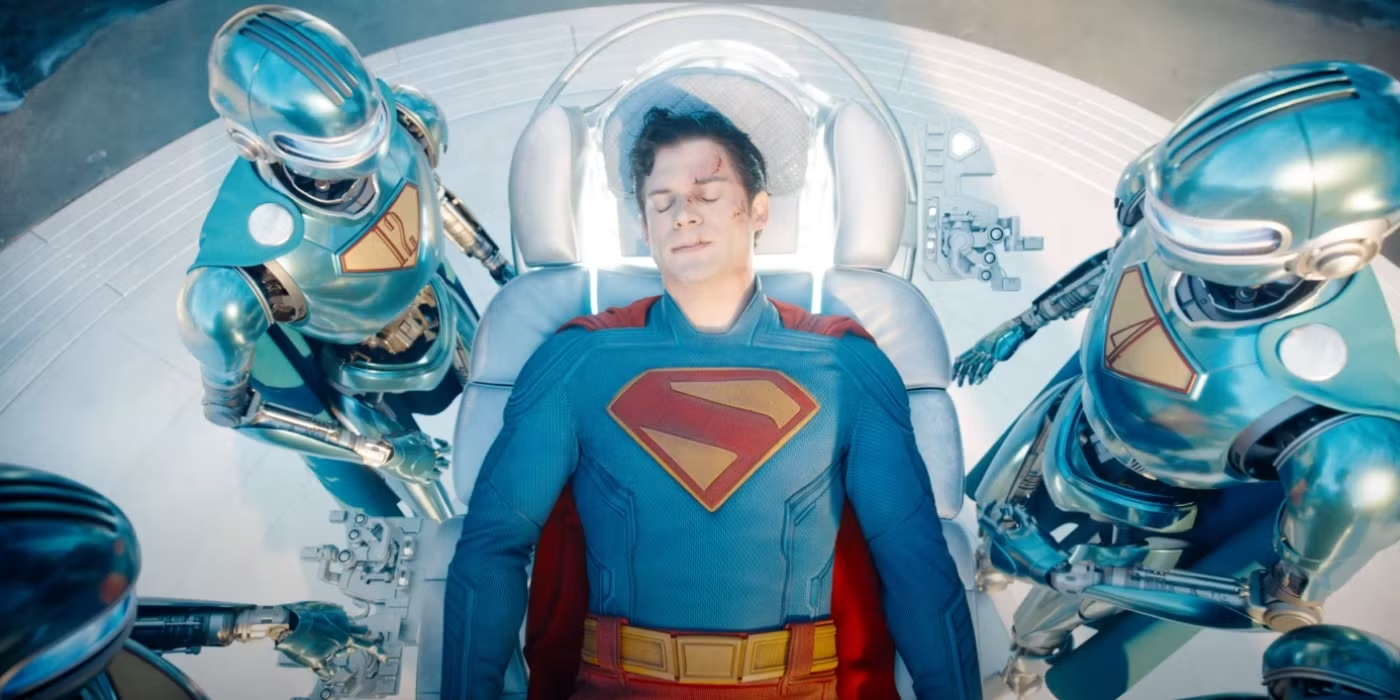
What it is not, notably, is an origin story. Perhaps taking his cue from Matt Reeves’ The Batman, Gunn shrewdly recognizes that most of his audience is already familiar with his hero’s lore—the escape from Krypton, the childhood in Smallville, the secret identity as a bespectacled Daily Planet reporter named Clark Kent—and that he needn’t waste time establishing it. Instead, Superman opens in medias res, with the Man of Steel (David Corenswet) licking his wounds and retreating to his antarctic fortress of solitude after getting his ass kicked by an enigmatic antagonist called the Hammer of Boravia. (The opening crawl initially provokes groans with its blather about metahumans arriving three centuries ago, but it then cleverly burns through exposition via mathematical factoring—three decades ago, three weeks, three minutes.)
The architect of Superman’s initial defeat is, of course, Lex Luthor (a game Nicholas Hoult), the bald megalomaniac who views the Kryptonian as both an existential threat and a personal insult. Lex isn’t blessed with physical superpowers, but he’s rich and committed, and he’s dedicated his unparalleled resources to dethroning his nemesis, in both the press and the flesh. Insistent that brains can conquer brawn, he has assembled a platoon of enemy combatants—not just dime-store villains like The Engineer (María Gabriela de Faría) and the masked Ultraman, but also a regiment of dedicated geeks who stare into monitors and type out the alphanumeric commands which Lex barks at regular intervals. The conceit is that Lex, an obsessive student of Superman’s tendencies, is the ultimate boxing coach, and his verbal instructions manipulate Ultraman’s movements in real time. He’s a kid playing a videogame, one whose quest is the destruction of a god.
It’s a cute concept, yet it also reveals that Gunn is flailing against the corporeal limitations of his main character. Superman may be an interesting mythological construct, but he’s a dud of an action hero because his might and his invulnerability can’t translate into cinematic excitement. There are quite a few scenes of him rushing in to save the day, often by buttressing humongous creatures or buildings just before they demolish helpless innocents. In the abstract, a human-like entity holding up a skyscraper is surely impressive, but on screen, despite Corenswet’s grunts, the image carries no palpable weight. (I was reminded of the wonderful moment in Spider-Man 2 when Tobey Maguire braces a collapsing structure that’s poised to annihilate Kirsten Dunst and remarks, “This is really heavy.”)
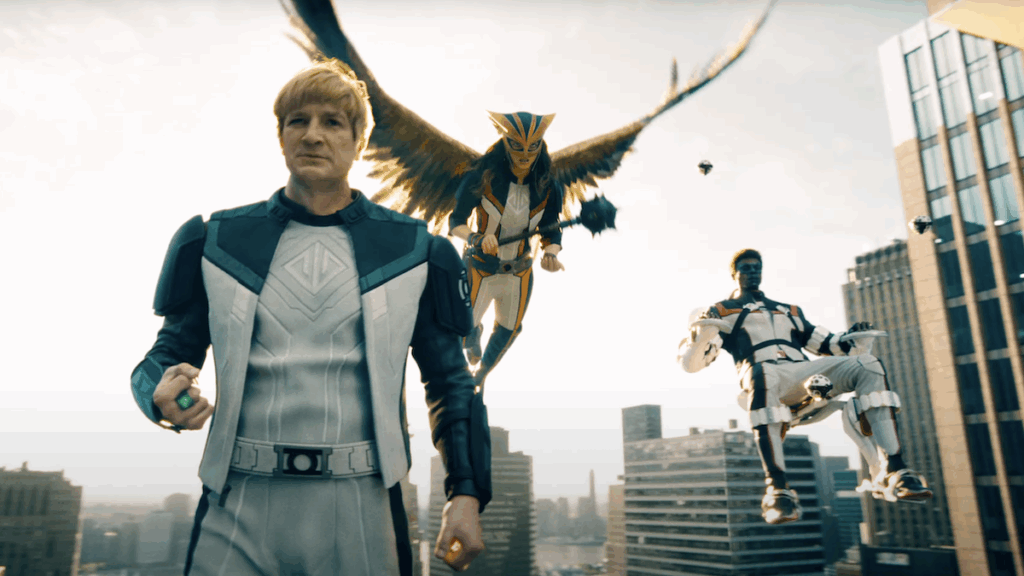
Thankfully, Gunn remains a canny storyteller, and aside from the generically noisy climax, he doesn’t allow the desultory action to stall his narrative momentum. In fact, some of his set pieces are played for laughs rather than thrills. The movie’s best and most imaginative sequence, a oner at a military encampment, unfolds largely from the perspective of a sheltered bystander who gawps in amazement as computer-generated chaos swirls around her while a pop song blares on the soundtrack. Gunn also attains considerable comic mileage from the “Justice Gang” (is their much-derided name a nettlesome poke at Snyder’s Justice League?), a second-tier band of costumed warriors comprising Green Lantern (Nathan Fillion, reliably funny), Hawkgirl (Isabela Merced, from The Last of Us), and Mr. Terrific (For All Mankind’s Edi Gathegi). And in an inspired touch, Gunn stages a rambunctious battle between this trio and a random kaiju (Starro the Conqueror, the big bad from The Suicide Squad) entirely in the background of an apartment’s window, instead directing his primary attention to the heart-to-heart between Superman/Clark and his girlfriend.
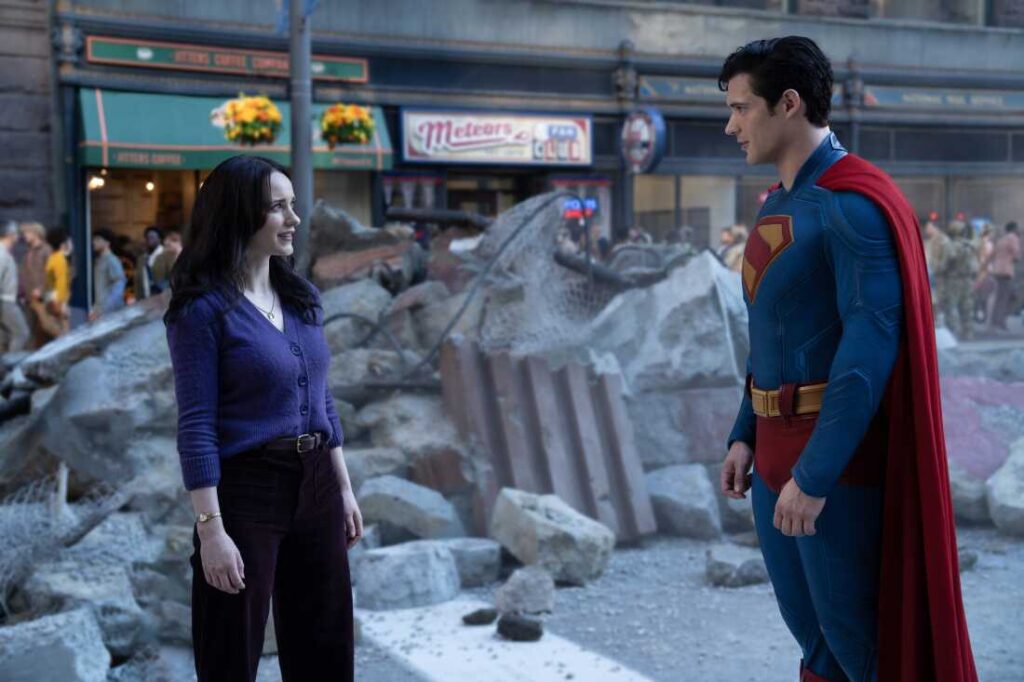
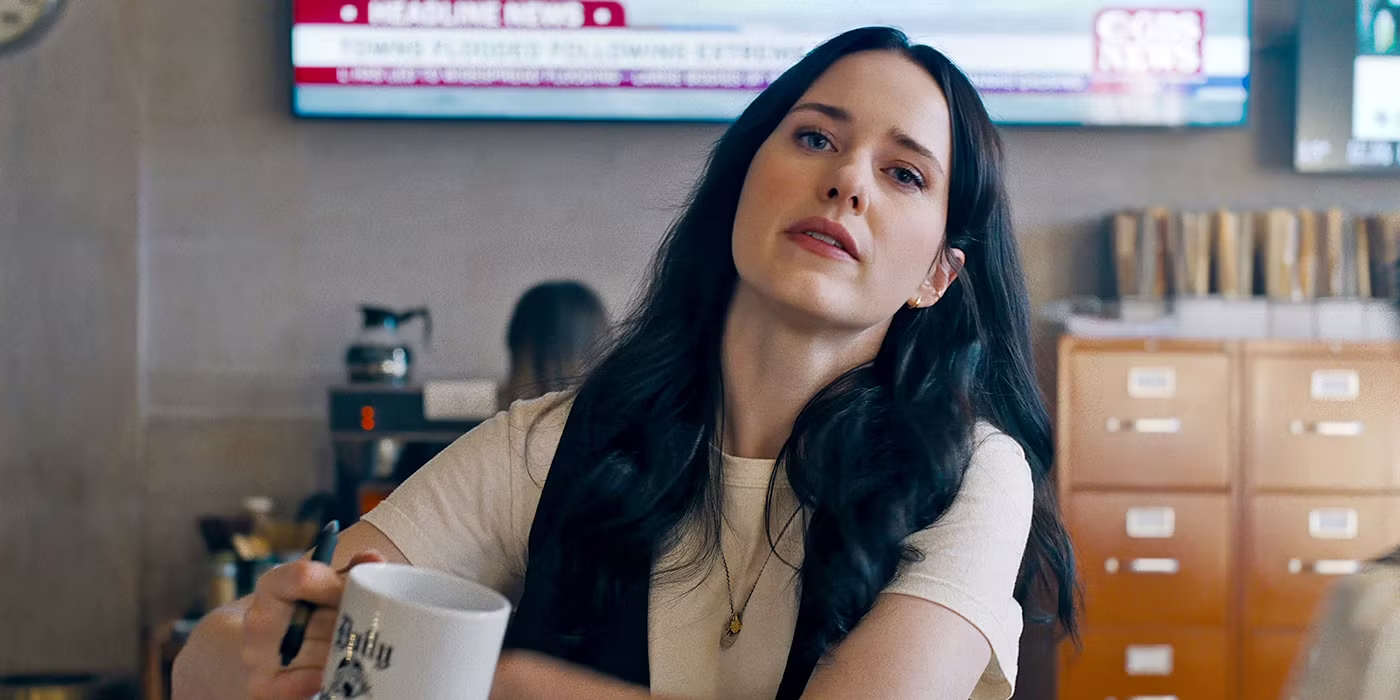
That, naturally, would be Lois Lane (Rachel Brosnahan, just right), and another of Gunn’s smart decisions is to skip past the predictable courtship and jump in after his two Daily Planet colleagues have started dating. Their relationship isn’t exactly idyllic, and an early scene where Lois conducts an impromptu interview of Superman—pressing him on his lack of diplomacy, questioning his unchecked power—reveals an underlying tension, even as it demonstrates Gunn’s facility with wordplay. Yet they also plainly have the hots for each other, and Corenswet and (especially) Brosnahan do a lovely job conveying both their physical attraction (they even kiss!) and their underlying devotion.
Not everyone views the Man of Steel so adoringly. Superman may be invincible in a fight, but he is less adept at the brutal warfare of public relations. Lex, a capable fearmonger—he has devised a social-media troll farm where hatred and misinformation are spewed by literal monkeys—regularly gives interviews to news-desk anchors, taking the guise of a concerned citizen who’s Just Asking Questions but really sowing mistrust and fomenting outrage. Superman has long embodied virtue and purity, but what happens when people perceive his gifts not as a check against tyranny but as a threat to their own freedom?
As a matter of allegory, Superman isn’t wholly coherent. The plot, in which the fictional Boravia seeks to invade a less prosperous neighbor called Jarhanpur, can presumably be mapped to the ongoing Russia-Ukraine war—Boravia’s president (Zlatko Buric) seems to combine Vladimir Putin’s bloodthirsty aggression with Donald Trump’s imbecility and susceptibility to puppet-mastering—while briefly glimpsed TV personalities suggest Sean Hannity or Tucker Carlson. This isn’t necessarily incisive, and there is a certain timidity in gesturing toward real-world conflict while still keeping things blurry enough to allows viewers to develop their own interpretation. But for a comic-book movie whose hero is traditionally deemed to represent “truth, justice, and the American way,” Superman deserves credit for wrestling with what “the American way” really means, and how the ideal can be weaponized and perverted.
Lex, beyond his general lust for power, is an unapologetic nationalist, repeatedly branding Superman “an alien.” It doesn’t take an expert in pop-culture literacy to link his bellicose rhetoric to current official U.S. immigration policy. The most unnerving thing about Hoult’s performance isn’t how easily he evokes Silicon Valley tech billionaires—if anything, this incarnation of Lex Luthor is less openly racist and deranged than Elon Musk—but how plausibly he launders rank bigotry into TV-friendly sound bites. (By contrast, the screenplay’s late speeches addressing Superman’s humanity and Lex’s envy play as forced rather than provocative.)
What’s neat about Superman is how it makes room for this kind of thorny material while still operating as a piece of four-quadrant entertainment that’s generally buoyant, pleasant, and shiny. Not everything works—the clandestine affair between Jimmy Olsen (Skyler Gisondo) and Lex’s girlfriend, Eve Teschmacher (Sara Sampaio), is awkwardly handled—but the comedy is largely appealing, whether it’s Clark and Lois’ verbal sparring, Green Lantern’s blundering self-importance, or Lois’ mounting impatience as she waits for Mr. Terrific to open his garage door. Alan Tudyk, cinema’s vocal laureate, earns laughs as one of Superman’s supportive droids, while the denouement involving Krypto and a future headliner deserves its own cheer.
Speaking of which, the success of Superman will surely lead to sequels, spin-offs, and all sorts of cross-promotional merchandising opportunities. Whether Gunn can adequately curate this nascent IP empire without sacrificing his creative instincts remains to be seen. But on its own terms, Superman is good enough to inspire confidence that he’ll continue treating movies as art rather than enterprises. Unlike Krypto, it can’t save the world, but it does allow the DC Universe to keep on spinning.
Grade: B

Jeremy Beck is the editor-in-chief of MovieManifesto. He watches more movies and television than he probably should.