

Some films yearn to transport you to days bygone, preying on your nostalgia for the glories of the past. Then there’s Eddington, the latest freak-out from Ari Aster and the exact opposite of a whimsical memory-lane venture, instead regarding its chosen era with suspicion and exasperation. Set in May 2020 at the outset of the COVID-19 pandemic, it’s an unholy time machine of a movie—the kind that will have you clawing at the walls, breaking your fingernails as you search for a way out.
Aster made his bones with Hereditary, a skin-crawling nightmare that refused to let you ever look at your parents or telephone poles the same way again. Eddington has no curses or demons or decapitations, but thematically speaking, it’s even scarier than his debut, seeing as it grapples with society’s collective cluelessness in response to an encroaching plague. Sure, supernatural forces are disturbing and all, but they’ve got nothing on human stupidity.
The thesis of Eddington is that it doesn’t have a thesis. Or maybe it has infinite theses, like a rotted Rorschach test. Police brutality is a scourge, and also protestors are virtue-signalling frauds. The alt-right are a bunch of fascists, and also antifa are secretly orchestrating the whole thing. Black lives matter, white men are wrongfully persecuted, and the Pueblo need to get over the whole “stolen land” thing.

Amid all of these conflicting sentiments lies at least one unifying idea: We all spend too much time on our phones. Eddington is full of scenes of people looking at or talking to screens, those nominally connective devices that tend to isolate, misinform, and polarize. Aster, a resolute formalist, challenges himself to harmonize his austere technique (long follow shots, careful framing) with the jittery, DIY aesthetic of amateur documentarians who reflexively film everything they see. If his new movie lacks the cold beauty of Midsommar or the hypnotic imagery of Beau Is Afraid, this is a sacrifice designed to mirror its scattershot narrative and its topical hodgepodge.
The chief ambassador of Eddington’s chaotic worldview is Joe (Joaquin Phoenix, reliably excellent), the weary sheriff of its titular New Mexico town. When we first meet him, he’s sitting in his patrol car, watching a self-help YouTube clip that’s adorned by a promotion for hydroxychloroquine—one of the picture’s many quiet flourishes that make you shudder with temporal recognition. Joe, unlike Phoenix’s rhymed protagonist from Aster’s prior feature, is not afraid. He is instead angry, irritable, and perpetually aggrieved. Spend time with him—spend time with anyone in this movie—and you’ll start to feel the same way.
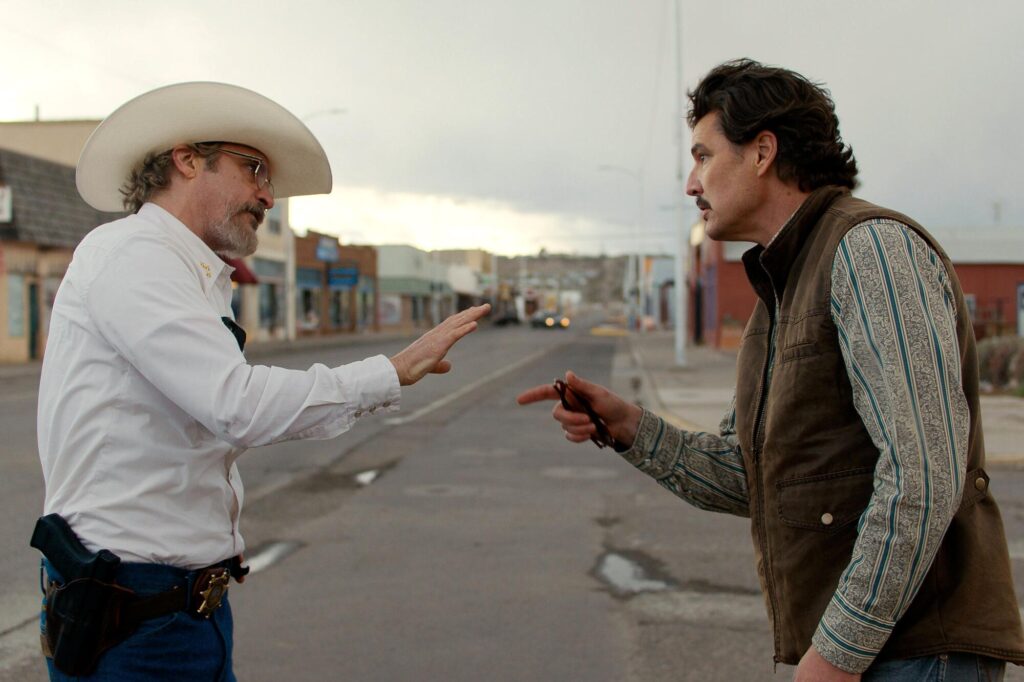
The principal target of Joe’s ire is Ted (the ubiquitous Pedro Pascal), Eddington’s putatively liberal mayor who has taken pains to enforce the state’s newly enacted mask mandates and social-distancing requirements. Joe, an asthmatic who perceives these health and safety measures as an affront to his personal liberty, impulsively resolves to mount a campaign and dethrone Ted from the mayoralty, a decision that sparks this powder keg of a hamlet into combustion.
As an ostensible satire, Eddington takes pride in its ideological incoherence, but given that it unfolds largely from Joe’s point of view, it’s initially unsettling (at least to this left-wing snowflake) how it seems to adopt his diatribes as plainspoken truths rather than manufactured grievances. This misgiving eases once you realize that Joe, despite his pretense of authority, is a complete idiot. Ignoring his constabulary duties in favor of his sudden battle with Ted, he immediately mobilizes his deputies (Luke Grimes and Micheal Ward) to serve as political operatives, resulting in grammatically unfortunate signage like “Your Being Manipulated.” His home life is even less organized: His wife (a catatonic Emma Stone) has fallen under the spell of a bright-eyed cult leader (Austin Butler) who murmurs about impending revolution; his mother-in-law (The Penguin’s Deirdre O’Connell) is a conspiracist who won’t stop prattling about the latest online gobbledygook.

Joe’s relatives are far from the only people talking nonsense. Eddington’s article of faith is that everyone—the cops, the candidates, the rebels, the influencers, the teenagers who spearhead demonstrations and also Google “Angela Davis” in the hope it’ll get them laid—is full of shit. (The lone exception may be the town drunk, whose single-minded pursuit of liquor achieves a certain integrity by comparison.) The approach isn’t so much that there are valid concerns on both sides but that all sides are equally bankrupt, with everyone trafficking in bogus rhetoric and phony posturing. There is limited value in this sort of wholesale lampooning; the more the film babbles about Instagram feeds and Chinese labs and land acknowledgements (I confess to laughing when a white do-gooder capped his monologue by howling, “This is a speech I had no right to make!”), the less it has to say of substance.
Had Eddington remained in this vein for the entirety of its 149-minute runtime, it might have proved insufferable. But Aster, never one to shy away from loading his pictures with vertiginous extravagance, has more in store. At its rough midpoint—specifically, when a very public slap (soundtracked by Katy Perry) is followed by a very private series of gunshots—the movie’s plot curves, and it pivots from an uneasy comedy into something resembling a thriller.

And one that is, if not exciting, nonetheless weirdly captivating. Aster’s execution of his set pieces is gleefully deranged, but his mania shouldn’t obscure the dexterity of Phoenix’s performance. Beyond his routine physical transformations (though his hat and glasses do most of the work here), the actor’s great gift is his unwavering commitment—his ability to take outlandish material (Inherent Vice, You Were Never Really Here) and imbue it with human frailty. Joe, with his constant coughing and wheezing, is sick in more ways than one, but Phoenix never lets you doubt the character’s demented self-belief, even as his carefully structured life comes tumbling down.
Which is, as they say, relatable. Roger Ebert was fond of saying, “It’s not what a movie is about, it’s how it is about it.” With due respect to Aster’s craft, Eddington is meaningful both because it’s about the dawn of COVID-19, and for how cruelly it makes you relive the sheer insanity of those early-pandemic days—the helplessness, the confusion, the anger. Those raw emotions haven’t really subsided in the half-decade since, which is why Eddington, despite its limp satire, ultimately acquires a measure of accuracy. This is the COVID movie we deserve—an absurd document of a broken world.
Grade: B

Jeremy Beck is the editor-in-chief of MovieManifesto. He watches more movies and television than he probably should.