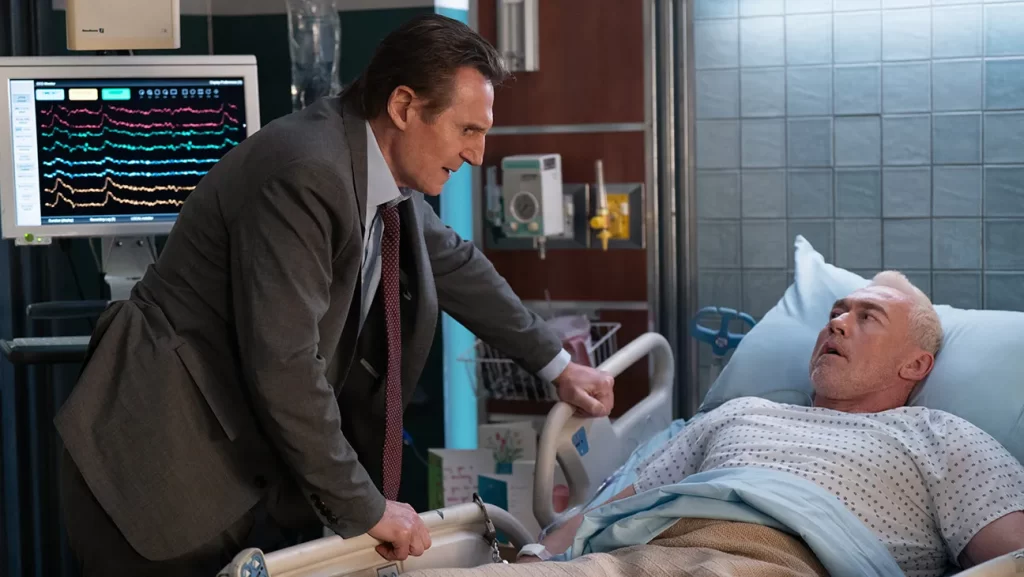
Wander into The Naked Gun at the exact wrong (or right) moment, and you may suspect that you’ve mistakenly arrived at the latest Mission: Impossible flick. As a henchman lies handcuffed to a hospital bed, a detective coaxes incriminating information from him under the pretense that the villain’s master plan has already succeeded. Once the crucial details are revealed—and just before the room’s false walls fall away to reveal a phony set, confirming the elaborate masquerade—the cop asks his unseen colleagues, “Did you get all that?”
You probably didn’t. The chief attribute of The Naked Gun, the new sorta-sequel to the Leslie Nielsen-led franchise from the ’80s and ’90s, is density. It runs 85 minutes and features roughly 10 times as many jokes, to the point where your brain can’t possibly process all of the purported humor in real time. The assault is relentless but also oddly reassuring. If a line or gag or reference sails over your head, you need not spend time chasing it; another one will be arriving within 10 seconds.
This means that the success The Naked Gun, which was directed by Akiva Schaffer from a script he wrote with Dan Gregor and Doug Mand, comes down to percentages. The higher the share of jokes that land, the more enjoyable it is. So when I say that one-third of this movie’s attempts at hilarity left me puzzled, annoyed, or appalled, it isn’t exactly an indictment, because it means I laughed approximately 500 times.
Shall I count the ways? I’m wary. After all, they say the surest way to ruin a joke is to explain it. This poses something of a problem for critics, whose job is to describe, analyze, and illuminate. Still, I’ll risk opining that one of the smart things about this Naked Gun—and it is, if not exactly an intelligent picture, one which wields its stupidity smartly—is that it’s as committed to variety as it is to quantity. Repetition can risk boredom, but while this movie’s pacing is certainly non-stop, its method is gleefully comprehensive, deploying any and all measure of comic stylings in its perpetual pursuit of a laugh.
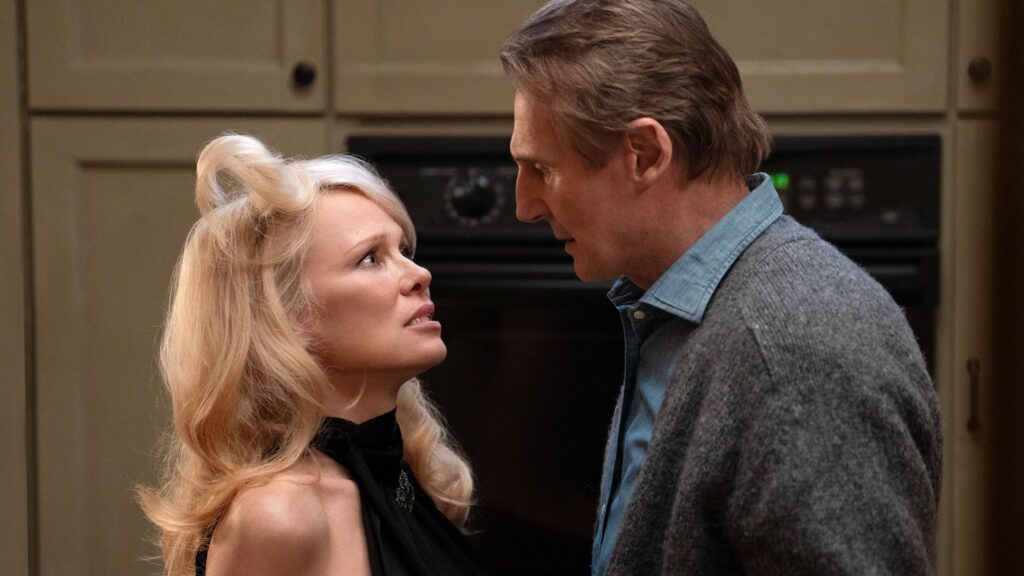
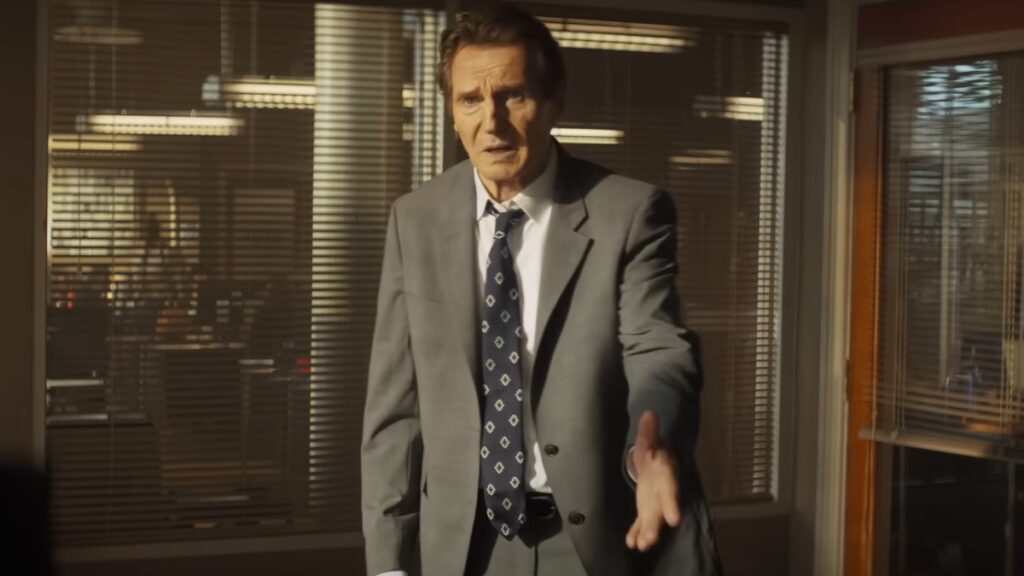
Yet perhaps the most crucial element of The Naked Gun is its casting of Liam Neeson, an actor of considerable gravitas, as its central boob. That would be Frank Drebin Jr., the Police Squad lieutenant who is both the supplier and the butt of most of the film’s gags. Despite his imposing presence and his prestige pedigree, Neeson has always had a talent for wry comedy, and here he and Schaffer have made the correct decision to play things completely straight, eschewing winking nods in favor of absolute commitment. It takes a certain skill to deliver outrageous lines without acknowledging their ridiculousness—when someone tells Drebin that his deceased wife sounds like a saint, he responds, “Or maybe a Bronco or a 49er”—and Neeson sells the jokes precisely by refusing to be in on them.
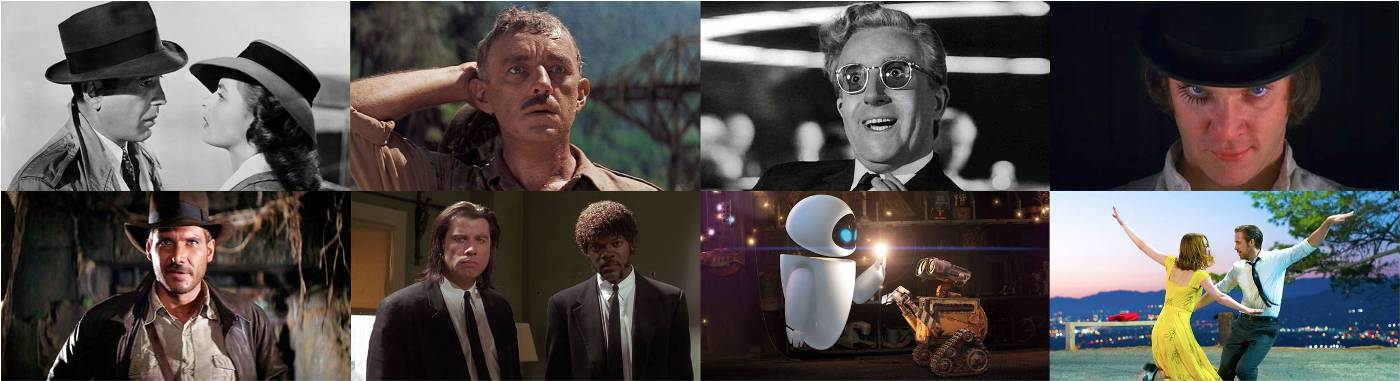
In fact, a guiding principle of The Naked Gun is that it functionally appears not as a smirking laugh riot but as a hard-boiled Hollywood noir. (Coincidentally or not, Neeson played one of fiction’s most famous Los Angeles detectives just a few years ago in Marlowe.) The plot features a femme fatale (Pamela Anderson as Beth), a dastardly heavy (Danny Huston), and a convoluted conspiracy involving corruption, blackmail, and murder. And with the exception of a direct-to-camera grimace regarding the legacy of O.J. Simpson, everyone on screen follows Neeson’s steadfast lead, which is why the ostensible mood is one of intensity rather than comedy.
Lest you think any of this be taken at face value, the film opens with a robbery in which someone steals a portentous gadget that’s inscribed with the label, “P.L.O.T. Device.” Yet despite a few playful references—including one to The Usual Suspects, which Nielsen previously parodied in Wrongfully Accused—The Naked Gun doesn’t really operate as a send-up of specific movies. It is too busy bombarding you with every species of joke you can fathom.
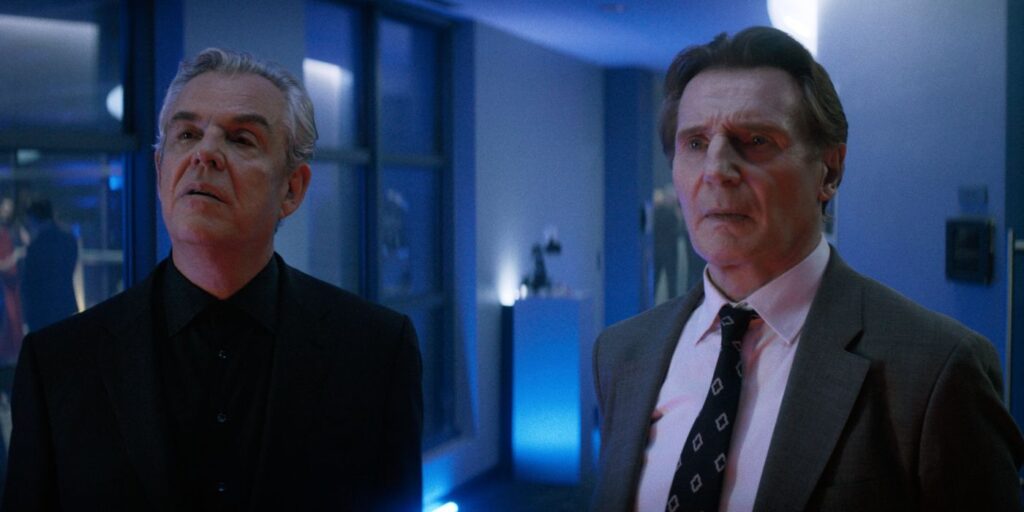
And so: There are sight gags, like how Drebin is always being handed increasingly large cups of coffee, or how the taking of mug shots at the police station doubles as a professional photoshoot. (Note also the jab at a certain cryptocurrency-sponsored L.A. venue, which is here renamed to “Ponzi-scheme.com Arena.”) There is scatological raunch, like the scene where an eavesdropper misapprehends his binoculars and thinks he’s witnessing various sex acts between Drebin, Beth, and a dog. There are over-the-top action goofs, as when Drebin singlehandedly disarms a cadre of thugs, including by biting one of their guns in half. There is delirious absurdity, most memorably in an imagined sequence involving a snowman that pivots from romantic fantasy to tawdry thriller. There is even some punchy satire, as the script takes aim at both police brutality (“Since when do cops have to follow the law?” Drebin grumbles) and tech-maven stupidity (it’s not for nothing that Huston’s sneering villain made his fortune in the electric-car business).
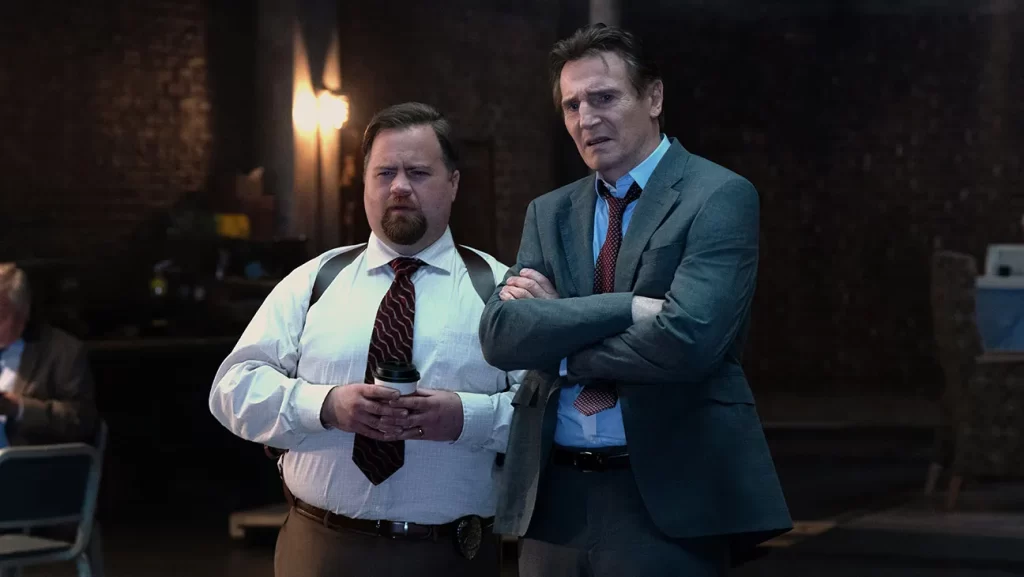
Most of all—or at least, most instantly appealing to me—there is a fanatical focus on language. Much like in Airplane (still the genre’s gold standard), this Naked Gun is obsessed with wordplay, and with how verbiage can be misunderstood or manipulated. Sometimes it exploits homophones, as when an associate reminds Drebin about Miranda rights and he counters, “Carrie writes, Miranda’s a lawyer.” Sometimes it plays with idioms, like how Drebin remarks that you can’t fight city hall and his partner (a solid Paul Walter Hauser) concurs, “No, it’s a building.” And sometimes it traffics in delightful, demented literalism; when he demands to see a nightclub’s security footage and the proprietor responds “May I ask why?” Drebin answers sincerely, “Go right ahead.”
Yet while that last one made me cackle louder than anyone else in the theater, I also spent a good portion of The Naked Gun wincing in bafflement as everyone around me kept cracking up. This is the blessing and the curse of subjective comedy: Not everything is funny to everyone, and one man’s laugh is another’s displeasure. An interminable scat rendition, a narcoleptic husband, a magical owl, a lengthy exchange involving the Black Eyed Peas—all of these moments, and more, left me cold. And though Schaffer deserves credit for staging his set pieces with a modicum of flair, the movie’s visual style can’t always resuscitate it during its many dead spots.
Still, such rough patches are endemic to The Naked Gun’s high-volume approach; all things considered, the movie’s hit quotient is fairly strong. It is also a noble reminder that cinematic humor can exist for its own sake—that there’s something sacred about sharing giggles in the company of strangers.
“It says here you did 20 years for man’s laughter,” Drebin growls while reading a suspect’s rap sheet. “Must’ve been quite the joke.” Indeed, but it’s also the work of a man who knows how to take comedy seriously.
Grade: B

Jeremy Beck is the editor-in-chief of MovieManifesto. He watches more movies and television than he probably should.