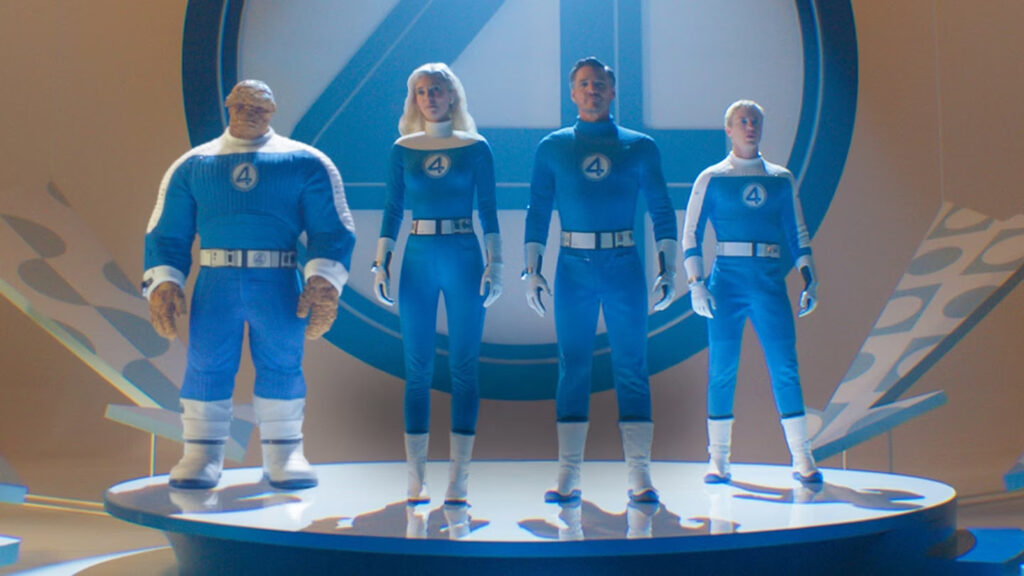
Things are different on Earth-828. I’m not talking about the laws of physics or the division of diplomatic supremacy or the popularity of late-night talk shows; all of that stuff is basically the same. (OK, maybe the talk show thing is a bad example.) No, what’s really jarring about this multiversal variant is that on this planet, nobody has ever heard of The Avengers.
Such ignorance is, if not exactly bliss, at least a small mercy. The Fantastic Four: First Steps is the fourth feature to depict Jack Kirby and Stan Lee’s superpowered quartet, but it’s the first to formally integrate them into the Marvel Cinematic Universe. Yet any proper crossover that pairs this new/old foursome with our more established caped heroes—an upcoming collaboration that’s teased in the stingers to both this film and Thunderbolts—will need to wait. This movie, for all its interstellar escapades and cosmic hand-wringing, is a relatively self-contained adventure, disregarding the extant members of the MCU and instead focusing exclusively on these four playful, imperiled heroes.
Actually, make that five: First Steps begins with Sue Storm (Vanessa Kirby) learning that she’s pregnant. It’s a reason for joy but also trepidation, given that Sue and her partner, Reed Richards (Pedro Pascal), are astronauts whose DNA was altered when they were blasted by cosmic radiation. That mishap blessed them with remarkable abilities—Reed can elongate his limbs to absurd length, while Sue can become invisible and also project temporary force fields—but it’s unclear how their mutations will influence the process of reproduction. Might their gifts impair their capacity to be parents?
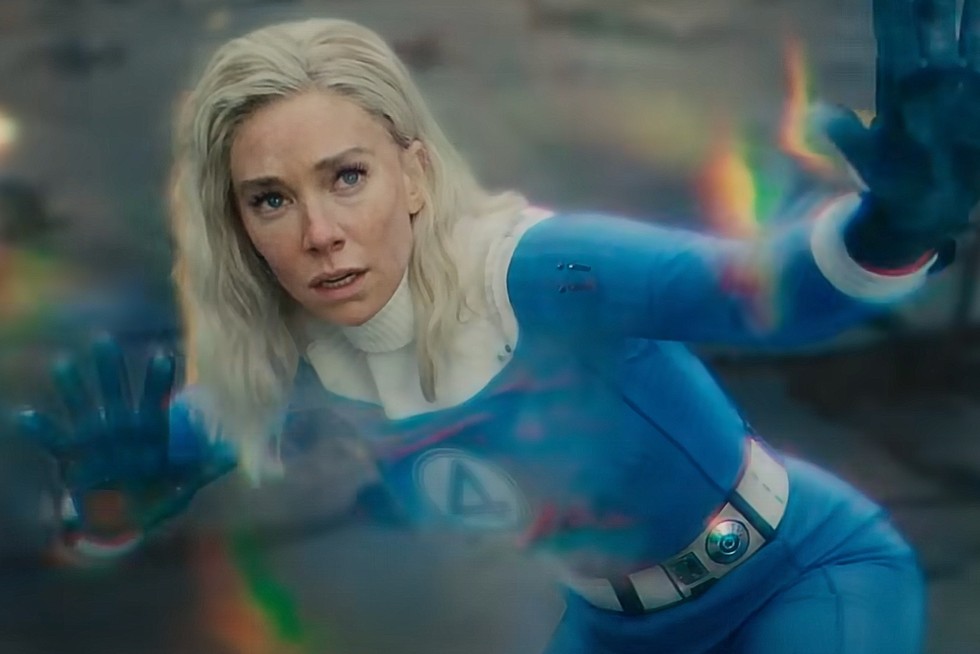
This is one of several intriguing metaphorical questions that First Steps asks and then, whether as the result of clumsiness or cowardice, fails to adequately tackle. Other conundrums presented include: How do you weigh individual liberty against collective welfare? Can nation-states with conflicting values set aside their differences to jointly address an existential threat? Is logic the enemy of passion? And how can the Silver Surfer be so hot despite not really having a face?
We’ll get to her. First there is exposition to burn through, and to its credit, First Steps’ opening is a canny blend of speed and elegance. The screenplay—credited, fittingly, to four separate writers—assumes a certain comic-book fluency from its viewers and thus wastes minimal time establishing the characters’ powers or origins. It instead devises a clever framing device in which a television personality (Mark Gatiss) hosts a program celebrating the “anniversary” of that outer-space incident and its aftermath, which it displays via faux interviews and stock footage. Beyond revealing our heroes’ talents—in case you’re a comic-book neophyte, the other two members of the gang are Sue’s brother Johnny (Joseph Quinn), who can fly and explode into flames, and Reed’s friend Ben (Ebon Moss-Bachrach), now a hulking rock-formed creature called The Thing—it informs us that they’re universally beloved for their valor and their altruism. To quote a different and superior take on a mutantly abled family of four: They’re superheroes, what could happen?
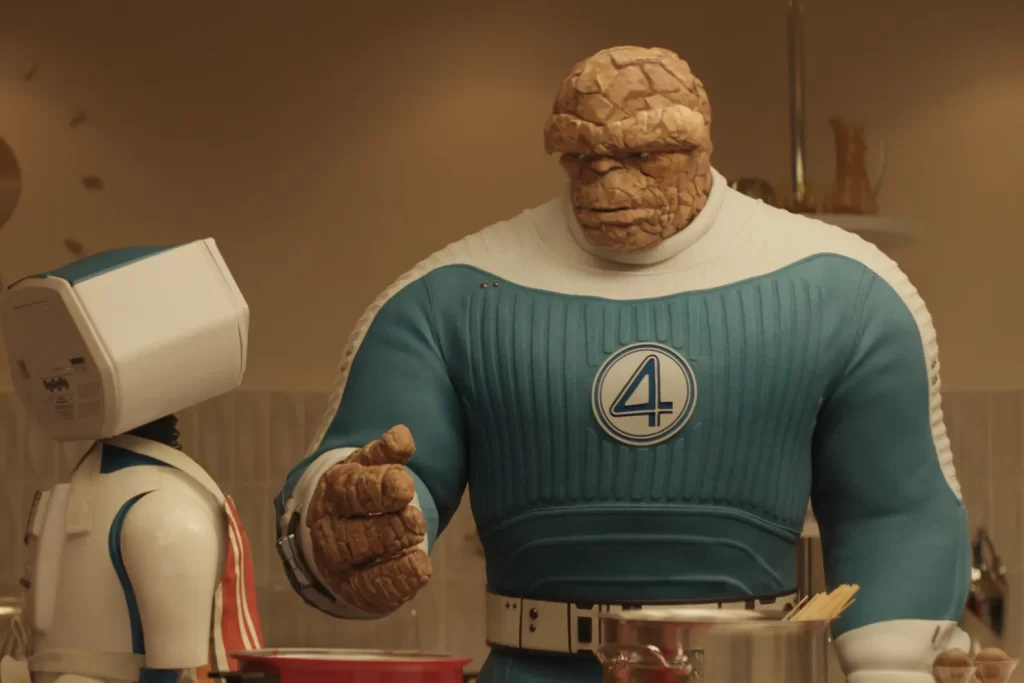
Quite a bit, though the movie’s comparatively narrow scope prevents it from feeling (har har) overstretched. Director Matt Shakman, a TV vet (he helmed all nine episodes of WandaVision) who’s making his first feature in 11 years, may struggle to execute the usual blockbuster imperatives, but he’s crafted a pleasant hangout picture. The 1960s setting and sky-blue color scheme lend the proceedings a perky appeal, and the characters are largely unburdened by the tiresome identity crises endemic to the genre. Ben, for example, seems perfectly comfortable in his metamorphic body, spending most of his time either critiquing his roommates’ cooking (a sly nod to Moss-Bachrach’s work on The Bear) or cautiously flirting with a local teacher (Natasha Lyonne), though coy glances are as far as it goes; any thoughts of consummative challenges have no place in the sexless MCU. For his part, Johnny is an agreeable goofball—less an impulsive rebel than a droll but supportive younger sibling—and Quinn handles the script’s many quips with disarming insouciance.
The movie’s main dramatic axis—well, aside from all of the planetary peril, which I’m postponing discussing for as long as possible—is the relationship between Sue and Reed, and their consternation in the face of impending parenthood. Reed, ever the brilliant scientist, is a ruthless logician, and he approaches Sue’s pregnancy (and its potential complications) as a problem that can be solved. His intellectual rigor vexes Sue, who tends to perceive his calculative method as retreating from life’s messy realities rather than confronting them.
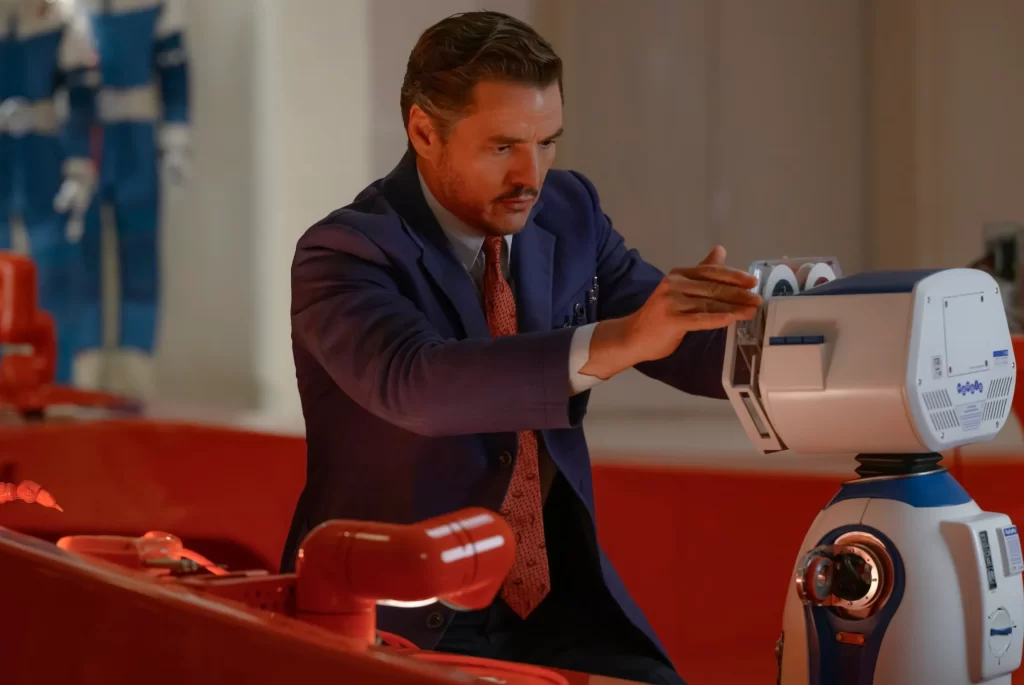
To the extent First Steps is meant to speak to general parental anxiety, it doesn’t fully cohere, in part because the script ultimately dodges the issue: Sue and Reed’s child, named Franklin, is born happy and healthy (albeit during a hectic space flight). Still, it’s nice to watch a superhero movie that features real people talking about real problems, and that depicts a marriage which is, while occasionally strained, broadly healthy and mature.
But although First Steps’ characters are well-drawn, it quickly banishes any foolish notion that it might center on people and feelings rather than plot and mayhem. Its ungainly story kicks into gear upon arrival of the aforementioned Silver Surfer, a sleekly designed herald of doom who speaks in the oddly soothing cadence of Julia Garner. As prophesiers of the apocalypse go, she’s more alluring than most, and the strange bond that intensifies between her and Johnny is a source of mystery as well as comedy.
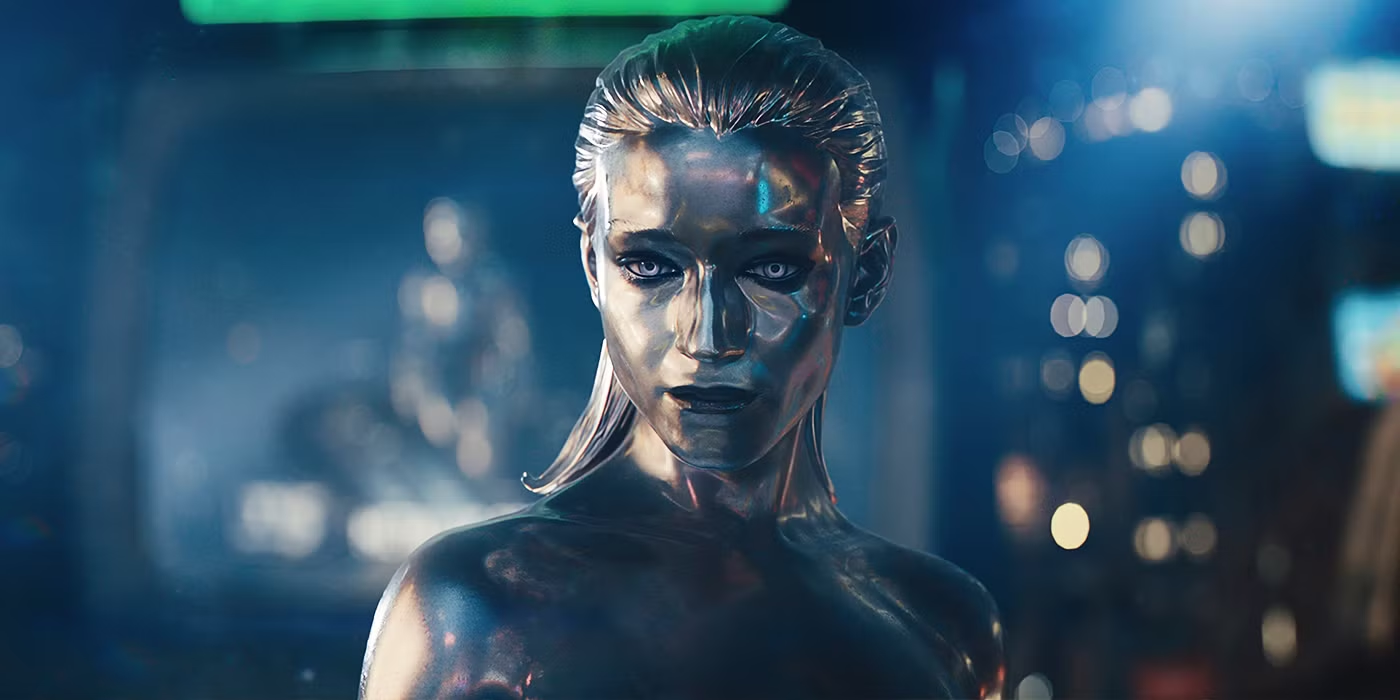
The problem, for both the movie’s characters and its quality, is that the Silver Surfer is the servant of Galactus (Ralph Ineson), an almighty titan who’s bent on the destruction of Earth-828. “He doesn’t want,” the Surfer explains, “he feeds.” Galactus, not unlike Pennywise the Clown, is an eater of worlds, and his insatiable appetite has turned toward the Fantastic Four’s realm. It’s nothing personal; he’s just hungry.
You’ll forgive me if I still take offense, because cinematically speaking, Galactus is a phenomenally boring villain. As an allegory, it’s possible to equate him to climate change—an encroaching disaster that can only be staved off via political cooperation and literal bridge-building—but while First Steps briefly traffics in a welcome fantasy of global harmony, that vision dissipates once this menacing Steppenwolf-like shithead starts stomping through New York and staring down at the Statue of Liberty. Similarly, although the movie purports to pose a provocative ethical dilemma—Galactus offers to spare the Fantastic Four’s world if they sacrifice Franklin—it abandons the idea following a speech from Sue that instantly mollifies a crowd of agitated onlookers.

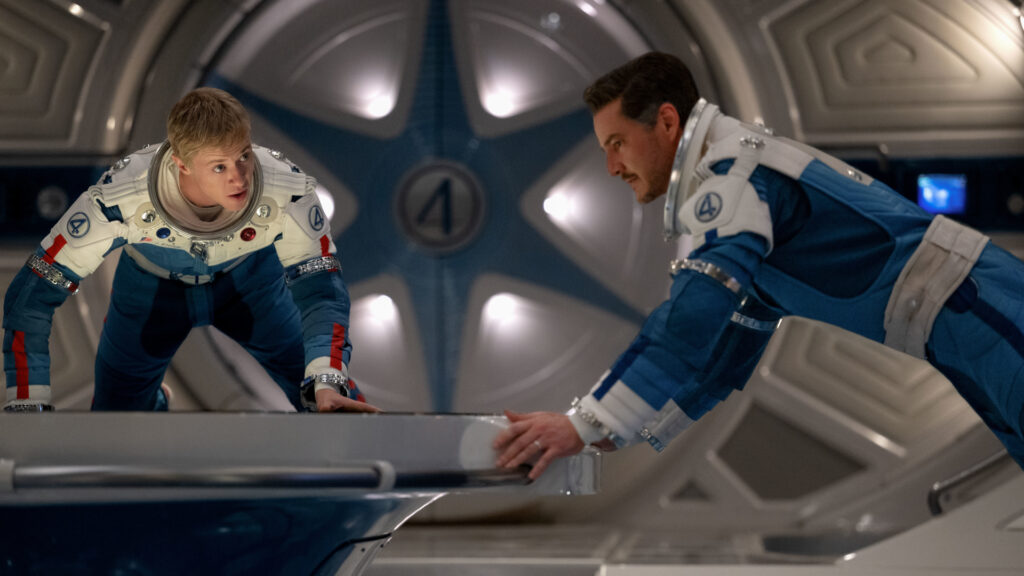
Perhaps Shakman was too invested in pulling off the film’s cataclysmic set pieces to pay the necessary attention to its thornier inquiries, but his labor is visible in all the wrong ways. As an action extravaganza, First Steps is a dud, with weightless special effects, random beams of computer-generated light, and a faulty sense of scale. An extended chase sequence in outer space lacks the requisite tactility and lucidity to be exciting, while the climax—a lumbering showdown set in Times Square—is laughably generic, not to mention far afield from the intimate and imaginative metaphysical horror of Thunderbolts.
And yet, despite its many shortcomings, The Fantastic Four: First Steps carries just enough color and whimsy to separate it from the superhero chaff. It does fine work on the margins, like casting Paul Walter Hauser as a subterranean instigator with pitch-perfect comic timing (seriously, his line reading “Please wipe your feet, I’m kidding it’s all dirt” is a minor masterpiece). It wryly comments on the inexhaustible popularity of comic-book culture, like how Ben is constantly telling people that the Thing’s catchphrase (“It’s clobberin’ time!”) is a hackneyed creation of a merchandised cartoon. And it periodically supplies some lovely images, such as a gorgeous shot of the Silver Surfer silhouetted against a grey moon, encapsulating her terrible power and her even greater sorrow.
“Die with yours,” the Surfer implores to Johnny in a tone of enigmatic tenderness. At the risk of disagreeing with such a beguiling alien, I can live with this.
Grade: B-

Jeremy Beck is the editor-in-chief of MovieManifesto. He watches more movies and television than he probably should.
I actually like how the film keeps things more character-focused instead of rushing into big crossovers. it makes the whole Fantastic Four dynamic feel fresh and a bit more personal, especially with that retro vibe. And honestly, the style stood out to me too… that whole aesthetic reminds me of how iconic pieces like the johnny storm fantastic four blue jacket can quietly steal the spotlight, just like the characters themselves.