
To watch sports is to subject yourself to a vocabulary riddled with hyperbole and cliché. You need to give 110%. The best players eat, sleep, and breathe the game. Athletes are soldiers, and every contest is a war. It’s not the size of the dog in the fight, it’s the size of the fight in the dog.
Him, the new movie from Justin Tipping, attempts to literalize this sort of inflated rhetoric. It imagines a heightened surreality where a draft prospect’s training regimen takes place at a militaristic boot camp, and where professional success equates to personal survival. It takes the metaphor out of blood sport.
Conceptually speaking, this isn’t a horrible idea. By their nature, movies dramatize and embellish real-life experiences, and the obsessive character of modern sports—the players’ pursuit of excellence, the fans’ deranged zeal, the economy’s spending of billions on advertising and gambling—naturally lends itself to an outsized treatment. So the problem with Him isn’t that it’s absurd. The problem is that it’s stupid.
In fact, and in the spirit of the film’s fanatical outlandishness, let’s go further: Him is the worst movie I’ve seen in theaters this decade. It is a failure on virtually every level—a work of shoddy craftsmanship, cringeworthy acting, and incoherent storytelling. It’s hard to conceive of how such a monumentally moronic enterprise came to exist, much less arrive from a major studio and bearing the imprimatur of Jordan Peele.
To be clear—and despite what the film’s marketing might have led you to believe—Peele is credited only as a producer here; Tipping wrote the screenplay with Zack Akers and Skip Bronkie, both scripting their first feature. (Tipping himself has mostly worked in TV, though he previously directed something called Kicks in 2016.) To the extent Him possesses any redeeming value, it lies in Tipping’s flashes of stylistic showmanship—the way he bathes the frame in blood-red tones and experiments with negative imaging. Yet he lacks the confidence to let his compositions breathe, instead overcooking his aesthetic with jagged noise and hyperactive editing. There are lots of hallucinatory inserts and crude fake-outs, like a Darren Aronofsky picture that inhaled a bad batch of opium.

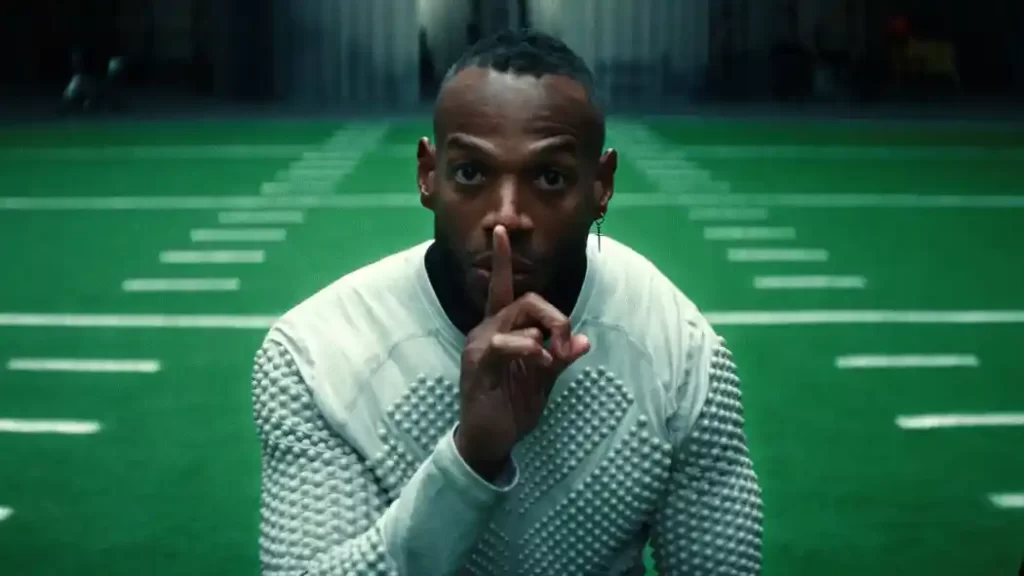
Perhaps Tipping felt obligated to assault viewers with sensory chaos in order to distract them from the movie’s idiotic story. Him centers on Cam Cade (Tyriq Withers), an aspiring football player who since childhood has dreamed of succeeding the legendary Isaiah White (Marlon Wayans) as quarterback of the fictional San Antonio Saviors. (The film’s lack of NFL licensing reflects its broader chintziness.) Pundits have tipped Cam to be the sport’s next big star, but when he gets bonked on the head by what appears to be a malevolent mascot, his resulting brain injury spurs questions about his physical and mental readiness. Refusing to participate in the league’s draft combine, he instead accepts an invitation to train at Isaiah’s isolated Texas compound in order to prove his athletic bona fides.
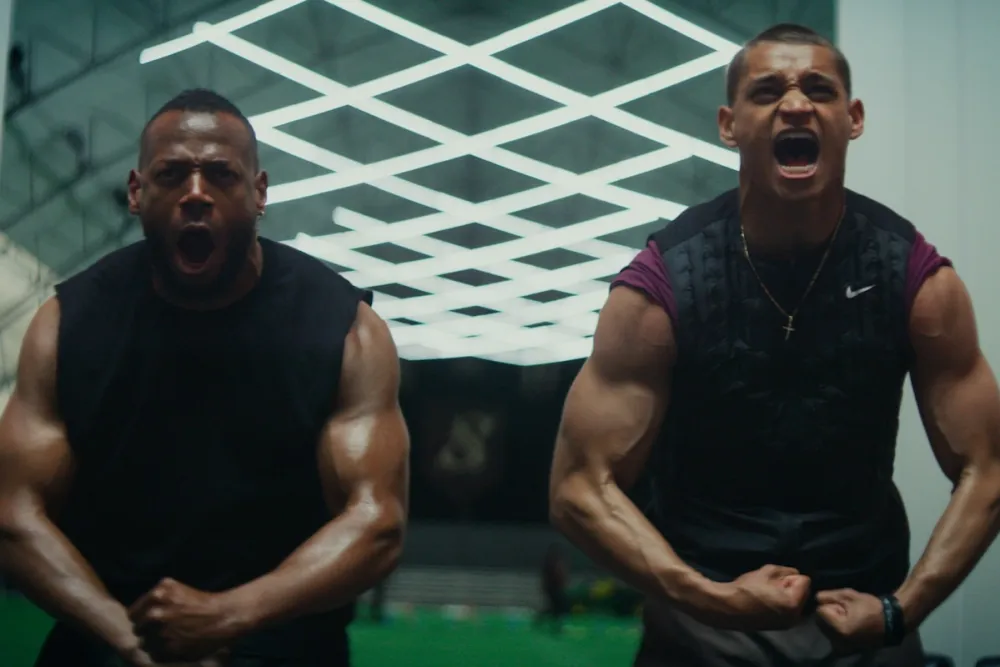
At this point, it should be clear that narrative credibility is not among Him’s concerns, and that’s fair enough. Yet once Cam arrives at Isaiah’s estate—a sprawling complex that’s a cross between a state-of-the-art facility and a billionaire’s conspiratorial bunker—the movie quickly devolves into vague and desultory nonsense. Isaiah puts Cam through a series of intense drills designed to test his body and mind; remarkably, none of these is remotely imaginative or stimulating. Even the one test that initially scans as intriguing—a timed exercise where Cam must complete a series of passes, lest a random volunteer be blasted in the face with footballs loosed from a jugs machine—soon fizzles into a pointless display of screaming brutality.
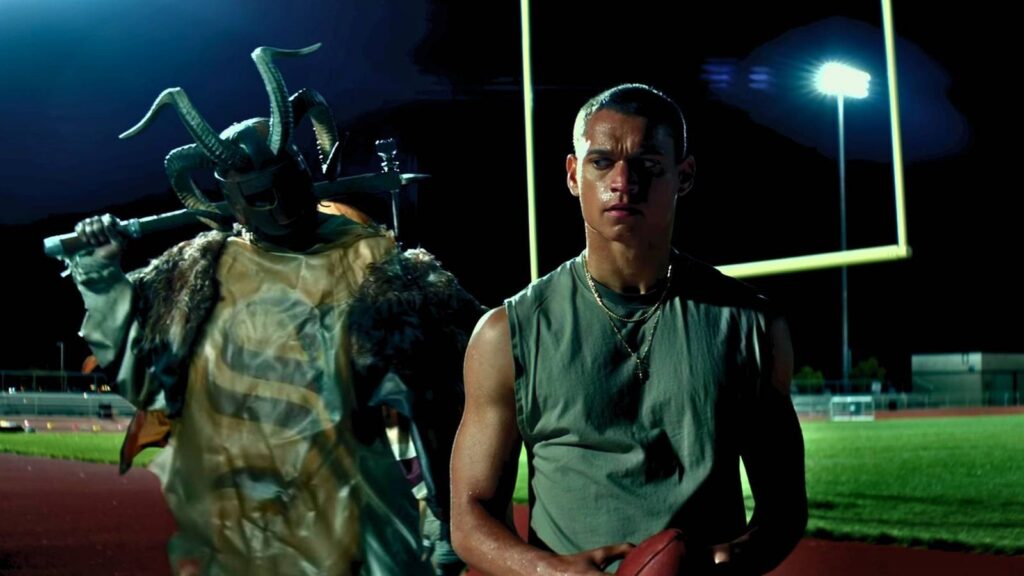
Meanwhile, mysteries percolate: Why does a doctor (Jim Jefferies) keep jabbing Cam with syringes full of red liquid? Why does Isaiah’s wife (Julia Fox) keep throwing Cam suggestive glances? Why does Cam keep waking up in strange places, forgetting how he got there?
The answers to these questions are predictably unsatisfying, but the bigger issue is that the questions themselves are enervating. Him attempts to inculcate an atmosphere of psychological terror, but its plot is so feeble and its characters so underwritten that it fails to develop any degree of immersion or suspense. Wayans, possibly sensing the material’s lifelessness, chooses to go wildly over the top, screaming much of his dialogue; it’s the kind of performance that aims to be terribly enjoyable and ends up just being terrible. Next to him, Withers’ abiding vacuity comes off as a relief.
Speaking of quarterbacks, a confession: I like football. I have spent countless hours watching large and powerful humans contort their bodies in a gripping panorama of grace and violence. Such balletic barbarism should translate naturally to the big screen, but Him evinces no interest in capturing the game’s inherent entertainment; most of our glimpses of Cam’s preternatural ability involve him chucking the pigskin 20 yards downfield to a nondescript receiver. The Super Bowl, this is not.
Of course, Him doesn’t want to be a conventionally exciting sports movie, though what it does want to be is harder to decipher. In its final stretch, having already collapsed as a fantastical thriller or moody horror picture, it tries to position itself as a racial commentary along the lines of Get Out. The effort is galling, given that it replaces Peele’s pinpoint satire and crowd-pleasing instincts with jumbled revelations and listless action.
One plot point here touches on the concept of “the GOAT”—the popular acronym in sports circles for “greatest of all time.” Him takes those capital letters and converts them into lowercase. It’s a brainless, bleating movie just waiting to be sacrificed and put out of its misery.
Grade: D

Jeremy Beck is the editor-in-chief of MovieManifesto. He watches more movies and television than he probably should.