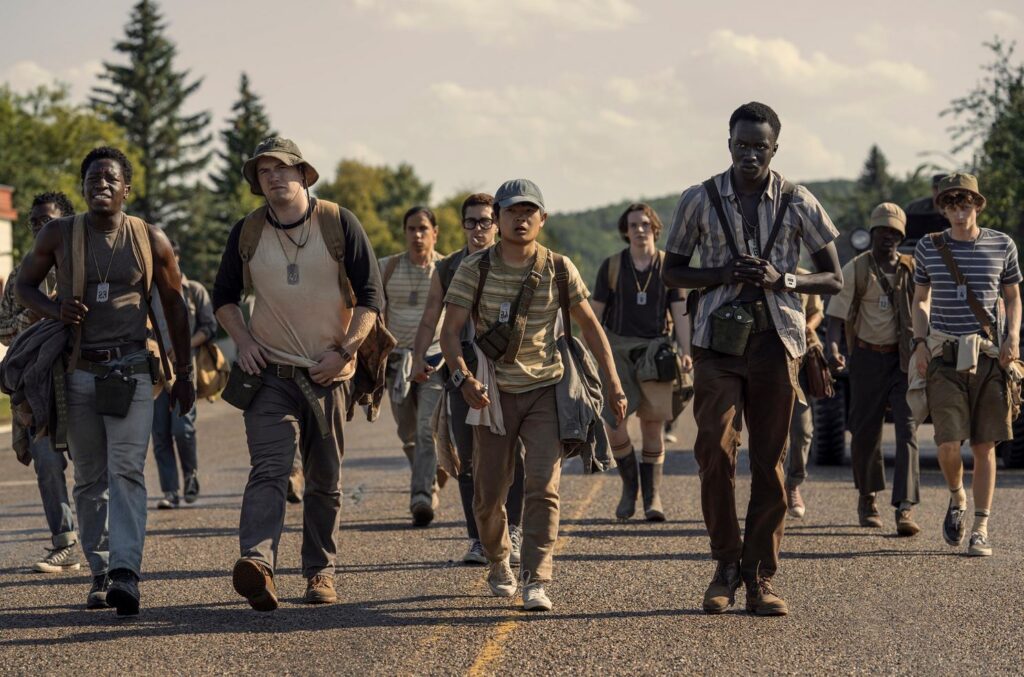
As depicted in The Long Walk, the United States is a land of turmoil and suffering. Shortfalls in productivity have led to a crippling economic depression. State-sanctioned violence is broadcast in the form of bread-and-circuses entertainment. The military persecutes citizens who dare voice their dissent. To clarify, the movie is a work of fiction, not a documentary.
Specifically, The Long Walk is based on a novel by Stephen King, though its horror is allegorical rather than supernatural. Taken literally, the story’s premise—in which 50-odd young men compete in a grueling endurance test that doubles a perverse battle for life and death—isn’t especially plausible. But it’s less unrealistic than it might have seemed, say, eight months or three days ago. When the nation’s president declares war on the free press, when his toadies mount an intimidation campaign against anyone who opposes conservative orthodoxy, when TV networks suspend late-night programs out of fear of governmental retribution… well, it becomes more difficult to frame the image of tanks rolling down public streets as a flight of imaginative fancy.
The political valence of The Long Walk is, for the moment at least, open to debate. Rather than didactically emphasizing their themes, Francis Lawrence and JT Mollner, the film’s director and screenwriter, have opted for ground-floor immediacy. Aside from the opening crawl—in which a “volunteer” is informed that he’s won a lottery and earned the right to compete in the titular event, which promises to the victor both a vast financial sum and a bespoke “wish”—the movie’s establishing scenes unfold with minimal context or fuss.
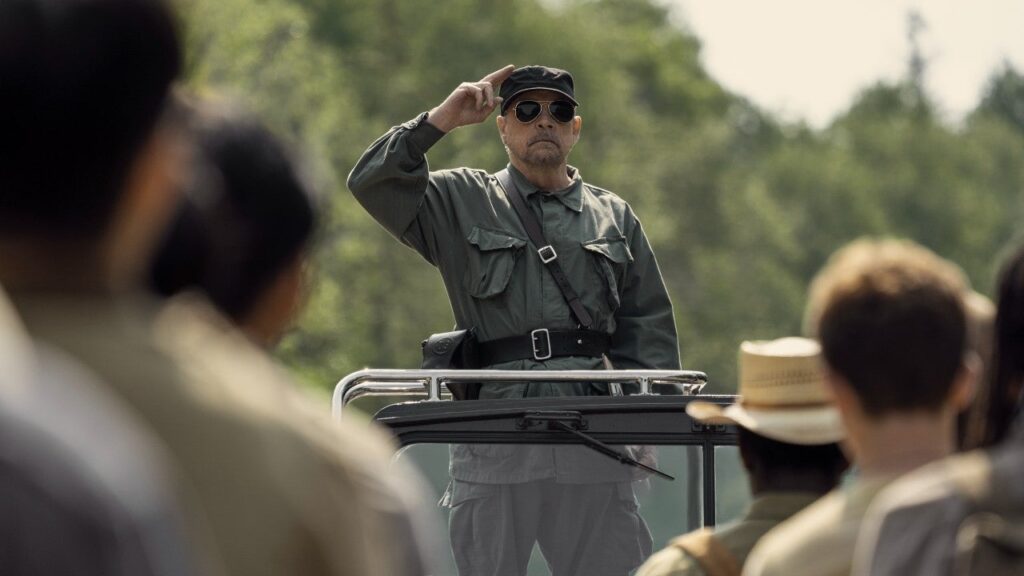
A group of twentysomething dudes mill about a Maine road, like restless marathoners awaiting the start of a race. As they make small talk and exchange insults, they’re outfitted with numbered tags and wrist-band pedometers. A supervisor, a sunglassed official known only as The Major (Mark Hamill, appearing in his second consecutive King adaptation following The Life of Chuck), informs us of the competition’s rules: You can’t stray from the highway, you can’t interfere with the soldiers patrolling the course, and you need to maintain a pace of at least 3 mph; if you drop below that speed, you get a series of warnings before ultimately receiving your “ticket.” The mood is anticipatory but cordial, and the impending contest feels more than anything like a high-profile sporting event.
Then someone lags behind and gets shot in the head.
That stark display of brutality swiftly underlines the stakes of The Long Walk (the title card crashes onto the screen immediately after), even as it also foreshadows the movie’s limitations. Eschewing exposition and backstory, Lawrence and Mollner instead employ an intimate simplicity that proves to be both virtue and vice. Narratively speaking, the film doesn’t feature a whole lot of substance. Guys walk and talk and die, and that’s pretty much it. If you’re anticipating some sort of shocking revelation or sudden gearshift, you are bound to be disappointed.
Yet within its self-imposed confines, The Long Walk exhibits admirable variety and ingenuity. Lawrence, who directed most of the Hunger Games pictures (whose original author was surely influenced by King’s 1979 novel), knows his way around this kind of surreal environment—a winner-take-all battle royale whose contestants are naturally at odds but who are also united in their clenched anger toward a suppressive state. Visually speaking, the movie presents a formidable challenge because the characters are always in motion—a more accurate title might have been “the long walk-and-talk”—but Lawrence and his regular cinematographer, Jo Willems, apply a technique that’s impressively invisible, the camera gliding along and around the actors without ever drawing attention to itself. (The score, by Jeremiah Fraites, is appropriately stirring.)
The central conceit of The Long Walk (which also recalls They Shoot Horses Don’t They) may be dubious, in particular the reveal that the race is being televised live; it’s unclear both why the event inspires people and how it translates into popular home entertainment. (We see a few cameras clamped onto tanks, but surely viewers would tire of the same endless footage of men trudging forward.) But rather than resisting this absurdity—and in an era where Squid Game received a reality spin-off, maybe I should be less skeptical—Lawrence tackles it with no-nonsense pragmatism, pursuing avenues that are logistical, personal, and even biological. What if you twist your ankle? What if you get a rock in your shoe? What if you need to take a shit? The movie explores these and other questions with surprising invention, imbuing its straight-ahead ambling with curvy suspense.
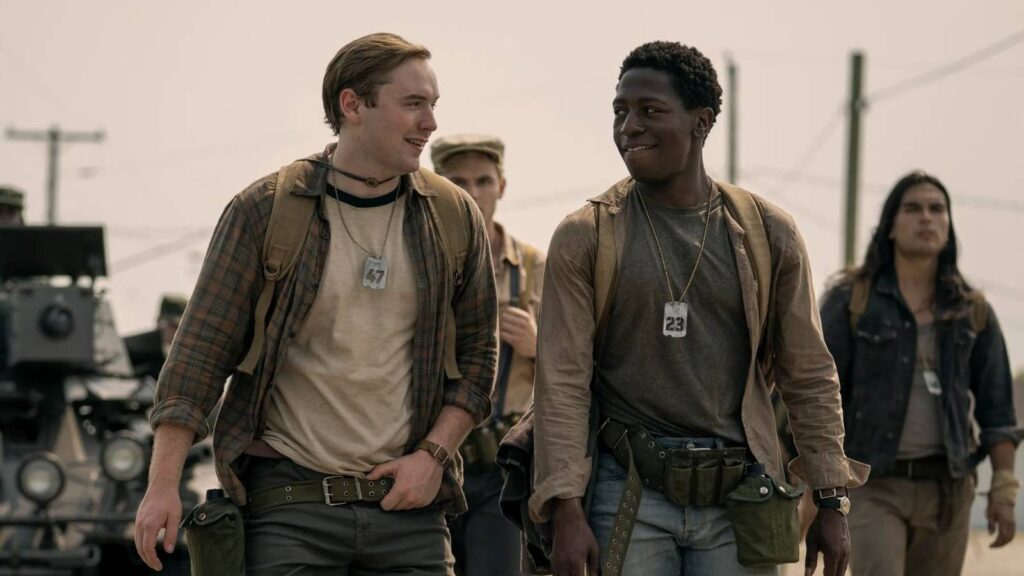
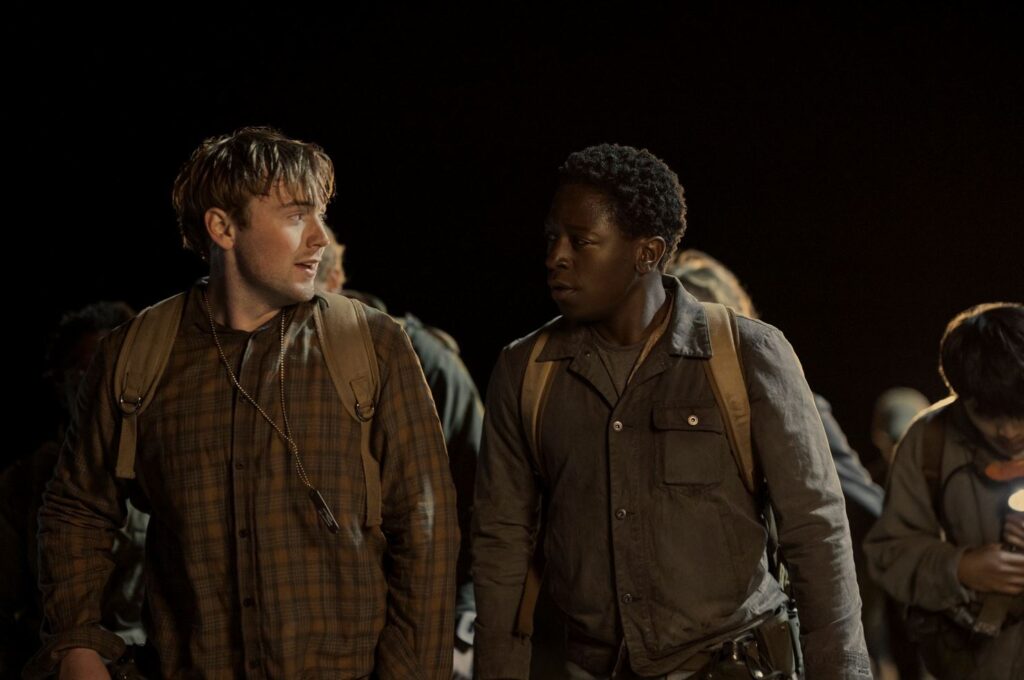
There are quite a few poor saps shuffling along the road, but only two really matter: Ray (Cooper Hoffman), our point-of-view character whom we initially meet sharing a fraught goodbye with his tearful mother (Judy Greer), and Peter (David Jonsson), a jocular fellow with a pronounced scar slashing down his right cheek. They quickly become fast friends, which seems ill-advised given the race’s parameters, but Mollner’s screenplay—whose rigorous linearity (a few brief flashbacks excepted) presents a dramatic departure following his pretzel-shaped script for Strange Darling—creates a thorny and engaging dynamic, one in which good-natured ribbing can suddenly turn into deadly bullying, and where a solemn pact can become a paean to human solidarity.
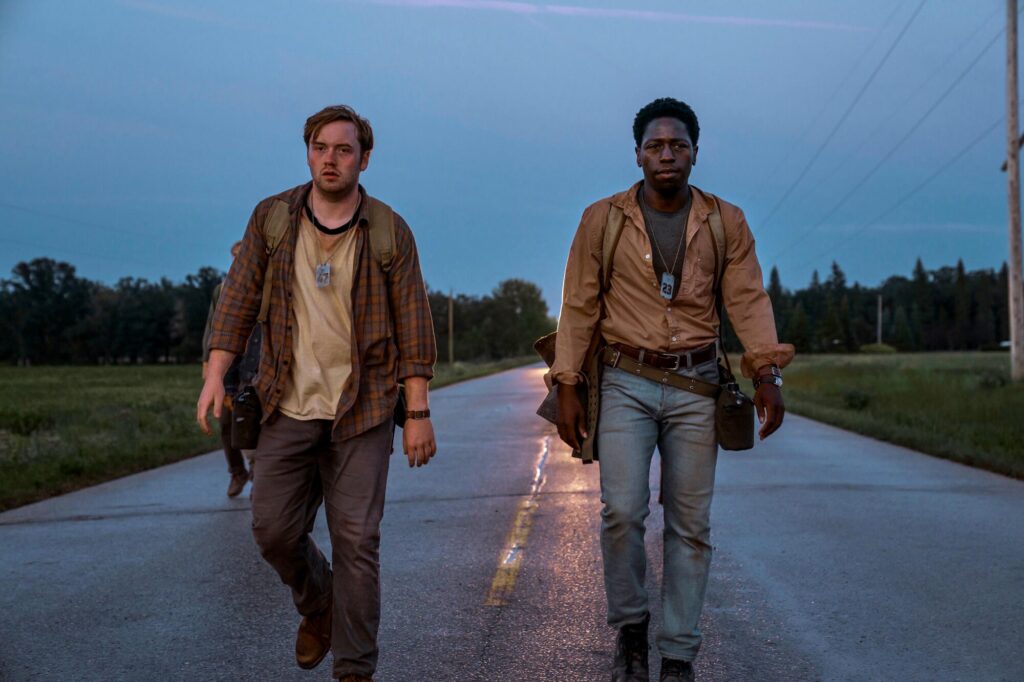
Is that all bullshit? Maybe, but both leads are excellent, their unforced naturalism undercutting any potential didacticism or mawkishness. Jonsson, with his beaming smile and exaggerated drawl, in particular is terrific for how he invests Peter with a mighty swagger while quietly conveying his despair.
At several points in The Long Walk, a participant begins to straggle on account of mortal wounds, yet the guardsmen refuse to execute him immediately, instead methodically announcing the requisite warnings before delivering the fatal blow. It’s a spectacle of ironic cruelty—a miniature adherence to due process amid the broader trampling of civil rights—and it’s those kinds of details that allow the movie to linger. The Long Walk is far from a perfect picture, but as you walk out of the theater, you may find that its tableaux of desire and desolation—and the anguish and resolve etched on Hoffman and Jonsson’s faces—have followed with you, continuing to keep pace.
Grade: B

Jeremy Beck is the editor-in-chief of MovieManifesto. He watches more movies and television than he probably should.