
It’s been a rough two decades for the romantic comedy. Twenty years ago, the summer box office was already showing signs of intellectual-property creep, but nestled amid the Star Wars prequel and the Batman origin story and the Steven Spielberg and Tim Burton remakes were two smash-hit original rom-coms: Wedding Crashers and The 40-Year-Old Virgin. (You could also throw in Mr. and Mrs. Smith, depending on your level of genre pedantry.) In 2025, you need to scroll all the way down to #18 before finding a single romantic comedy, Materialists (and calling that one a rom-com is a bit of a stretch); at a modest $37M, it’s the only rom-com of the year to scrape its way past $3M domestic.
Were studios just waiting to unleash their laugh riots until after Labor Day? Whatever the reason, last weekend saw the release of two new comedies that, while not strictly adhering to rom-com conventions, nevertheless serve as a welcome change of pace for anyone exhausted by all of the comic-book adaptations and animated sequels. Neither exactly set the box office afire, which is a shame, given that one of the pleasures of a well-made romantic comedy is the joy of experiencing collective laughter and heartbreak with fellow patrons. That, and both of these happen to be pretty good.
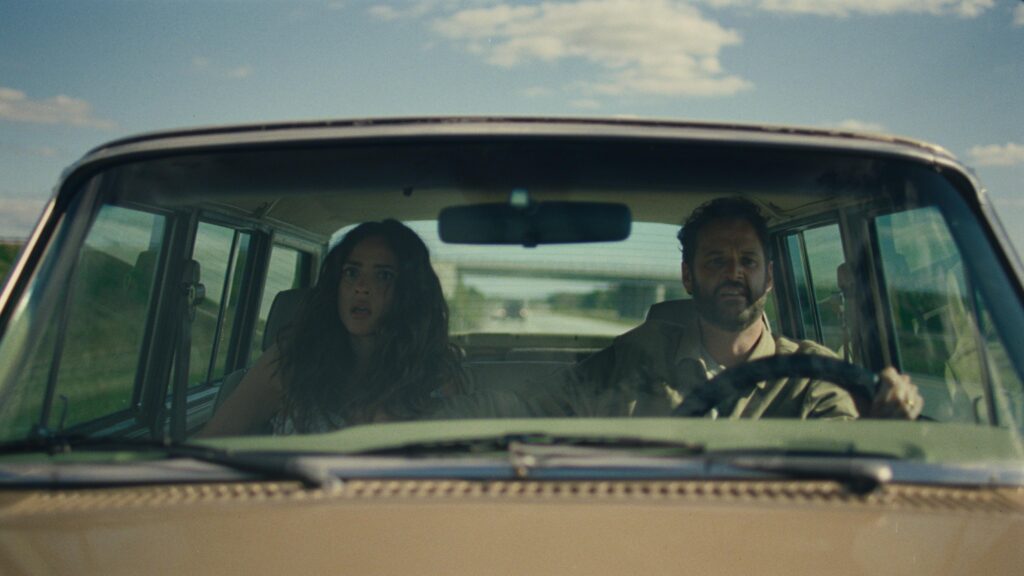
Splitsville, which technically received a limited release in August before expanding last Friday, is the work of Michael Angelo Covino and Kyle Marvin—two dudes you’ve probably never heard of. In their debut feature, The Climb (which they both wrote, with Covino also directing), they played best buds whose friendship disintegrated after one slept with the other’s fiancée, with further betrayals and reconciliations in the years to come. Splitsville follows a similar trajectory; once again, the narrative is divided into chapters, the story traffics in deception and infidelity, and the relationship between the male leads is alternately tender and hostile. There’s just one big difference: This movie stars Dakota Johnson.
A well-known actress if not quite an A-lister (coincidentally, she also headlined Materialists), Johnson’s very presence suggests that Covino and Marvin have leveled up in terms of prestige and ambition. It also introduces something of a plausibility issue, as does the casting of Adria Arjona, who’s barely a year removed from portraying one of the sexiest women in cinematic history. We’re supposed to believe that these two beautiful women, whose recent on-screen partners include Chris Evans and Glen Powell, are married to these guys? To its credit, Splitsville lampshades this apparent disconnect, both by verbally pointing out the attractiveness disparity and by insisting that Marvin has a big dick.
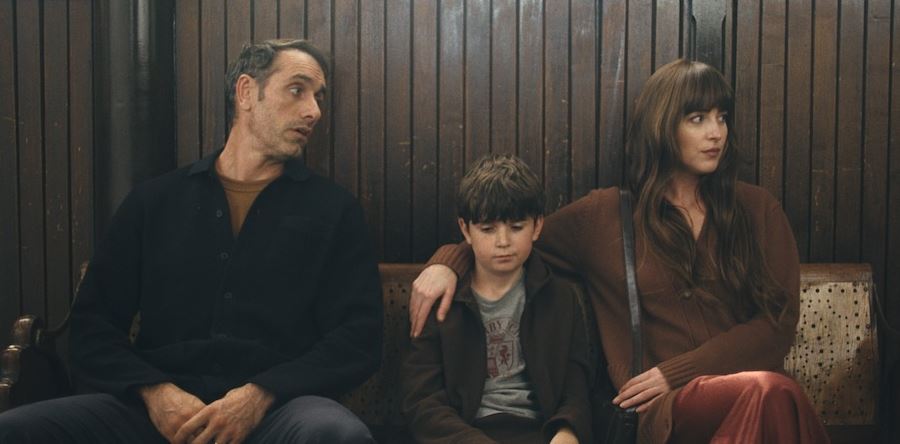
Yet despite its schlubs-and-babes composition, Splitsville isn’t really a warm-hearted love story in the vein of early Judd Apatow. Quite the opposite: The movie begins with its two central couples already hitched, only for both unions to quickly implode. Ashley (played by Arjona), in the grips of existential ennui, demands a divorce from Carey (Marvin), who literally runs away from the problem and toward the swanky Long Island estate of his closest friend, Paul (Covino). The ensuing scene where Paul instructs Carey to take a shower, then immediately climbs in with him and checks his undercarriage for ticks, demonstrates their familiarity, but Carey is still shocked to learn that Paul and his gorgeous wife, Julie (Johnson), have for years maintained an open marriage. It’s the key to their happiness, at least until it becomes the instrument of their destruction.
In terms of plotting, Splitsville exhibits a circularity that can be frustrating. Characters fall in and out of love, relationships are rended and mended, and lessons are learned only to be forgotten. It may be an accurate representation of contemporary romance, but the themes—love is complicated, sex is messy, human desire is capricious—aren’t especially novel or resonant.
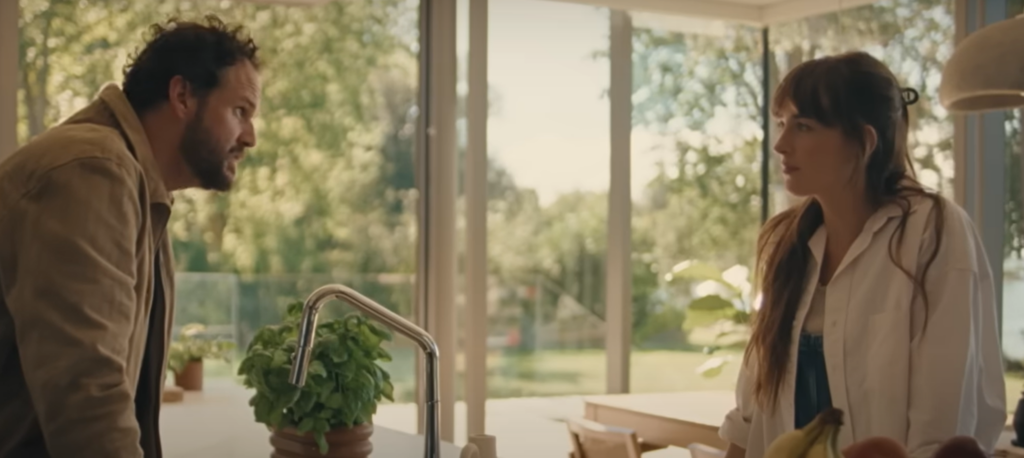
What distinguishes the movie is the crisp confidence of its storytelling, both aurally and visually. The dialogue has a fluid rhythm, and the actors locate the proper balance between natural earnestness and heightened banter. (Sample joke from Carey: “You hear the one about IKEA? Never mind, the setup takes too long.”) Secondary characters, like an enthusiastic underachiever (Charlie Gillespie) or a brooding mentalist (Nicholas Braun), contribute just the right touch of zaniness, ensuring that the film’s rambunctious energy never flags.
More impressively, Splitsville is the rare comedy that pays particular attention to its own aesthetic. As he did in The Climb, Covino deploys a number of silky long takes, but he also enlivens the proceedings with snappy editing and graceful choreography. A montage featuring Ashley’s parade of post-separation lovers is deftly orchestrated, while a fight between Carey and Paul is an inspired medley of violence, mayhem, and humor—a cross between Looney Tunes and John Wick.
It’s these cinematic qualities, rather than its putative insights into monogamy or dating, that make Splitsville memorable. Between this movie and The Climb, Covino and Marvin have established themselves as a talented filmmaking duo. Their characters may always be breaking up, but these guys need to stay together.

If Splitsville’s sensibility is arguably too perverse to qualify as a romantic comedy, calling Twinless one might also arouse the genre police, given that its protagonists never date or kiss. But this strange and absorbing new movie, the second from writer-director James Sweeney, resists easy classification. In chronicling a complex and mutating friendship, it assumes various forms: a family melodrama, a rehabilitative weepie, a love story, and even a suspense thriller.
That is a good deal of conceptual ambition to pack into 100 minutes, but Sweeney is an economical storyteller with a knack for finding the nooks between genres. His first feature, Straight Up, examined the quasi-romance between a straight woman and a gay man, considering the centrality of sex (or lack thereof) in human intimacy. Twinless maintains that film’s dichotomous orientation but tweaks the gender composition, concentrating on two men, Roman (Dylan O’Brien) and Dennis (played by Sweeney himself), who have both recently lost their respective twin brothers.
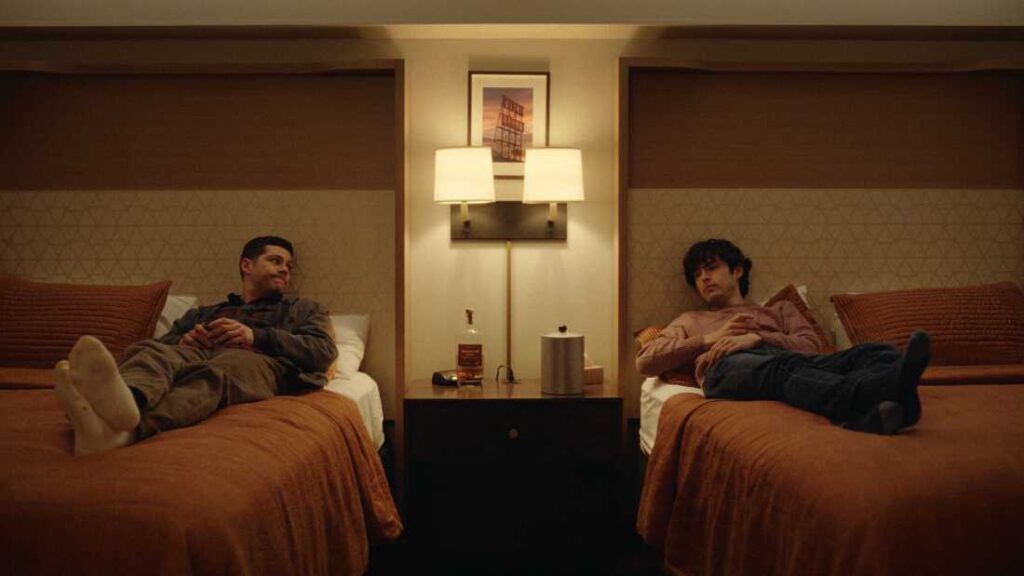
It’s a somewhat bleak setup, and the movie’s early focus on Roman suggests a potential for darkness. With his broad shoulders and close-cropped haircut, Roman cuts a severe figure, and his sudden bereavement has only deepened his gloom. Hot-tempered and dim-witted—when someone mocks him for failing to recognize the difference between lemons and limes, he acknowledges that he’s “not the sharpest bulb in the shed”—he seems an unlikely hero of a literate comedy, much less one by a director whose last film featured a debate about the linguistic errors in the song “Ironic.” Yet Dennis, who meets Roman at a support group for surviving twins, finds himself drawn to this recessive creature, for reasons that are initially more clear to the character than the audience.
As with most movies, it’s best to go into Twinless as cold as possible—not because its script is especially twisty, but because its shifts in tone are so unusual and adroit. At its core, though, it’s about connection and vulnerability—how sharing ourselves with another person is the only way we can feel truly whole, even as it opens up the possibility of pain and loss.
That might sound heavy, but Sweeney operates with a light touch, observing his leads’ contrapuntal kinship with playfulness and warmth. Roman, despite his simmering volatility, is basically a big-hearted galoot, and O’Brien makes him decent by shedding all vestiges of vanity. Dennis, by contrast, is an effete nebbish with a hyperactive brain; he’s a smart and intuitive guy who also might be a sociopath. Yet while the character may have flirted with danger on the page—the stereotype of the gay predator who manipulates his prey to slake his persistent hunger (think Saltburn)—Sweeney’s performance rounds him out, mingling arrogance and lust with shame and empathy.

And just as Splitsville showcases Covino’s filmmaking technique, Twinless substantiates Sweeney’s gifts as a visual artist as well as a capable writer and actor. It’s less visibly distinctive than Straight Up, with its cramped aspect ratio and dead-center close-ups, but it’s still a work of impressive polish, and certain scenes, like a split-screen sequence at a house party (capped with a triumphant mirror shot), hum with precision and ingenuity.
Lest you think Twinless is a dudes-only affair, it also makes room for Marcie (Aisling Franciosi, from… Speak No Evil and The Nightingale??), Dennis’ gentle colleague who later becomes Roman’s love interest. Her emergence represents a plotty complication, but it also underlines the movie’s emotional richness, and Franciosi’s luminescence works in perfect complement with O’Brien’s cluelessness and Sweeney’s calculation. In Splitsville, four is a crowd; in Twinless, three is wonderful company.
Grades
Splitsville: B
Twinless: A-

Jeremy Beck is the editor-in-chief of MovieManifesto. He watches more movies and television than he probably should.