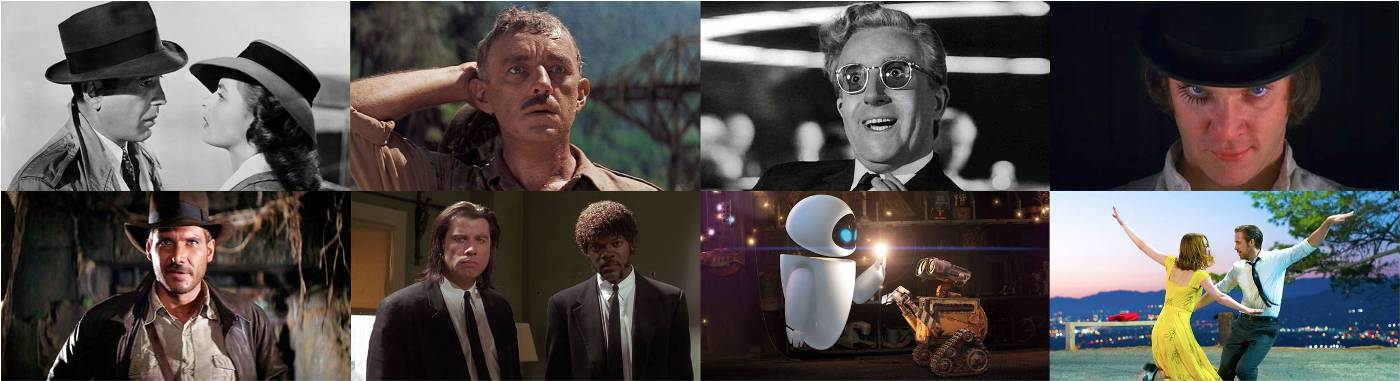
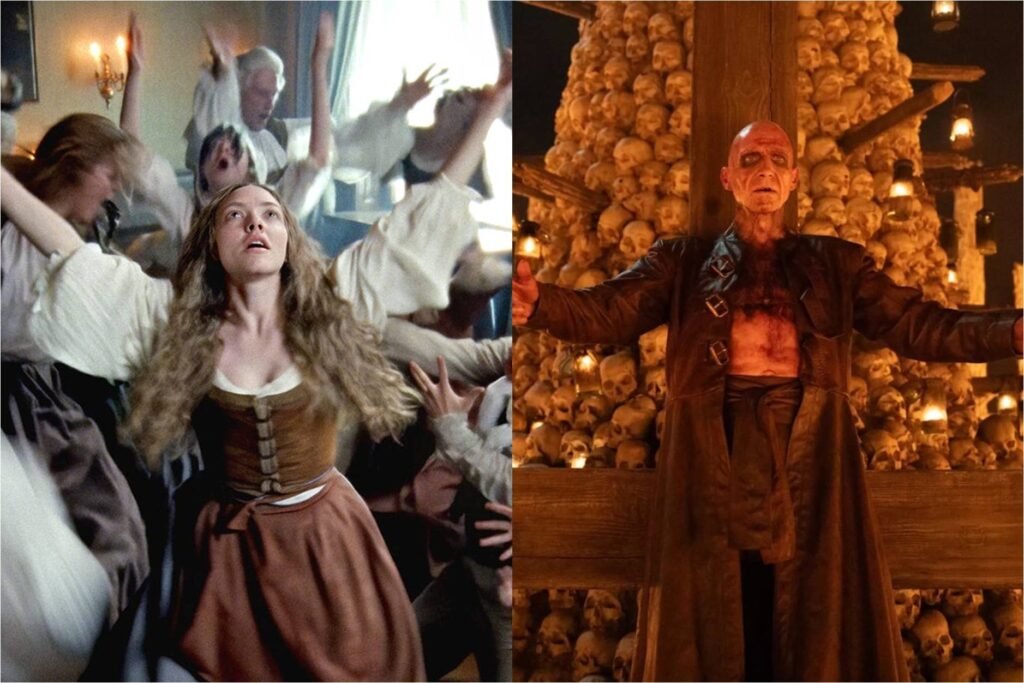
All movies compel suspension of disbelief, but the musical demands an extra dose of willful credulity. In real life, people don’t break into choreographed song-and-dance routines, so appreciating the genre requires accepting the form’s heightened surreality. It’s an act of faith—a gesture of surrender to a higher power whom you trust to guide you through the inexplicable.
This means that musicals about religion create a kind of feedback loop, reinforcing their characters’ spirituality—the belief in the unseen, the quest to convert others through vigorous performance—via their staging and technique. As (ahem) fate would have it, two recent releases toy with this idea, even if neither of them conforms to classical conventions of how movie musicals are meant to operate.
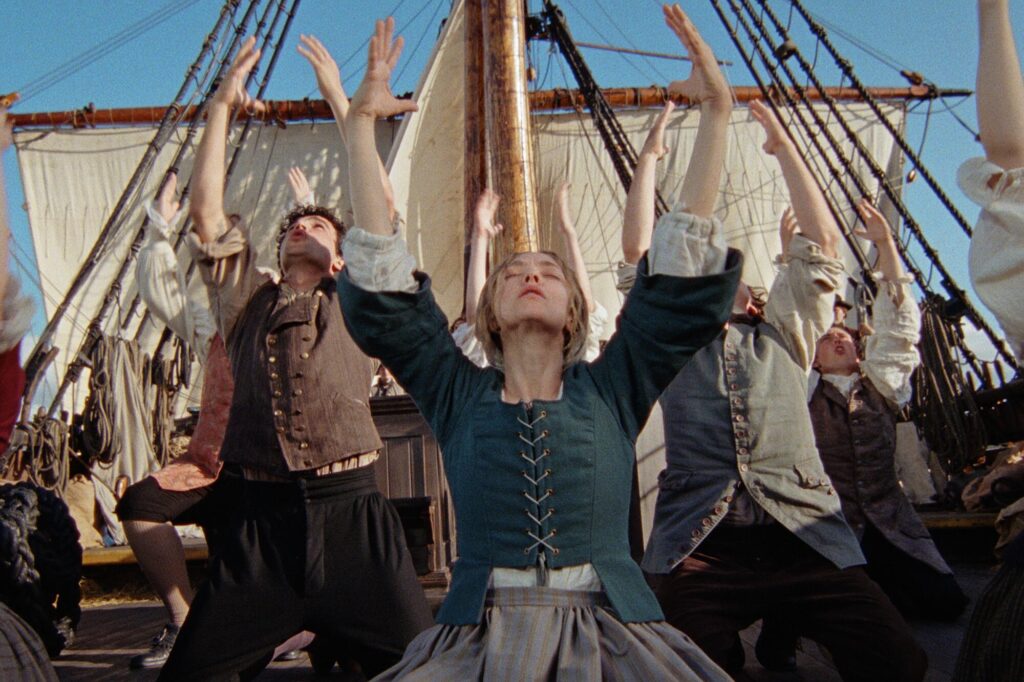
The Testament of Ann Lee, the third feature from Mona Fastvold, chronicles the founding of the Shakers, the eponymous sect known for its expressive, nigh-ecstatic forms of worship. On one level, this subject matter lends itself naturally to a musical treatment, given the cohort’s frenzied, full-bodied dancing. At the same time, their movement is grounded in solemnity and restraint; the movie’s titular subject, played with fearless commitment by Amanda Seyfried, preaches not just sexual abstinence but also a broader withdrawal from chaotic modernity and sensual pleasure. As Sinners demonstrated, the heedlessness of debauchery can be exhilarating; the deprivations of piety are less readily rousing.
Fastvold, who wrote the screenplay with her partner Brady Corbet (they reversed roles on last year’s The Brutalist), embraces this duality by structuring the film as an in-between creature—not quite a traditional musical, not quite a straightforward drama. To be sure, there are a good deal of songs (all composed by Daniel Blumberg), and they’re performed by the cast with competence and conviction. But whereas most musicals function akin to action pictures, brandishing their numbers like gung-ho set pieces, The Testament of Ann Lee embeds its vocals more organically, as though they’re bubbling out of the characters’ innermost desires. There are no true show-stoppers, because a typical peaks-and-valleys approach wouldn’t square with the tone of persistent, unyielding reverence. Perhaps that’s why the movie’s most memorable song, “Hunger and Thirst,” is a delicate solo that relies on Seyfried’s plaintive voice and wide-eyed yearning, rather than aggressive choreography or brassy swells of instrumentation.

It’s a nervy decision by Fastvold, and one that enriches a production which might otherwise have played as a familiar period piece. The story of Ann Lee is absorbing, but it’s also dour and depressing—a sad piece of American history in which a spirited woman is pilloried and repressed. (As befits Ann’s carnal revulsion, the sex on screen is decidedly unsexy, not least when a man commands, on two different occasions, that his quarry “Take me in your mouth”—a hellish echo of The Squid and the Whale.) Yet the gentle beauty of the music prevents the movie from feeling squalid or grim, instead quietly but insistently underlining Ann’s steadfast devotion. It lends Ann Lee real resonance, emphasizing the quixotic dreams of a woman with her own vision of social harmony.
On the surface, The Testament of Ann Lee has little in common with 28 Years Later: The Bone Temple, Nia DaCosta’s sequel to Danny Boyle’s thriller (which in turn was a long-delayed follow-up to 28 Weeks Later… which itself was a sorta-sequel to Boyle’s 28 Days Later). Where Ann Lee is rational, historical, and tender, The Bone Temple is supernatural, contemporary, and vicious, continuing the franchise’s exploration of a disease-ravaged England where feral zombies run amok. Yet for all its bloodshed, DaCosta’s picture shares with Fastvold’s an appreciation of the power of music, along with an understanding of how religion can catalyze a certain type of ritualized performance.
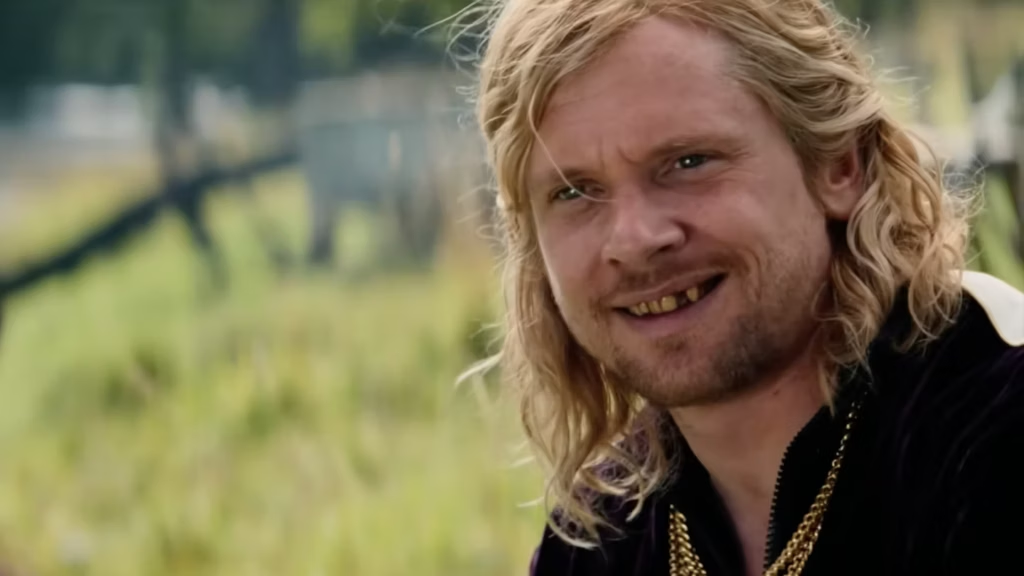
Much like Ann, the central character of The Bone Temple is a uniquely charismatic preacher attended by a flock of disciples. His name is Jimmy (Jack O’Connell), and he regularly communes with a divinity, “Old Nick.” His observance of scripture results in adherence to a strict set of rules, which he insists that his followers similarly abide. And his calling is to spread his peculiar gospel, roving the British countryside and bestowing on its folk a very particular form of “charity.”
If any of that sounds affirming in word, it’s loathsome in deed. The Bone Temple is a horror movie, and Jimmy is a repulsive sadist who leads an army of child killers, whom he dubs his “fingers.” In fact, Jimmy is a perversely inventive linguist: Old Nick is his preferred moniker for Satan, while “charity” is his term for flaying innocents alive and sacrificing their bodies as a devilish offering. The film is replete with ghastly sequences of mayhem and murder, and the anguish on display is as far removed from Ann Lee’s envisioned utopia as you can imagine.

Yet while DaCosta proves a talented purveyor of carnage (her prior credits include Candyman and The Marvels), The Bone Temple isn’t purely an exercise an grisly apocalyptic terror. The screenplay, by Alex Garland, provides a moral counterpart for Jimmy in the form of Ian Kelson (Ralph Fiennes), the seemingly mad doctor of 28 Years Later whom we eventually learned was intelligent, compassionate, and entirely sane. Where Jimmy views the zombie epidemic as an opportunity to create a new and brutal world order, Kelson fantasizes about reversing its effects, and he stumbles upon a test subject—a gigantic, animalistic figure with long hair whom he aptly names Samson (Chi Lewis-Parry)—whom he treats with tenderness and mercy, qualities that Jimmy cruelly withholds from his Fingers.
There isn’t a whole lot of music in The Bone Temple, though it does have a few delightful scenes where Kelson introduces the narcotized Samson to the synthesized majesty of Duran Duran. But when Jimmy and Kelson’s destinies inevitably collide, DaCosta conceives of a spectacular climax that doubles as a spiritual awakening. (Be warned: Spoilers follow.) Jimmy, having assured his underlings that he knows Old Nick personally, demands that Kelson perform a pantomime of Lucifer, on pain of death. (“You’re in a bind,” Jimmy says before threatening to disembowel Kelson unless he plays his satanic part, to which the doctor responds, “That is a bind.”) And to fulfill his role in this duplicitous production, Kelson calls upon his own version of a higher power: Iron Maiden.
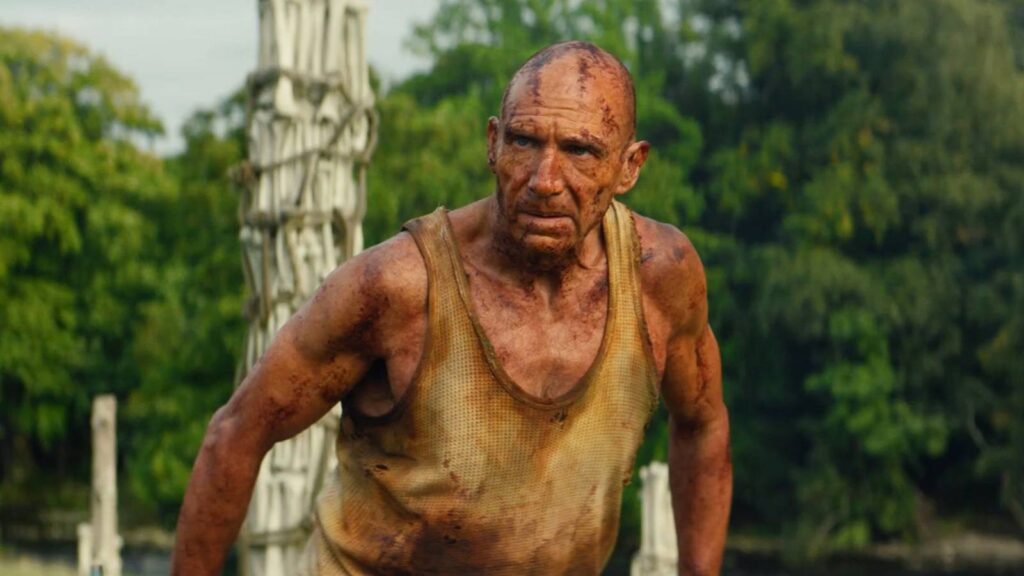
I’ve watched Ralph Fiennes act for roughly half his life. Despite his patrician pedigree, he’s a performer of impressive range; I’ve seen him play Nazis and mobsters and grifters and soldiers and butlers and lawyers and chefs. But I’ve never seen him do anything like he does during the closing scenes of The Bone Temple, when he dazzles his stupefied audience with an explosive, sound-and-fury rendition of “The Number of the Beast.” It’s a mesmerizing sequence, elevated by DaCosta’s (and Kelson’s) colorful makeup and canny pyrotechnics, and while I’m not religious, I suspect it resembles what true believers feel in a place of worship when they’re overwhelmed by rhapsodic ecstasy. As Kelson sings and twirls and leaps, you aren’t just watching a man execute a daring piece of deception; you’re bearing witness to a god.
Neither The Testament of Ann Lee nor 28 Years Later: The Bone Temple can hope to sustain such metaphysical wonderment for an extended period of time. But in its final scenes (before its sequel-teasing stinger), The Bone Temple somehow gives birth to the type of awe that Ann Lee grasped in her visions. Movies aren’t deities, but in moments like this, they can show us a glimpse of the divine.

Jeremy Beck is the editor-in-chief of MovieManifesto. He watches more movies and television than he probably should.