Spectre: Secret Agent Man, Haunted by His Past

Daniel Craig returns as James Bond, Agent 007, in "Spectre"

James Bond may be a spy, but he’s also a known quantity. Britain’s most daring and debonair secret agent has been gliding cavalierly across movie screens for the past half-century, consistently dazzling us with his savvy and his pluck, even as we have grown accustomed to his nonchalant displays of implausible superheroism. The sheer volume of the Bond canon—23 films, some inevitably better than others, but all adhering more or less to the same basic template—makes the prospect of a new film featuring Agent 007 both challenging and liberating. It is difficult by now to impress us, we who have watched Bond consistently outfight and outwit his foes, whether via car or plane or parachute. But familiarity can breed opportunity as well as contempt, and recent Bond pictures have illustrated the franchise’s capacity for growth, even as they have dutifully paid homage to their forebears.

Spectre, the fourth James Bond movie to star Daniel Craig (and the second directed by Sam Mendes, following his superb Skyfall), is both the most traditional and the most ambitious of his quartet. It conforms to the established formula with jovial style, bombarding us with outlandish action sequences, beautiful women, luxury cars, and exotic locations. But it also attempts to serve as a conclusion of sorts, a culmination of the franchise rebooting cultivated by the first three Craig-led pictures. The aspiration may be admirable, but the results are decidedly less so. As a classic Bond movie, Spectre is perfectly adequate, a collection of reasonably impressive moments that do little to distinguish themselves from prior entries. But as a piece of serialized storytelling, it is startlingly misguided, a poorly judged attempt to retcon the previous films into the building blocks of a larger scheme. Spectre raises itself up as the Big Bad, but it really just brings the Craig era to its low point. Read More

The Man from U.N.C.L.E.: The Super-Spy Shuffle, with a Smile and a Wink

Armie Hammer, Alicia Vikander, and Henry Cavill are charming spies in "The Man from U.N.C.L.E."

It is telling that the best scene in The Man from U.N.C.L.E., Guy Ritchie’s fun and frivolous update of a forgotten ’60s spy show, involves a man quietly helping himself to a sandwich. That would be Napoleon Solo (Man of Steel‘s Henry Cavill), a crack thief-turned CIA agent who, during the scene in question, finds himself fleeing from angry German sentries after breaking into a heavily guarded warehouse. He begins the sequence—along with his grudging partner, KGB operative Illya Kuryakin (The Social Network‘s Armie Hammer)—attempting to outmaneuver ‘ze Germans on a speedboat, but during the chaos, he gets thrown overboard. Any reasonable movie would keep the focus on Kuryakin, hurtling alongside him as he evades his pursuers through heroism and ingenuity. Instead, Ritchie stays with Solo as he calmly finds his way to a pickup truck, where he happily discovers a Little Red Riding Hood-like basket of goodies. As Solo uncorks a bottle of wine and carefully tucks in a bib, the boat chase featuring Kuryakin rages on in the background, orange flames silently erupting into the black night sky. Yet only after savoring a bite of his stolen sandwich, then emitting a weary sigh of annoyance, does Solo come to his partner’s aid.

This is a very funny scene, but it’s also illustrative of Ritchie’s commitment to lightness as a mode of storytelling. To say he favors style over substance almost gives him too much credit. What really matters to him is buoyancy, which is why The Man from U.N.C.L.E. floats along in a state of perpetual ease and winking insouciance. Evoking a James Bond picture from the Roger Moore era (there is even a spectacularly cheesy double entendre), it is difficult to imagine a spy film less interested in generating danger or suspense. It’s pointless, but at the same time, it persuasively suggests that having a point is overrated. Read More

Mission: Impossible—Rogue Nation: Keep Hold of That Plane, and Your Breath

Tom Cruise keeps on trucking in "Mission: Impossible—Rogue Nation"

Just what is the Rogue Nation, anyway? Is it the Syndicate, a group of presumed-dead spies working covertly to kill or corrupt fellow agents across the globe? Is it the IMF (that’s “Impossible Mission Force”, not “International Monetary Fund”), a disgraced organization that operates without oversight and that has come under legislative fire for its “wanton brinksmanship”? Or could it be the Mission: Impossible franchise itself, a series of supremely entertaining smashes that exhibit no interest in playing by industry rules? In an era of world-building and synthesis—of movies meshing with TV and of Batman battling Superman—these films are largely self-contained, eschewing continuity in favor of methodical reinvention and authorial vision. (Each installment has been helmed by a new director.) Models of energy, style, and craft, the Mission: Impossible movies don’t care about building a world; they just want to astonish an audience.

And does Rogue Nation ever do that. The fifth and flashiest entry in the Mission: Impossible series, Rogue Nation is a fleet and exhilarating affair, dazzling viewers with gripping stunt work and expertly conceived set pieces. To complain that it elevates action over story is to miss the point. Here, the action is the story. Each crackerjack chase sequence, each audacious stunt, each close-quarters combat scene—all are executed with the rigor and thoughtfulness typically reserved for screenwriting. When two men in this movie trade blows while cartwheeling along a rafter beam hundreds of feet in the air, you aren’t just taking in an obligatory fight scene. You’re watching art. Read More

Jurassic World: Fleeing from the Past, All Over Again

Chris Pratt attempts to tame velociraptors in "Jurassic World"

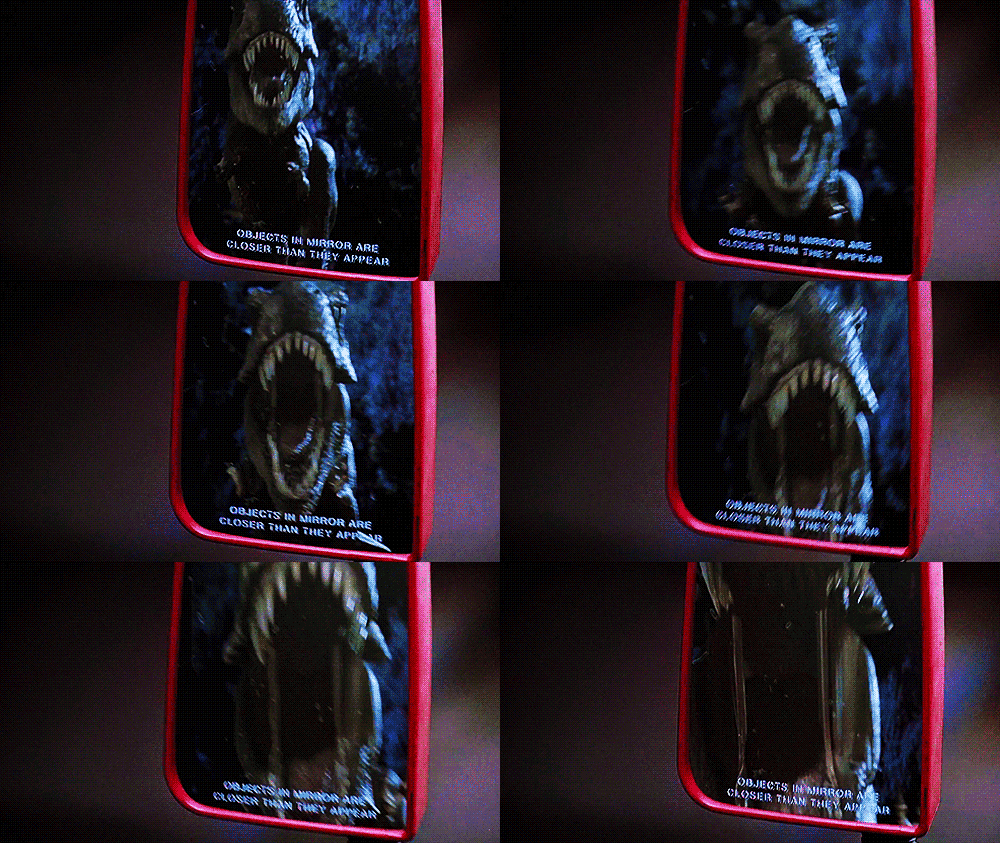
A giant looms over the tourists of Jurassic World, a towering figure that casts a long, dark shadow. But it is not a dinosaur. It is, rather, the specter of Steven Spielberg and the lingering greatness of the original Jurassic Park. One score and two years ago, our forefather of blockbuster filmmaking brought forth into multiplexes a new species of movie, a thrilling adventure of CGI-assisted wonder. But as striking and terrifying as certain moments of Jurassic Park were—the sight of water rippling from a faraway impact, the reveal that a reassuring hand is attached to a severed arm, that iconic warning that “objects in mirror are closer than they appear”—what made it truly special was its intimacy. Spielberg makes movies about fantastical creatures and aliens with an inimitably human touch, and in Jurassic Park, he made us care about the people he was terrorizing, from Sam Neill’s wary paleontologist to Richard Attenborough’s hubristic businessman to (most memorably) Jeff Goldblum’s cynical mathematician. It is not hyperbole to suggest that every effects-laden studio production released since 1993 has measured itself, at least in part, against the staggering triumph of Jurassic Park.

Jurassic World, the fourth and not-at-all-bad installment in the dino franchise, never entirely evades the yawning shadow cast by its primogenitor. But this is less a failure of imagination than a consequence of evolution. The world has changed. We now demand increasingly bigger amazements from our summer blockbusters, to the point where it’s difficult to cram emotional texture or narrative depth into a product already bulging with action and spectacle. Or, as one character puts it: “No one’s impressed by a dinosaur anymore.” I beg to differ, and as evidence, I need look no further than Jurassic World. This movie, which was directed by Colin Trevorrow from a screenplay he wrote with three others, may lack certain filmmaking fundamentals—plotting, character development, halfway-decent dialogue—but it is damn impressive. Read More

Mad Max: Fury Road: On the Dusty Road, with Revved-up Engines

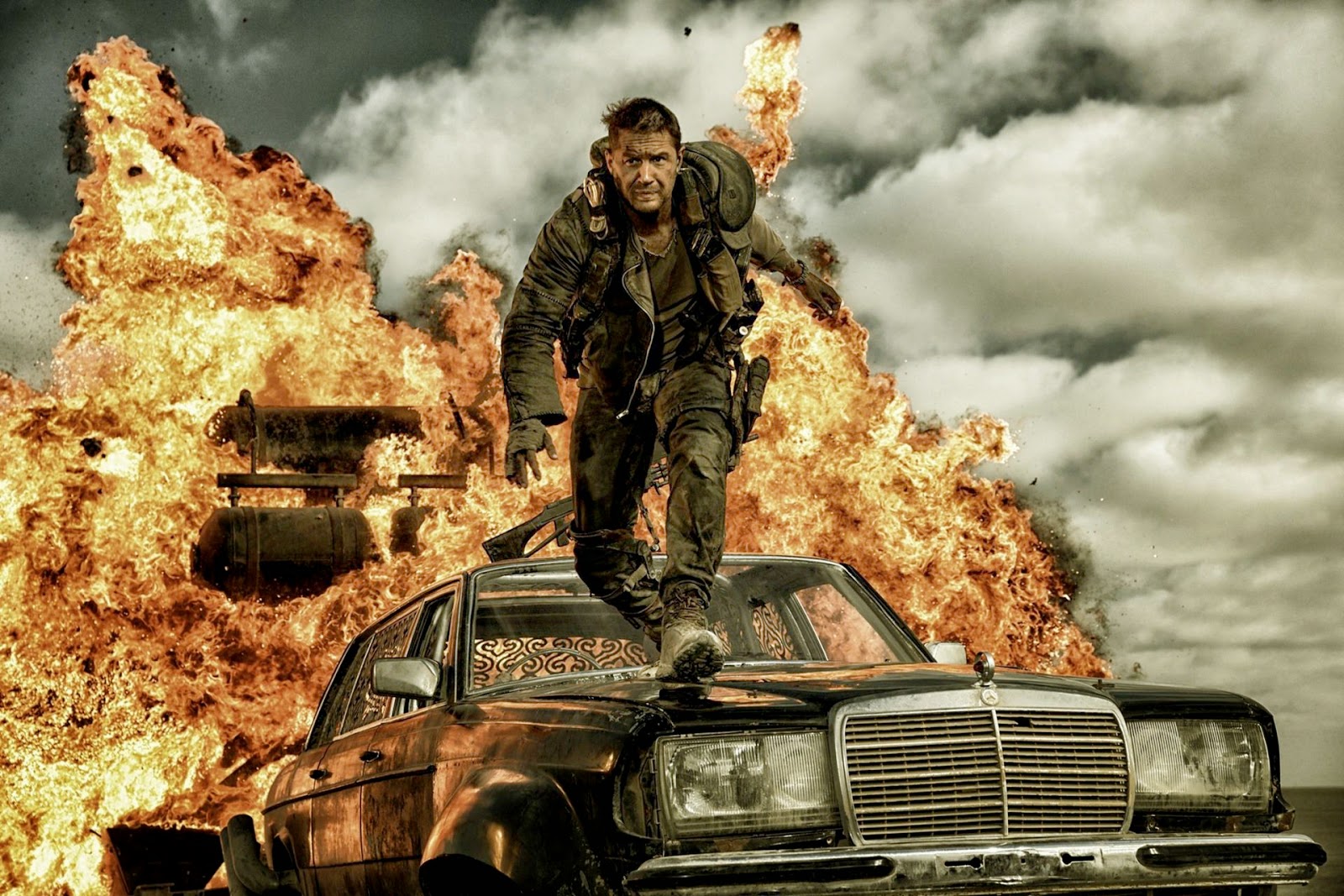
Tom Hardy stars in George Miller's explosive "Mad Max: Fury Road"

At various points in Mad Max: Fury Road—George Miller’s outlandish, unpretentious, frequently glorious action epic—an electric guitar suddenly reverberates on the soundtrack. It’s a playful sonic touch, but the musicality of the riff is beside the point; the real story is that the composer, Tom Holkenborg (credited here as Junkie XL), seems to be taking his cues from an actual character in the film, a red-clad, masked musician armed with the biggest double-neck six-string you’ve ever seen. Credited as Coma-Doof Warrior or the Doof Warrior (and played by the Australian instrumentalist iOTA), whenever he slashes his right arm across the strings, not only do bolts of noise blare on the soundtrack, but giant flames shoot out of the guitar’s headstock. And if that isn’t enough, the Doof Warrior spends his entire time riding on the roof of a massive 18-wheeler (the Doof Wagon, naturally) that’s barreling at top speed through the Australian Outback.

The Doof Warrior, the movie's grandest flourish

The Doof Warrior is the most memorable thing about Mad Max: Fury Road, but he is also the embodiment of its zany, carefree spirit. This is, after all, a movie that features a host of pursuing ATVs adorned with bristling spikes, resembling a motorized prickle of mutant porcupines. When bald, emaciated underlings aren’t sailing through the air on tall pieces of wood like demented pole-vaulters, they’re scrambling onto the hoods of speeding cars and spitting gasoline into open engines. Big rigs crash into one another, characters leap from vehicle to vehicle, and everything always seems to be on fire. (It’s hardly surprising that Verdi’s iconic “Requiem” figures prominently on the soundtrack.) Yet as crazed as Fury Road is, it is also lovingly intimate, the work of a director who cares deeply about his fictional dystopia. Miller may paint on an enormous, chaotic canvas, but he’s still an artist. Read More