Deadpool: A Wisecracking Superhero Takes Aim at Bad Guys, and a Genre

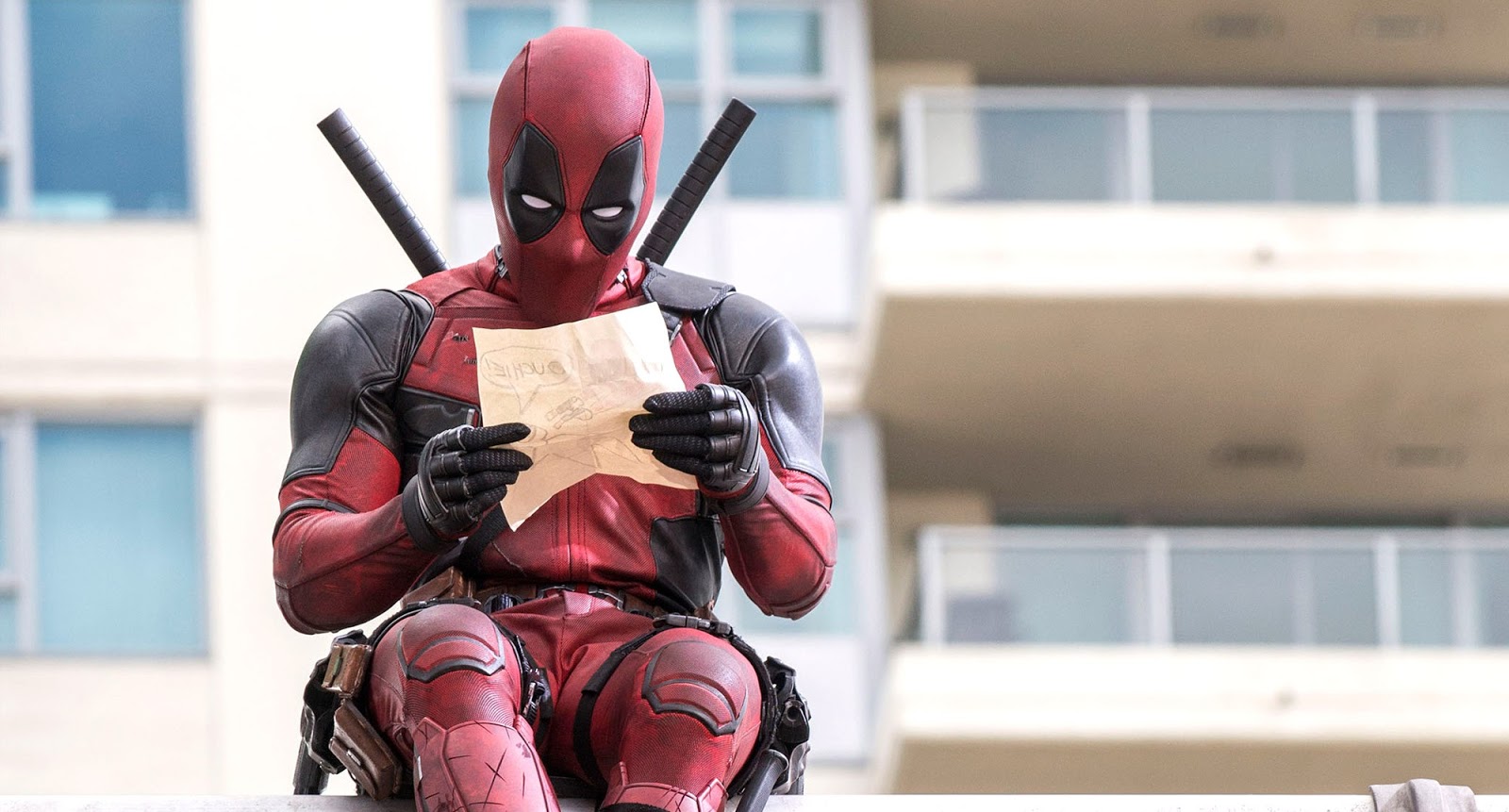
Ryan Reynolds as a smartass superhero in "Deadpool"

There’s truth in advertising, and then there are the opening credits to Deadpool. Soundtracked to Juice Newton’s ’80s ballad “Angel of the Morning”, the camera pans and pulls slowly through a frozen still of interrupted carnage, and amid the suspended bullets and geysers of spurting blood, there peeks out a People Magazine cover. In that 2010 issue, People named Ryan Reynolds the sexiest man alive, so this would seem to be an opportune time for the title sequence to announce Reynolds’s presence in this madcap meta movie. Instead, the credits read, “Starring: God’s Perfect Idiot,” followed by other trivializing labels that summarize the remaining cast members: “a hot chick,” “a British villain,” “the comic relief,” “a CGI character.” The sequence concludes by informing us that Deadpool was produced by “asshats”, written by “the real heroes here”, and directed by “an overpaid tool”.

Is this anarchically funny or pitifully defensive? Who says it can’t be both? An ultraviolent superhero origin story filtered through the self-aware parody of send-ups like 21 Jump Street, Deadpool seeks to eviscerate the formula that pervades the Marvel Cinematic Universe while simultaneously hewing to that very template. (For the record, Deadpool is a Marvel production but is not formally associated with the MCU.) This means that it comes wrapped in a shield of protective irony that makes it virtually impervious to criticism. That is, how do you judge a pointless comic-book movie that so clearly knows it’s a pointless comic-book movie? Many MCU pictures are like schoolyard bullies, browbeating their mass audiences into submission through brute force. Deadpool is more like the class clown; accuse it of being stupid, and it’s likely to retort, “I know you are, but what am I?” Read More

Black Mass: Cops and Gangsters, Caught in a City’s Undertow

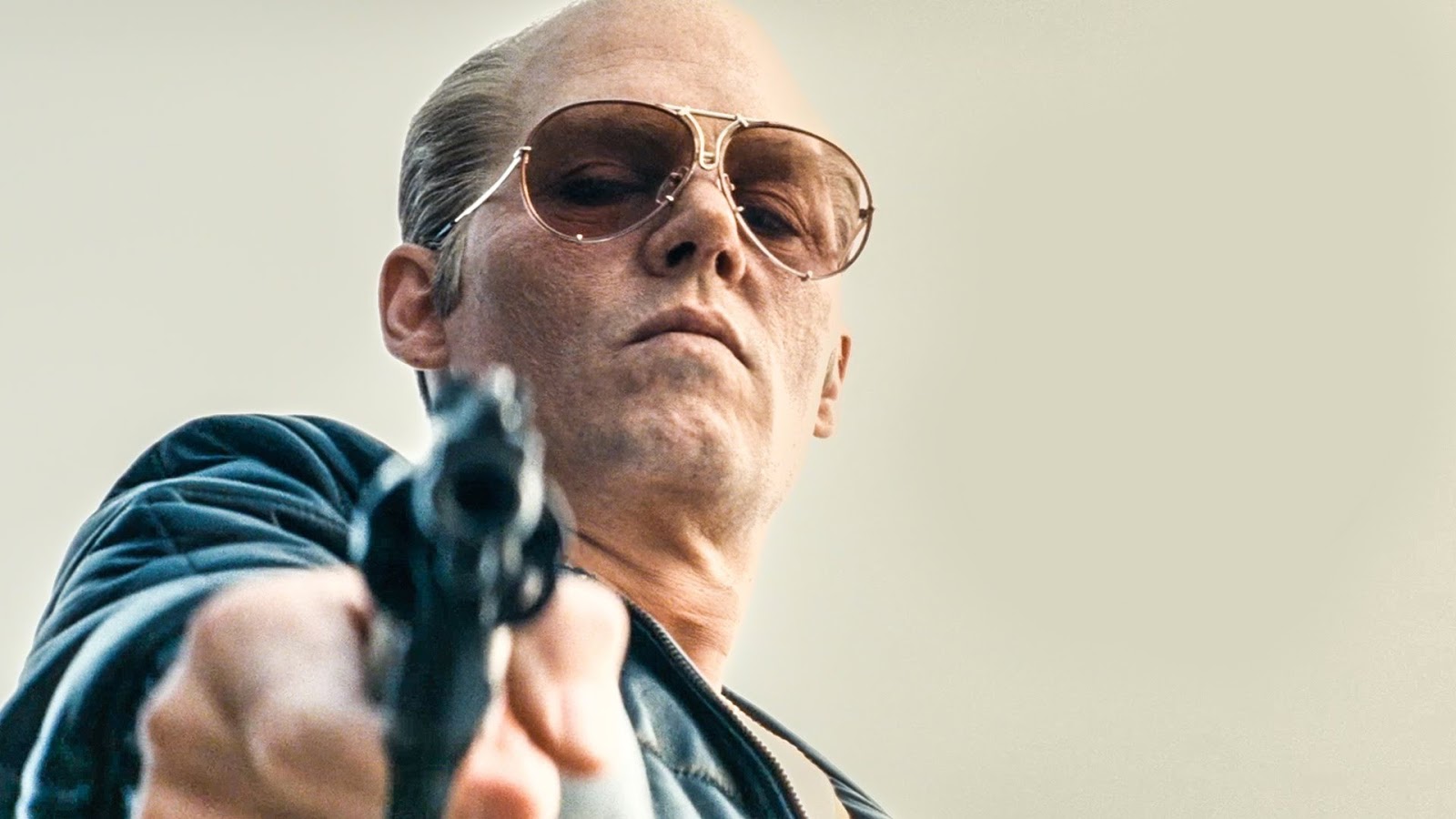
Johnny Depp stars as Whitey Bulger in "Black Mass"

James Whitey Bulger was one of the most notorious mobsters in United States history. What, don’t believe me? Just watch Black Mass, a movie that repeatedly and insistently trumpets Bulger’s legendary place in American gangster lore at every shrill turn. It features no shortage of people, whether harried law enforcement agents or cowed criminal cohorts, braying about Bulger’s illegal exploits and moral contemptibility. Yet the oddest thing about this adequately entertaining movie, which was directed in workmanlike fashion by Scott Cooper and features a dream-team cast, is that for all its vociferous proclamations, it reveals very little about who Bulger was, what he did, or how he eventually became one of the country’s most wanted fugitives. Yes, he kills a few people over the course of the film, and he threatens a few others, and he certainly seems very mean. But to the extent that he ruled Boston’s underworld for two decades as the leader of the Winter Hill Gang, well, you’ll just have to take Black Mass at its word. It presents a litany of testimony swearing to Bulger’s evil, but therein lies its flaw: It tells, but it does not show.

This does not mean that there is nothing to see. To begin with, there is the unforgettable sight of a blue-eyed Johnny Depp. Those eerie cerulean irises (the product of contact lenses), along with slicked-back pale-blond hair and prosthetically rotted teeth, combine to give 2009’s sexiest man alive a truly frightening countenance. And while one might quibble with the subtlety of Depp’s performance as Bulger—which is to say, there is none—it is impossible to deny the ferocious commitment he brings to the role. Often the target of critical ridicule for his unfettered flamboyance (which can, of course, yield spectacular results), he is all business here, those unblinking, alien blues teaming with a snarling Beantown monotone that befits Bulger’s blunt, monolithic persona. He rarely raises his voice, but he is always threatening, whether he’s coolly berating an underling or, in the film’s most quietly terrifying scene, exerting his will over a colleague’s wife. He is not someone you wish to cross. Read More

Pitch Perfect 2: Straining to Hit Those High Notes Amid New Lows

Anna Kendrick and Rebel Wilson lead the way in "Pitch Perfect 2"

The dirty little secret of Pitch Perfect is that, as delightful and refreshing as it may have been, it wasn’t a good movie. (In this, it was essentially the musical equivalent of Love Actually.) Its characters were one-dimensional, its romance was insipid, and its story was inane. Yet isolated parts of the movie—the riff-off, the “Since You Been Gone” auditions, anything involving Rebel Wilson’s Fat Amy—were so transcendently joyful that it became a classic anyway, an irresistible send-up of the sports movie transplanted to the goofy arena of competitive a cappella. It may have been familiar, but thanks to its inspired staging and tap-your-foot singing, it also felt fresh. Now, Pitch Perfect 2 attempts to repeat the first film’s formula; almost axiomatically, it is only half-successful. The unaccompanied musical numbers once again range from robustly enjoyable to deliriously fun, but the element of novelty has vanished. It’s hard for your movie to feel fresh when all of your material is recycled.

Anna Kendrick again stars as Beca, the too-cool-for-school member of the Barden Bellas who has embraced her role as the group’s primary arranger, even as she’s also covertly pursuing her dream of becoming a music producer via an internship at a record studio. She’s still dating Jesse (Skylar Astin), and to the movie’s credit, it doesn’t manufacture any lame complications between the two lovebirds and instead just shunts Beca’s bland boyfriend to the sidelines. (Astin does get to show off his vocal chops in an early scene.) That makes room for a far more interesting romantic pairing: Fat Amy (Wilson remains the franchise’s strongest asset, which is saying something, given that Anna Kendrick is involved) and Bumper (Adam DeVine), the buffoonish villain of the original who is now both pathetic and strangely endearing. Their love story is extravagantly goofy and commensurately enjoyable; there’s a funny scene in which Bumper feebly attempts to court his intended via forced grownup talk (“So, there’s a war, and also, the economy.”), but it’s dwarfed by the sight of Fat Amy subsequently serenading him with Pat Benatar’s “We Belong” while standing in a rowboat. Read More

Jupiter Ascending: Mila Kunis Is a Queen, Channing Tatum Has Cool Boots

Mila Kunis heads off to space in the Wachowskis' "Jupiter Ascending"

You have to hand it to Andy and Lana Wachowski: They don’t do things halfway. The Matrix was a heroic work of maniacal vision, but even their lesser movies, like the vibrantly colorful Speed Racer and the cockamamie, sporadically delightful Cloud Atlas (which they co-directed with Tom Tykwer) felt like products of artistic aspiration rather than dutiful commercialism. Now they return with Jupiter Ascending, a grandiloquent space opera that attempts to fuse the galaxy-trotting mythology of Star Wars with the familial treachery of Shakespeare. It is a labor of love, with emphasis on the labor. Like all of the Wachowskis’ films (with the exception of their first feature, the taut, terrific crime thriller Bound), this one strains for greatness; unlike their early catalog, it is ultimately weighed down by its own leaden seriousness. An enormously ambitious undertaking, Jupiter Ascending glistens with flop sweat, and you can sense the frantic desperation of its creators. It’s a valiant effort, which is another way of calling it a noble failure.

Not a typical one, though. There is far too much visual splendor and painstaking world-building on display here to dismiss Jupiter Ascending as yet another trifling, noisy, wannabe franchise-starter. After a ludicrous prologue set in Russia, we begin on a faraway planet, where Kalique and Titus Abrasax (Tuppence Middleton and Douglas Booth), two royal siblings dressed in finery, talk idly about the colonization of distant worlds. They are interrupted by their elder brother, Balem (a campy, scenery-munching Eddie Redmayne), who appears suddenly by stepping through a shimmering void in the air. The three speak in the thin politeness that masks bitter jealousy, and their social hierarchy is made clear when Titus casually asks Balem if he might consider parting with one of his more valuable properties. “What’s it called? Earth?” Read More

Focus: Will Smith and Margot Robbie Are Light as Air, But the Plot Is All Fumes

Will Smith and Margot Robbie in "Focus"

A breezy, sexy, ultimately empty crime caper, Focus is a victim of its own sleight of hand. It is so intent on hoodwinking its audience and disguising its characters’ motivations that it doesn’t entertain so much as tease, constantly taunting us with one version of events before yanking out the rug again and again. It’s the kind of movie where nothing is what it seems. That does make things unpredictable, since no viewer could possibly anticipate Focus‘ sudden twists and hairpin curves. But following this movie’s labyrinthine structure becomes less a tantalizing task of puzzling things out than a tedious exercise of wait-and-see. When you’re constantly on guard for the next big surprise, nothing is truly surprising.

Here’s the good news: For its first 40 minutes or so, Focus is a blast. The ageless Will Smith stars as Nicky, an inveterate con man who decides to tutor Jess, a fledgling pickpocket played by the fast-emerging Margot Robbie (last seen heating up the screen in The Wolf of Wall Street and set to appear next summer as Jane in Warner’s Tarzan reboot). They make a pretty pair, he with his relaxed handsomeness, she with the pale blue eyes and curves that need no introduction. Their difference in years may consternate some viewers—at 46, Smith is nearly twice the age of the 24-year-old Robbie, and his goatee now betrays the slightest whispers of grey—but his charisma hasn’t waned, and it’s easy to buy the mutual attraction that quickly leads them tumbling into bed. It’s a romance that operates on surface appeal rather than real heat, which proves problematic once Focus tethers its twist-and-turn plot to the notion that Nicky, typically such a cool customer, has fallen desperately in love. Read More