Over the past 18 years, Dwayne Johnson has appeared in several dozen films but has been credited as “The Rock” only once (in the wrestling drama Fighting with My Family, where he played a lightly fictionalized version of himself). That he was able to drop his famous WWE moniker and still become one of the world’s most bankable movie stars—headlining a number of original hits (San Andreas, Central Intelligence), supercharging the Fast & Furious franchise, turning Jumanji into a global brand—is a testament to the impressiveness of his career transition; he’s come a long way since the brute who awkwardly lumbered across the screen in The Scorpion King. Yet while Johnson has proved his talents as an action hero and self-deprecating comedian (the latter quality best displayed in his vocal part in Moana, if maybe not its forgettable sequel), he’s rarely found work as a dramatic actor, possibly because his hulking size and booming voice prevented filmmakers from envisioning him as a regular person.
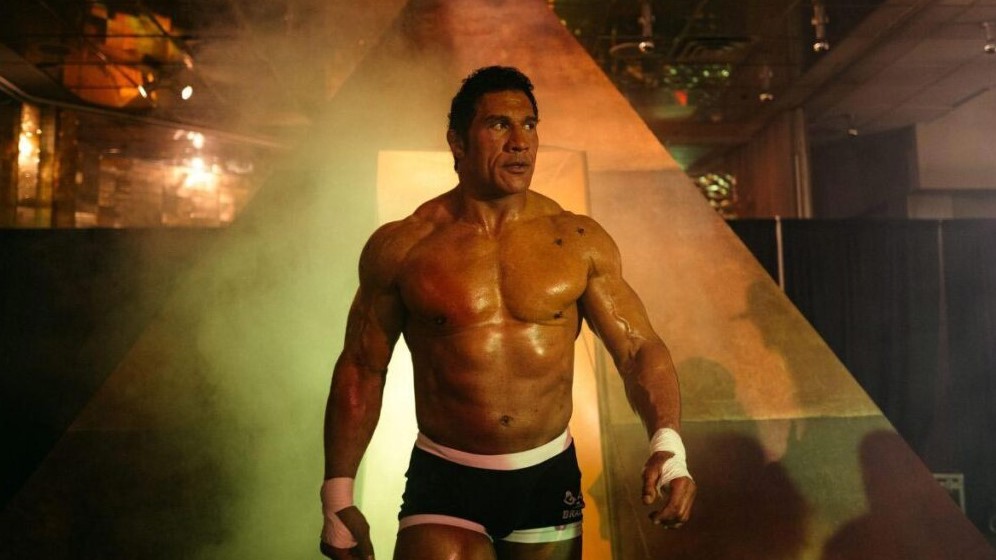
The Smashing Machine, the new biopic from Benny Safdie, represents an effort to change that. Not that Mark Kerr, Johnson’s role here, could fairly be dubbed a normal guy; he’s a muscle-bound giant, the kind of incredible hulk whose sheer mass draws stares in waiting rooms. But he isn’t a spy or a thief or superhero. He’s just an athlete, and his (relative) ordinariness seems designed to reshape Johnson’s image, and to lend his rippling physique a sheen of prestige credibility—the kind of artist who earns Oscars as well as dollars.
So let’s get this out of the way: Johnson is good in The Smashing Machine. He’s not, like, amazing; there are moments when his stiffness suggests a performer’s indecision rather than a character’s self-doubt. But in portraying Kerr as both a fearsome force and a brittle soul, he is persuasive, effectively conveying passion, anguish, and kindness. The Rock, flamboyant wrestler, is gone; Dwayne Johnson, legitimate actor, is here.
The movie that surrounds him is less assured, though it is occasionally striking. Safdie’s prior feature was Uncut Gems, a frenetic tour de force that wielded its relentless momentum (plus Adam Sandler) to overpower its aesthetic ugliness. He made that film with his brother, Josh, but has since gone solo (while also acting in excellent pictures like Licorice Pizza and Oppenheimer). With The Smashing Machine, he seems to have consciously muzzled his antic energy, instead applying a more sober method intended to pull focus away from his filmmaking flair and toward his nuts-and-bolts storytelling.
As someone who previously chafed against the Safdie Brothers’ crazed style (don’t get me started on Good Time), I should welcome this shift. Yet the tradeoff produces minimal benefits. The Smashing Machine’s visuals may not be arrestingly vulgar, but that doesn’t mean they look good; the camerawork is often jittery, and the compositions tend toward indifferent. In terms of imagery, the movie occupies stock indie territory, possessing neither amateurish self-indulgence nor expert polish.
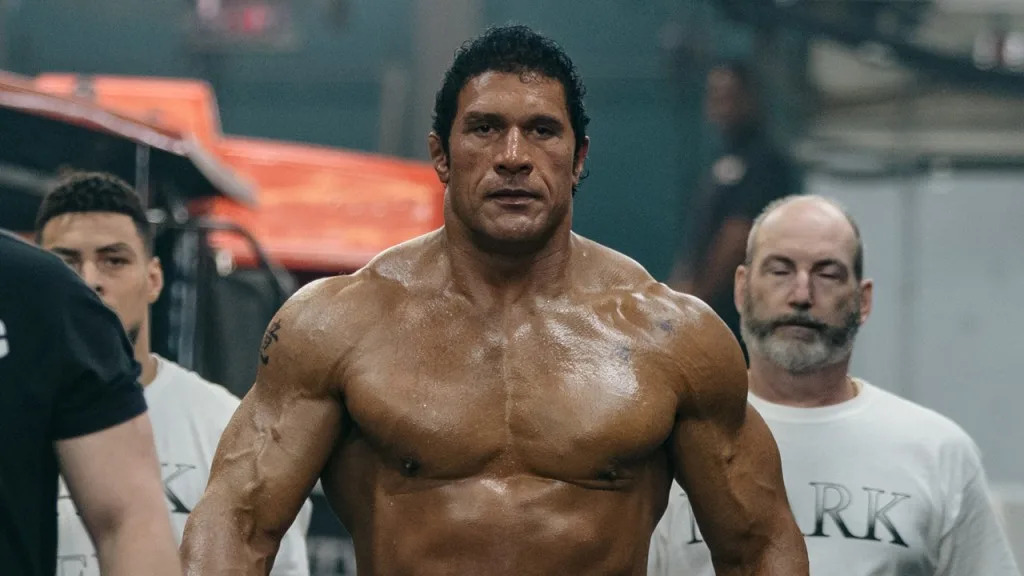
Again, this may be the point, as Safdie doesn’t want his technique to distract from his screenplay, which proves both conventional and unpredictable. In one sense, The Smashing Machine is a straightforward biopic, telling the story of Kerr—the mixed martial artist who in the late ’90s helped blaze the trail for the Ultimate Fighting Championship, which in the years since has transformed from cable-TV curio into worldwide phenomenon. Yet while the picture feints toward conformance with a number of durable sports-movie templates—the underdog journey, the star’s rise and fall, the conflict between professional success and personal happiness—it doesn’t squarely fall within any of these subgenres. It instead simply relays a small slice of Kerr’s exploits—wisely, Safdie limits his scope to the three-year period between 1997 and 2000—while attempting to better understand what makes him tick.
There appear to be two clashing options to that question. The first is the thrill of competition. Mark insists that UFC isn’t a matter of hatred or ferocity; it’s just an athletic contest where victory turns on the imposition of will. He’s good at it, combining bullheaded strength with extraordinary pain tolerance and perseverance. When an interviewer asks him how it might feel to lose a fight, he genuinely struggles to answer the question because he can’t fathom the possibility of failure.

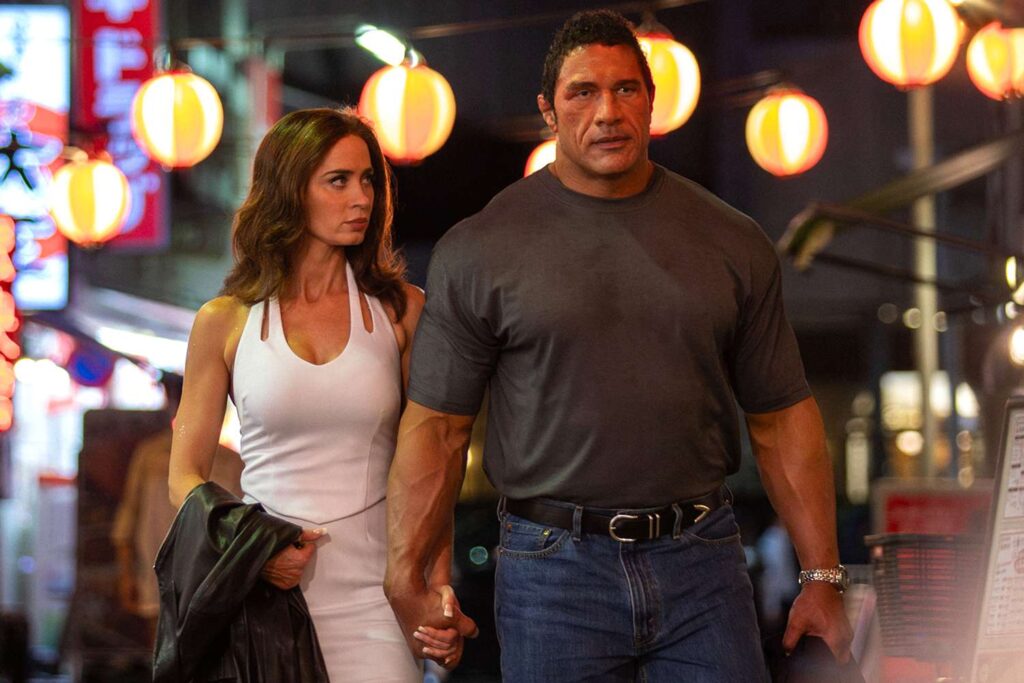
The second driving factor in Mark’s life—the one that compromises both his and the movie’s integrity—is his girlfriend, Dawn (a poorly served Emily Blunt). Initially they seem to share a healthy romance; when she makes his protein smoothie with the wrong ingredients, he gently chides her before apologizing, and she later describes him as “my big strong man.” Yet as Mark’s career progresses, their relationship degenerates, collapsing into a disturbing cycle of fights and accusations.
It is something of a cliché for male critics to complain about female characters in sports movies. Yet Dawn herself is a cliché—an underwritten figure who is depicted as impetuous and selfish, and whose primary function in the script is to hinder Mark in his quest for greatness. Blunt is a terrific actress (she previously played opposite Johnson in the fitfully enjoyable Jungle Cruise), but she is stranded here; with the exception of a harrowing scene where Dawn and Mark’s argument leads to him ripping a door in half, she has no interesting material to work with, and she can’t imbue such a thin persona with dimensionality. (That her wardrobe repeatedly accentuates her cleavage only reinforces the character’s flatness.)
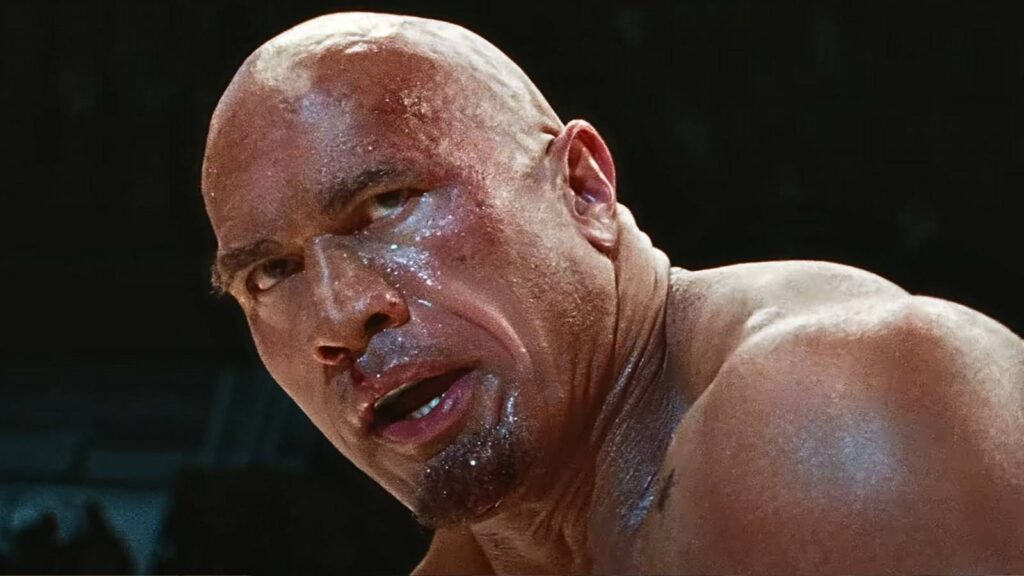
In fact, much of The Smashing Machine—such as Mark’s debilitating addiction to painkilling opioids, followed by his inevitable post-recovery training montage—fails to achieve real depth, instead skimming the genre’s familiar surface. It broaches something provocative in portraying Mark as a gentle giant—a fundamentally decent man whose vicious temper leaves him (and those around him) prone to terrible rages—but despite Johnson’s inhabiting performance, it never fully pursues the idea. Its fight scenes, meanwhile, are about what you’d expect from a Safdie UFC flick: violent, intense, and not especially dynamic, with an emphasis on brutality at the expense of coherence.
Yet while its typicality can be deflating, The Smashing Machine provides its share of pleasures—not all of them expected. Most fact-based sports dramas face difficulty in smoothing the bumps of real history into a satisfying narrative, but Safdie’s screenplays turns this challenge into an asset, building to a climax that manages to be both touching and surprising. In life, it recognizes, not every tale of resilience ends in triumph; not every loss is a mere stepping stone to a subsequent win.
“I didn’t lose,” Mark insists after one dubiously refereed brawl. And for all its flaws, The Smashing Machine never succumbs to obviousness or sentimentality. It draws you in to its octagonal ring. It just never knocks you out.
Grade: B-

Jeremy Beck is the editor-in-chief of MovieManifesto. He watches more movies and television than he probably should.