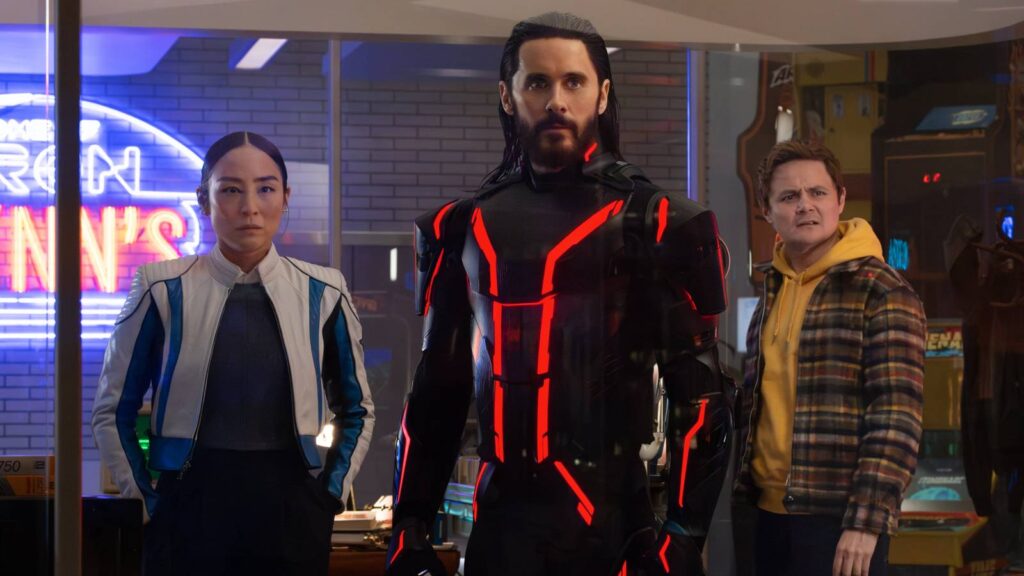
There has never been a good Tron movie. But Ares, the third installment in this baffling techno-obsessed franchise, is probably the least bad of the bunch. It retains the series’ sleek, color-coded aesthetic while also taking steps to minimize its mythological inanity. Calling it smart would be a stretch, but it reflects enough considered thought to qualify as sensible debugging.
Not that the storytelling in Ares is especially persuasive, or even interesting. In an accidental flirtation with topicality, its screenplay (by Jesse Wigutow) contemplates the rewards and costs of artificial intelligence. Corporate warfare has broken out over the search for “the permanence code,” an electronic MacGuffin that will allow digitized creations to attain lasting physical form. On one side of this commercial conflict is Eve (Greta Lee), an environmentally conscious entrepreneur who longs to continue the work of her deceased sister, envisioning the code as a vehicle for medical and scientific breakthroughs. On the other is Dillinger (Evan Peters), an industrial scion who dreams of commodifying and militarizing the technology; when we first meet him, he’s demoing its capabilities to a brigade of generals who salivate at the notion of a powerful and indefatigable soldier who executes all commands without question. Eve, in contrast, wants to make an orange grove whose trees always bear fruit. You earn no points for guessing which character is the movie’s chief villain.

“We’re not going there,” Dillinger says of imagined digital universes; “they’re coming here.” And from a meta perspective, the truth of that statement symbolizes Ares’ greatest (relative) strength. The first two Tron pictures unfolded primarily in the Grid: an uncanny, frictionless realm where human actors embodied hard-wired programs. The Grid carries potential from a design perspective, but in terms of narrative logic it’s a total dead zone, with its senseless jargon (users, portals, deresolution, blah blah) and its spatial vagueness. 2010’s Tron: Legacy improved on the 1982 original thanks to Joseph Kosinski’s stylish technique, but once it leapt from the real world into a land of glowing discus battles and “isomorphic algorithms” (seriously), it quickly relinquished its dramatic stakes.
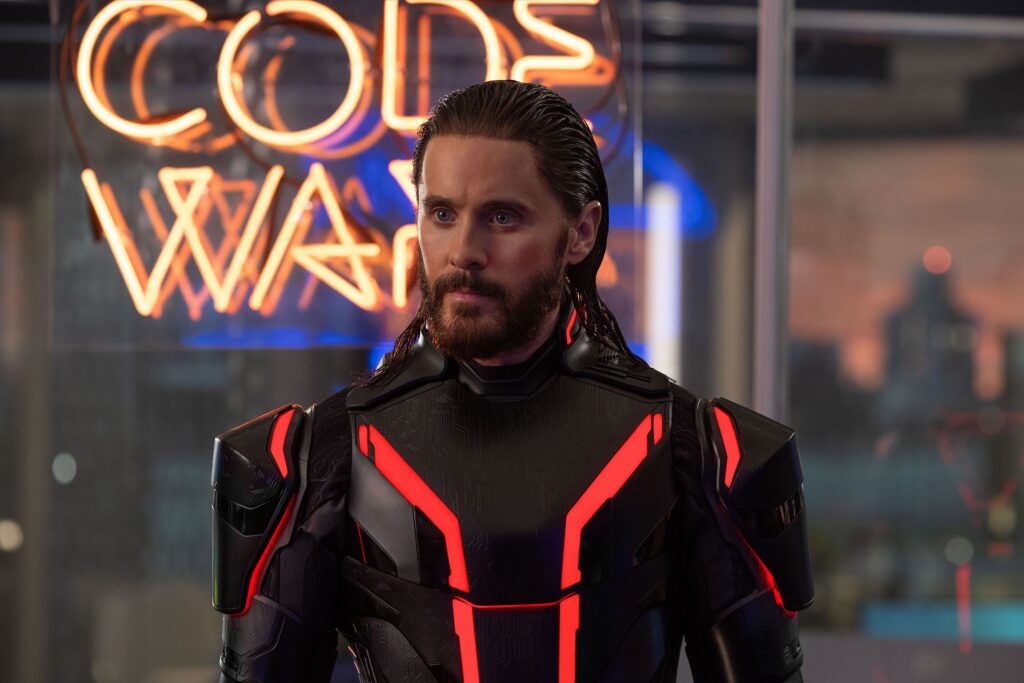
Ares endeavors to reverse this polarity. Sure, a handful of its scenes take place in the Grid, and they’re as goofy and listless as you might expect. (At one point the screenplay contrives to resuscitate the “original” domain from 1982, but what purports to be playful retro chic instead comes off as simpering nostalgia.) Yet the brunt of the action transpires in corporeal rather than virtual reality. Dillinger, having previously engineered the titular warrior (played with daffy curiosity by Jared Leto), uploads him into a flesh-and-blood body and orders him and his top lieutenant, Athena (Jodie Turner-Smith, in a thankless role), to track down Eve and her precious code. The ensuing hunt is notable not just for its for its kinetic panache, but for how director Joachim Rønning implements the franchise’s fanciful iconography within tangible streets and buildings.
The Tron movies are dumb, but they at least possess a visual vocabulary that distinguishes them from other multiplex fare. Rønning, whose specialty appears to be taking the helm of sinking properties (Pirates of the Caribbean, Maleficent) and steering them into the beachhead of irrelevance, is not an innovator, but he displays a capable grasp of this series’ distinctive elements: beams of light, complementary colors, a geometric exactitude that emphasizes circles and triangles. The sequence in which Ares and Athena chase after Eve on luminescent motorbikes (“light cycles,” in the saga’s parlance) is fleet and effective, combining glittering wonderment with muscular cinematic action.
And on the whole, Ares looks and sounds pretty cool. Metaphorically speaking, Eve and Dillinger occupy opposing ends of the visible spectrum (she’s light, he’s dark), and the movie literalizes their clash by juxtaposing vivid reds against striking blues. The score, by Nine Inch Nails (succeeding Legacy’s Daft Punk), thrums with energy and ingenuity. The special effects are carefully designed and thoughtfully deployed—at least until the dreary third act, which sacrifices precision in favor of weightless, glowering clamor. (That’s also when the plotting succumbs to the need to integrate this sequel with its predecessors; certain moments, as when Dillinger screams “End of line!” are likely to puzzle first-time viewers.)
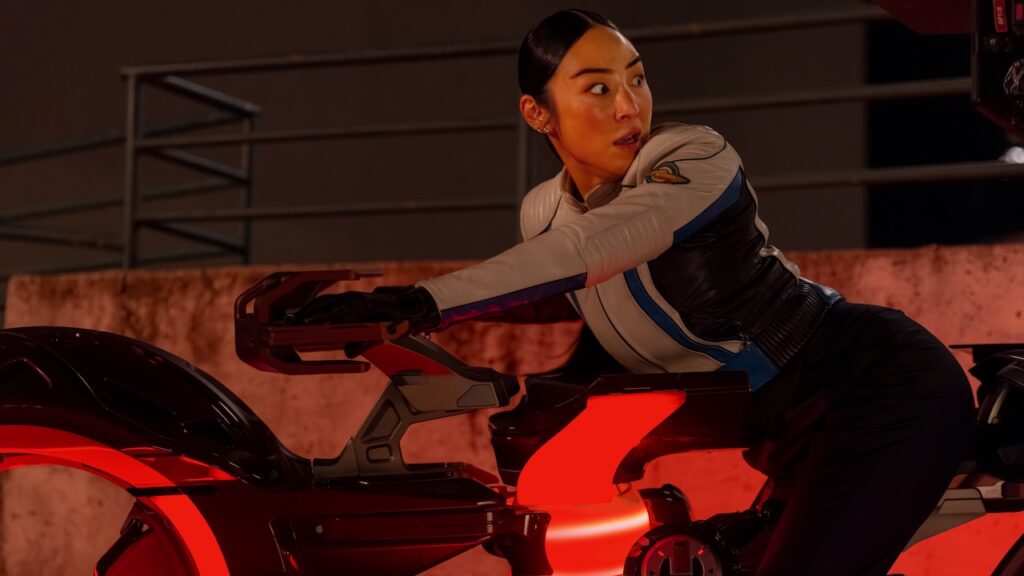
The characters at the center of Ares are constructed with considerably less care, which places the actors in a challenging position. Lee is a nimble and intuitive performer, capable of exuding both tenderness and toughness (her work in Past Lives remains haunting), so it’s frustrating that Eve is so blankly written, with her dead sister supplanting any potential for more complex motivations. Leto is a stranger casting choice; he’s a naturally eccentric presence who works best when he can be operatic (The Little Things, House of Gucci), which doesn’t make him a natural fit for Ares’ robotic mannerisms. (I confess to laughing when a crumpled Ares looks up at a concerned Eve and his interface determines, “Empathetic Response.”) Yet the two play off each other nicely, particularly once the characters’ interests become aligned and this high-concept action picture transforms, all too briefly, into a disarming buddy comedy.
But to what end? As a science-fiction tentpole, Ares dutifully echoes its forebears—comb through its DNA, and you can pick out strands of Terminator 2, The Matrix, even The Creator—but aside from its vibrant aesthetic, it contributes nothing of its own to the genre’s (sorry) legacy. And while there’s nothing inherently wrong with a blockbuster that prioritizes brawn over brains, this one pretends to offer provocative thoughts on the human condition in the age of AI’s ascendancy, only to hastily retreat from saying anything meaningful.
Ares, as manufactured by both Dillinger and the film’s screenplay, is a program, not a person. Yet as he spends more time in our world, he begins to develop what can only be called (and what the script pointedly does call) feelings—not just a semblance of affection for Eve, but a broader appreciation of artistry and beauty. (More specifically: He likes Depeche Mode.) Does the movie intend to posit that AI possesses the capacity to become human—that all of that computerized code can constitute the wiring of a soul? Is it a prophetic warning that such fearsome technology can’t be controlled, and that its mushrooming growth will (as in so many other pieces of dystopian sci-fi) spell civilization’s doom? Or is Ares’ (r)evolution a rebuke of Dillinger’s cold calculations, an insistence that the mechanistic imperatives of AI are in fact incompatible with the unknowable spark of humanity?
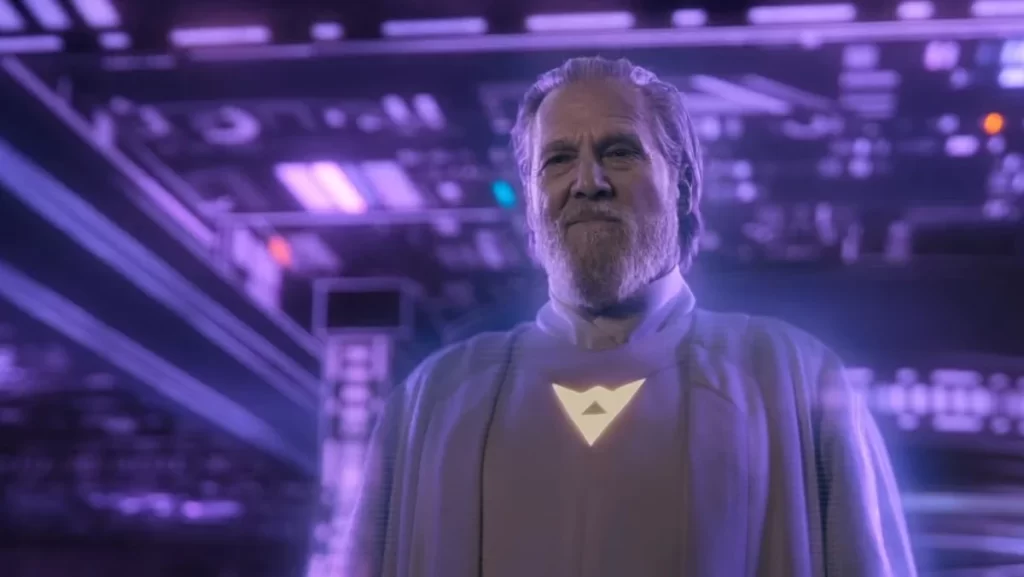
A more ambitious movie might have grappled with these tangled possibilities. Tron: Ares instead resurrects a haloed Jeff Bridges to intone some faux philosophical mumbo-jumbo, then returns to its glitzy sound-and-light show, which eventually becomes clumsy and chaotic. (There is also far too much frantic tapping of keyboards, though I do dig a good floppy disk reference.) Perhaps I’m demanding too much of a Tron picture to exhibit some level of thematic coherence, but it’s disappointing that Ares wields its technical prowess in service of such a forgettable story. Its style can be eye-catching, but in terms of substance, it careens right off the grid.
Grade: C+

Jeremy Beck is the editor-in-chief of MovieManifesto. He watches more movies and television than he probably should.