Did Paul Thomas Anderson just make an action movie? Yes and no. Certainly, One Battle After Another is a robust and muscular production, replete with car chases, kidnappings, and explosions. Yet its most exhilarating sequence—the one that best encapsulates its singular combination of tumultuous suspense and whip-smart comedy—is just a guy talking on the phone.
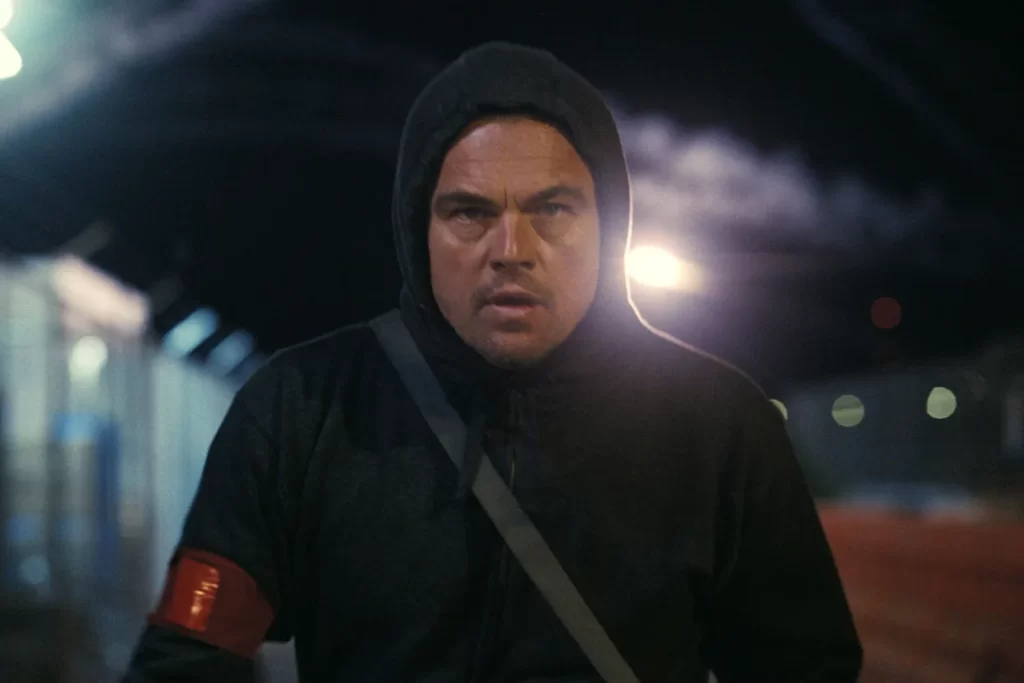
It helps, of course, that said guy is Leonardo DiCaprio, one of our last true movie stars. He plays Bob Ferguson, a lapsed revolutionary whose stormy past as an ideological militant has long since subsided into a cloud of bong smoke and disorientation. With his scraggly facial hair and his fried brain cells, Bob seems an unlikely hero of a decades-spanning epic from the acclaimed director of Magnolia and There Will Be Blood. But One Battle After Another, which Anderson adapted from Thomas Pynchon’s Vineland, has no interest in being bound by expectation or convention. It is a wildly ambitious picture that takes as its subject no less than the precarity of the American experiment, yet it is also an intimate family melodrama—a poignant tale of darkened souls clawing their way back toward the light.
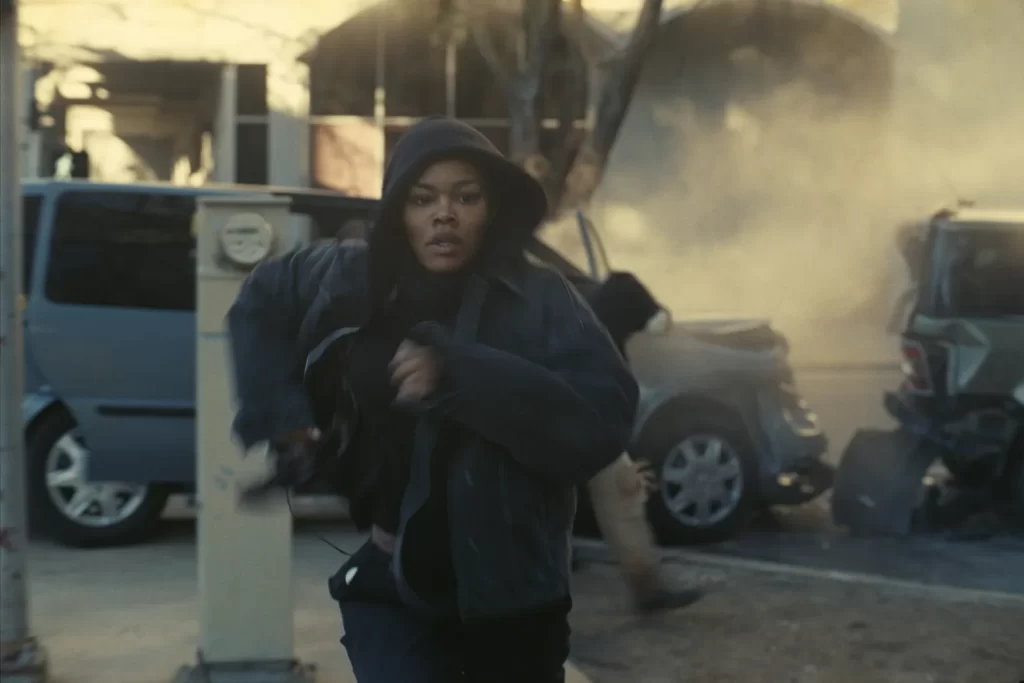
In the movie’s opening sequence, that light is strikingly literal, as a series of bombs triggered by Bob (then called Pat) set the night sky aglow. The place is the U.S.-Mexico border, the time pointedly unspecified, and Pat is a member of the French 75, a group that is either (depending on your perspective) a valiant band of freedom fighters or a thuggish gang of radicals. Holding the latter view is Capt. Steven J. Lockjaw (Sean Penn), the roided-out supervisor of an immigrant detention facility who awakens one night to find Pat’s girlfriend, Perfidia (an electric Teyana Taylor), pointing a gun at his crotch. Her taunting of Lockjaw, which mingles humiliation with arousal, inflames in him an obsession, and he soon devotes his life and his martial resources to eradicating the French 75, resulting in a cascade of murder, anguish, and betrayal.
The first act of One Battle After Another unfolds largely via montage, as Anderson lays strategic narration atop episodes of the French 75 performing various acts of terror/resistance. It’s a display of vigorous momentum that also carries undercurrents of confusion and sadness, especially once Pat and Perfidia have a child and she begins to suffer post-partum depression. Taylor, who previously flashed her obvious talent in A Thousand and One, plays Perfidia as a creature of bottomless need, and Lockjaw exploits her hunger with ruthless efficiency, splintering the faction and scattering its constituents. (One such casualty is Alana Haim, the star of Anderson’s Licorice Pizza, whose dedicated rebel is dispatched with shocking suddenness.) Before long, Perfidia has vanished—though not before shattering Lockjaw’s visions of illicit bliss with the sneering note, “This pussy don’t pop for you”—Pat has fled and assumed the identity of Bob, and 16 years have passed, during which a narrator informs us that “not much has changed.”
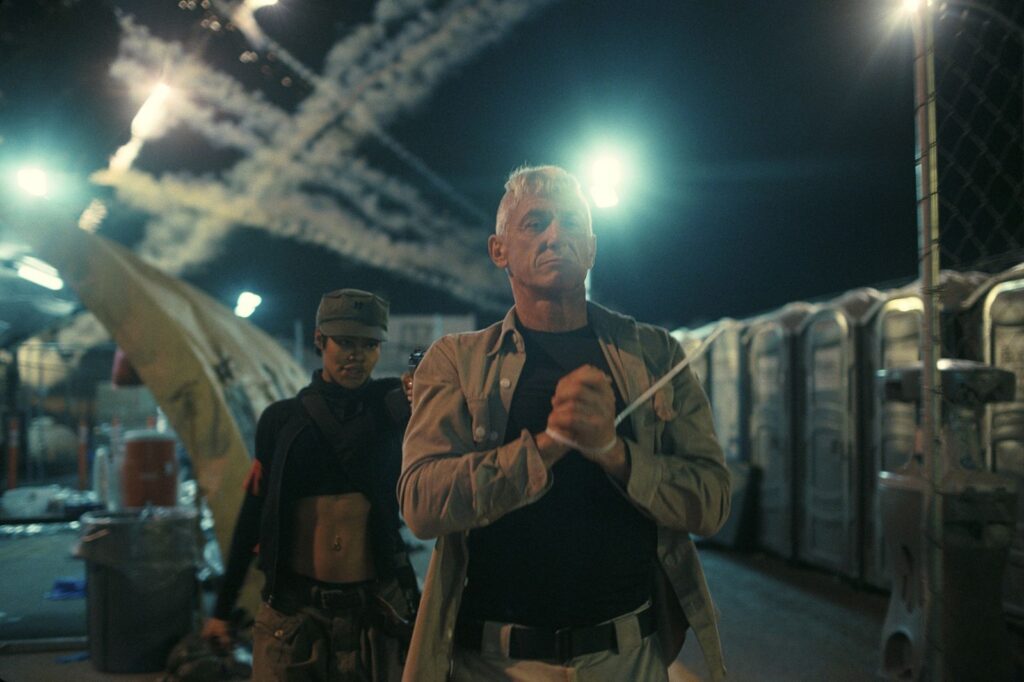
Ain’t that the truth. Anderson plays coy with the movie’s period, but despite its time jump, both phases of One Battle After Another take place decidedly in the here and now—an America awash in jingoistic cruelty and encroaching fascism, where sanctuary cities do battle with riot police and where dissidents are disappeared in broad daylight. Lockjaw, since promoted to colonel, dreams of joining the Christmas Adventurers, a white-nationalist hate group whose members are embedded throughout the government and high society. (Their superior entitlement is embodied by a number of oily character actors, most visibly Tony Goldwyn at his most casually smug.) For reasons best left obscured, Lockjaw’s quest returns Bob to his crosshairs, along with Bob’s now-teenage daughter, Willa (born heartbreaker Chase Infiniti).
For a movie so packed with incident and detail, One Battle After Another’s narrative trajectory is surprisingly simple: It’s a hide-and-seek picture. Lockjaw, backed by the might of the nation’s military and armed with his own demented zeal, is hunting Willa and Bob, who are vaguely schooled in cloak-and-dagger protocols—they’ve retained a marvelously low-tech pair of musical sensors whose harmonic frequencies rhyme when in close proximity—but aren’t exactly vigilant in their stealth. And so it goes that Bob, half-baked and seeing double, finds himself screaming into a payphone, infuriated that a confederate refuses to disclose the location of a safe house until he remembers some damn password.
Cinephiles will forever link DiCaprio to his six collaborations with Martin Scorsese (maybe seven, if The Wager ever gets made), but he’s loaned his twitchy charisma to a number of other auteurs: Spielberg, Nolan, Tarantino, Cameron, Eastwood, and more. (Sorry, Adam McKay doesn’t count, but Sam Mendes might!) In retrospect, it’s odd that it took him this long to team up with Anderson, but the wait was worth it. Bob is one of the heartthrob’s finest creations: a noble, protective father who is also a complete idiot. “Uhh, it’s been years, and I got a little bit high,” he explains when justifying his inability to recall a particular countersign, and the many scenes of Bob flailing against his own incompetence—always trying to help his daughter, never executing his mission as planned—lend One Battle After Another its considerable comic kick. DiCaprio is a fiercely intelligent actor, but he’s never smarter than when he’s playing dumb.
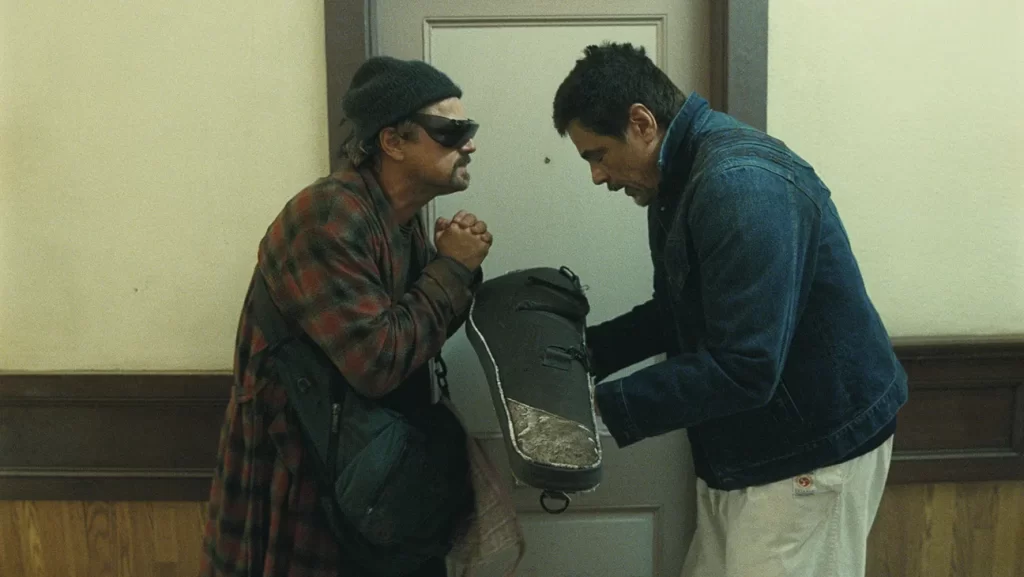
Not that Anderson is kidding around; to the contrary, his unapologetically political screenplay features a charged and cogent point of view. It hardly seems accidental that Bob and Willa’s personal predicament is set amid a broader immigration crackdown, which accounts for why Willa’s karate instructor, Sergio (a wonderful Benicio Del Toro), also runs a clandestine shelter for refugees. (As in Spielberg’s West Side Story, the Spanish spoken here goes unsubtitled.) The bustling chaos of Sergio’s operation stands in marked counterpoint to the Christmas Adventurers, who meet in roomy lodges with antiseptic surfaces, and who behave with calm, clinical precision. (They share a spiritual kinship with the officious bureaucrats whom Del Toro clashed with in The Phoenician Scheme.) Their methodical approach camouflages the absurdity of their words and actions—Lockjaw is a terrifying jackboot who is also, with his tight shirts and stiff mannerisms, utterly ridiculous—suggesting that when it comes to white supremacy, stupidity and brutality aren’t mutually exclusive.

These topical insights in no way hamper Anderson’s fluency as an entertainer. His craftsmanship here is less flamboyant than in works like There Will Be Blood or The Master, but he remains a supremely confident filmmaker, and he now operates with a kind of loose grandeur. One Battle After Another is a big movie (it was shot in VistaVision, though good luck seeing it projected that way), with sweeping landscapes and lavish production values, but it isn’t overly enamored with its own opulence. (A partial exception is Jonny Greenwood’s agitated score, whose persistent plinking isn’t to my taste, though there are some dazzling moments when it seems to sample A Clockwork Orange.) Anderson also demonstrates a heretofore unforeseen facility for dynamic action: A scene where Bob leaps across nighttime rooftops courses with energy and surprise, a fraught encounter ends with a startling shotgun blast, and the climax—a car chase up and down the rolling hills of southern California—feels like it invents a new form of vehicular mayhem.
Yet while One Battle After Another hums with tension and excitement, its lingering impression—the quality that distinguishes it from other mighty epics—is its abiding warmth. On the surface, Bob and Willa have a tempestuous relationship, but their love for one another is undeniable, and Infiniti complements DiCaprio’s hot-blooded dynamism with her own clenched resolve. Their scrappy decency trickles down and throughout the French 75, as in Regina Hall’s stern-but-compassionate portrayal of Willa’s temporary de-facto guardian, or in how one of Bob’s old pals (the musician Dijon) adjusts a security question to a cheeky familiarity (“What’s my favorite kind of pussy?”). And as Sergio, the sensei-turned-underground-railroad conductor, Del Toro exudes remarkable tenderness; he’s a relaxed, jovial presence whose brimming humanity reinforces that these characters are worth caring about, and worth fighting for.
Combat is this movie’s engine, in ways both narrative and artistic. Among the many appealing needle drops on its soundtrack (hey neat, “American Girl”!) is “The Revolution Will Not Be Televised.” True enough, but despite that song’s famous closing line, it won’t be live either. No, this cinematic rebellion has already been filmed, and it’s playing up there, on the big screen.
Grade: A

Jeremy Beck is the editor-in-chief of MovieManifesto. He watches more movies and television than he probably should.
One Battle After Another is simply about the demonization of ICE who are only doing their jobs and ridding the land of criminal illegal aliens that invaded our country! Wake up people and see how many illegal aliens are commiting crimes including murder, rape, drug trafficking and sex trafficking, just to name a few. All liberal politicians want is to keep them here for voting purposes only. They care nothing about them as people. These liberal cities look like war zones and the liberal media won’t tell you the truth. I sincerely hope people are not as stupid as they seem and realize that instead of all the doxxing, violence, professional paid protestors, and false rhetoric, they should be praising these men and women who have families just like you.
Sir, did you graduate from an accredited school?
Get a life Mark