
The biopic-to-Oscar pipeline isn’t what it used to be. Sure, slathering on makeup and adopting a pronounced accent is probably still the safest way to catch the Academy’s eye; of the past 10 ceremonies, seven have awarded at least one acting trophy to someone playing a celebrity or historical figure. (You could quibble about including 2015 in this tally, since Leonardo DiCaprio, Alicia Vikander, and Mark Rylance and all won statuettes for portraying people who are real but not exactly embedded in the popular imagination.) But it’s hardly a sure thing. Last year, for example, Timothée Chalamet, Edward Norton, and Monica Barbaro all received Oscar nominations for playing famous musicians in A Complete Unknown, but they all lost to competitors portraying fictional characters (in The Brutalist, A Real Pain, and Emilia Pérez); two years prior, Austin Butler’s flashy reincarnation of Elvis Presley succumbed to Brendan Fraser’s obese writing teacher, a person who wasn’t real in any sense.
Still, the biopic star turn remains appealing to the Academy, and for reasons beyond its membership lazily equating dutiful impersonating with great acting. There is undeniable pleasure in watching a performer trying to embody a renowned individual, using the inherent falseness of their craft to achieve a semblance of truth. Last weekend saw two new releases featuring actors playing 20th-century artists. One of these depictions is conventionally satisfying; the other flirts with the sublime.
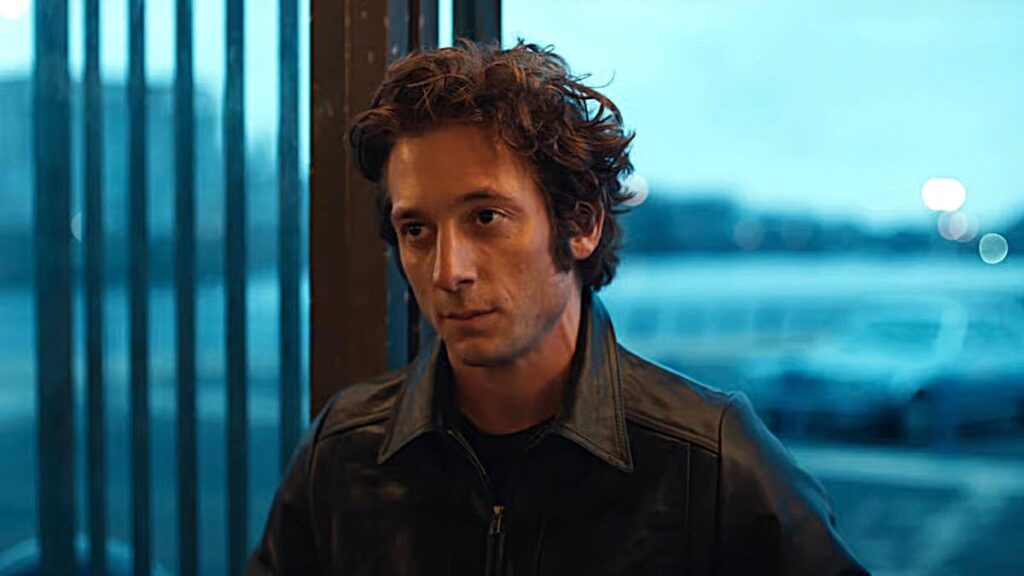
Springsteen: Deliver Me from Nowhere belongs to an emergent subgenre of biopics, one that prioritizes immediacy over totality. Rather than attempting to compress its subject’s entire life into two hours, it homes in on a short but significant period of his career. This prevents the movie, which was written and directed by Scott Cooper (adapting the book by Warren Zanes), from feeling baggy or overstuffed, though it still uses a framing device—regularly flashing back to black-and-white periods in which the young Bruce Springsteen is tormented by his alcoholic father (played by Stephen Graham)—that’s deeply misguided. Springsteen’s music is beloved in part for its unvarnished relatability; in this telling, the Boss is just like us in that he too has daddy issues.
In narrative terms, Deliver Me from Nowhere is unremarkable. When he isn’t glumly remembering his adolescent abuse, Bruce (Jeremy Allen White) is striking up a tentative romance with Faye (Odessa Young); his unwillingness to commit mirrors the clumsiness of the screenplay, which treats Faye less as a fully fledged person than an obstacle blocking his path to greatness. That greatness, of course, is the movie’s real focus: It begins with an ascendant Bruce riding a wave of success after his tour for The River, only for him to chafe against industry convention when writing and recording his follow-up album, Nebraska. The angst underlying that record’s birth—a combination of ingenuity, defiance, and self-doubt—is what White’s performance attempts to lock in.
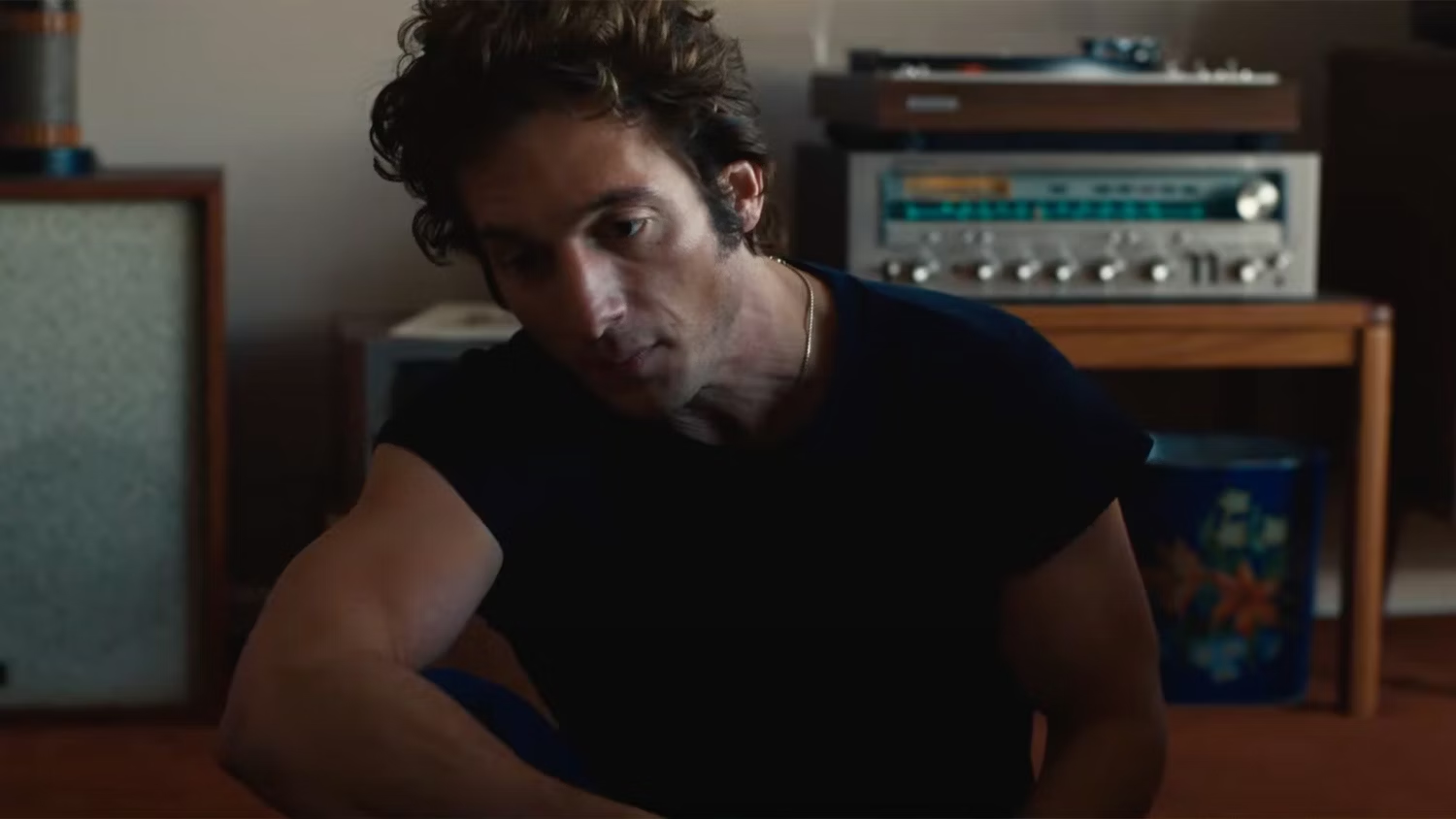
Biopics tend to invite glitzy showmanship, so it’s notable that White’s work in Deliver Me from Nowhere tacks in the opposite direction. Yes, we first see him on stage, sweat pouring off him as he belts out the lyrics to “Born to Run” and whales away at his guitar. But he disdains physical tics or flourishes, instead approaching the role as one of internal conflict. Far from the assured troubadour behind hits like “Thunder Road” and “Hungry Heart,” this version of Bruce is paralyzed by indecision and confusion; he knows what he wants Nebraska to sound like—essentially a scratchy, stripped-down record lifted from the four-track in his bedroom, without any studio gloss—but he struggles to articulate that desire with the necessary clarity. White may not be an actor of great range, but he does a nice job conveying Bruce’s baffling loneliness and fear.
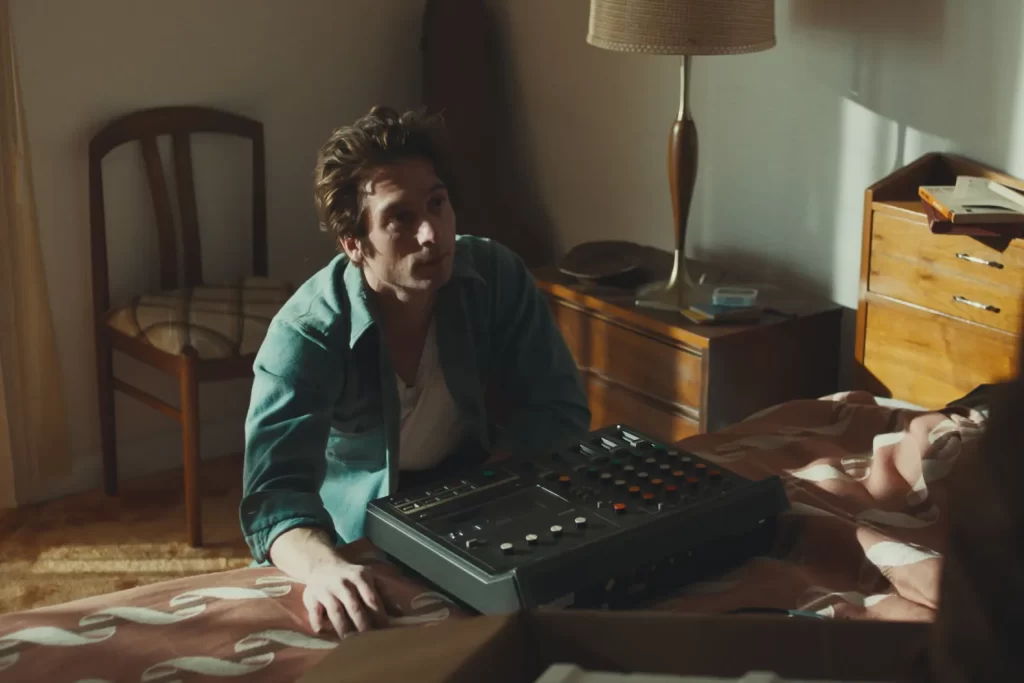
There’s valor in such restraint, but in this context it also proves somewhat limiting. Chintzy family melodrama aside, Deliver Me from Nowhere is admirably centered on the creation of a seminal American album, but its narrowness also blunts its impact. White’s vocals are certainly impressive (whether he looks or sounds like the real Springsteen isn’t for me to say), but otherwise, he isn’t extending himself; it’s hard not to watch him and think, “What if the dude from The Bear could sing?” It’s a solid, sturdy performance whose lack of bravado works both for and against it.
“Let’s burn this place down,” Bruce says to his manager (a similarly on-point Jeremy Strong) before cutting a track of “Born in the USA.” Yet there is nothing incendiary about White’s performance in Deliver Me from Nowhere; its whole conception is that Bruce isn’t setting the world ablaze but is instead retreating within himself. Sometimes that act of withdrawal produces art with a storied legacy like Nebraska. And sometimes it just makes you appreciate the technique without evoking the biopic’s glory days.
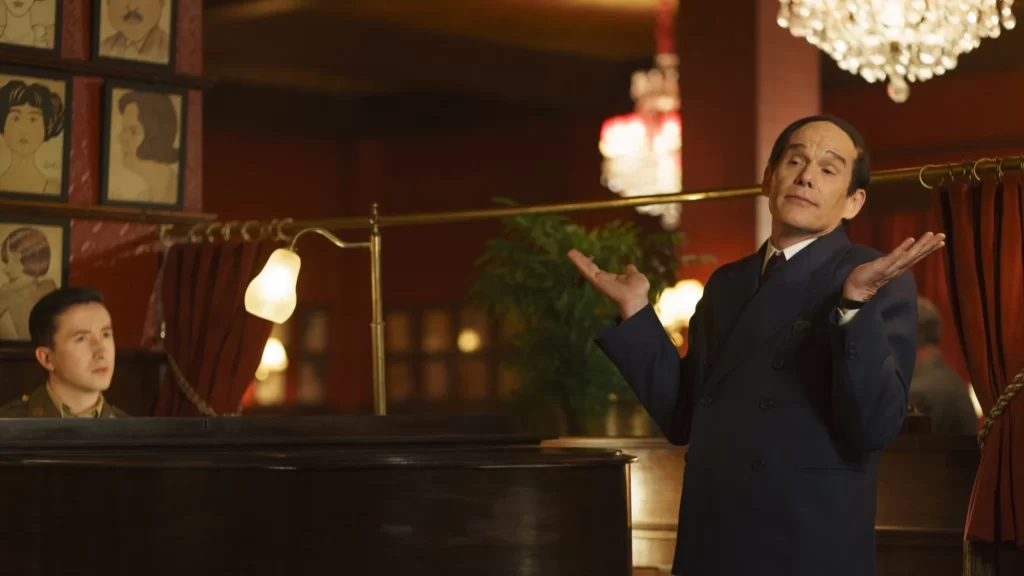
In terms of historical repute, Lorenz Hart is plainly a less celebrated figure than Bruce Springsteen. So it’s curious that Ethan Hawke, who plays Hart in Richard Linklater’s Blue Moon, delivers a far more visible performance than White as the Boss. Empirically, Hawke ticks off a number of boxes that tends to raise critics’ hackles. He alters his voice, tweaking his Texan drawl with a slight but noticeable mincing quality. He changes his appearance, rocking a hideous comb-over that makes Christian Bale’s hair in American Hustle look flattering by comparison. He even somehow shrinks himself, with Linklater using forced perspective to make it appear as though the actor has dropped 10 inches to match Hart’s diminutive stature. (This represents the inverse of Gattaca, where Hawke’s impostor undergoes painful surgery to lengthen his legs, Materialists-style.)
All of this would seem to suggest a performance that favors broadness over subtlety. Yet while Hawke’s work in Blue Moon is undeniably flamboyant, it is also remarkably textured and nuanced. His orotund vocals and eccentric mannerisms are in service of a fully rounded portrayal, one that mingles an infectious joie de vivre with a crushing sadness.
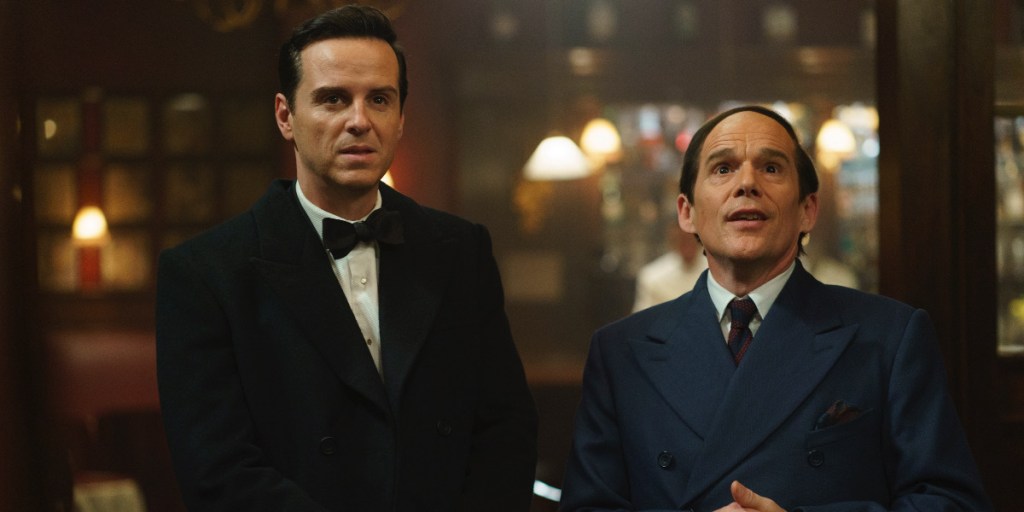
To be fair, he has the advantage of a superior screenplay. Virtually all of Blue Moon takes place at Sardi’s, the Broadway restaurant and bar where Lorenz—“Larry” to his friends—has come to rhapsodize, venerate, and sulk. It’s the night of the premiere of Oklahoma, which was of course written by the soon-to-be-legendary duo of Richard Rodgers (Andrew Scott) and Oscar Hammerstein (Simon Delaney)—the latter having replaced Hart as Rodgers’ lyricist and librettist. Larry, the jilted writer, knows that the show will be a smash hit (“high schools will perform it for decades,” he prophesies), and he takes its impending success about as well as you’d expect—drinking heavily and barking to everyone in sight about his own genius and Hammerstein’s commensurate ineptitude.
Linklater and Hawke are no stranger to talky dramas, having previously collaborated on the Before trilogy (not to mention Boyhood). And Blue Moon is above all a gabfest. Larry, fueled by jealousy and lubricated by liquor (the loutish but congenial bartender is played by Bobby Cannavale), relishes holding court, yammering about all sorts of topics: art, beauty, sexuality, and his own burgeoning relationship with a bottle-blond looker named Elizabeth Weiland (Margaret Qualley), whom he refers to as “my irreplaceable Elizabeth.”
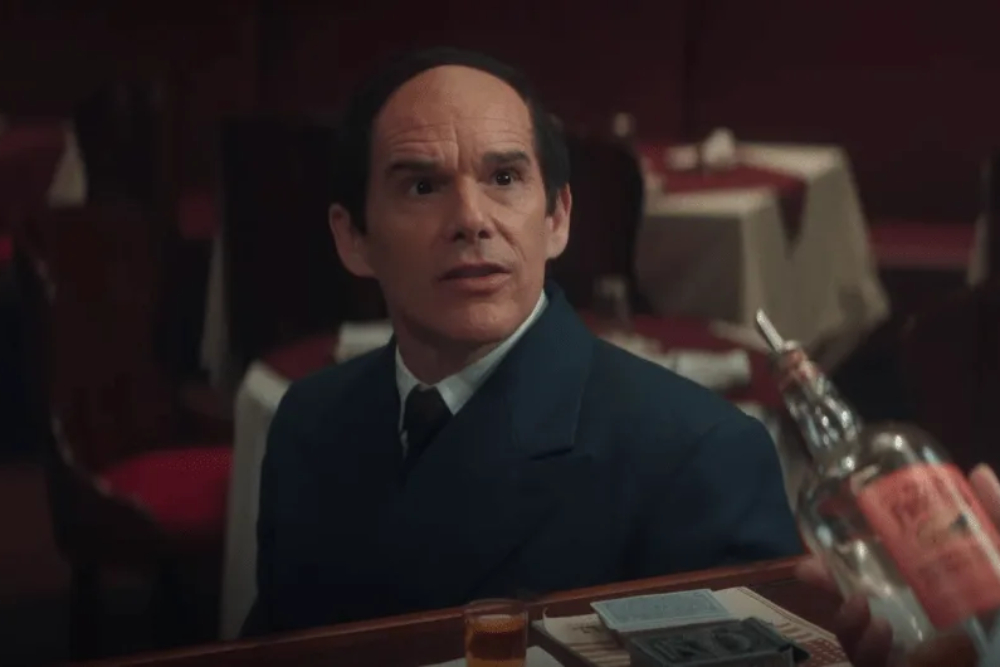
The script for Blue Moon, by Robert Kaplow (who also wrote Linklater’s Me and Orson Welles), is full of bons mots and sharp rejoinders. (There are also quite a few quotations of Casablanca, which doesn’t hurt.) But Hawke’s performance entails more than just delivering smartly written quips with rhythmic precision. He is also wielding his natural charisma to accentuate the tragicomic nature of his protagonist.
This doesn’t mean that he disappears into the role, obliterating the distinction between actor and character. Quite the opposite: Hawke flaunts his gifts with a conspicuous élan, and it’s this showboating quality that makes his performance so inhabiting. As envisioned in Blue Moon, Larry Hart is a man who feels a compulsion to be the life of the party, to consume all of the oxygen in the room. Hawke’s bluster underlines Larry’s self-aggrandizing persona while also communicating that it’s a defense mechanism to shield his own crippling melancholy. The movie’s opening scene informs us that Larry’s death will arrive seven months from the premiere, and that foreknowledge coats this sparky comedy with a glaze of anguish—a haunting undertone that Hawke nurtures beneath his bright eyes and broad smiles.
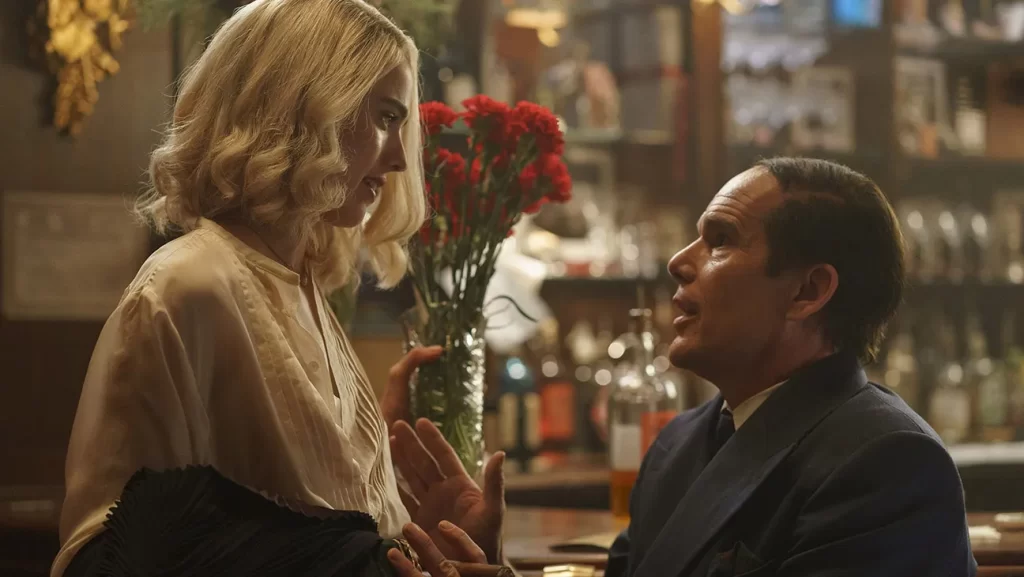
Aside from a few private moments with Rodgers (when he manages to simultaneously commend and condemn Oklahoma), Larry spends most of the movie sitting at the bar, cracking dirty jokes (I dare not repeat his pet term for “a tireless homosexual”) and puffing out his chest for the young piano player. But late in Blue Moon, Linklater takes Larry and Elizabeth into the coat check, where she tells him the sordid details of a recent sexual encounter. It’s the one scene where Larry primarily listens rather than talks, and Hawke’s reactions—particularly his crestfallen face when Elizabeth assures Larry that she loves him, “just not that way”—speak just as loud as his words. (It also recalls a similar moment in Cyrano, which, again, doesn’t hurt.)
This may make Blue Moon sound depressing, but the movie is too richly detailed—and Hawke’s performance too enjoyable—to deflate audiences. Instead, his work reminds you of the immense satisfaction you can derive from watching an actor practice their craft with such canny instincts and consummate control. You’ll find a dream in your heart, seeing him standing alone.

Jeremy Beck is the editor-in-chief of MovieManifesto. He watches more movies and television than he probably should.