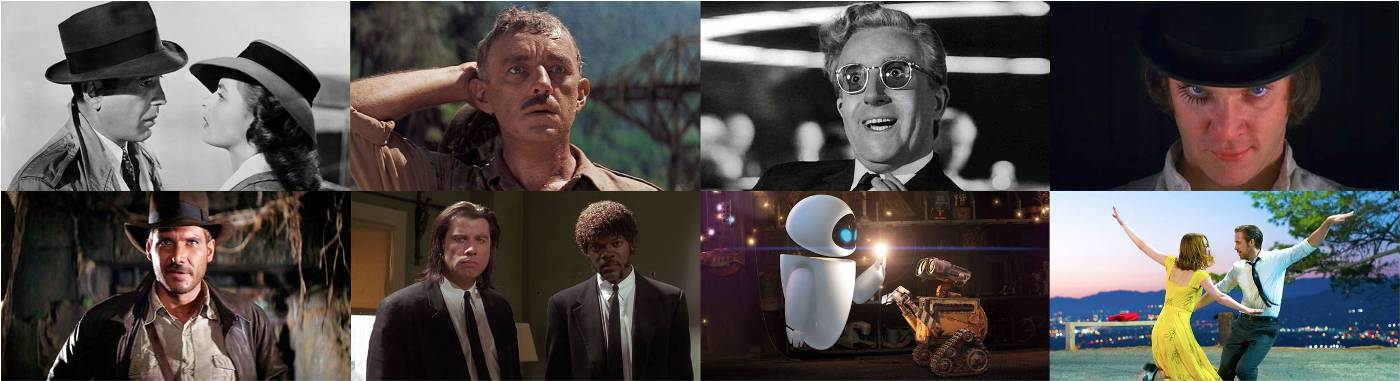
Pandora represents the promise of the new. In narrative terms, the Avatar pictures aren’t revolutionary; they refract age-old tales—about conquest and heroism, exploration and degradation, love and loss—through their own giddy popular mythology. But they are nonetheless designed to astonish viewers with their visual bravado and innovative grammar. In Avatar and its sequel, The Way of Water, James Cameron showed us things we’ve never seen before: blue warriors catapulting through the air and landing on orange winged beasts; reef-dwellers diving into the ocean and communing with its exotic flora and fauna; luminescent landscapes glittering with color and danger. The challenge for the third installment, Fire and Ash, is not just to perpetuate Pandora’s extant wonders, but to conceive of even more dazzling forms of cinematic novelty.
Judged against that lofty standard, Fire and Ash falls a bit short. It is, to be clear, a hugely impressive movie: vibrant and gorgeous, with engaging characters and provocative ideas. But it is also something of a recycling, repurposing its predecessors’ brilliant technique without equaling their sense of true discovery. It’s expectedly amazing.
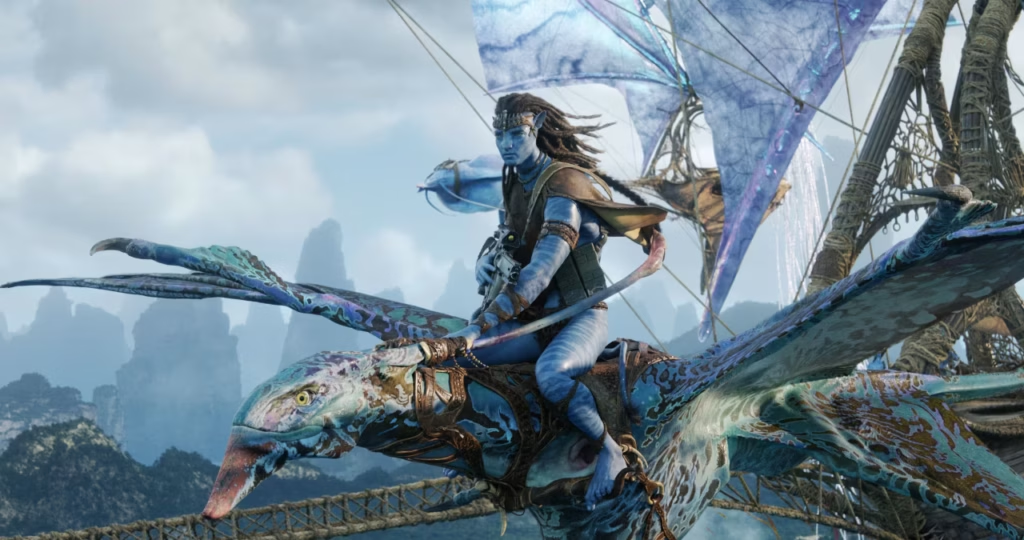
Which is no small feat. With the exception of his unfortunate obsession with a high frame rate (more on that in a bit), Cameron’s grasp of envelope-pushing technology remains exhilarating. It’s easy to take his masterful visual vocabulary for granted, but we shouldn’t become inured to his facility for translating his febrile imagination into legible action cinema. Fire and Ash’s first big set piece, an aerial raid involving dirigible-like vehicles with blooming lavender sails, is a marvel of crisply choreographed mayhem; it’s also smartly set during daylight, allowing us to clearly track the many combatants as they fly and fight and dodge. The climax, in which our old sparring partners, Jake Sully (Sam Worthington) and Miles Quaritch (Stephen Lang), leap to and fro across gigantic floating rocks, marries eye-popping spectacle with personal intensity. In between are any number of vigorous sequences that are constructed with clarity and ingenuity.

And also movement, which brings me to that damn HFR. Between the two Avatar sequels and Gemini Man, I’ve now gathered a large enough sample size to reliably gauge my own mental processes regarding this particular aesthetic development, which feels like a Best Buy floor model TV with the motion-smoothing setting toggled to “Steroids.” First, my brain, conditioned to appreciate films at the conventional rate of 24 frames per second, recoils at the plasticity of the image—the fast-flowing sheen that paradoxically looks both lifelike and unnatural. Then I remind myself that I’m not a Luddite, that cinema is a medium of constant change, that orthodoxy is the enemy of creativity. And then I still chafe against the speedy awkwardness, annoyed that it’s distracting me from what is otherwise a world of splendorous invention. Cameron is an undisputed pioneer, but he got this one wrong. (He does, however, remain the only current director who adds value via 3-D, which once again enfolds the screen with immersive depth.)
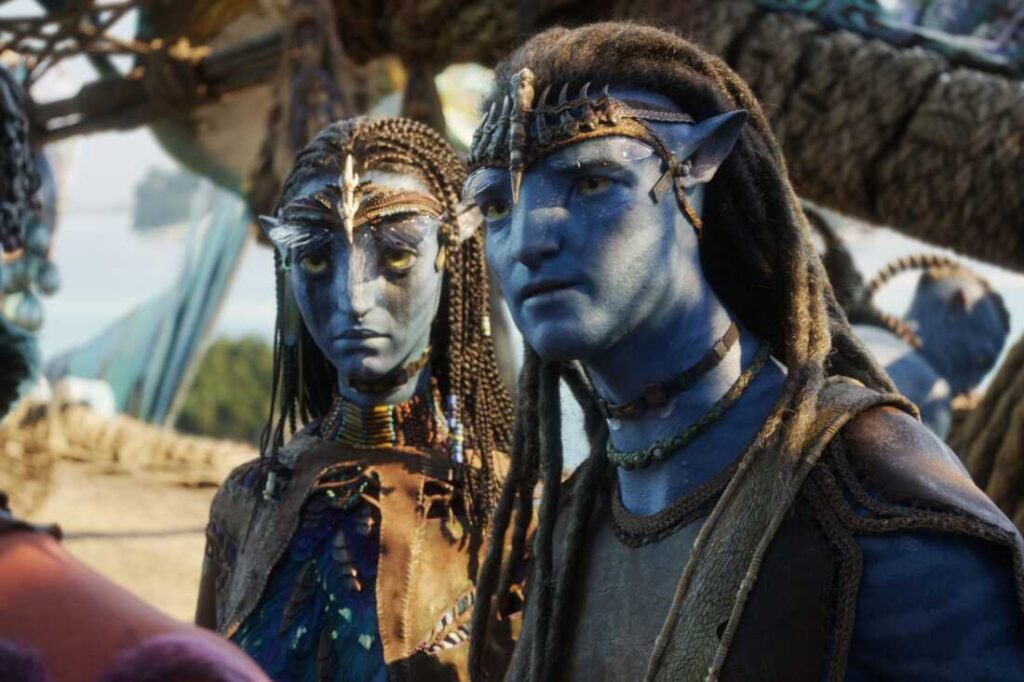
The HFR is hardly the only element of Fire and Ash that recalls The Way of Water. The screenplay, which Cameron wrote with Rick Jaffa and Amanda Silver, once again examines the blood feud between Jake and Quaritch, a private vendetta that also resembles the broader battle for the soul of Pandora between the indigenous Na’vi and the invading “sky people,” aka humans. Jake and his wife, Neytiri (Zoe Saldaña), now mourn the death of their eldest child, a tragedy that further splinters Jake’s already-fraught relationship with his younger son, Lo’ak (Britain Dalton, assuming voiceover duties from Worthington). Jake also remains burdened with the mantle of leadership—specifically how his presence among the Metkayina clan might draw Quaritch’s wrath and endanger the village. The evil whalers are back, their greedy captain (Brendan Cowell) now sporting a mechanical arm after his fleshy limb was severed during one of the prior film’s most rousing moments; they continue to stalk the Tulkun, those hyper-intelligent maritime animals whose proximity to the reef poses the risk of collateral Metkayina suffering. (As a dissenting scientist, Jemaine Clement returns as well, with a bit more to do this time beyond informing us of the whales’ cultural and intellectual sophistication.) Oh, and Jake and Neytiri’s adopted daughter, Kiri (Sigourney Weaver), is still around and still trying to tap in to Pandora’s spiritual undercurrents, the better to embellish the franchise’s vague mysticism.
Not much of this is new. The (misguided) knock on the Avatar movies is that they’re just stealing from preexisting epics, a simplistic critique that ignores both Cameron’s extraordinary flair as a showman and his deceptive fluidity as a storyteller. But when Avatar copies from Avatar, the specter of artistic cannibalism becomes more debilitating. In particular, the last hour of Fire and Ash is almost galling in how neatly it traces onto The Way of Water’s breathtaking final act: a savage Tulkun hunt that reaches the Metkayina’s shores; a wild fracas involving all manner of swooping friends and foes that gives way to a more intimate familial duel; a secondary character’s death that imbues the proceedings with a semblance of stakes. Rinse and motion-capture and repeat.
Yet while the plot of Fire and Ash may be familiar, its themes—the complexity of family, the horrors of colonialism, the tension between technological supremacy and environmental purity—carry new and intriguing shading. The movie’s most important new character is Varang (Oona Chaplin), leader of “the ash people,” a rival Na’vi tribe that answers the Metkayina’s abiding gentleness with cruelty and ferocity. She’s essentially a cracked-mirror version of Neytiri; where our heroine found love and grace in the form of Jake, Varang strikes up a charged alliance with Quaritch, with each hoping to exploit the other’s inherent bloodlust.
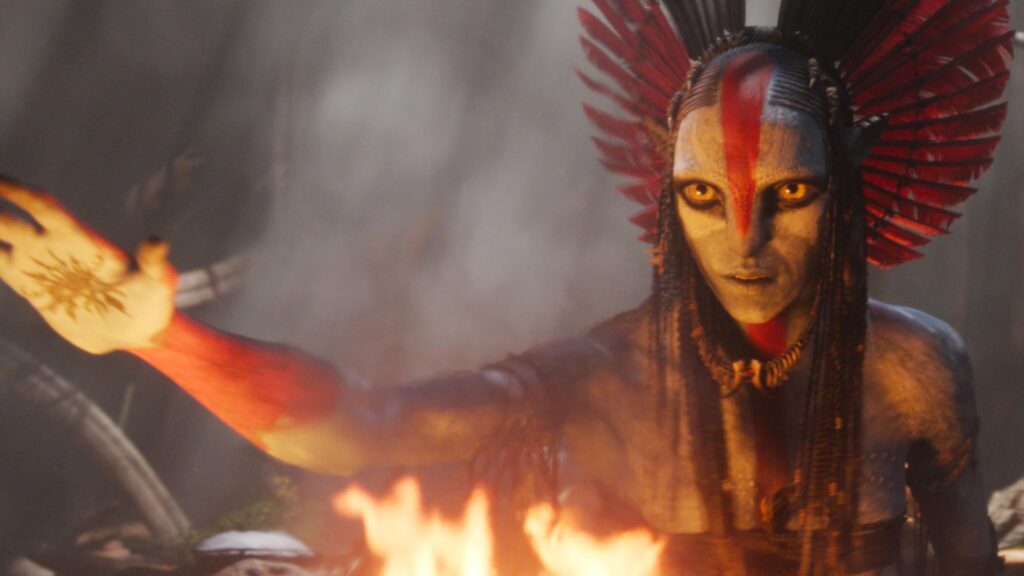
It is hard to watch Varang, with her red headdress and her insistence that Quaritch supply her with advanced weaponry (“Show me how to make thunder!”), and not think of the centuries-old subjugation of Native Americans. This reads not as a tactless error but as a blunt and sobering reminder of our history—one whose resonance is especially acute now that the United States is openly behaving like an imperialist country. Regardless, Chaplin’s performance is too lively and intelligent to engender bad taste; with a menacing sneer that matches Saldaña’s patented snarl, she lends the movie its most potent thrum of electricity.
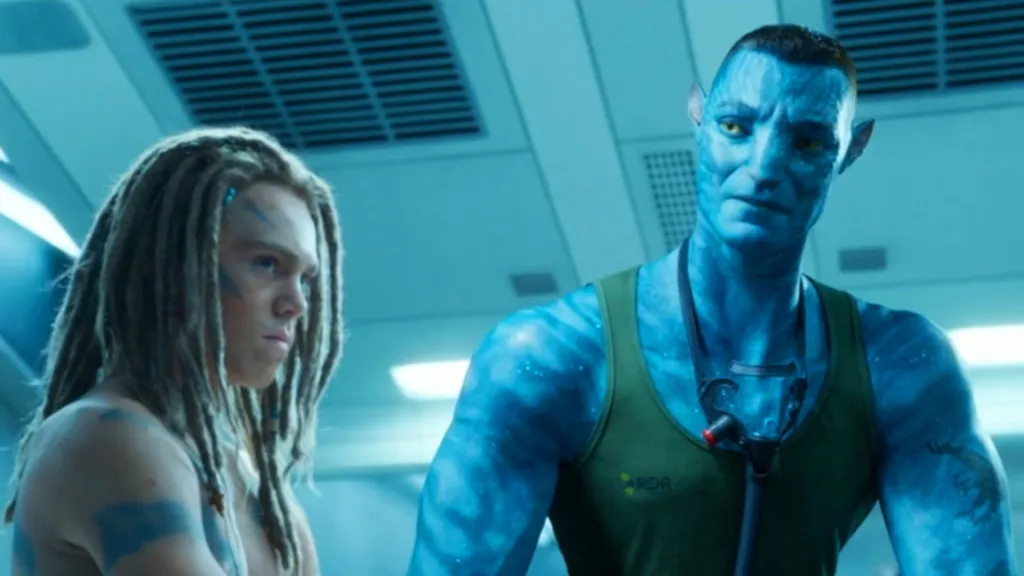
For her part, Neytiri’s marriage with Jake has grown increasingly strained, and the primary cause of their discord is Spider (Jack Champion), Quaritch’s biological son who’s spent most of his life palling around with Lo’ak and Kiri. As a human, Spider still requires a battery-powered mask to breathe Pandora’s air, and there’s a great early scene where Jake and his kids scramble to locate a backup before he asphyxiates while Neytiri watches impassively—figuratively and literally unmoved. Her entrenchment echoes that of the Tulkun, whose philosophy of non-violence results in the ostracism of Payakan, the whale who previously befriended Lo’ak and defended the Sullys with force—breaking his species’ sacred code in the process.
The ideas at play here—the intricacies of race, the corrosive nature of grief, the values and costs of pacifism—are thornier than you might expect for a science-fiction blockbuster about blue-skinned creatures with magic tails. It’s curious that for all of Fire and Ash’s technical bravura, its two most spine-tingling scenes are relatively static and hushed. One is the initial negotiation between Quaritch and Varang, a slippery verbal back-and-forth that is somehow tense, funny, and seductive all at once. The other is an anguished sequence in the jungle where Jake wrestles with the trolley problem, and which culminates in a moving invocation of the franchise’s mantra, “I see you.”
Perhaps this dissonance arises because Cameron already maximized the potential of the Avatar-verse with the first two episodes, meaning the emotional and thematic material carries greater room for growth than the resplendent, repetitive grandeur. Or maybe he will climb to new heights of cinematic innovation in the saga’s future sequels—assuming he’s inclined to make them. For now, we must content ourselves with this flawed, enjoyable movie whose thrills are both majestic and secondhand. I see you, Avatar: Fire and Ash. I just wonder how much more there is to see.
Grade: B

Jeremy Beck is the editor-in-chief of MovieManifesto. He watches more movies and television than he probably should.