
There’s a moment in Marty Supreme when someone tells the title character to stay calm. I generally don’t like spoiling things, but given that the movie was directed by Josh Safdie—and given that Marty (surname Mauser) is played as a bundle of raw nerves and febrile energy by Timothée Chalamet—I feel comfortable in informing you that this advice proves unsuccessful. Asking Marty Mauser not to get agitated is like asking the earth not to rotate on its axis. It’s a plea in defiance of natural order.
The cinema of the Safdie Brothers, which includes grubby scraps like Good Time and Heaven Knows What, places a premium on speed and shock while also championing aesthetic ugliness in the name of visceral authenticity. They found the right calibration on Uncut Gems, their 2019 tour de force of addictive anxiety, before venturing out on their own. Benny recently made The Smashing Machine, a solid enough picture that was largely forgettable outside of Dwayne Johnson’s committed performance. Marty Supreme is hardly a perfect movie, but it sure is a memorable one. It’s got sex and violence and mad dogs and crooked cops and Chalamet’s bare ass and Gwyneth Paltrow in mink-wrapped lingerie. Josh Safdie may have gone solo, but he hasn’t gone acoustic; he remains committed to pulverizing viewers with volume and intensity, resulting in an experience that straddles the line between exhilarating and exhausting.
To be fair, as a matter of style and technique, Marty Supreme is slightly less belligerent than Safdie’s past works. The cinematography, by the great Darius Khondji, evinces a measure of polish amid the freneticism. The score, by Daniel Lopatin (aka Oneohtrix Point Never), employs flutes and reeds alongside the usual electronic percussion and drone. The movie is propulsive but also legible, centering its story even as it bombards you with (to paraphrase another 2025 hit) one crisis after another.

Much like Howard Ratner, the gambling junkie played by Adam Sandler in Uncut Gems, Marty’s predicaments tend to be of his own making, though he would surely describe himself as a victim of persecution and circumstance. Set in Manhattan in 1952, the opening scene finds Marty working as a fast-talking footwear clerk (“I could sell shoes to an amputee”), swindling an elderly customer before retreating to the storeroom to fuck his married girlfriend (a dubiously served Odessa A’zion). For the title sequence, Safdie conceives of conception, as the camera tracks sperm fertilizing egg before the spherical zygote morphs into a ping-pong ball. It’s a boisterous introduction, and the movie’s momentum doesn’t flag anytime soon.
Safdie’s relentless pacing can be overwhelming, but here he channels it into a surprising subgenre: the sports picture. Marty is a gifted table tennis player, and the screenplay—which Safdie wrote with Ronald Bronstein, loosely based on the life of Marty Reisman—follows his triumphs and trials as he attempts to prove himself on the world stage. We follow him to London, where he does battle with an adversary-turned friend (Son of Saul’s Géza Röhrig) whom he plans to defeat and thereby “do what Auschwitz couldn’t.” (Seeing journalists’ shocked faces, he hastily clarifies, “I’m Jewish, I’m allowed to say that.”) He also encounters a nemesis in the form of a Japanese star (Koto Kawaguchi), though he naturally dismisses his loss as the result of his opponent’s advanced paddle rather than his athletic superiority. The engine of the plot is Marty’s frantic attempt to acquire enough money so that he can attend the world championships in Tokyo and cement his heroic stature—a Jewish Rocky longing to dethrone an Asian Apollo.
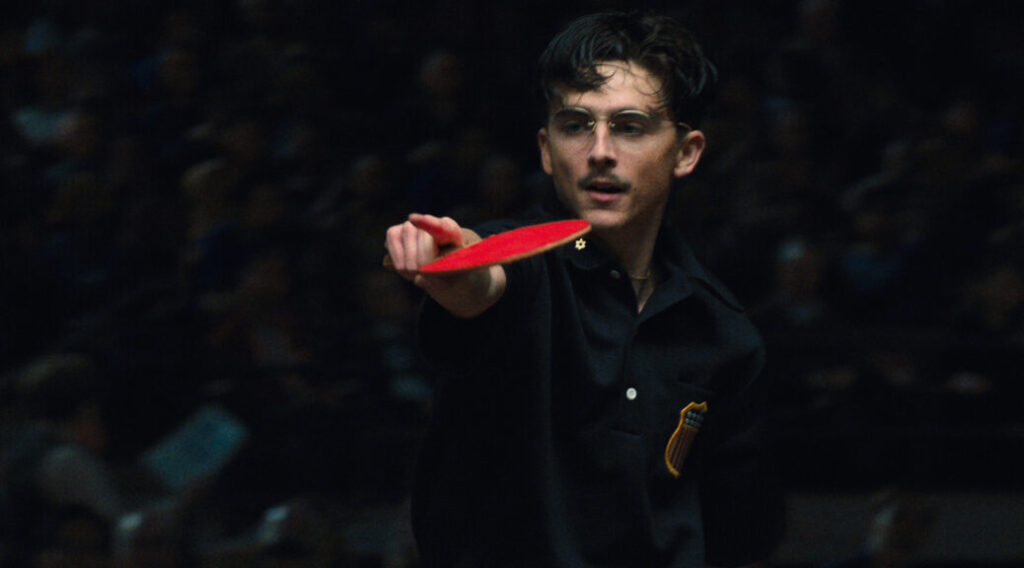
If you’ve ever picked up a ping-pong paddle at a friend’s house or in a gaming club, you are likely of the view that table tennis is more enjoyable to play than it is to watch. Yet the tempo and clatter of the sport fit nicely with Safdie’s hectic rhythms, and the movie’s handful of competition scenes prove surprisingly dynamic. Rather than giving you whiplash as you follow the flight of the ball, Safdie makes the racket-propelled warfare fluid and lucid, with no visible seams of whatever digital wizardry was involved in their creation.
Not that Marty Supreme is really about ping-pong. It is more an odyssey of desperation and persistence, as well as a character study of an indefatigable schmuck. Marty is blessed with supernatural confidence—he’s convinced that it’s his destiny to become a champion and to cultivate table tennis’ popularity as the next great American sport—which entitles him to treat everyone in his path as a stepping stone or an obstacle. He betrays friends, abandons animals, robs colleagues, steals jewelry, and leaves people to die. He does all of this with neither pride nor remorse; it’s just a byproduct of his need—to prove himself, to be the best, to get to the next thing. Americans are taught that we can achieve anything if we just have the strength to follow our dreams. Marty Mauser’s dream compels him to act like a nightmare.
Such behavior is less than inspiring. In Chalamet’s hands, it is also mesmerizing. He has always been a lively and intelligent screen presence, but in Dune: Part Two and A Complete Unknown, he began to allow shades of darkness to creep into his vivacious persona. Here he sheds all semblance of vanity, embracing the character’s spiritual and physical ugliness—in addition to weak hexagonal glasses to match his scrawny frame, Marty sports a pockmarked face and ghastly unibrow—while also turning him into a wrecking ball of toxic charm. In the abstract, it’s hard to imagine why anyone would tolerate this guy, but Chalamet renders his narcissism enthralling. He’s a black hole of selfishness, and you can’t help but be sucked in by his seductive swagger.
The characters around him are considerably less developed—especially the women. A’zion’s girlfriend is more of a plot device than a person, and while Paltrow is slyly cast as a past-her-prime movie star, her flailing actress doesn’t seem to possess much of an inner life. If anything, the figures in Marty’s orbit are more interesting for who they are than what they do. Safdie enjoys populating his films with a mix of amateur actors and random celebrities, and the call sheet for Marty Supreme is a strange mélange of retired athletes (George Gervin), has-been TV stars (Fran Drescher), fellow directors (Abel Ferrara, David Mamet), and artists from other disciplines (Tyler the Creator, Penn Jillette). Spotting these faces can be fun—Kemba Walker and Tracy McGrady have cameos, continuing Safdie’s basketball obsession—but the only one who really makes an impression is Kevin O’Leary, playing a tycoon whose arrogance rivals Marty’s and who receives a late line of dialogue so fascinating, I’m still puzzling out its meaning.

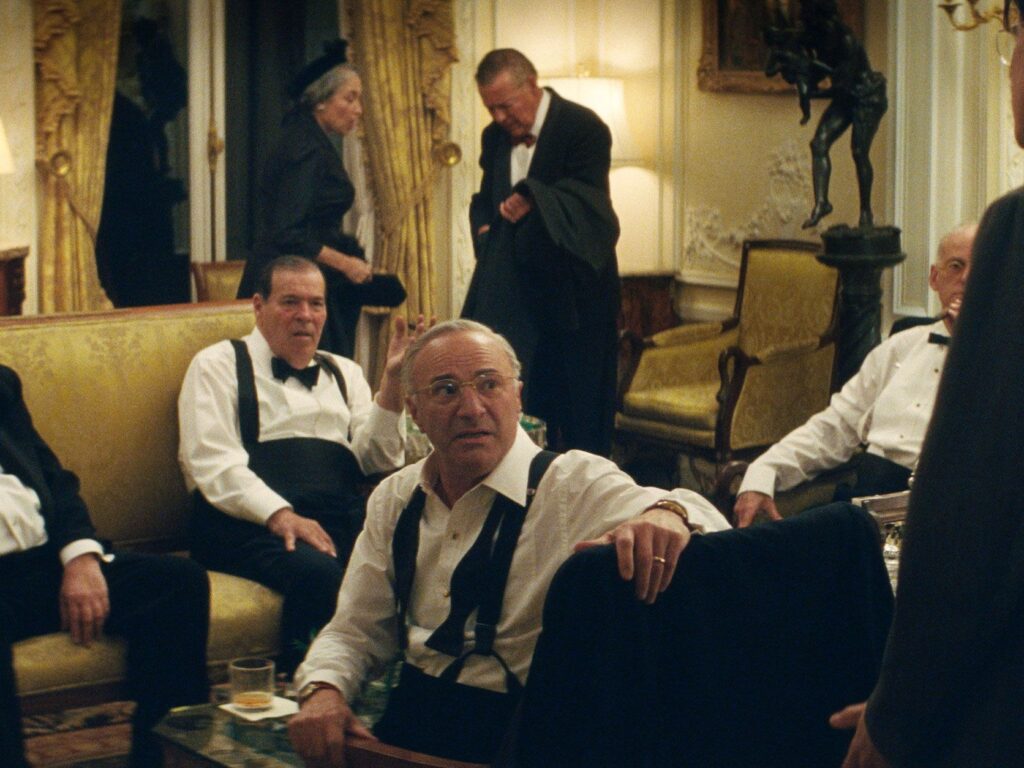
That’s an intriguing bit, but Safdie otherwise prefers to operate with brute force, concocting a series of escapades designed to rattle your nerves and trouble your soul. Some of these, as when Marty’s motel bathtub crashes through the floor or when he hustles some schnooks at a bowling alley, pulse with genuine excitement and danger. (That some of Marty’s marks are anti-Semites is no accident, nor is the startling flashback sequence in which Röhrig’s Holocaust survivor recounts an act of grace he undertook in order to feed his fellow inmates.) Others, like a chaotic shootout at a farmhouse or a debasing display at a posh party, feel more like overkill.
Yet while Marty Supreme is sometimes tactless, it is never boring. With its anachronistic ’80s soundtrack (Tears for Fears!) and its eccentric imagination (wait, is that a walrus?), it develops a captivating quality that befits its protagonist. You may get worn out, but you have no choice but to keep returning serve.
Grade: B+

Jeremy Beck is the editor-in-chief of MovieManifesto. He watches more movies and television than he probably should.