
Movies aren’t folktales. They don’t change over time, like myths relayed around a campfire. But they are nevertheless ideal vehicles for telling stories, and their unique form allows them to explore the process of how we perpetuate fiction. Last weekend featured the arrival of two films that are very different in structure and style, but which both wrestle with the metatextual relationship between artist and audience. It’s a subject that sounds academic but proves, at least in these two instances, to be awfully entertaining.
Jay Kelly is named for its main character, a man who is less a famous actor than a megawatt celebrity. Entering his 60s, he’s been captivating ticket-buyers for decades, working in a variety of genres—action flicks, mature dramas, romantic comedies—yet always brandishing his singular screen presence. He is handsome, eloquent, charming. I should probably mention that he’s played by George Clooney.

Whether the real Clooney receives the same level of public adoration and obsession as Jay does, I can’t really say; I have no doubt that he’s constantly besieged for autographs and selfies, but it’s unclear, in the age of Netflix and TikTok, if any American movie star can attain messianic stature. (In terms of raw fan worship, the artist whom Jay most accurately resembles is probably Taylor Swift.) In any event, Jay Kelly, which Noah Baumbach directed from a script he wrote with Emily Mortimer, isn’t exclusively a Clooney star text. It is also, more broadly, a study of cinematic fame and its attendant benefits and miseries, considering the price that stardom exacts on its hero’s soul.
One of the movie’s central premises, which it interrogates thoughtfully and maybe self-servingly, is the perception that Clooney tends to play the same type of character—capable, successful, authoritative. Yet in at least one crucial sense, Jay is the opposite of Ryan Bingham, the frequent flyer Clooney played in Up in the Air—a man who glided through the world in relative seclusion but who, when his sister called his lifestyle “isolated,” protested “I’m surrounded!” Jay never seems to be alone—he is attended by a retinue of staffers including a stylist (played by Mortimer), a publicist (Laura Dern), and his steadfast manager, Ron (Adam Sandler)—but he nonetheless describes himself as lonely. Most of his existential solitude derives from his strained relationships with his two daughters, the adult Jessica (Riley Keough) and the recent high school grad Daisy (Grace Edwards, from Asteroid City).
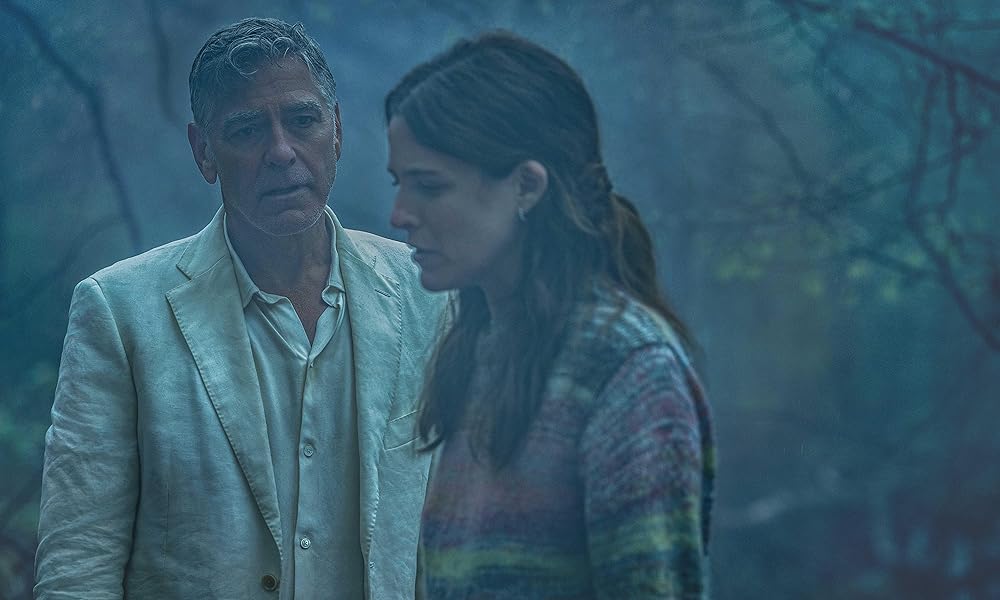
This parental angst finds Jay Kelly at its most conventional. There is poignancy in Jay’s lingering regret over his absent fatherhood; a late phone call between Jay and Jessica, which Baumbach stages as an imagined walk through the woods, is wrenching in its understatement. But the principal idea at work—that the pursuit of professional success can result in the sacrifice of personal happiness—is hardly a revealing insight, and despite the sensitive performances, the characters here never achieve the depth of feeling that Baumbach brought to Marriage Story. Jay contrasts his fatherly failures with those of his own gruff dad (Stacy Keach), but that pairing is also half-formed (though it’s a nice touch that they refer to each other as “Studly”).
More interesting is the connection between Jay and Ron, a fluctuating bond whose true nature is elusive, varying from friendly to exploitative to tender to parasitic. Ron is the guy behind the guy—the hard-working, fast-talking associate who’s always massaging schedules and smoothing out mishaps. Deploying endearments like “puppy,” Ron appears singularly devoted to Jay—it comes as something of a shock when we learn that he has other clients, including a less renowned actor played by Patrick Wilson—but to what extent is his affection born of genuine admiration versus pecuniary self-interest? “I’m your friend,” Ron insists, to which Jay spits in response, “You’re my friend who takes 15% of my income.” It’s a constantly mutating relationship with a rich implied history, and Sandler’s abiding neediness harmonizes beautifully with Clooney’s inherent superiority.

And the actor’s smug persona is Jay Kelly’s true subject. Baumbach and Mortimer have structured the film as a sort of time travelogue; Jay hightails it to France in order to spend time with Daisy during her European vacation, but he also periodically steps into flashbacks, reflecting on past milestones which just happen to coincide with his former movies. In one, a drama teacher informs the young Jay (played by Charlie Rowe) that it’s doubly difficult for an actor to simply be himself, given that he needs to inhabit both the role and his own life. Later, Jay parrots that chestnut to an onlooker who accuses him of playing himself on screen.
It is of course possible to watch and enjoy Jay Kelly with no knowledge of Clooney’s career or its criticisms. But in framing Jay as a kind of shadow image of George, Baumbach and Clooney are actively inviting viewers to draw on their preconceptions of the actor, and to examine the validity of their assumptions. Some might call this defensive, but I found it weirdly exhilarating, as though I were an unwitting participant in the movie’s creation.
In Jay Kelly’s final scene, Baumbach delivers a Golden Globes-style tribute montage that splices together footage of prior Clooney performances, from pictures as varied as Syriana and The Thin Red Line to Leatherheads and Burn After Reading. Depending on your perspective, it’s either audacious or self-indulgent. Yet even if you aren’t partial to Clooney’s filmography, you may find yourself stirred and possibly even shaken. In collapsing the barrier between Jay and George, Baumbach is suggesting that cinema doesn’t exist in isolation; it’s a living thing, and it changes depending on who’s watching, and when. The images may stay the same, but we lend them meaning anew.
If such meta commentary isn’t your speed, 100 Nights of Hero supplies a more direct application of the transformative power of storytelling. It’s a twist on the Arabian Nights folktale, as a woman spins a yarn against the Damocles of a ticking clock. But writer-director Julia Jackman has more on her mind than simply refurbishing a classic tale.
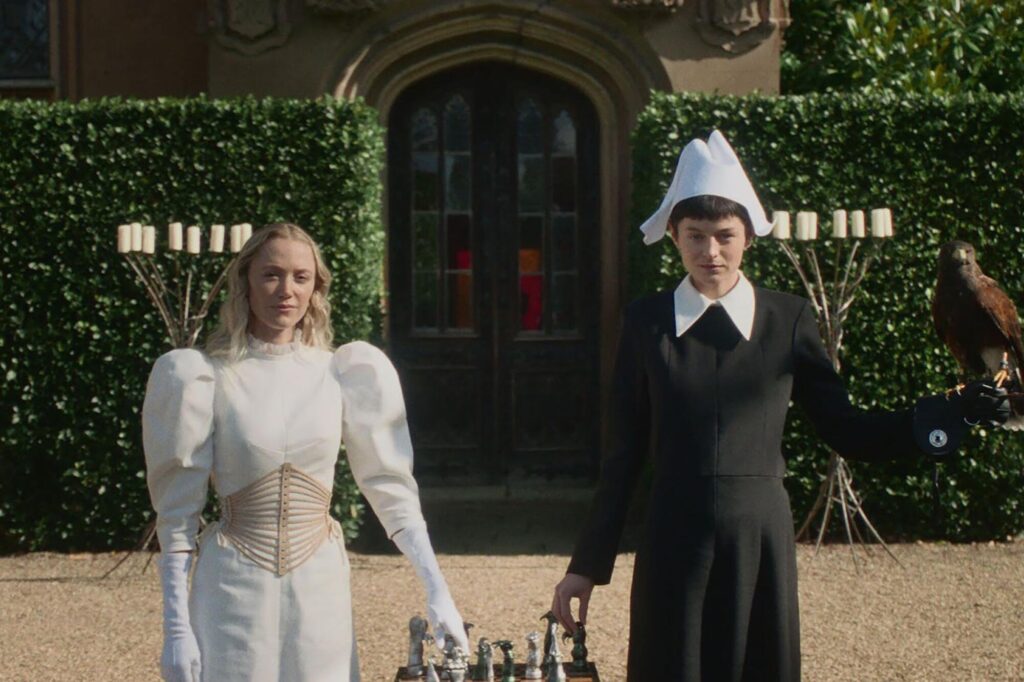
100 Nights of Hero takes its characters and its ideas seriously, but it is also an inventive and playful movie. Its framing device casts it as a piece of diegetic mythology: A cheerful, whimsical goddess (Safia Oakley-Green) conceives a vibrant new world, only for her father, the imperious Birdman (Richard E. Grant), to infuse it with pitiless order—a patriarchal code whose architectural severity and religious orthodoxy evoke Medieval Europe. (Its inhabitants worship beaked statues because, again, Birdman.) Our heroine in this realm, with its Gothic fortresses and its different-colored moons, is Cherry (Maika Monroe), an accomplished woman—she is adept at both chess and falconry—who has nonetheless failed to complete her most important task: getting pregnant. The local lord imposes a deadline (you can guess how many nights it runs), by which point she’d better exhibit signs of expectancy, or else.
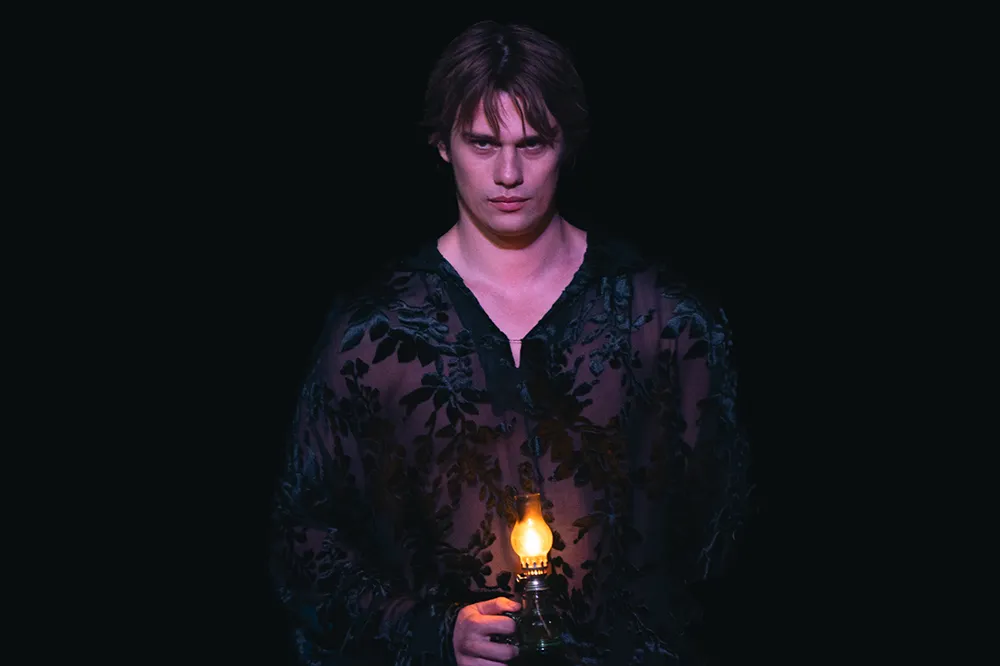
Cherry’s first problem is that her husband, Jerome (Amir El-Masry), exhibits no physical interest in her. Her second problem, which is maybe more of a complication, is that two others in her orbit covet her quite fiercely. One is Manfred (Nicholas Galitzine, smartly cast), a frolicsome aristocrat who accepts Jerome’s crude wager that he can’t take Cherry’s virginity over the next three-plus months. The odds would seem to be in Manfred’s favor: On his first night in the castle, he asks Cherry if he might see her bedroom, and she promptly faints. When she awakens, she surmises that he’ll surely be more restrained tomorrow, followed by a very funny smash cut to Manfred striding toward the camera, bare chest slicked with blood, hauling the carcass of a recently slain deer. This dude is trouble.
The other desirous figure on hand is Hero (Emma Corrin), a gamine maid whom our unseen narrator (Felicity Jones) describes, somewhat coyly, as Cherry’s “best friend.” She clocks Manfred’s rapacious intent and quickly devises a stratagem: Whenever he threatens to overwhelm Cherry’s defenses, Hero will distract him with a story—an enveloping fable about three sisters (including one played by Charli XCX) that’s redolent with beauty and danger and excitement. After all, what is sex compared to literature?
Jackman’s command of her material is confident and fluid, and she moves comfortably within the nested levels of her narrative. (Her screenplay is based on a graphic novel by Isabel Greenberg.) Much like Jay Kelly, 100 Nights of Hero regards storytelling as a sacred art—a mode of personal expression that has the capacity to change lives and even inspire revolution. This has the potential to be cornball, and indeed certain elements of the picture—particularly when it strays beyond the castle walls—lack the intimacy and texture of its central melodrama.

But even if the ambition of 100 Nights of Hero can be ungainly, the film also reinforces the strength of its themes through the sheer pleasure of its craft; this is a thoroughly appealing movie that brims with humor, passion, and wonder. Galitzine is a pretty thing (fans should check out Mary & George), and his natural vapidity makes him the perfect foil for Corrin’s wiry resolve, even as both of them suggest glimmers of inner longing. As the object of their lustful rivalry, Monroe defies the inherent passiveness of her character, instead wielding her innate vulnerability (remember Longlegs? remember It Follows??) to create a woman of true dimension.
It is the goal of every filmmaker to draw their viewers in, and 100 Nights of Hero is above all a work of seduction, for characters and audience alike. Its most entrancing scene finds Cherry and Hero pantomiming a ritual of courtship, their approximations of affection gradually giving way to genuine ardor. It’s sweet and suspenseful and indecently hot. Hero is a born entertainer, a raconteur who tells of others’ triumphs and misfortunes, but she is also a flesh-and-blood figure with her own sorrows and cravings. She’s a story within a story, and while mythology is what she knows, cinema is where she belongs.
Grades
Jay Kelly: B
100 Nights of Hero: B+

Jeremy Beck is the editor-in-chief of MovieManifesto. He watches more movies and television than he probably should.