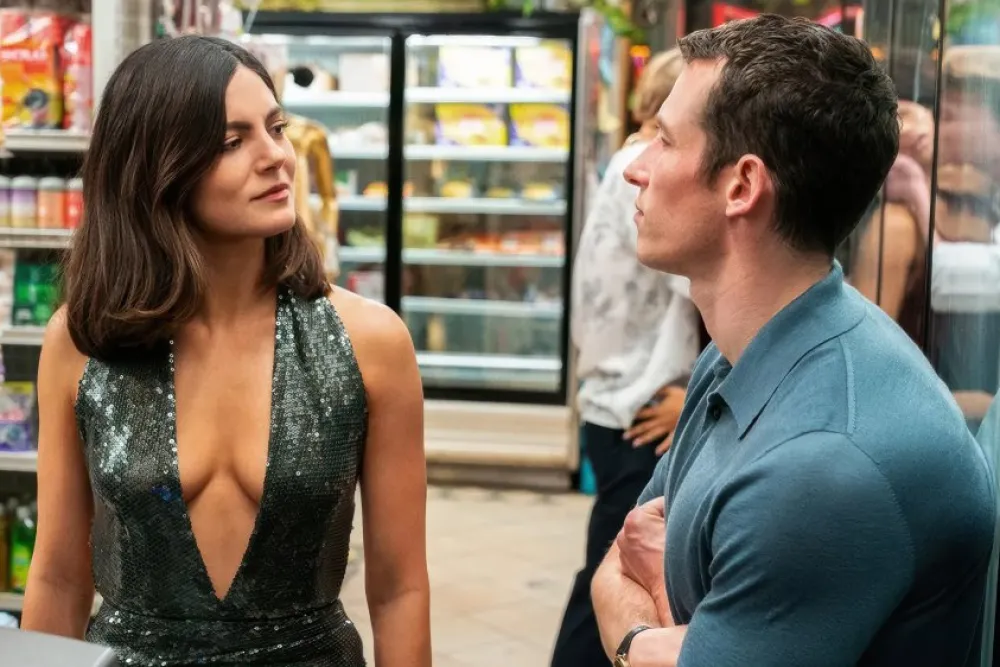
Earlier this summer, the Trump administration issued new grant criteria, stating that nonprofits seeking federal funding to help prevent teen pregnancy must counsel adolescents about “family stability” and “marriage prior to childbearing.” It then revoked the grant of an agency called Fact Forward, presumably for the sin of teaching teenagers about proper condom use. So the premise of One Night Only—which takes place in an alternate America where premarital sex has been outlawed, with the exception of a single evening per year—seems less preposterous than it might have a decade ago. The movie is set three years in the future, but it may as well take place in a realm of perpetual Project 2025.
You might perceive this scenario—the U.S. government wielding its power as a surveillance state to curtail the bodily autonomy of its citizens, in part by branding trackers onto people’s wrists—as the backbone of a harrowing piece of dystopian fiction. But Will Gluck, directing from a script by Travis Braun, has no interest in exploring the troubling sociopolitical ramifications of this conceit. Instead, he has molded the idea into a lighter, more frivolous creature (those trackers take the form of colored animal tattoos, how cute!), one whose shape is classically familiar but whose appearance on the big screen is vanishingly rare. He’s made a romantic comedy.
And that, frankly, is fine. The real world is rife with dispiriting stories of subjugation and overreach; cinema offers the chance to turn the petty cruelty of fascist rule into the grist of personal fantasy. In One Night Only, the brutality and stupidity of modern life yield to the more pressing question of whether two hot people can find love and get laid.
This doesn’t excuse the sloppiness of the movie’s storytelling. An opening title card quickly conveys the setup (which the internet clocked as a sexualized variant of the Purge franchise), but the film’s first act is nonetheless clunky with exposition, whether it’s characters explaining the ritual’s logistics to one other or a ham-fisted newscast where a conservative official justifies the 12-hour grace period as a political compromise. The dialogue, on the whole, carries a pang of faux-ingratiating banter, aiming for cozy intimacy but instead suggesting clumsy punch-ups. Plot points, such as one involving the cruciality of condoms, tend to appear and disappear at random, while several secondary characters—in particular a foul-mouthed adolescent—are less playful than just obnoxious.
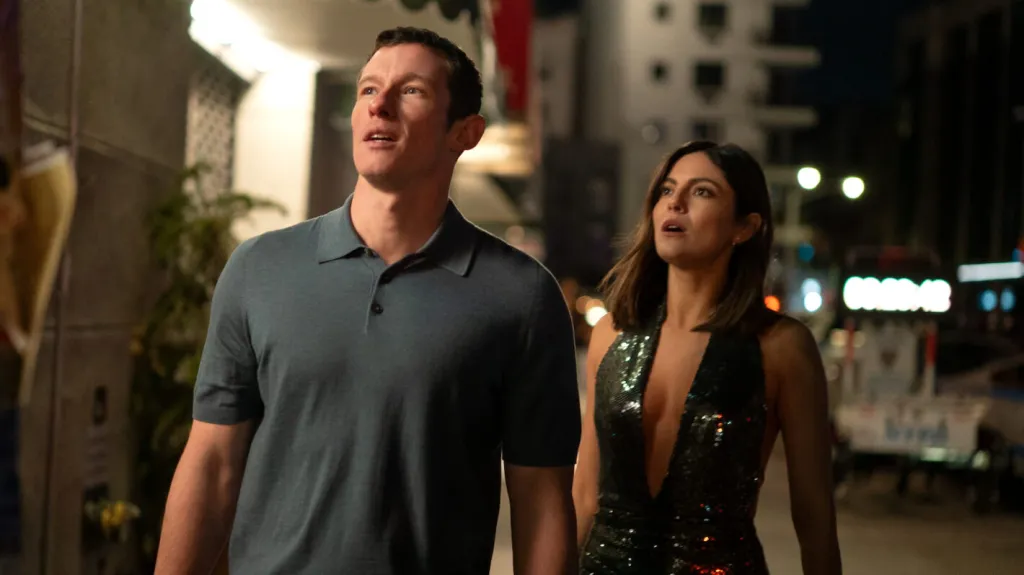
Yes, but did you see Monica Barbaro’s dress? She actually wears two fetching garments, starting out in a sleek chestnut chemise before swapping it for a more revealing piece of sequined silver and matching heels. “It’s a lot of this,” she remarks, referring to her chest—an accurate assessment that certain disreputable viewers might not register as a complaint. But there is more to her appeal than mere attractiveness. The actor has previously demonstrated her talents with engaging supporting performances in A Complete Unknown and Crime 101 (plus the Top Gun sequel), but One Night Only gives Barbaro the opportunity to showcase the full breadth of her charisma: smart, ardent, vivacious. She gives the movie its soul.
Not that her character, Allie, is a figure of great complexity. She’s one of many New York singles itching to capitalize on the titular holiday, but her fantasist streak—her mind often conjures sweeping, storybook moments only to be rudely jerked back to reality—means she’s less interested in sex than love. (This seems to place her in the severe minority, as everyone around her is making out with youthful abandon.) And so fate, along with the screenplay’s fidelity to the rom-com playbook, place her on a collision course with a handsome pizzaiolo, who promptly vomits sushi all over her shoes.

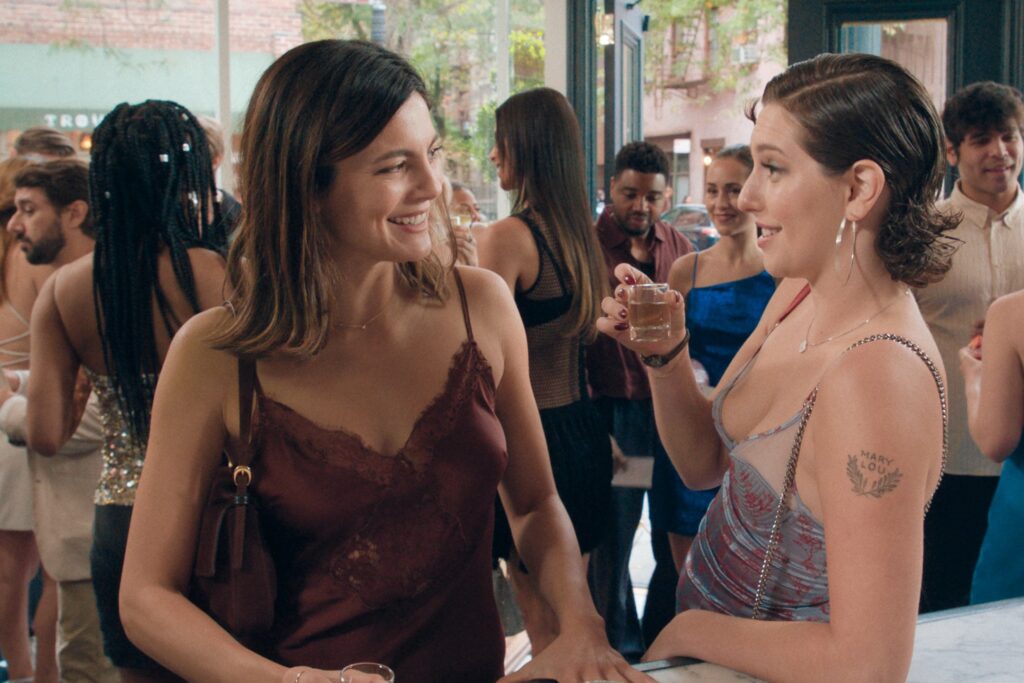
That would be Owen (Callum Turner), the other half of One Night Only’s central pairing. He’s planning to finally propose to his girlfriend (Maya Hawke), but her libertine spirit scuttles those plans. He also can’t stay home because, in lieu of the genre’s usual wacky best friend, he has a mother (Molly Ringwald) who demands privacy so that she can cavort with Levar Burton. (For her part, Allie’s quirky bestie, played by King Princess, quickly abandons her, though she also receives spunky counsel from another ally, this one portrayed by Quintessa Swindell.) So Owen ends up sullenly walking the streets, vainly hoping to encounter a kindred spirit. Also, he just wolfed down too much sushi.
The first encounter between Owen and Allie represents a clever subversion of rom-com tropes, twisting the traditional meet-cute into an awkward display of mortification. It also has the effect of delaying the movie’s strongest asset, which is Turner and Barbaro’s snappy repartee. Litmus tests have no place in cinema, but I tend to prefer romantic comedies that thrust their lovers together rather than keeping them separate. (This is why I regard Sleepless in Seattle as philosophically bankrupt.) Gluck, whose career includes three perfectly watchable genre specimens (Easy A, Friends with Benefits, and Anyone But You), deploys some canny early tricks in drawing out the inevitable—after their initial disastrous meeting, Allie and Owen repeatedly just miss each other on sidewalks and in stores while searching for their own (soul)mates—but his purported wit mostly operates as deprivation for his audience.

Yet once its leads reunite—in a desperate quest for prophylactics that recalls the early Jennifer Love Hewitt vehicle Trojan War—One Night Only’s momentum picks up considerably. Turner is less naturally magnetic than Barbaro, and he’s saddled with a Noo Yawk accent that sometimes defeats him, but he’s good-looking, and he gives Owen a roguish warmth that nicely complements his co-star’s sizzling charm. Little that unfolds between them could be called unpredictable, but their shared hijinks—such as a run-in at a police station, which displays government-issued, green-and-red diagrams designating what is and isn’t legal sexual behavior—carry an easygoing, satisfying tenderness. Gluck is also sensible enough to make Allie a singer in order to exploit Barbaro’s siren-like voice, leading to the picture’s most enchanting scene: a honeyed rendition of an ’80s synth-pop hit at a nightclub that casts a spell on you and Owen alike.
The irony of One Night Only is that, while its characters yearn for enduring bliss, the movie itself doesn’t try to make a lasting impact, instead just settling to be cheerful, transitory company. It won’t make you fall in love. But it does reinforce the ephemeral pleasures of a one-night stand.
Grade: B-

Jeremy Beck is the editor-in-chief of MovieManifesto. He watches more movies and television than he probably should.
Its Amazing
If you are mad at me, just curse me out
Been playing slots for years and this platform really stands out with its fast withdrawals and daily free spins. The interface feels clean and I never got stuck waiting for my bonus to load. Highly recommend it to anyone chasing weekend fun ecmaggico