

The novelist Andy Weir specializes in “hard” science-fiction, embroidering his stories with mathematical precision and analytic rigor. He’s a best-selling author whom you might also call a serious writer. The filmmakers Phil Lord and Christopher Miller, by contrast, have built their success on silliness, making droll animated yarns (Cloudy with a Chance of Meatballs, The LEGO Movie) and the spoofy Jump Street pictures. They seem unlikely candidates to translate Weir’s brainy acumen to the screen. But while Project Hail Mary, which Lord and Miller have adapted from Weir’s 2021 book (via a screenplay by Drew Goddard), may be a blend of durable genres—part space opera, part survival saga, part buddy comedy—it isn’t a jumble of tones. Instead, the directing duo has applied their quippy instincts with warmth and sincerity, resulting in a crowd-pleasing movie that’s both playful and earnest. Call it hardy har har sci-fi.
This doesn’t mean Project Hail Mary is a model of discipline. It’s long, sappy, and choppy, with set pieces that are more intriguing than eye-popping. But it’s nonetheless coherent, and its humor works in tandem with both its muscular ambition and its abiding sweetness.
Funny, charming, attractive—am I describing the movie, or Ryan Gosling? Is there a difference? Project Hail Mary is a bustling film, full of stress and clamor, but it’s fundamentally the story of one guy—a charismatic egghead whose job is to save the world and also entertain the audience. Gosling is no stranger to outer-space exploits, having previously played Neil Armstrong in First Man. But whereas that adventure leveraged the actor’s talent for brooding stoicism (see also: Blade Runner 2049), this one showcases his rascally intelligence, allowing him to undercut his matinee-idol looks with insouciance and self-mockery (see also: The Nice Guys and Barbie). It’s a role that seems engineered for him, and maybe it was; he signed on as producer and star of this adaptation before the novel was even finished.
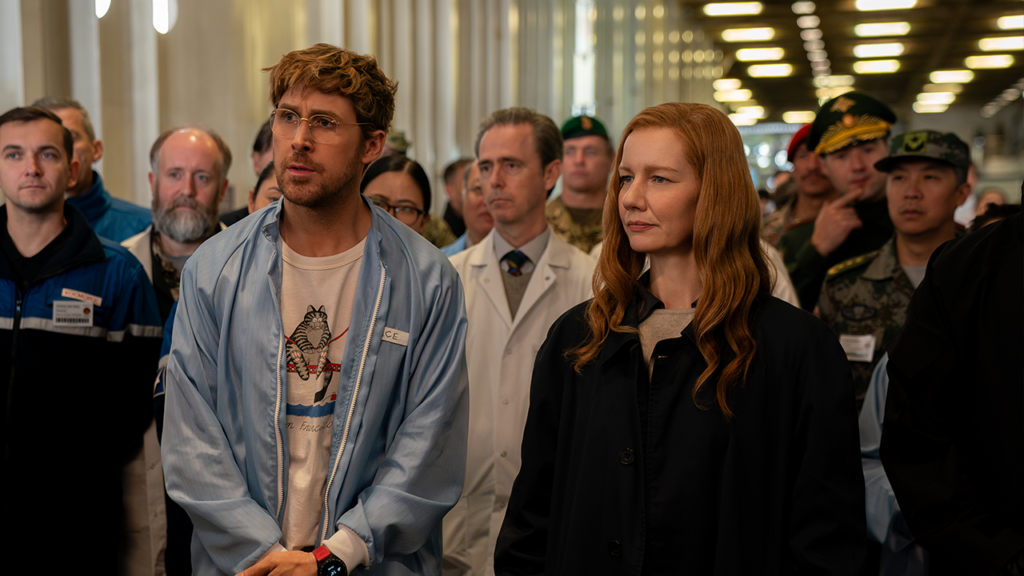
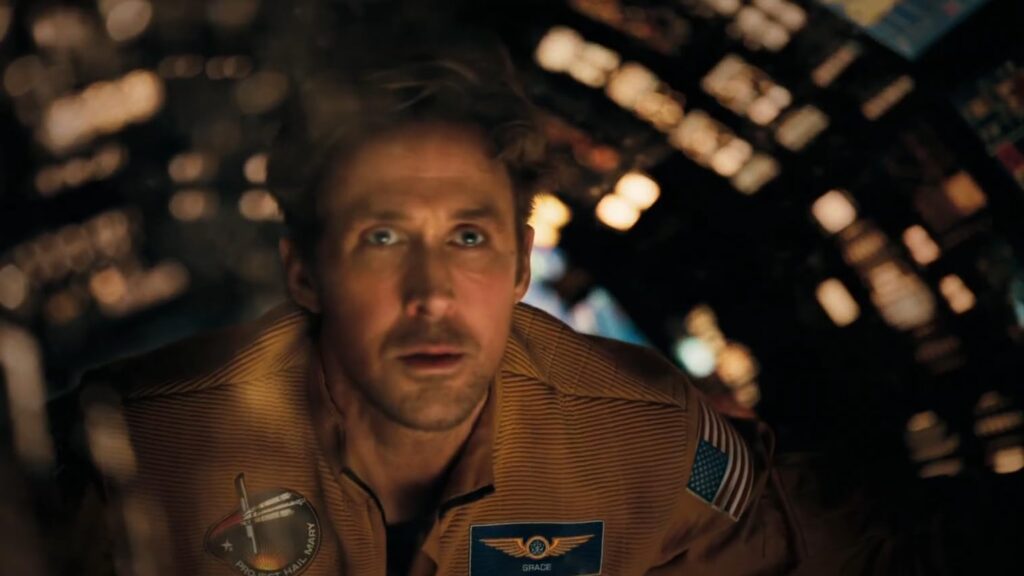
Gosling plays Ryland Grace, the sexiest middle school science teacher in our planet’s history. Speaking of our planet, Grace is already off it when the movie opens, awakening from an induced coma in a spaceship that’s 11-odd light-years from Earth. His crew is dead and he’s lost his memory, and for a few brief scenes, Lord and Miller luxuriate in their lead’s fish-out-of-gravity haplessness; disheveled and disoriented, Grace repeatedly crosses wires with his craft’s automated control center (voiced by Priya Kansara), as when he stumbles into a deck chair and panics as the system declares, “Pilot Detected.” But exposition must be expounded, and Goddard’s script soon flashes back to Grace’s earthbound days, where a G-woman (Sandra Hüller, pitch-perfect) recruits him to serve in the titular enterprise, whose objective is no less than the salvation of all humanity. Turns out a nefarious black goo called Astrophage is slowly covering the surface of the sun, a development that imperils civilization; it also reveals Project Hail Mary to be a cinematic cousin of sci-fi disaster pictures like Armageddon, Interstellar, and Sunshine.
Why do writers keep envisioning a future where our third rock from the sun is on the brink of destruction? Take as many guesses as you like. But Project Hail Mary is less a climate-change parable than a portrait of logistical challenges and collective problem-solving. As with the prior adaptation of Weir’s work, The Martian, it splits its time between the secular and the otherworldly, cross-cutting from Grace’s collaborative preparations at home to his solitary escapade in the stars where he performs celestial recon, hoping to discover an antidote to our solar system’s deadliest carcinogen.
The way you know Project Hail Mary works—the sign that it’s an engrossing piece of populist storytelling—is that whenever it toggles from one time period to another, your rising anticipation is accompanied by a slight sting of disappointment. Don’t cut away, it was just getting good! The prosaic scenes may be rife with familiar plot points reminiscent of Arrival and Oppenheimer, but they’re also pleasurable for how they knit a patchwork of smart people working together. Simple moments of connection—Grace and his security watchdog (The Bear’s Lionel Boyce) hitting up a hardware store for supplies, Grace and a fellow scientist describing the Astrophage’s reproductive process as “Whoomp, there it is,” Hüller’s no-frills bureaucrat dropping her guard for an impromptu karaoke performance—brim with color and enthusiasm.
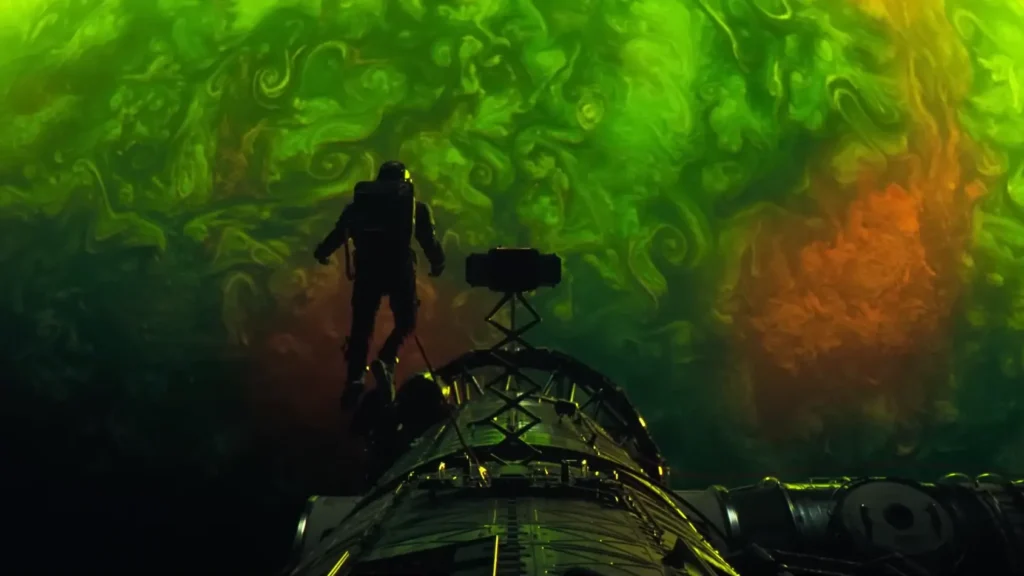
The real heart of the movie, though, lies in the cosmos, where Lord and Miller prove both adept and overextended. Visually, Project Hail Mary is an ambitious production, and the directors conceive of some sights that are alluring in their innovation. (The cinematographer is Greig Fraser, who shot Dune and its sequel; the production designer, Charles Wood, worked on a bunch of MCU flicks.) Grace inevitably encounters another vessel, and its look is distinctive—a kind of thatched, oblong leviathan that stretches out toward infinity. Yet for all its ostensible grandeur, the film’s action isn’t especially kinetic or satisfying. Perhaps Lord and Miller are beholden to Weir’s technical realism, but their sequences of frenetic motion struggle to acquire true momentum, certainly paling compared to the audacity of Gravity or the majesty of Interstellar.
But those are high bars, and besides, Lord and Miller are more invested in their smaller-scale elements. Every fictional castaway needs a companion, and Grace eventually finds his in the form of Rocky, a spiderlike creature with spindly limbs protruding from a tan massy center. Absent wide eyes, Rocky doesn’t possess the cuteness of most adorable aliens (E.T., Wall-E, etc.), and his initial interactions with Grace are cautious, but the slow buildup serves a purpose. As in The Martian, Weir and Goddard are committed to exploring the complexity of communication, and Project Hail Mary spends considerable time detailing Grace’s laborious attempts to break the intergalactic language barrier. He eventually succeeds (with a partial assist from Meryl Streep), translating Rocky’s musical warbles into human speech, at which point the movie pivots from a stranded-man saga to a mismatched buddy comedy.
And an undeniably enjoyable one. Rocky has a fearsome intellect, and his deductive reasoning opens up new avenues of outer-space derring-do. (“I didn’t think of that,” Grace admits after Rocky solves a scientific quandary, to which Rocky responds, “I did.”) At the same time, the imperfections of Grace’s customized Rosetta stone render Rocky’s dialect into broken English; he speaks in the third person, he misconjugates verbs and uses “amaze” as an adjective, and he’s prone to malapropisms like “it’s time go” and “fist my bump.” (He’s voiced by James Ortiz, who also serves as the lead puppeteer on the F/X team, which does impressively seamless work.) As a result, the relationship between Grace and Rocky resembles not only two professionals operating in concert, but also a father nurturing his precocious, naïve child.

This dynamic carries with it a risk of undue preciousness. Yet despite Lord and Miller’s sentimental leanings and Gosling’s inherent likability (and his bespoke cardigan), the friendship that naturally develops between Grace and Rocky manages to evade obvious schmaltz, instead unfolding with tenderness and authenticity. There’s a surprising poignancy when the giant, legged pebble assesses a dilemma and pronounces, “Rocky fix.”
This in turn feeds into Project Hail Mary’s real theme: the value of cooperation. In our era of imperialism and isolationism, here is an unabashedly corny movie that pays tribute to the salutary quality of teamwork: between people, between nations, between species. It’s a moving depiction of camaraderie that retrospectively throws Grace’s initial loneliness into even sharper relief; an early scene where he eulogizes his fellow astronauts despite failing to remember them is beautiful in its halting sadness, while a late reveal about the true origin of his mission attains greater, thornier weight.
So it’s a mild betrayal when Lord and Miller eventually succumb to their mawkish sensibilities, indulging in a protracted denouement that ladles on the sap and doesn’t know when to quit. Yet the irritating character of Project Hail Mary’s ending also reflects just how amiable the movie is for the majority of its runtime—how confidently it intertwines its humor, its imagination, and its message. It’s inspiring. Just maybe not amaze.
Grade: B+

Jeremy Beck is the editor-in-chief of MovieManifesto. He watches more movies and television than he probably should.