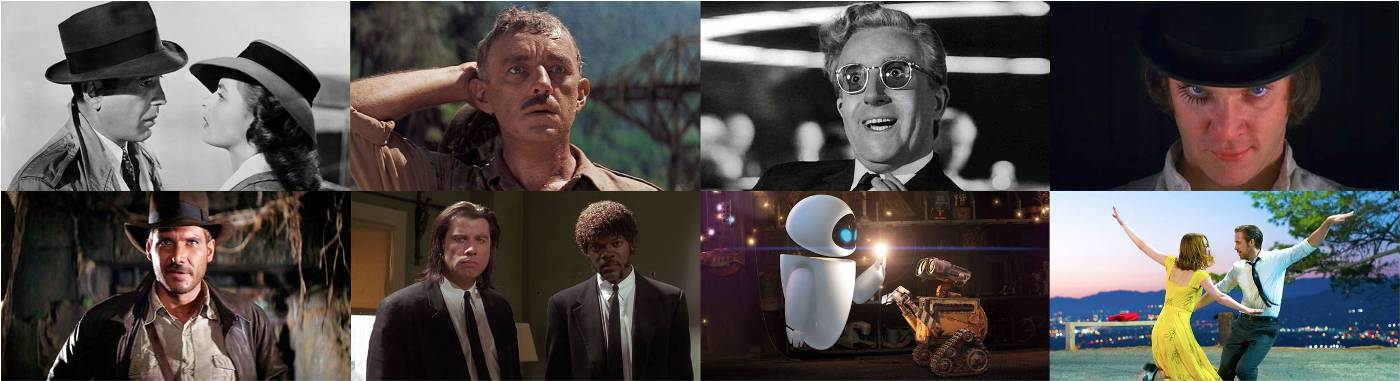

Glen Powell is a charmer. Yes he’s obscenely good-looking, but he also possesses a natural magnetism—a glint in his eye, a spark in his smile—that draws you toward him. Hit Man, Twisters, and Anyone But You may be of varying quality, but Powell is roguishly appealing in all of them, elevating the material with his calibrated carelessness. The Running Man, the new science-fiction movie from Edgar Wright, attempts to nudge the actor’s inherent allure into a different register, envisioning him not as an amiable romantic lead but as a bruising, brooding action hero.
“I’m not angry,” are the first words we hear from Ben Richards (Powell), in a tone that indicates the opposite. Myself, I am hardly incensed by The Running Man, but I nonetheless find it misguided and dispiriting. Not only does it fail to leverage the skills of its leading man, but it also struggles to work as a piece of blockbuster filmmaking. For a movie ostensibly focused on speed and excitement, it is oddly sluggish and sullen.

As with most protagonists in dystopian fiction, Ben has good reason to be mad. Despite his eminent qualifications as a laborer, he has been fired from yet another job, apparently for violating unwritten corporate rules. His daughter is sick, and without health insurance, he can’t afford life-saving medication. Desperate for quick cash, Ben reluctantly trudges down to the headquarters of media empire FreeVee, ultimately agreeing to participate in the titular competition—a 30-day endurance test whose lone goal is survival, a challenging task given that contestants are chased by both designated hunters and a reward-hungry public.
Based on a novel by Stephen King, The Running Man takes place in one of those queasily plausible futures that combines technological advancement (think dime-store Blade Runner) with moral deterioration. Wright exhibits far less visual panache here than he did in his prior feature, the unappreciated Last Night in Soho, but he tackles the requisite world-building with competence and efficiency. Certain flourishes, like how the currency is called “new dollars” (bills bear the face of Arnold Schwarzenegger, who played Ben in the 1987 adaptation), are revealed organically and without embellishment, while the game’s rules—players must take and mail daily video footage, they receive bonuses for killing hunters and “goons,” etc.—are explained in the form of a TV broadcast that’s as economical as it is expository. A simple scene where Ben shuffles through a cordoned line, grimacing at shouted instructions from armed officers before conversing with a smarmy FreeVee rep, briskly conveys the realm’s bureaucratic hostility—the DMV from hell.
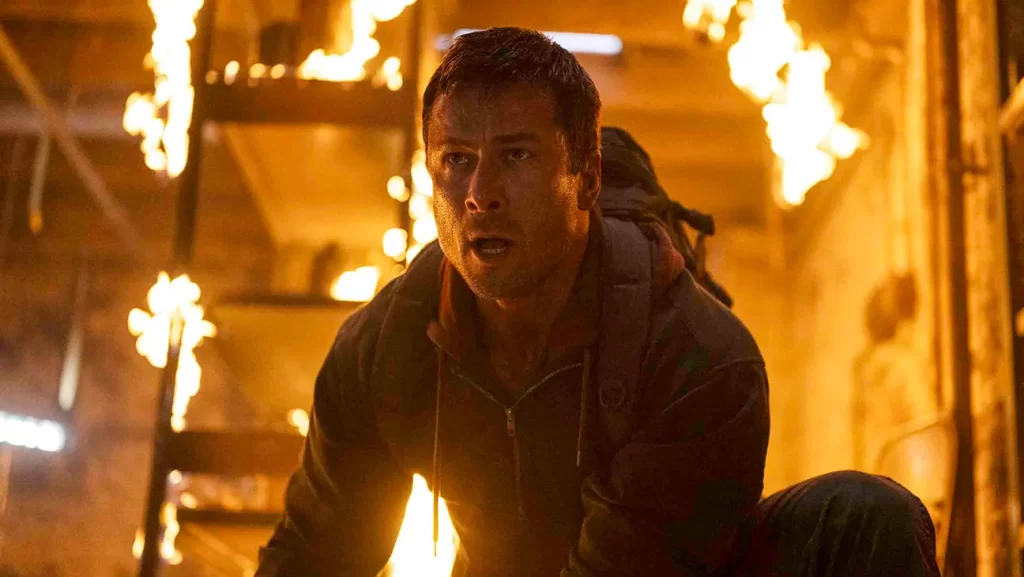
If you’re searching for another King adaptation about a reality TV program with life-or-death stakes, you need to reach back all of two months, when Francis Lawrence took audiences on The Long Walk. Thematically, The Running Man is quite similar, again centering on a browbeaten, rebellious young man pitted against a totalitarian regime. Tonally, however, things have changed. Whereas The Long Walk was sober and meditative, contemplating its ghastly circumstances with a curious combination of despair and camaraderie, The Running Man is vigorous and chaotic. The screenplay, which Wright wrote with Michael Bacall, alludes to various political ideas— about healthcare, unions, state media and its distortive use of AI—but its real focus is on Ben’s feverish efforts to evade detection and turn the tables on his fiendish pursuers.
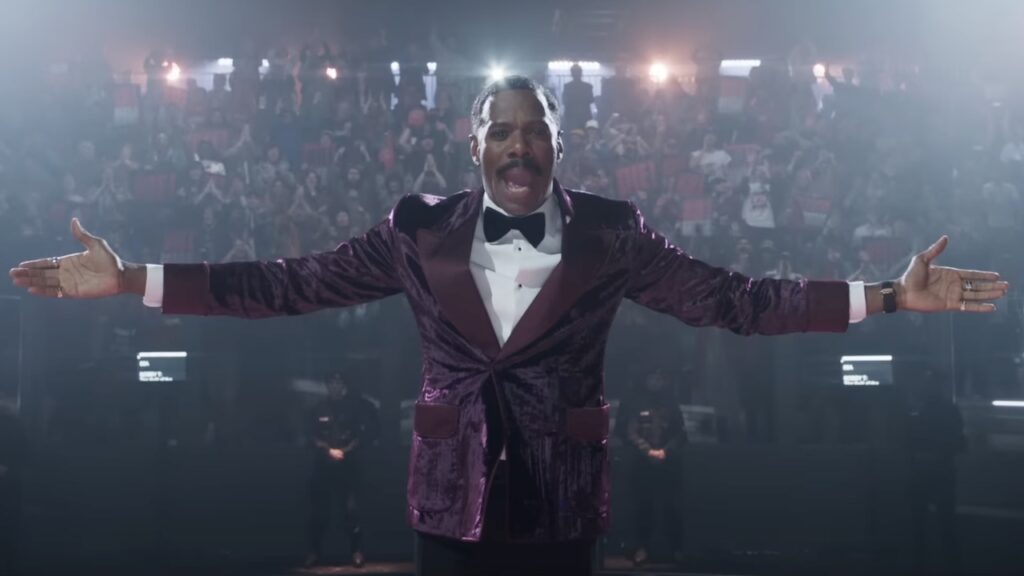
This is all fine conceptually, and certain elements of the movie, like Julian Day’s sleekly tailored costumes and Marcus Rowland’s menacing production design, provide a welcome jolt of retro-futuristic pizzazz. The supporting cast is strong: Colman Domingo enjoys himself as the show’s flamboyant host, spouting profanity and unleashing streams of hacky alliteration, while Josh Brolin is perfectly cast as its oily, amoral producer. Playing one of Ben’s purported rivals, Katy O’Brian continues to be good in everything. Other talented actors, like William H. Macy and Emilia Jones, pop up for a few scenes, imbuing Ben’s misadventure with a picaresque quality.
All of this is welcome window dressing. (Less welcome: Michael Cera, the star of Wright’s best movie, whose chemistry with Powell proves awkward.) The problem with The Running Man is that, while it presents itself as a pulse-pounding action picture, its set pieces are flat and generic. Wright has long been an underrated action choreographer—The World’s End may have been a provocative comedy of friendship, but its fight scenes crackled with energy—yet here he seems daunted by the scale of his enterprise. The shootouts, the car chases, the hectic brawls—they are all undistinguished and tedious. There’s a scene late in the film where the chief hunter, a guy called McCone who’s spent the entire time with his face covered, finally takes off his shroud to reveal a semi-famous actor, and it lands with a gigantic thud. How do you botch a mask-unveiling?

And then there is the issue of the running man himself. Powell looks the part here, striking the balance between rugged everyman and magazine-cover heartthrob. (Sensibly, Wright includes a scene of him shirtless.) But in choosing to emphasize Ben’s volatility, Powell has drained the sparky charisma that makes him so engaging. There’s nothing wrong with a handsome actor trying to stretch his range, and perhaps he’s just playing the role as written, but his performance is too resolutely dour to hold the movie’s center—a crippling flaw, given that the action surrounding him feels so perfunctory.
The Running Man fancies itself the story of a revolution—how a valiant warrior beats tyrants at their own game, turning the cruelty of state-sponsored entertainment back on his oppressors. The notion of television serving as the vehicle for systemic subjugation and upheaval carries a more troubling frisson today than it did when King wrote the book over 40 years ago. But it’s hard to use TV to change the world when you don’t give people a reason to tune in.
Grade: C+

Jeremy Beck is the editor-in-chief of MovieManifesto. He watches more movies and television than he probably should.